Stefan Trzcieliński (2020). Strategic Focus on Agility. In: Advances in The Ergonomics in Manufacturing: Managing the Enterprise of the Future. AHFE Open Access, vol. 12. https://doi.org/10.54941/ahfe100437
There are two current paradigms of organizational strategies of enterprises - lean enterprises and agile enterprises. The lean enterprise is such one that eliminates or reduces the wastes. Wastes (muda) can be categorized according to how easy or difficult they can be reduced. They are connected with the efficiency and productivity of use of the resources that the enterprise possesses. We can presume and this is confirmed in practice, that more resources are possessed by the enterprise bigger risk that they will not be utilized efficiently. This leads to conclusion that for big enterprises lean is very important strategy. The second strategy is agile enterprise. Agility is meant as the ability to use the opportunities. It is necessary to notice that opportunities appeared in changeable environment. Usually the environment is divided into such segments like: political and legal, economic, social and demographic, technological, customers, suppliers, new entrants and the competitors. The combination of events and situations that exists in the environment creates opportunities that are the situations which are favorable to the enterprise. As the current business environment is strongly changeable, unpredictable and turbulent, thus a huge number of events take place. That, if they are recognized as favorable, depends on the objectives and resources of the enterprise. These situations which are positively correlated with the objectives and create the demand for the resources are favorable i.e. are recognized as opportunities. There is a question what features and abilities must characterize the enterprise to be agile? There are four features constituting the agile enterprise: brightness, flexibility, intelligence and shrewdness. Brightness is the ability of the enterprise to perceive the opportunities, flexibility refers to the repertoire of products that can be manufactured with use of the disposal resources, intelligence is the ability to learn and adapt to the changing environment and shrewdness is the ability to achieve the goals in practical mode. Each of the features is based on the enterprise knowledge which is considered to be the most important resource. Knowledge is that what results in creativity and innovations and allows the enterprise to achieve the competitive advantage. More changeable is the environment more important is the knowledge. From that view point it is interesting if the enterprises became knowledge based firms and move towards agility. To get an answer for this question the research have been undertaken if the enterprises including SMEs form their opportunities oriented strategies and shape their brightness, flexibility, intelligence and shrewdness. In this paper the results of the research are presented. The research was done on a sample of 150 enterprises including 45 big, 60 medium and 45 small firms.
Early in 2010, the European Commission proposed the Europe 2020 strategy which was launched as the EU’s strategy for smart, sustainable and inclusive growth. The aim was to improve the EU's competitiveness while maintaining its social market economy model and improving significantly its resource efficiency. When it was launched the Europe 2020 strategy was a front runner in advocating a growth model going beyond simply increasing GDP. Today many bodies promote smart, sustainable and inclusive growth as a crucial element of economic development.
The Europe 2020 strategy was initiated against a background of lower growth and productivity levels than in other developed countries and a rapidly deteriorating economic and social environment, in the wake of the worst global financial crisis the EU has ever faced. It drew the lessons from the Lisbon strategy for growth and jobs which was launched in 2000, renewed in 2005 and was in place until 2010. The founding document made it clear that the "short-term priority (was) a successful exit from the crisis", but that "to achieve a sustainable future", the EU needed "to tackle its structural weaknesses" and "already look beyond the short-term". The ambition was to "come out stronger from the crisis and turn the EU into a smart, sustainable and inclusive economy, delivering high levels of employment, productivity and social cohesion (European Commission, 2014). Europe 2020 puts forward three mutually reinforcing priorities (European Commission, 2010):
- Smart growth: developing an economy based on knowledge and innovation. - Sustainable growth: promoting a more resource efficient, greener and more competitive economy. - Inclusive growth: fostering a high-employment economy delivering social and territorial cohesion.
To turn the priorities into alive, in the financial perspective 2007-2013 European Union used Structural Funds to finance (Wrona, 2014):
- Convergence objective including human and physical capital, innovation, knowledge society, environment and administrative efficiency, - Regional Competitiveness and Employment to reinforce the competitiveness, employment and attractiveness of regions as well as promotion of entrepreneurship and environment protection, - Territorial Cooperation Objective that aims to promote cooperation between European regions on different levels. It is divided into three strands of cooperation: cross-border, transnational and interregional.
The first priority financed from the Structural Funds is directly aimed for development of Knowledge Based Economy. Making the transition to a knowledge-based economy requires effective action within a four-pillared framework that expresses the prerequisites for effective use of knowledge for economic growth. The pillars are: (World Bank Institute, 2007):
- An economic and institutional regime to provide incentives for the efficient use of existing and new knowledge and the flourishing of entrepreneurship. - An educated and skilled population to create, share, and use knowledge well. - Information and communication technology to facilitate the effective creation, dissemination, and processing of information. - An efficient innovation system of firms, research centers, universities, consultants and other organizations to tap into the growing stock of global knowledge, assimilate and adapt it to local needs, and create new technology.
The above actions lead to situations that, for the presumption, favour the development of innovativeness and therefore the competitiveness of enterprises and European economies. Because of this it seems to be rational to ask a question if the conditions created by knowledge based economy are recognized by the enterprises as opportunities and help them to convert themselves into knowledge based enterprises. To get an answer for the question a research project has been undertaken at the Faculty of Engineering Management at Poznan University of Technology (project N N115 293838). The changes that take place in the enterprises are investigated in the following cross sections: the strategic focus, human capital, organizational structure and the information and communication technologies of the enterprise.
THE SUBJECT AND METHOD OF THE RESEARCH A hypothesis has put forward that in the increasingly changeable environment the enterprises enhance their agility.
The agility is defined by four features of the enterprise that are brightness, flexibility, intelligence and shrewdness (Trzcieliński and Trzcielińska, 2011). The brightness of the enterprise is its ability to perceive the events that happen in the environment, match them and categorize into favorable or unfavorable situations that is either opportunities or threats. Flexibility is a feature of achievable resources that depends on the possibility of extending the scope of their use, and the same on extending the repertoire of the task which can be executed with use of these resources. The intelligence of the enterprise is its feature that depends on the enterprise ability to cumulate the knowledge, benefits from the knowledge and developing it in the purpose to adopt itself to the changes in the environment. The shrewdness of the enterprise is its feature to use the appearing opportunities effectively and efficiently.
The subject of the research is the changes of the strategic focus of the enterprises aimed at enhancement of its agility that is its brightness, flexibility, intelligence and shrewdness. The research was done on a sample of 150 enterprises in Poland including 30% of small, 40% medium, and 30% big firms. The data were collected from the owners or top levels managers. The research was done in August and September 2012.
The model of the analysis of the relations between the strategy and the agility of the enterprise consists of:
- Areas of strategic decisions which are (Pierścionek, 2003): developing the resources and competencies of the enterprise, appointing new directions and scope of utilization of the resources and competencies, shaping the organization of the enterprise, and affecting the environment to make some of its components favor with the enterprise objectives. - Features of the enterprise’s agility i.e. brightness, flexibility, intelligence and shrewdness. - The relationships between the areas of strategic decision and the features of the agility.
In this paper the analysis has been limited to the changes of the enterprise flexibility, intelligence and shrewdness.
SOME RESULTS OF THE RESEARCH Flexibility of Enterprise
Flexible enterprise is able to adapt to the changing environment. Thus flexibility can be assessed by the enterprise involvement into implementation of actions that adapt it to the changes. The adaptability of the enterprise can be described by: implementation of concepts and methods to manage the business in the changeable environment, initiatives in adjustment the structures, procedures, technologies and resources as well as by orientation on using the short life time opportunities.
The implementation of such managerial concepts and methods was analyzed as: process management, workflow systems, principles of lean enterprise, TQM, JiT, empowerment, network structures and continuous improvement. At present any involvement in implementation of the above concepts and methods is observed by 22,22% of small and 20% medium enterprises. Comparing with 2007 this percentage decreased in group of small, medium and big enterprises by 11,11%, 1,67% and 2,22% appropriately. The small and big enterprises are the most involved in implementing continuous improvement (51,11 % and 80%) when among the medium firms the most common is process management (58,33%). The involvement of the firms was measured in scale from 0 (lack of involvement) to 5 (fully implemented). Comparing with 2007 the involvement has been increased of 11,11%, and 13,33% in small and medium enterprises appropriately.
To adapt to the changing environment the enterprises inspect and adjust their personal, procedures, and organizational structures. In this scope any activities are present among 22,22% of small and 18,33% medium enterprises and no changes in this percentage were evidenced from 2007.
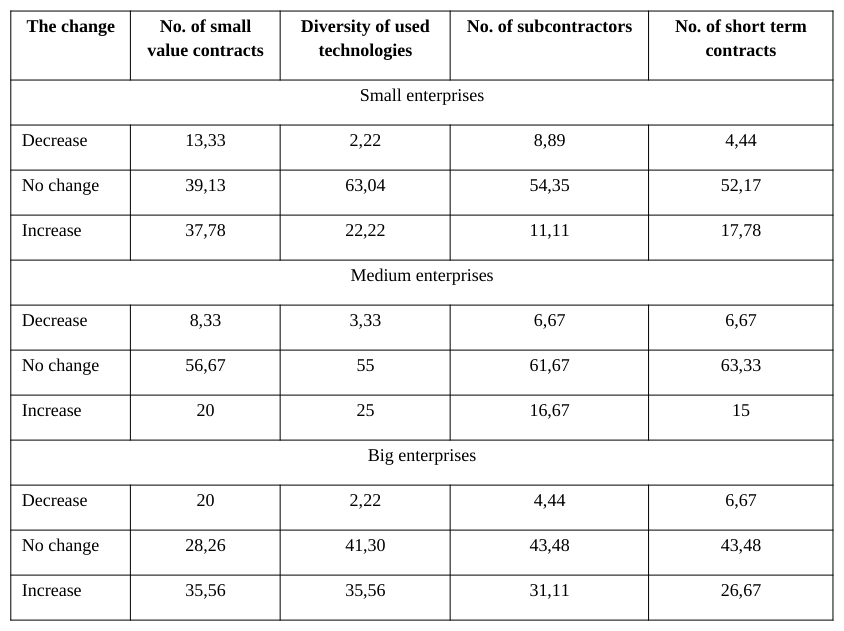
Another symptom of adaptability of the firms to the changing environment is when they undertake short life time opportunities (Trzcieliński and Trzcielińska, 2011; Trzcieliński, 2011). The move towards shorter life time opportunities can be evidenced by increase of: small value contracts, short term contracts, diversity of used technologies and number subcontractors (see Table 1).
Intelligence and Shrewdness of the Enterprise By the end of 90’ of XX century a concept of intelligent organization was introduced to the management science in result of development of the concept of learning organization. As March (1999) says, it is confirmed by numerous studies that learning can improve the performance, and thus the intelligence of organization. The ability to learn is a condition the organizational intelligence. The learning organization is that one that cumulates the knowledge. According to Nonaka and Takeuchi (1995) “knowledge is created by that very flow of information, that is anchored in the beliefs and commitment of its holder”. The intelligent organization not only cumulates the knowledge but benefits from it and develops it intentionally to cope with changes that appear in the environment.
Table 1. Change of some features of flexibility in 2007-2011 - percentage of firms (Trzcieliński, 2013a)
To increase its intelligence the firm can employ highly competent specialists as well as staff with basic competencies who next are trained. As it is presented at the Figure 1, particular the SMEs lead rather conservative human resource development policy and during a period of 5 years no significant changes took the place. In big enterprises the policy oriented on strengthening the intelligence was found in almost 50% of them mostly by employment of highly competent staff.
a) b) 120,0% 120,0%
S M B
S M B a) Employment of staff with basic competencies and training them; b) Employment of high competencies staff
Figures 1. The percentage of firms which changed the staff employment policy (Trzcieliński, 2014)
The SMEs personal policy does not support the development of the firms’ intelligence. The percentage of small and medium enterprises that employ no less than 20% of highly competent staff is no bigger than 47% and these that employ at least 50% of the specialists is lower than 35% Particularly the weak human capital is present in the functions like R&D and marketing and sale (Figure 2).
a) b) 70,0% 50,0% 62,2% 45,0% 60,0% 53,3% 53,3% 55,6%
a) No less than 20% of specialists in each function; b) No less than 50% of specialists in each function Figures 2. The percentage of firms that employ highly competent specialists (Trzcieliński, 2014)
Although by the end of 2011 the state of human capital was not satisfying, it seems that from the view point of the future the more important is how it has been changed since 2007. The improvement has been found in 24,4% small, 21,7% medium, and 42,2% of big enterprises (Figure 3).
120,0% Decrease No change Increase 100,0% 0,0% 5,0% 0,0%
S M B
Figures 3. The percentage of firms that have enlarged the employment of highly competent specialists (Trzcieliński, 2014) The increase affected partly the employment of specialists in functions that are crucial for shaping the intelligence of the enterprise. As it is presented at Figure 4, among the enterprises that employ no less 50% highly competent specialists in particular function, there is no more than 7% small,12% medium, and 23% of big enterprises.
S 11,7% M
Strategy R&D Organization Finance Marketing
Figures 4. The percentage of firms with increase of high competencies specialists and their participation in particular functions no
less than 50% (Trzcieliński, 2014)
The intelligent enterprise develops its resources and competencies to use them to innovate the products and enter new markets. The percentage of firms that during the 5 years period at least once did extend the line of product and entered new sector not exceeds 14%, 15% and 25% appropriately small, medium and big enterprises. The percentage of these that did this at least four times is about three times smaller (Figure 5).
Equation reproduced from the original PDF.
S M B
Figures 5. The percentage of firms that used their resources and competencies for new implementations (Trzcieliński, 2014) The percentage of firms that entered at least one or four new foreign country market is presented at Figure 6.
Equation reproduced from the original PDF.Equation reproduced from the original PDF.
S M B
Figures 6. The percentage of firms that entered new foreign countries markets (Trzcieliński, 2014) It seems that the crucial for new implementations of the enterprise’s resources and competencies is the human capital employed in functions like R&D and marketing. However as it is presented at Figure 7 the correlation is rather weak and in case of small enterprises it is very weak.
a) b) 20,0% 30,0% Marketing R&D Marketing R&D
S M B
S M B a) Entrance to new sector with new product; b) Entrance to new foreign countries markets
Figures 7. The percentage of firms that used at least once their resources and competencies for new implementations and employ
no less than 20% specialists in particular functions
The intelligent enterprise is also able to adjust its organization to use the market opportunities. Particular this concerns the implementation of lean management principles. To be successful the knowledge about new concept and management practices is needed. Such knowledge should be possessed by staff responsible for improvement of the firm organization and management. The percentage of enterprises that are involved in lean implementation with intensity of 2 in the scale from 0 (lack of involvement) to 5 (full implementation) and employ no less than 20% and 50% specialists in the organization and management function is presented at Figure 8.
Equation reproduced from the original PDF.
M S D
Figures 8. The percentage of firms that with intensity no less than 2 (0-5) implements lean management and employ no less than 20% or 50% specialists in the function of organization and management (Trzcieliński, 2014)
The intelligent and shrewd enterprise is able influence on its environment. One of symptoms of such influence is the change of bargaining power against its customers and suppliers. The crucial competencies for that are connected with strategic management. The percentage of firms that increased their bargaining power and employ no less than 20% specialists in the function of strategic management is presented at Figure 9.
25,0% Suppliers Customers
S M B
Figures 9. The percentage of firms that increased their bargaining power and employ no less than 20% specialists in the function
of strategic management (Trzcieliński, 2014)
DISCUSSION AND CONCLUSIONS Small and medium enterprises are not big because their business basis on using short life time opportunities. With the increase of its changeability the environment generates more opportunities (Trzcieliński, 2013). The enterprise that is able to use short life time opportunities is considered to be agile. Agility is what extends the firm life time. Therefore it could be expected that SMEs should head themselves for agility. However to be agile the enterprise have to posses such features like brightness, flexibility, intelligence and shrewdness. The results of the undertaken research allow stating the following:
1. Although majority of SMEs keep their flexibility unchanged, the percentage of these that increase their flexibility is bigger than these that became less flexible (see Table 1). The increase of flexibility is caused mostly by the accessible technology. The technology is available not only to SMEs that enhanced their flexibility but to most of the firms. Therefore that what explain the biggest portion of enterprises that did not changed their flexibility is probably relatively low brightness of the firms. To improve the ability to perceive the opportunities the firms must develop human capital so the staff would be able to observe systematically the environment and analyze it. 2. The intelligence of SMEs is relatively low. The enterprises poorly invest in the development of human capital (see Figure 1). This concerns particular the small percentage of highly competent specialists who are employed if functions like: strategic management, R&D, organization and management, finances and marketing. Comparing with SMEs the situation is much better in big enterprises. (see Figure 2). To make some improvement in this matter the SMEs should use a wide market of labor force created by the students and graduates of university. 3. The percentage of SMEs that increased the employment of staff with high professional competencies is relatively low (see Figure 3). However these firms that did this, had employed the specialists mostly in other functions than strategic management, R&D, organization and management, finance, and marketing. Probably the increase of employment was mainly in production functions. This is of course positive as it leads to bigger efficiency and higher quality of product and processes. However the increase of specialist in production functions should not be contradictory to employment of specialists in functions that are crucial for development and competitiveness of the whole enterprise (see Figure 4). 4. SMEs relatively seldom innovate products and enter new sectors or new foreign countries markets (see Figure 5 and 6). This can be partly explained by poor involvement of the firms in looking for opportunities and deficit of staff that is able make product, process and marketing innovations (see Figure 7) as well as organizational innovations (see Figure 8). Even if the specialists look for opportunities they mostly limit their observations to local or home country market. 5. SMEs have rather weak bargaining power against the players in the environment. This is understandable as they usually act at the competitive markets. That what can strengthen their position against their customers are innovations. However this requires investment in development of the knowledge and the same in the human capital.
In the light of the above results it can be stated that Polish SMEs are relatively low agile. Their agility is mostly affected by relatively good level of flexibility. However to be truly agile they must develop their brightness, intelligent and shrewdness.
REFERENCES
European Commission. (2010), EUROPE 2020. A strategy for smart, sustainable and inclusive growth, Brussels, 3.3.2010.
COM(2010) 2020 final. European Commission. (2014),“Taking stock of the Europe 2020 strategy for smart, sustainable and inclusive growth”, in: Communication From the Commission to the European Parliament, the Council, the European Economic and Social Committee and the Committee of the Regions, Brussels, 5.3.2014. COM(2014) 130 final.
March, J.G. (1999), „The Pursuit of Organizational Intelligence”, Blackwell: Malden. Nonaka, I., Takeuchi H. (1995), “The Knowledge-Creating Company”, Oxford University Press: New York. Pierścionek, Z. (2003), „Strategia konkurencji i rozwoju przedsiębiorstwa”, Warszawa: Wydawnictwo Naukowe PWN. Trzcieliński, S. (2011). „Przedsiębiorstwo zwinne”, Wydawnictwo Politechniki Poznańskiej: Poznań. Trzcieliński, S. (2013a). „Niektóre symptom zmiany strategii przedsięiorstw. Wstępne wyniki badań GOW”, in: Budowa gospodarki opartej na wiedzy w Polsce - modele i doświadczenia, M. Moszkowicz, R. Kamiński, M. Wąsowicz (Eds). Prace Naukowe Uniwersytetu Ekonomicznego we Wrocławiu, 298, pp. 170-178. Trzcieliński, S. (2013b). „Changeability of environment - enemy or ally?” , in: Management science in transition period in South
Africa and Poland, J. Teczke, N. Terblanche (Eds), pp. 257-265. Trzcieliński, S. (2014). „Wybrane wyniki badań inteligencji przedsiębiorstw w Gospodarce Opartej na Wiedzy”, Materiały Konferencji „Szkoła Letnia Nauk Organizacji i Zarządzania” (w druku). Trzcieliński, S., Trzcielińska, J. (2011). “Some elements of theory of opportunities”, Human Factors and Ergonomics in
Manufacturing & Service Industries, 21 (2) 124–131. Wrona, K. (2014), Structural funds and the knowledge-based economy. http://eprints.aston.ac.uk/21412/1/Studentthesis-2014.pdf
LISTED IN THE AHFE DIGITAL BOOKSTORE CATALOGUE
Explore the complete digital volume
Advances in The Ergonomics in Manufacturing: Managing the Enterprise of the Future
Read this individual research paper free through the original publisher, or explore the full digital proceedings book.
ISBN 978-1-4951-2103-6
Explore this ISBN in the AHFE Bookstore ↗Listed in the July 2026 bookstore catalogue; search by ISBN to confirm current availability · Digital book purchase optional