Stefan Trzcielinski (2023). Human intelligence vs Artificial intelligence in opportunity discovery. In: Human Aspects of Advanced Manufacturing. AHFE Open Access, vol. 80, pp. 100–110. https://doi.org/10.54941/ahfe1003512
Opportunity is a core phenomenon in theories of: strategic management, entrepreneurship and agile enterprise. Usually it is meant as an external situation which favours the enterprise achieving its objectives and goals with accessible resources. Strategists and entrepreneurs search for opportunities to improve the firm’s performance. Some of them do this intuitively when others apply methods of strategic analysis and/or conduct marketing research. The Artificial intelligence particular cognitive computing creates new possibilities to discover opportunities. The aim of this paper is to present a general model of opportunity recognition that applies to all above mentioned approaches. Basing on this model a review of traditional methods of opportunity discovery, exploiting mostly human intelligence, is presented. Next a generic model of Artificial Intelligence aided opportunity discovery is discussed. The article also shows the results of a study of companies' use of traditional opportunity discovery methods and preliminary results of a study of opportunity discovery using artificial intelligence.
Organisations operate in an environment. Significant change in the state of the environment is called an event. Events can occur both within an orga- nisation and in its environment. A system that responds to events is called a sense-and-respond system (Chandy et al. 2007). Organisations are sense-and- respond systems. In order to last and grow, they must respond to significant events in their environment, i.e. opportunities and threats.
Opportunity is an interdisciplinary phenomenon. In microeconomics, opportunity cost is understood as the benefit to be sacrificed by choosing another option. In strategic management, it is something that can be achieved using the strengths of the organisation. In the concept of the agile enterprise, it is something that needs to be responded to quickly and the exploitation of which leads to a competitive advantage. In entrepreneurial theory, it is what an entrepreneur seeks in order to make a profit.
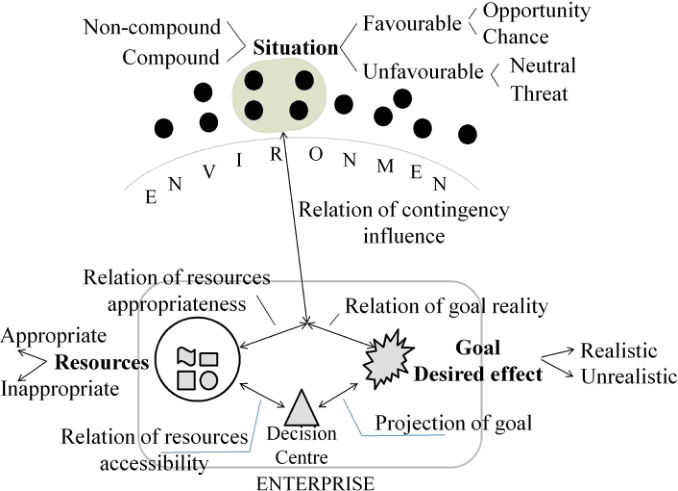
By opportunity we mean a relationship between three elements: (1) the objectives, which express the benefit that the organisation wishes to obtain; (2) the situation in the environment, and (3) the resources at the disposal of the organisation, such that the situation favours the achievement of the
Human Intelligence vs. Artificial Intelligence in Opportunity Discovery 101
objectives using the resources at its disposal (Trzcielinski and Trzcielinska, 2011). Its model is shown in Figure 1. Opportunities can be created by organisations, mainly through creative and innovative activities, as Schumpeter pointed out, but they can also be discovered in the environment. Both of these cases, i.e. opportunity creation and opportunity discovery, are called opportunity recognition. Opportunity creation is a proactive activity while discovery is a reactive activity. In each of these cases, there must be an association between the company’s objectives, the situation in its environment and its resources and whether this situa- tion is conducive to achieving the objectives using the available resources. In both cases, however, the time perspective of recognising the situation in the environment is different. In the case of opportunity discovery, the object of recognition is the current state of affairs, while opportunity creation requires forecasting future states of the environment.
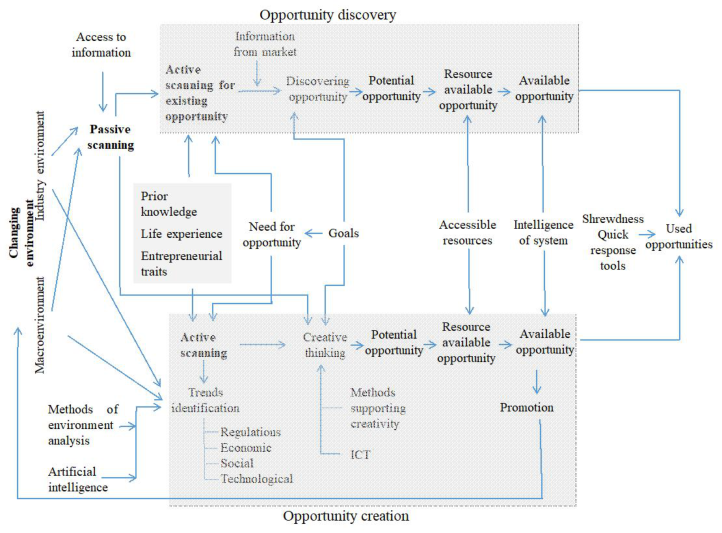
If a situation in the environment is attractive from the point of view of the company’s objectives, it is called a “potential opportunity”. However, this does not mean that it is achievable for the company. Only by con- fronting it with disposable resources can we recognise it as a “resource available opportunity”. Disposable resources are a necessary but not suffi- cient condition. Also necessary is organisational intelligence i.e. the capacity of an organisation to create knowledge and use it to strategically adapt to its environment. This leads to ‘available opportunity’. Finally, the use of opportunity requires practical problem solving at an operational level. The capacity of an organisation to do this is called the ‘shrewdness’ of enterprise (see Figure 2).
Figure 1: Opportunity as a relationship between a company’s objectives, resources and the situation in the environment.
102 Trzcielinski
Figure 2: Opportunities recognition model.
HUMAN INTELLIGENCE IN OPPORTUNITY DISCOVERY Intelligence is usually understood as the ability to solve complex problems or make decisions with outcomes benefiting the actor. Such a problem is opportunity discovery. There are many approaches to opportunity discovery based on human intelligence.
Kirzner (1977) links an opportunity with what is first spotted as an impre- cisely defined market need, unused resources or capabilities. He states that discovering opportunities is not the result of a series of happy accidents, but is the result of the entrepreneur’s alertness consisting in the fact that he constan- tly scans the environment, even when he does not know what he is looking for in it and does not use any deliberate methods of looking for opportuni- ties. Entrepreneurial “alertness refers to a sense of what might be “around the corner”, i.e., the sense to notice that which has hitherto not been suspected of existing at all” (Kirzner, 2008).
Kirzner’s concept of alertness inspired many researchers to identify factors that constitute it. Baron (2006) defined an opportunity “as a perceived means of generating economic value (i.e. profit) that previously has not been exploi- ted and is not currently being exploited by others”. On the other hand, he treats opportunity recognition as “a cognitive process (or processes) through which individuals conclude that they have identified an opportunity”. It also states that “opportunities emerge from a complex pattern of changing condi- tions — changes in technology, economic, political, social, and demographic conditions. They come into existence at a given point in time because of a
Human Intelligence vs. Artificial Intelligence in Opportunity Discovery 103
juxtaposition or confluence of conditions which did not exist previously but is now present”.
As particularly important elements for the recognition of opportunities for new business venture, Baron (2006) lists: active searching for opportunities, alertness and prior knowledge of market, industry or customers. These three factors work together in recognizing opportunities in accordance with “pat- tern recognition” that is a “cognitive process through which specific persons perceive complex and seemingly unrelated events”. Active searching involves, among other things, using information obtained from various publications and as a result of personal contacts. Alertness is meant as cognitive capaci- ties possessed by individuals. These capacities include, among others, factors such as intelligence, creativity, self-confidence, risk propensity, and a num- ber of others. Prior knowledge refers mostly to information resulting from professional experience, experience gained from running various activities, performing various functions and life experience.
Shane and Venkataraman (2000) admitted that “entrepreneurial opportu- nities are those situations in which new goods, services, raw materials, and organizing methods can be introduced and sold at greater than their cost of production”. In order to take advantage of an opportunity, one must first spot it. In a later work, Eckhardt and Shane (2003) stated that “opportunities exist prior to their discovery and opportunities are discovered before they are exploited”. For opportunities to be identified, it is important to have access to information. It depends on knowledge corridors, the search process, and social ties. The knowledge corridor is the ability to gather information about opportunities as a result of broadly understood life experience. It is specific to individual persons. The search process is also an individual ability. People search more effectively for information about opportunities which are closer to what they currently know. Social ties i.e. the structure of social relation- ships into which people enter also influence the acquisition of information. They condition the quantity, quality and speed of obtaining information use- ful for the identification of an opportunity. Based on the work by Baron and Shane, Bjerke (2007) states that to improve opportunity recognition one should: build a broad and rich knowledge base, organize one’s knowledge, increase one’s access to information, create connection between the know- ledge one has, build one’s practical intelligence, and mix one’s eagerness for hits with wariness of false alarm.
Barringer and Ireland (2012) define an opportunity as a “favourable set of circumstances that creates a need for a new product, service, or business”. They list three approaches that can be used to identify an oppor- tunity: (1) observing trends in PEST segments of the macroenvironment, (2) solving problems that people have in their daily life, (3) finding gaps in the marketplace created by large firms that look for achieving economies of scale.
In the theory of strategic management, opportunities are understood as positive situations external to the enterprise that exert a key influence on the strategy (Thompson and Strickland, 1993). These situations exist in the envi- ronment and therefore, in order to be included in the strategy, they must be identified. In order to identify opportunities, the above authors propose the
104 Trzcielinski
following recommendations: serving additional customer groups, entering new markets or segments, expanding the product line to meet a broader range of customer needs, diversifying into related products, vertical integration, fal- ling trade barriers in attractive foreign markets, complacency among rival firms. Incorporating opportunities into the strategy also requires matching them with corporate resources (Mintzberg et al., 1998).
The extensive source literature provides many methods that assist the iden- tification of opportunities. These methods can be divided into those that are used for the macro-environment analysis and those that are used for the indu- stry environment analysis. The macro-environment analysis is usually carried out in its segments determined by the PEST method. On the other hand, the basic method of conducting the industry environment analysis is the structu- ral analysis of competitive forces (Johnson and Scholes, 1993). There are also comprehensive methods that are used both to analyze the enterprise environ- ment and potential. They include the SWOT and SPACE analyses (Lynch, 2012). In the theory of agility, opportunity is understood as a situation resulting from disruption and adversity in an uncertain and complex competitive envi- ronment that can be used in ways that are purposeful, decisive and grounded in the will to win. Opportunities as well as threats are results of changes in the environment. The agility process consists of stages like detecting, asses- sing and responding to changes (Tilman and Jacoby, 2019). In this sense the theory of agility assumes, similarly to Kirzner, that opportunities appear in the environment and must be detected. Detection, assessing and respon- ding requires three essential competences - risk intelligence, decisiveness and execution dexterity.
Risk intelligence enables the enterprise to recognize and assess changes that take place in the environment. As a result, they are seen either as opportuni- ties or as threats. Decisiveness is a competence that activates the operation of an organization when opportunities and threats appear. Execution dexterity, on the other hand, enables the effective use of resources and capabilities in accordance with the situation in the environment (Tilman and Jacoby, 2019). Alberts (2011) points out that the detection and recognition of the situation in the environment is limited by imagination and expectations. So, it depends on cognitive capabilities of individuals.
Below we present some results of two studies that were conducted at the Faculty of Engineering Management of Poznan University of Technology. The first represents the analytical aspect of human intelligence. The second refers to intelligence manifested by cognitive entrepreneurial traits.
In 2018, we conducted research in 150 companies operating in Poland. The research was directed at obtaining answers to the following questions:
1) whether managers with prior knowledge operationalized by life experie- nce (measured by age) and work experience as well as experience gained from performing management functions implement method of strategic analysis and conduct marketing research to obtain knowledge about the changes in environment that helps them to recognize opportunities? 2) does implementation of methods of strategic analysis and conducting of marketing research helps to recognize market opportunities?
Human Intelligence vs. Artificial Intelligence in Opportunity Discovery 105
We found that prior knowledge is not significantly correlated with use of methods of strategic analysis and marketing research. The only significant but weak correlation was between managerial experience and use of mar- keting research methods aimed on investigation of customers’ satisfaction. Additionally we found that work experience is significantly but negatively correlated with use of methods like trend extrapolation, Delphic method, Porter’s 5 forces analysis, sector attractiveness analysis, and methods to investigate market share and trust to brand. This can be interpreted that along with longer work experience, managers lose interest in using these methods to understand changes in the business environment that may be recognized as opportunities. Therefore, their prior knowledge is not enri- ched by the methodical application of tools used to analyse the business environment.
Also the correlation between use of strategic analysis methods as well as methods of marketing research and symptoms of opportunity recognition was weak. The main symptom of opportunity recognition that was statisti- cally significantly correlated with strategic analysis methods and marketing research was conducting analyses of business environment. This symptom was correlated with the following methods: SWOT analysis, trend extrapo- lation, Delphic method, scenario methods, strategic gap analysis, Porter’s 5 forces analysis, sector attractiveness analysis and analysis of market share (Trzcielinski, 2019).
Trzcielinska (2020) investigated what entrepreneurial traits support mar- ket opportunities recognition in SMEs? She considered the following 17 entrepreneurial traits, which she treated as independent variables: Iv1 – determination, Iv2 – initiative, Iv3 – perseverance, Iv4 – creativity and innovativeness, Iv5 – courage in decision making, Iv6 – risk propensity, Iv7 – self-confidence, Iv8 – independence, Iv9 – honesty and responsibility, Iv10 – assertiveness, Iv11 – persuasiveness, Iv12 – dedication and hard work, Iv13 – networking, Iv14 – commitment and leadership, Iv15 – adaptability to change, Iv16 – product and customer focus, and Iv17 – learning from personal experience.
She found that in small firms, mostly two traits are important – Iv13 and Iv14. Less important are Iv2 and Iv17. They all help identify the opportunities connected with introducing new product to the market and cooperation with new suppliers / subcontractors. In medium-sized enterprises, the most impor- tant traits are Iv5, Iv7, Iv 12, Iv3, Iv5, and Iv6. The first three are conducive to the search for opportunities manifested by market share enlargement; the second three support searching for opportunities through analysis of business environment.
The above results allow us to conclude that in practice cognitive skills, compared to analytical skills, are the dominant skills, especially in small and medium-sized enterprises. Although the literature indicates (Barringer and Ireland 2012) that the use of strategic analysis and marketing research methods is an important way to identify opportunities, our research did not confirm this. Although the cognitive skills of the entrepreneur are valuable for opportunity recognition, yet in new and complex situations subject to dynamic change their usefulness is random. Artificial intelligence may be a more robust tool in this regard.
106 Trzcielinski
ARTIFICIAL INTELLIGENCE IN OPPORTUNITY DISCOVERY Opportunities arise in different markets. In this article, we limit ourselves to the customer market. In this market, an opportunity arises when demand is greater than supply.
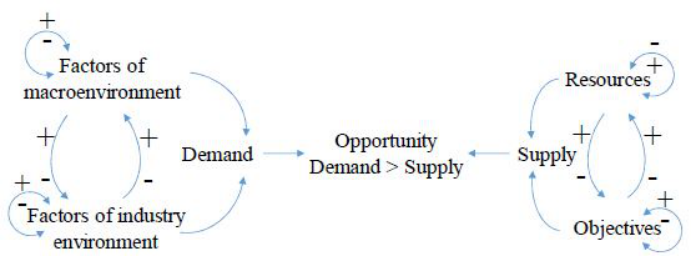
Demand is shaped by macro-environment and competitive environment factors. Macro-environment factors can be distinguished according to the PEST method or its various variants. The factors of the industrial environ- ment, on the other hand, can be identified, for example, using Porter’s 5 forces method. The factors take on values that determine the state of the environ- ment. There are internal and external feedback loops between the factors. Depending on the value of a factor, these can be feedbacks that increase (positive) or decrease (negative) the value of the factor coupled to it.
The supply side is shaped by the objectives/expected outcomes and the resources at its disposal with which it wants to achieve these objectives. There are also internal and external feedback loops between them, causing an increase or decrease in the value of the coupled factors (see Figure 3).
We adopted the following methodology to identify an opportunity in the fridge market.
1) Building a simulation model. We used statistical modelling using wei- ghts and probabilities of elementary simulation movements in terms of Bayesian modelling (Table 1). 2) Data acquisition. Large data sets were generated based on the ado- pted market model, using simulation procedures according to the Monte Carlo method. It involves repeatedly simulating the probability of the possible outcomes of an uncertain event. 3) Running a simulation using the Monte Carlo algorithm:
The state X of the system is determined by the complete set of coor- dinate vectors X(c1,c2,..., z1,z2,..., o1,o2,...) where: c - goals; z - resources; o – environment;
The successive states of the system are determined on a stochastic basis;
The transition from state to state takes place with a designated pro- bability which means that the state becomes a random variable from the set: {Xo, X1, X2,...Xn} (the so-called Markov chain);
Figure 3: Close-loop forming an opportunity.
Human Intelligence vs. Artificial Intelligence in Opportunity Discovery 107
The independent variable is the discrete time, the so-called simulation step.
The decision mechanism in this simulation is the Metropolist- Hastings algorithm. In this algorithm, the global measure is the relative gain or loss due to the change process made (the so-called Simulation Balance); this measure determines the realisation of the adopted main objective. The result of the simulation stage is a mul- tidimensional dataset, which is the basis for the construction of a relational database (the model predicates are complete).
4) Data analysis using artificial intelligence. We use an AI tool, which is cluster analysis in a multidimensional space. The aim of the analysis is to cluster the results by looking for distinct areas of increased entropy. A simulation algorithm was performed in the R environment using MS R-Server and was verified for test data and then the target set was implemented.
The above methodology was applied to discover opportunities in the sector of manufacturers of refrigerators, fridge-freezers, iceboxes and freezers, i.e. to predict demand for these products. Four component factors of the demand vector were identified, corresponding to 4 customer types and 4 product characteristics (see Table 1):
Panicky - needs a fridge because he builds up stock for fear of food supply risks (FSR); product with increased size,
Developer - buys a second or larger fridge because he has a large living space (LS); product with increased modularity,
Innovator - replaces the fridge that is in maturity faze of its life cycle, with a modern one (PLC); product equipped with AI and IoT,
Environmentalist - exchanges the fridge for a more energy-saving one (ES); product with higher energy efficiency class.
The simulation was carried out for 4 scenarios. Here we limit ourselves to first scenario only. This scenario assumes that customers prefer large fridges due to their desire to store more food (FSR), take into account their energy class (ES), but are less driven by the desire to have another fridge (LS) and do not consider newer technology (PLC). Customers’ choice preferences are shown in Table 2.
Table 1. Fridge market model.
Table available in the original PDF paper.
Probability of a factor P_FSR P_LS P_PLC P_ES P<0; 1>
Type of customer Weight in the purchasing decision
Market fraction MF <0; 1> G-FSR G-LS G-PLC G-ES Sum
Table 2. Matrix of the probability of customers moving to another group.
Table available in the original PDF paper.
Next choice
FSR LS PLC ES FSR 0,8 0,1 0,0 0,1 First LS 0,1 0,7 0,0 0,2 choice PLC 0,4 0,1 0,1 0,4 ES 0,1 0,1 0,0 0,8
Using the methodology we have got so called stationary point that is the most probable share of customers FSR, LS. PLC and ES in refrigerator purchases. This point is the result of a simulation in 1000 steps of customer transitions to other product groups (see Table 2).
By projecting the results obtained onto the probability matrix of purch- ase decisions (vector of buyers) (see Table 1), we obtain the market structure M_FR. It is described by the following equations: MF_FSR*0.6 + MF_LS*0.2 + MF_PLC*0.2 + MF_ES*0.3 = P_FSR MF_FSR*0.1 + MF_LS*0.7 + MF_PLC*0.1 + MF_ES*0.2 = P_LS MF_FSR*0.1 + MF_LS*0.0 + MF_PLC*0.6 + MF_ES*0.0 = P_PLC MF_FSR*0.2 + MF_LS*0.1 + MF_PLC*0.1 + MF_ES*0.5 = P_ES
To obtain the structure of the buyers’ market in each step of the simula- tion, a matrix equation of the type A*X = B is solved, where: A=probability matrix (see Table 1), X=MF(FSR,LS,PLC,ES), B= P(FSR,LS,PLC,ES).
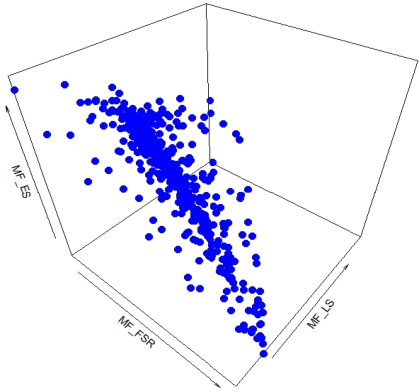
This resulted in a plot of fraction vectors (see Figure 4) for each state (MF_FSR, MF_LS, MF_ES) without MF_PLC (MF_PLC was omitted so that the results could be presented in a 3D plot). Each point on this graph
Figure 4: Graph of vectors of individual customer fractions.
Human Intelligence vs. Artificial Intelligence in Opportunity Discovery 109
represents a fraction of each client type. The most likely result is presented by the stationary vector of the fraction MF(FSR, LS, ES) →0.14444444, 0.12407407, 0.73555556. This means that for the scenario analysed, the projected distribution of customer fractions is as follows: Panicky - 14%, Developer - 12%, Innovator - 0%, and Environmentalist - 74%. These figures correspond respectively to the demand for: large-size refrigerators, fridges and freezers in a modular (expandable) system, refrigerators using IoT, and refrigerator-freezers of the highest class (A++, A++).
CONCLUSION
In a turbulent environment, entrepreneurs and companies recognise oppor- tunities through which their business can exist and grow and be competitive. Recognising opportunities is either about creating or discovering them. In both cases, it is necessary to scan the environment and a company’s brightness is required in order to recognise the states of the environment and trends in them, and assess them in terms of identifying threats and, above all, opportu- nities. This assessment is carried out, among other things, through the prism of available resources and their flexibility, which makes it possible to judge whether the opportunity is achievable using these resources. Addressing the opportunity furthermore requires an assessment of the value of the opportu- nity and an analysis of the adaptation changes needed, as well as the use of the organisation’s skills and knowledge, thus requiring the use of its intelligence. It is normal practice, especially for small and medium-sized enterprises, to use this form of entrepreneurial intelligence, which manifests itself in their cogni- tive qualities. In practice, this boils down to the use of trial and error, learning from mistakes and drawing lessons for the future. As our research shows, in the process of opportunity identification, small and medium-sized enterprises relatively rarely use methods of strategic analysis and marketing research, i.e. analytical tools that enhance and rationalise their cognitive intelligence.
New and powerful tool for opportunity identification are offered by arti- ficial intelligence. The results of the pilot study we obtained allow us to see that they are exploratory and it would be difficult to expect that they can only be obtained using human intelligence.
ACKNOWLEDGMENT
The present research was funded by a research grant 0813/SBAD/2970.
REFERENCES
Alberts, D. S. (February 5, 2023). The agility advantage. A survival guide for complex enterprises and endeavors. CCRP: https://scholar.google.com/citations ?view_op=view_citation&hl=en&user=o2SfUEIAAAAJ&citation_for_view=o2S fUEIAAAAJ:eQOLeE2rZwMC Baron, R. A. (2006). Opportunity Recognition as Pattern Recognition: How Entre-
preneurs Connect the Dots to Identify New Business Opportunities. Academy of Management Perspectives, February: pp. 104–119.
110 Trzcielinski
Barringer, B. R., Ireland, D. R. (2012). Entrepreneurship. Successfully launching new ventures. Boston: Pearson. Bjerke, B. (2007). Understanding Entrepreneurship. Cheltenham: Edward Elgar
Publishing, Inc. Chandy, K. M., Charpentier, M., Capponi, A. (2007). Towards a Theory of Events.
Toronto: DEBS. Eckhardt, J. T., Shane, S. (2003). “The Individual-Opportunity Nexus”, in: Handbook of Entrepreneurship Research. An Interdisciplinary Survey and Introduction, Acs, Z. J. and Audretsch, D. B. (Eds). New York: Springer, pp. 161–191. Kirzner, I. M. (1997). Entrepreneurial Discovery and the Competitive Market Pro-
cess: An Austrian Approach. Journal of Economic Literature Volume 35 No. 1, pp. 60- 85. Kirzner, I. M. (2008). The Alert and Creative Entrepreneur: A Clarification. IFN Working Paper. Research Institute of Industrial Economics, Volume 760: pp. 1–13. Lynch, R. (2012). Strategic Management. Harlow: Pearson. Mintzberg, H., Quinn, J. B., Ghoshal, S. (1998). The Strategy Process. London:
Prentice Hall. Shane, S., Venkataraman, S. (2000). The promise of entrepreneurship as a field of research. Academy of Management Review, Volume 26 No. 1, pp. 13–17. Thompson, A. A., Stricklan, A. J. (1993). Strategic Management. Concepts and
Cases. Burr Ridge: Irwin. Tilman, L. M., Jackoby, C. (2019). Agility. How to navigate the unknown and seize opportunity in a world of disruption. USA: Missionday. Trzcielinski S. (2019). “Prior Knowledge and Opportunity Recognition”, in: Adva-
nces in Manufacturing, Production Management and Process Control, Karwow- ski, W., Trzcielinski, S., Mrugalska, B., Nicolantonio, M., Rossi, E. (Eds), Springer, Cham, pp. 191–202. Trzcielinski, S., Trzcielinska, J. (2011). Some Elements of Theory of Opportunities.
Human Factors and Ergonomics in Manufacturing & Service Industries Volime 21 No. 2: pp. 124–131. Trzcielinska, J. “Entrepreneurial Traits in Recognizing Opportunities By SMES”,proceedings of the 37th International Business Information Management Association (IBIMA), Cordoba, Spain.
LISTED IN THE AHFE DIGITAL BOOKSTORE CATALOGUE
Explore the complete digital volume
Human Aspects of Advanced Manufacturing
Read this individual research paper free through the original publisher, or explore the full digital proceedings book.
ISBN 978-1-958651-56-8
Explore this ISBN in the AHFE Bookstore ↗Listed in the July 2026 bookstore catalogue; search by ISBN to confirm current availability · Digital book purchase optional