Agnese Brunzini, Manila Caragiuli, Alessandra Papetti, Michele Germani (2022). Clinical and social well-being for older adults: a personalised product-service assignment based on user’s needs. In: Human Interaction & Emerging Technologies (IHIET 2022): Artificial Intelligence & Future Applications. AHFE Open Access, vol. 68, pp. 658–665. https://doi.org/10.54941/ahfe1002790
The numerousness of over-65 people in the EU-27 population will significantly increase by about 43% by 2050. The main issue is to help aging people stay healthy, active, and integrated into society. In this context, this work aims to develop a novel assistance model, for the elderly’ social and health care, based on a patient-oriented approach. The assistance model is provided through a software platform that integrates three different modules: i) frailty diagnosis and user-product/service matching, ii) users’ monitoring, data acquisition, and telemedicine, iii) organization and management of logistics. This paper focuses on the first module, showing the variables, the logics, and the necessary rules to realise the personalised product-service assignment, within the user-centred method.
In the last years, Active Ageing and Health&Wellbeing have become the cen- tre of the European debate. The numerousness of older people (defined as those aged 65 years or more) in the EU-27 population will increase signifi- cantly by about 43% by 2050, rising from 90.5 million at the start of 2019 reaching 129.8 million. The extended life expectancy does not necessarily entail a better quality of life. Indeed, the growing demand for care and servi- ces involves an economic burden for the Italian National Health System due to the direct costs of medical treatments, rehabilitation, and hospitalization as well as for the private citizen due to the indirect costs of prolonged caregi- ver assistance and, in the worst case, institutionalization. To be sustainable, population ageing requires an adequate level of well-being that should be managed at social, political, economic, and technological levels. The main issue is to help aging people stay active and integrated into society. Rese- arch and innovation may thus provide a solution to this global challenge. Such structural interventions must affect the models for the provision of social and health services and, consequently, the technologies supporting the aforementioned models.
Clinical and Social Well-Being for Older Adults: A Personalised Product-Service 659
The spreading of the fourth industrial revolution is involving also the health domain, moving eHealth and its environment towards the concept of Healthcare 4.0 (HC4.0). New efficient solutions to mitigate and overcome long-lasting healthcare issues can be developed thanks to the use of the ena- bling information and communication technologies, such as the Internet of Things (IoT), Big Data analysis, Cloud and Fog Computing. Within this per- spective, the main health-related application scenarios include the monitoring of physiological and pathological signals for self-management, wellness and disease monitoring, personalised healthcare, cloud-based health information systems, rehabilitation, telemedicine, and assisted living (Aceto et al. 2020).
From the analysis of the projects in CORDIS (Community Research and Development Information Service) and scientific literature, it emerges that the response to the social and health needs of senior citizens is addressed with a prevailing digital approach and a virtual assistance service based on the virtual coach for the physiological training, on mobile robotics for assista- nce in household chores, on virtual communities for social interaction. Many platforms for the elderly care mainly deal with the prevention of frailty rela- ted risks (e.g., risk of falling, cardiovascular risk), through the monitoring of various vital parameters, environmental data, and personalised interven- tions (Vercelli et al. 2017), (Marshall and Novakovic 2019), (Yacchirema et al. 2019), (Dias et al. 2020), (Gomez-Garcia et al. 2021), neglecting the role of the community in the behavioural and social domains. One of the greatest challenges for healthy aging is ensuring the social inclusion of the elderly, since they often find themselves in isolation and loneliness conditions, causing depression and, therefore, frailty. Homecare robotic systems (i.e., human-appearance robots capable of moving) result in “digital caregivers” allowing to monitor the user’s health, communicate, provide rehabilitation training, and assistance in the activities of daily life (Yang et al. 2020). A robotic assistant represents an intermediate solution between a purely digital form of virtual assistance and real human assistance. Today’s elders present scepticism and reluctance towards the use of new technological solutions and wearables. For this reason, the technology alone cannot guarantee complete participation and trust by the elderly user who is not familiar with a digi- tal interface. Therefore, the health and social care system must be based on the synergy between people (i.e., clinicians, caregivers, …) and technolo- gies. Moreover, the technologies should provide the services trying to ‘please’ the users and fulfil their healthcare requirements. Specifically, to be useful, consumer-oriented health information technologies should be designed to simultaneously achieve health promotion purposes and enhance the effecti- veness of healthcare activities. Also, the acceptance of such technologies is determined by their perceived usefulness, suggesting the necessity of tailo- red design and implementation strategies to fit each specific user (Tao et al. 2020). In this context, the present paper aims at proposing a new assistance model and software platform and describing the needed variables and rules to iden- tify the user’s critical domains and consequently automatically associate the most suitable ICT devices and social services, in an iterative way over time.
THE NEW ASSISTANCE MODEL AND SOFTWARE PLATFORM This work aims to develop a novel assistance model, for the elderly’s health- care and social care, based on a patient-oriented approach, which integrates the capabilities of a telemedicine platform with a network of social and welfare services to monitor and prevent frailties.
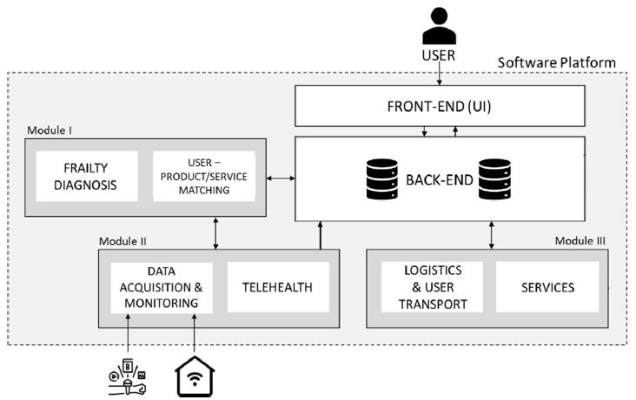
The assistance model is provided through a software platform that inte- grates three different modules (Figure 1): i) frailty diagnosis and user- product/service matching, ii) users’ monitoring, data acquisition, and teleme- dicine, iii) organization and management of transports, logistics, and services. This work focuses on the first module.
Figure 1: Software platform modules.
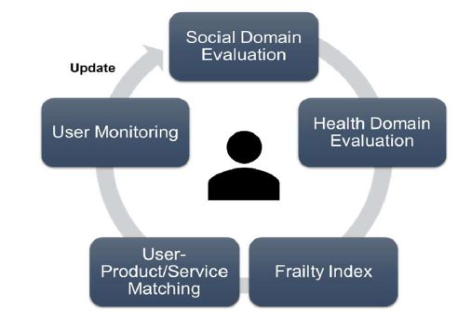
Based on a multidimensional evaluation of the health and social status, specific interventions are suggested to prevent acute events and improve the quality of life and the permanence of the elder people at home for indepen- dent living. This new assistance model involves a sort of human-in-the-loop approach, with a first holistic assessment of the patient’s frailty, the consequ- ent tailored assignment of products and services, followed by the continuous re-assessment of the patient’s health status and needed products-services kit, iteratively (Figure 2).
In detail, the individual frailty risk is mapped across multiple domains through the patient’s characteristics from the clinical and social aspects. This frailty index allows automatically profiling the best kit of technological devi- ces for clinical monitoring and services for social inclusion, based on the user’s needs, to contrast any further worsening of the health status and social sphere. Selected ICT solutions include smart objects, wearables, and environ- mental devices to evaluate the onset of risky events, monitor the own health status, and train the user hindering the process of frailty. A large suite of tech- nological devices with different levels of user engagement has been defined to improve user accessibility and reduce the impact of the digital gap intrin- sic to the Silver Generation. Also, a wide list of social innovative services to
Clinical and Social Well-Being for Older Adults: A Personalised Product-Service 661
Figure 2: Approach for the iterative patient evaluation and product/service assignment.
prevent isolation and health deterioration has been defined. These services include social aggregation events, group activities for psychophysical well- being, logistic services for people and goods, home delivery, telemedicine, and so on. The acquired data from the monitoring devices and the used services enables to update the frailty evaluation of the user for a refinement of the assigned set of products-services over time and to track the dynamics of the frailty evolution. Indeed, the frailty index has been thought to be dynamic and updated over time.
LOGIC AND RULES FOR PERSONALISED PRODUCT-SERVICE ASSIGNMENT Clinical and Social Variables Evaluation
The multidimensional evaluation of the social and health conditions of the user, and his/her classification into different frailty classes are neces- sary conditions for the personalised product-service assignment. The defined frailty index describes the vulnerability of an individual according to a mul- tidimensional approach, by analysing the functional, motor, nutritional, pathological, cognitive, psychological, social, and quality of life domains. Thus, it integrates a social evaluation and a clinical examination, by emplo- ying three different validated scales: the Social Support Scale (SSS) (Cohen 1988), the Clinical Frailty Scale (CFS) (Rockwood et al. 2005), and the Italian Frailty Index (IFI) (Abete et al. 2017). The assessment, which is carried out according to a decision-making flowchart defined by authors, allows distin- guishing between four classes of frailty (the robust subject is classified in the first one).
The classification into four frailty classes determines different treatment approaches in terms of:
Frequency of frailty index update (higher as the vulnerability worsens) and, consequently, frequency of refinement of the product-service kit assigned.
Type of services to be provided to the user (the intervention strategy for robust users is mostly preventive and therefore focuses on maintaining and improving the well-being state, while frailer users must counteract the decline avoiding further deterioration in the health and social states).
The suite of monitoring devices (greater frailty implies the need for continuous monitoring with adequate tools).
Therefore, this model is intended to act as: i) a mechanism for preventing and contrasting clinical and social frailty, ii) a path for defining a targeted diagnosis and planning a therapeutic approach to contrast the worsening of the health state, iii) a method to early identify eventual risky and acute events, through the provision of tailored devices and services, and alerts to the clinicians.
Technologies and Services Overview An extensive suite of social services and technological and smart devices for the monitoring of the health conditions, to be provided to the users, has been defined and is hereunder summarized:
Services: provided at home (e.g., nursing, telemedicine, physiotherapy, medical examination, home maintenance, digital mediator, operator assi- gned to help in administrative procedures/bill payment/other, home and personal care), home delivery (grocery, medicines), user transport (clini- cal and social), recreational activities (garden, card games, cultural events) and fitness, psychological support, behavioral information (training cour- ses and reminders), caregiver reservation.
ICT Monitoring Devices: wearable and environmental fall detection systems, blood pressure monitor, body scale (for weight and body com- position indexes), portable ECG for personal use, multiparameter smar- twatch, multiparameter patch, smart diabetes test kit, GPS locator, video communication system (for social and inclusive aims).
The ICT monitoring devices can communicate with the platform and update the frailty index in several items, in an iterative way, to guarantee to the user always the most proper set of products and services, avoiding the worsening of the health and social conditions. Indeed, it is worth noticing the great relevance given to the tailored social services with respect to the e-health platforms and telemedicine services at the state of the art. Concerning the selected technologies, some of them are commercially available, while others are designed and developed specifically for this work. They have been chosen according to different levels of easiness of use, acceptability, and learnability, and considering their technological requirements and limitations (e.g., small screen, incorrect functioning in determined situations, unusable for people with prosthetics, ICD, pacemakers).
Personalised Product-Service Assignment Through proper decision-support algorithms, that take into account the mul- tidimensional assessment, the frailty index, (and, later, the monitoring data), the system automatically generates (and updates) a correspondence between
Clinical and Social Well-Being for Older Adults: A Personalised Product-Service 663
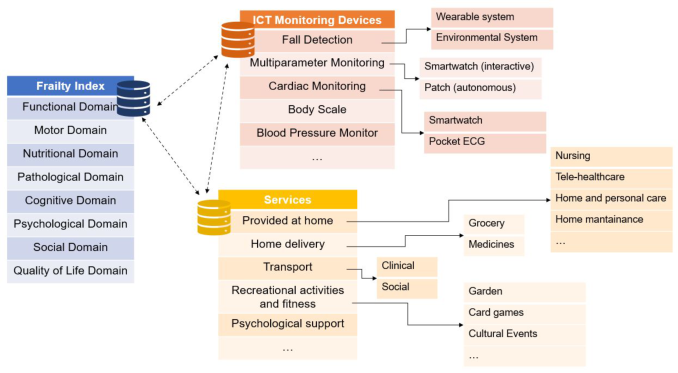
Figure 3: Databases interaction.
the user’s needs and the most suitable product-service suite (Figure 3 shows the links between the different databases). The suggested set of services and devices will then be confirmed or revised by the clinician, and, lastly, accepted or rejected by the user.
The platform acquires data both from the ICT devices and booked servi- ces, to collect all the relevant data to early identify any negative trends or worsening in the user’s health and social conditions. Thus, the frailty index and class are updated, and the suite of product-services can be accordingly modified.
Moreover, if a critical event or a negative trend emerges from the inter- pretation of the monitoring data, then the platform, based on predetermined thresholds, automatically sends an alert to the clinician. This system allows a fast intervention and a prompt response to the eventual deterioration of the user’s frailty.
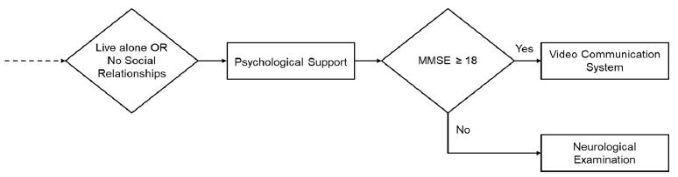
Figure 4: A part of the decision rules for the tailored product-service assignment.
Figure 4 shows a very small cut of the logic and rules which allow the personalised product-service assignment. In detail, part of the social and cognitive evaluation, through the Mini-Mental State Examination (MMSE) is illustrated: if the user lives alone or does not have social relationships then psychological analysis and support are suggested. Consequently, if a severe impairment of cognitive skills is diagnosed then a neurological examination is
recommended, otherwise, the use of a video communication system is advised to enhance social contacts and to play brain games.
CONCLUSIONS AND FUTURE VALIDATION This paper proposes a novel assistance model to keep the elderly healthy and socially active, preventing risky acute events and improving their quality of life. An overview of the software platform and a focus on the module for the multidimensional user’s evaluation and tailored product-service matching is provided.
The effectiveness of the matching algorithms for personalised product- service assignment will be verified and validated with the clinicians’ and users’ feedback through experimentation over more than two hundred over-65 peo- ple. It will consist of a two-step process, at the beginning and the end of the experimentation. First, it will be asked to the clinician if the algorithm pro- perly suggested the product-service association in relation to the patient’s clinical and social needs. Also, it will be asked to the patient the appropriate- ness and the acceptability of the matching. The same question will be set to the elder even at the end of the trial. At the same time, the clinician will evalu- ate the correctness of the devices/services assignment based on the variation or maintenance of the frailty index, with respect to the beginning of the expe- rimentation. Furthermore, the presence or absence of received alerts during the trial will also be indirect indicators of the correctness of the matching.
ACKNOWLEDGMENT
The authors would like to acknowledge all the Project’s partners for their valuable work in the project development. [Italian National Project “MOSAICO - Models, products and services to make the life of frailty people socially active and inclusive in communities spread across the terri- tory”, funded by the Ministry of Economic Development under the tender for Innovation Agreements].
REFERENCES
Abete, P., et al. (2017) “The Italian version of the “frailty index” based on deficits in health: a validation study”, Aging Clin Exp Res., 29, 5, pp. 913–926. Aceto, G., Persico, V., Pescape, A. (2020) “Industry 4.0 and Health: Internet of
Things, Big Data, and Cloud Computing for Healthcare 4.0”, Journal of Industrial Information Integration, 18, 100129. Cohen, S., (1988) “Psychosocial models of the role of social support in the aetiology of physical disease”, Health Psychol., 7, pp. 269–297. Dias, S.B. et al. (2020) “Innovative Parkinson’s Disease Patients” Motor Skills
Assessment: The i-PROGNOSIS Paradigm”, Frontiers in Computer Science, 2. Gomez-Garcia, C.A., Askar-Rodriguez, M., Velasco-Medina, J. (2021) “Platform for Healthcare Promotion and Cardiovascular Disease Prevention”, IEEE J Biomed Health Inform, 25(7), pp. 2758–2767.
Clinical and Social Well-Being for Older Adults: A Personalised Product-Service 665
Marshall, A. H., Novakovic, A. (2019) “Analysing the Performance of a Real-Time Healthcare 4.0 System using Shared Frailty Time to Event Models”, In 2019 IEEE 32nd International Symposium on Computer-Based Medical Systems (CBMS), pp. 622–627. Rockwood, K., Song, X., MacKnight, C., et al. (2005), “A global clinical measure of
fitness and frailty in elderly people”, CMAJ., 173, 5, pp. 489–495. Tao, D., Wang, T., Wang, T., et al. (2020) “A systematic review and meta-analysis of user acceptance of consumer-oriented health information technologies”, Compu- ters in Human Behavior, 104, 106147. Vercelli, A. et al. (2017) “My-active and healthy ageing (My-AHA): An ICT platform
to detect frailty risk and propose intervention,” 25th International Conference on Software, Telecommunications and Computer Networks (SoftCOM), Split, pp. 1–4. Yacchirema, D., de Puga, J.S., Palau, C. et al. (2019) “Fall detection system for elderly people using IoT and ensemble machine learning algorithm”, Pers Ubiquit Comput, 23, pp. 801–817. Yang, G., et al. (2020) “Homecare Robotic Systems for Healthcare 4.0: Visions and
Enabling Technologies”, in IEEE Journal of Biomedical and Health Informatics, 24 (9), pp. 2535–2549.
Read this individual research paper free through the original publisher, or explore the full digital proceedings book.
ISBN 978-1-958651-44-5
Explore this ISBN in the AHFE Bookstore ↗Listed in the July 2026 bookstore catalogue; search by ISBN to confirm current availability · Digital book purchase optional