Kristiina Hellstén, Seija Arve, Leena Tamminen-Peter, Hannu Isoaho, Tuula Putus (2019). Risk Management as. In: Advances in Safety Management and Human Factors. AHFE Open Access, vol. 5. https://doi.org/10.54941/ahfe100168
The aim of this two-year intervention study was to provide information on the work-related physical demands and risks among nurses working in elderly 24-hour care units and to determine what kind of measures and management means can reduce physical strain on nurses. A variety of measures were used. This paper presents the key findings of nurses' physical load and risks associated with nursing care (The Care Thermometer method) and perceived workload of nurses (job strain and satisfaction questionnaire).The level of working safety increased from 56% to 71.5%. High-risk tasks have been reduced from 22.5% to 13.9%.There were significant differences (p-value <.001) in perceived stress between physical and psychological stress and by activities (long term care; homes for elderly; service homes) and by professions (nurses; practical nurses; nursing aids; first-line managers). Both physical stress and psychological stress increased, but physical stress increased less than psychological stress. It can be assumed that the interventions in this study had a positive impact on physical stress. Additional tests are needed to explain the differences between physical and psychological stress and the measures and management means that can best reduce physical strain on nurses.
Approximately 40 000 Finnish people, aged 75 or older live in institutions and service homes (Ministry of social affairs and health, 2013). Work in elderly care is physically demanding when compared to other social and health sectors and often, nursing facilities, assistive devices and nurses' skills do not meet the needs of their patients (Tamminen-Peter, 2007). There are several physical risks factors in nursing. 82 % of back injures happen during manual patient handling and more than one third of sick leaves are due to musculoskeletal disorders (Gropelli and Corle, 2011).
Shortage in nursing personnel is a problem in all western countries and it is expected to worsen, especially in elderly care. Therefore, strategies must be put in place to reduce physical strain and improve workers' wellbeing in nursing of the elderly (Ministry of social affairs and health, 2013; Robertson and Cooper, 2011).
In the city of Turku, Finland, the amount of the population that is aged 75 or over is increasing rapidly. It was decided to carry out a two-year intervention study which related to the development of social and health care services for the elderly. As a practical tool for intervention implementation the Management Model for Physical Risks in the Care Work created in 2010 by The Finnish Institute of Occupational Health was used (Tamminen-Peter et al., 2010). The model helps to assess and manage physical risks in workplaces. Some previous research using ergonomic interventions based on risk assessment can be found (Hignett, 2003; Hignett and Crumpton, 2005).
AIMS The aim of the study was to provide information on the work-related physical demands and risks among nurses working in 24-hour elderly care units and to determine the measures and management means that can reduce physical strain on nurses. People are, however, complete entities and psychological and psychosocial factors affect their perception of the physical load and musculoskeletal disorders. Thus, the notion of perceived psychological stress was considered important to this study.
MATERIAL AND METHODS Intervention study 2010-2012
This two-year intervention study focused on 24-hour elderly care working units (n = 47) and their employees in the city of Turku, Finland. 24-hour care in long-term hospital care, a home for the elderly or a service home are the options when living at home is impossible even with assistive services. The clients were mostly over the age of 75.The baseline measurements were carried out in 2010 and follow-up measurements in 2012. The data was collected from clients, nursing staff, first-line managers and ergo-coaches by questionnaires, interviews and statistics. (Figure 1) The core of the intervention was the introduction of the Management Model for Physical Risks in Care Work developed in 2010 by the Finnish Institute of Occupational Health. The model helps to assess and manage physical risks in the workplace (Tamminen-Peter et al., 2010). The intervention included knowledge management, ergonomic training, monitoring the implementation of the measures and the success of the project evaluation. Patient assistive transfer devices and ergonomic furniture purchase was designed to support the success of the intervention. During the intervention training and education was provided for the first-line managers (Dellve et al., 2007).
Figure1. The whole study setting
Figure available in the original PDF paper.
In Figure 1 the whole study setting and all the measurements are presented. Clients' mobility was measured with RAVA-Index. Nurses' physical load and risks associated with nursing care were estimated with the Care Thermometer method and a nursing staff questionnaire was conducted for perceived job work load, job satisfaction, work ability and musculoskeletal disorders. The Patient Handling Organizational Question set (PHOQS) method was used by first-line management to detect the state of the safety culture of the work unit. Furthermore, the Finnish 10-Town Study was used to survey changes in working community, management, staff well-being and sick leaves.
In 2011, a survey was conducted as a part of the intervention on first-line managers and ergo-coaches to discover executed actions, the role of ergo-coaches in promoting ergonomic measures and the follow-up plans of units.
The intervention was diverse and complex. The success of the implementation and impact assessment was difficult, especially when many other changes were taking place at the same time in the organization. The intervention was reported as comprehensively and transparently as possible. Criteria for reporting the development and evaluation of complex interventions in healthcare (CReDESI) was used (Möhler et al., 2012).
The data were described using frequencies and percentages. Modeling and statistical inference were done by analysis of variance with the Tukey-Kramer Multiple –Comparison Test and regression analysis.
This paper presents the key findings of nurses' physical load and risks associated with nursing care (The Care Thermometer method) and perceived job workload of nurses (job strain and satisfaction questionnaire).
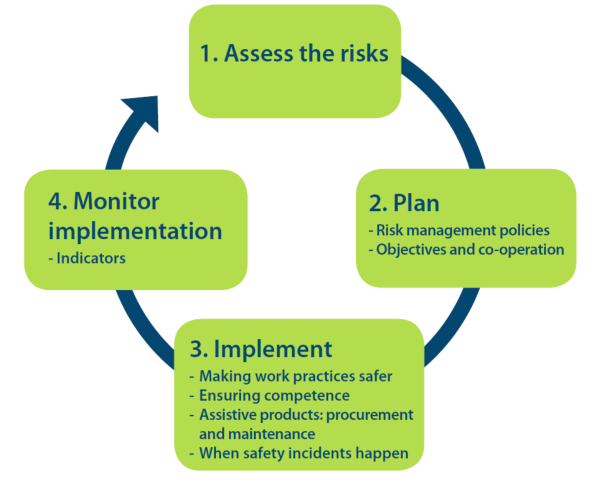
The management model for physical risks in the care work The management model for physical risks in care work describes the methods with which new procedures leading to more safety can be integrated into the daily work of the healthcare community. The management model includes operational targets for safety management, the organization`s objectives and the methods to achieve them. The idea behind the model is that the issues raised in the model should be individually considered at each workplace. (Tamminen-Peter et al., 2010)
The management model for physical risks is a process (see Figure2), which is based on the Occupational Health and Safety Assessment Series (OHSAS 18001: fi). In the planning stage, objectives are set and processes created related to the achievement of the organization`s occupational health and safety policy results (Parantainen and Soini, 2010). Subsequently the processes are implemented and the implementation monitored. On the basis of monitoring assessments, measures are taken by which the performance of the occupational health and safety management system is continuously improved.
Figure2. The process of the management model for physical risks in care work (Tamminen-Peter et al. 2010, 9) The management model for physical risk assessment supports independent development efforts on wards. More research and education is needed to support the adoption of the model as a working practice both on wards and in organizations as a whole (Fagerström et al., 2011).
The Care Thermometer™ The Care Thermometer is a web-based self-assessment tool designed to get an overview of the present situation in two specific areas: the physical care load and the prevention policy in the unit. It also indicates if there are areas where quality of care for the resident can be approved. (Knibbe and Friele, 1999) The Care Thermometer is a validated assessment tool and the further step in the development of TilThermometer™ .The method is based e.g. on the international guidelines of NIOSH (the National Institute for Occupational Safety and Health), RAI (Resident Assessment Instrument) and ICIDH (International Classification of Impairments, Disabilities and Handicaps). (Knibbe and Knibbe, 2012) The Care Thermometer is recommended in the ISO Technical Report 12296:2012. Ergonomics - manual handling of people in the healthcare sector (Hignett et al., 2014). ArjoHuntleigh (www.arjo.co.uk) maintain the Care Thermometer method.
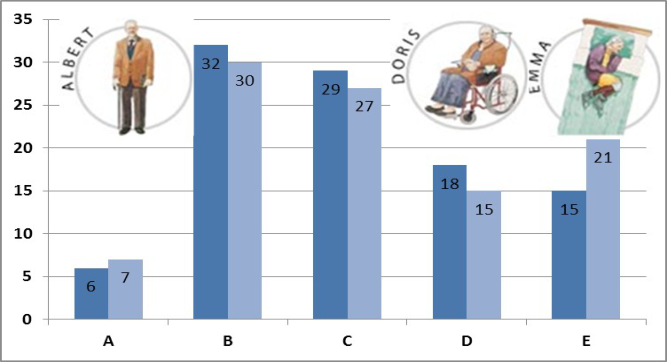
For the purpose of monitoring the physical care load, The Care Thermometer uses Mobility Gallery™ (www.CareThermometer.com). This is a five level classification system ranging from completely mobile and independent residents/patients to fully dependent residents who are entirely bedridden. The classes are named in alphabetical order from Albert (A) to Emma (E). The idea behind is, passive residents potentially represent a higher occupational health risk for caregivers than residents who are fully mobile and require no physical assistance. The mobility level of the residents correlates directly with physical load for caregivers and their exposure level. (Knibbe and Knibbe, 2012.)
Job strain and satisfaction questionnaire The nursing staff questionnaire (adopted from Tamminen-Peter et al., 2010) was conducted for perceived job workload, job satisfaction, work ability and musculoskeletal disorders in 2010 and 2012.
RESULTS
Physical load and risks associated with nursing care Physical care load changed from 2010 to 2012 on the basis of clients' functional mobility (classes A-E, the Mobility Gallery™). The percentage of fully dependent residents (E=Emma) rose 6 % (Figure 3).
Figure3. Clients (%) in mobility classes (A-E) in 2010 (n=995) and in 2012 (n= 1034) (Images from ArjoHuntleigh, 2013) In the 2010 baseline, the Care Thermometer key findings showed that guidelines were followed in many patient handling situations, but too heavy patients were still lifted manually. No lifting devices were used with customers needing full assistance and assisting devices were not adequately utilized with partly assisted patients. Hygiene care in sitting position was strenuous.
Follow-up measurements in 2012 showed that the working level of safety had increased from 56% to 71.5%. High- risk tasks have been reduced from 22.5% to13.9%. Assisting devices were not adequately utilized with partly assisted patients. Guidelines for developing quality of the care were that the use of lifting equipment should be further intensified. Hygiene care in sitting positions should be used for all except E-types patients.
Physical stress in 2010 and 2012 Nurses assessed the physical stress of their work on a scale of 0 to 14 (0 = very light, 14 = very heavy) in 2010 and in 2012.
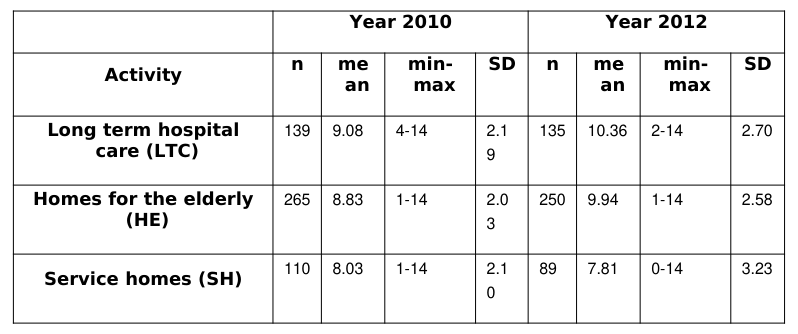
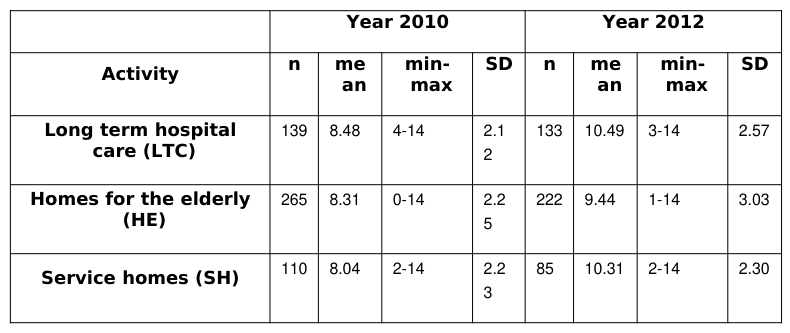
In 2010, mean perceived physical stress was 8.72 and in 2012 it was 9.66. The increase of physical stress was highly significant (p-value <0.001). Perceived physical stress was the highest in long term hospital care (LTC), the second highest in homes for the elderly (HE) and the least in service homes (SH) (Table 1).
Table 1: Perceived physical stress by activity in 2010 (n= 541) and 2012 (n=475) Year 2010 Year 2012 min-
In 2010, there were statistically significant differences in the perceived physical stress between service homes and long term hospital care and between service homes and homes for the elderly. However, the difference between means of long-term care and homes for the elderly were not statistically significant. The results were similar to the 2012 data.
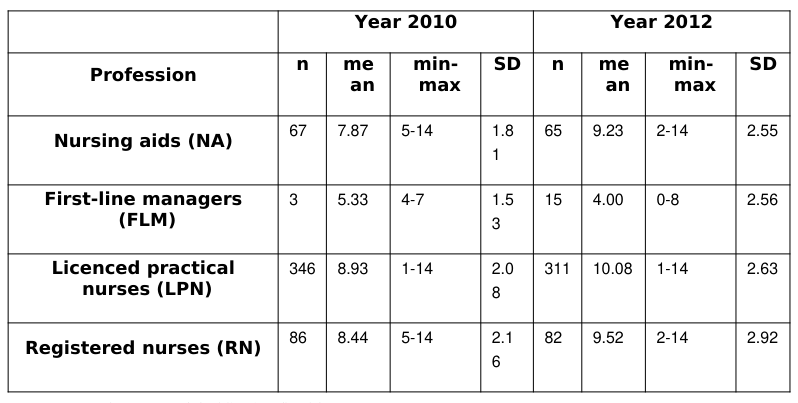
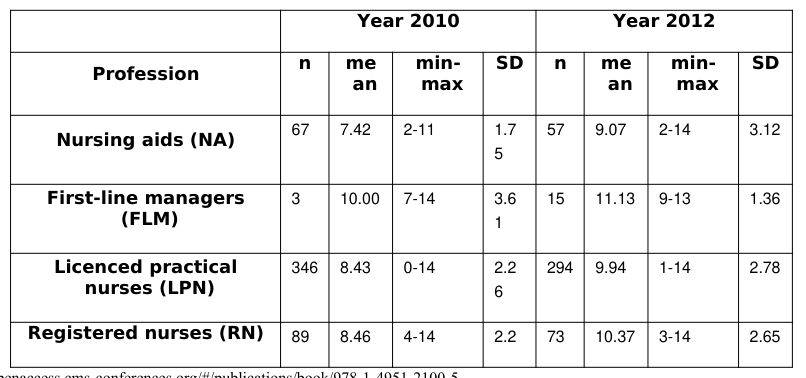
Physical stress was also examined by profession. Licenced practical nurses (LPN) experienced their work as the most physically stressful and the work of registered nurses (RN) was the second stressful. Nursing aids (NA), whose duties mainly related to cleaning and food service, physical stress of the work was in third place. First-line managers` (FLM) work was less physically strenuous. (Table 2)
Table 2: Perceived physical stress by profession in 2010 (n=502) and in 2012 (n=473) Year 2010 Year 2012 min-
Perceived physical stress increased in all professional groups from 2010 to 2012. Differences between the professions were statistically significant (p-value <.001) both in 2010 and in 2012.
Psychological stress in 2010 and 2012 Nurses assessed the psychological stress of their work on a scale of 0 to 14 (0 = very light, 14 = very heavy) in 2010 and in 2012.
In 2010, mean perceived psychological stress was 8.32 and in 2012 it was 9.93. The increase of psychological stress was highly significant (p-value <0.001).
The perceived psychological stress by activities in 2010 was the highest in long term hospital care (LTC), the second highest in homes for the elderly (HE) and the least burden in service homes (SH). In the follow-up measurement in 2012 the perceived psychological stress was still highest in long term care but service homes staff experienced now more stress than staff of homes for elderly. (Table 3)
Table 3: Perceived psychological stress by activity in 2010 (n= 541) and in 2012 (n=441) Year 2010 Year 2012 min-
In 2010 there were no significant differences in perceived psychological stress between the activities: long term hospital care, homes for the elderly and service homes, but in 2012 the stress had increased unevenly and the differences between the activities were statistically significant (p-value < 0.001).
First-line managers (FLM) perceived their work most psychologically stressful. Work of registered nurses (RN) was the second stressful and work of licenced practical nurses (LPN) was in third place. Nursing aids (NA) experienced their work as the least psychologically stressful. (Table 4)
Table 4: Perceived psychological stress by profession in 2010 (n=514) and 2012 (n=440) Year 2010 Year 2012 min-
4
There were significant differences (p-value <.001) in perceived psychological stress between different professional groups both in 2010 and 2012.
Changes in physical and psychological stress 2010-2012 When looking at the interaction effect of activity and year on physical stress, the connection was statistically significant (p = .002). Physical stress increased in long term hospital care and home for the elderly, but in service homes it slightly declined. (Figure 4)
Means Plot of Physical Stress by Activities
11
10
9
8
Physical Stress
Activities:
7
LTC HE SH
2010 2012
Year
Figure4. Changes in physical stress by year and by activities: long term hospital care (LTC); homes for the elderly (HE) and service homes (SH) from 2010 (n=529) to 2012 (n=474)
Figure available in the original PDF paper.
Psychological stress increased in all activities, the most in service homes, the least in the homes for the elderly. The change from 2010 to 2012 was statistically significant (p-value < .001). (Figure 5)
Means Plot of Psychological Stress by Activities
11
10
9
8
Psychological Stress
Activities:
7
LTC HE SH
2010 2012
Year
Figure5. Changes in psychological stress by year and by activities: long term hospital care (LTC); homes for the elderly (HE) and service homes (SH) from 2010 (n= 529) to 2012 (n=440)
Figure available in the original PDF paper.
Physical stress grew in all professions except first-line managers (Figure 6).
Means Plot of Physical Stress by Professions
11
10
9
8
7
6
Professions:
P hysical S tress
5
NA FLM
4
LPN RN
2010 2012
Year
Figure6. Changes in physical stress by year and by professions: registered nurses (RN), licenced practical nurses (LPN), nursing aids (NA) and first-line managers (FLM) from 2010 (n=502) to 2012 (n=473)
Figure available in the original PDF paper.
Psychological stress increased in all professions, the most first-line managers (Figure 7).
Means Plot of Psychological Stress by Professions
11
10
9
8
7
6
Professions:
Psychological Stress
5
NA FLM
4
LPN RN
2010 2012
Year
Figure7. Changes in psychological stress by year and by professions: registered nurses (RN), licenced practical nurses (LPN), nursing aids (NA) and first-line managers (FLM) from 2010 (n=514) to 2012 (n=440)
Figure available in the original PDF paper.
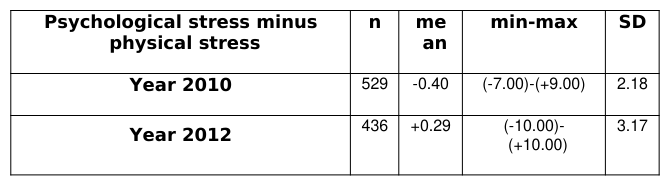
Both physical stress and psychological stress increased, but physical stress increased less than psychological stress. This relationship was examined more closely (Table 5). In 2010, physical stress was greater than psychological stress. In 2012, the situation had changed, and psychological stress was greater than physical stress. The change was statistically significant (p-value<.001).
Table5. Changes of relationship between psychological and physical stress from 2010 (n=529) to 2012Equation reproduced from the original PDF.
DISCUSSION AND CONCLUSIONS The aim of this two-year intervention study was to provide information on the work-related physical demands and risks among nurses working in elderly 24-hour care units and to determine what kind of measures and management means can reduce physical strain on nurses. The intervention was diverse and complex. The success of the implementation and impact assessment was difficult, especially when many other changes took place at the same time in the organization.
There were many work-related physical demands and several risks among nurses working in elderly 24-hour care units. Clients` need of care increased during the study years and caused more work load and risks. Guidelines were followed in many patient handling situations but, still, there were incorrect working methods. The Care Thermometer measurements only partly explained changes in physical and psychological stress. The nurses need more ergonomic training for client handling, as well as information on work safety.
Work in elderly 24-hour care units is physically and psychologically demanding. Differences in perceived physical and in perceived psychological stress both by activities and by professions should, in the future, be better taken into consideration when managing risks in care work.
The effectiveness of the interventions was contradictory. Both physical stress and psychological stress increased, but physical stress less than psychological stress. It can be assumed that the interventions in this study had a positive impact on physical stress but the impact on psychological stress was marginal. Additional tests are needed to explain more about the differences between physical and psychological stress and what kind of measures and management means can best reduce the physical strain of employees.
The Management Model for Physical Risks in Care Work and the Care Thermometer method systematically supported the assessment and management of physical risks in elderly care workplaces. The goal was to achieve permanent changes and to establish a better understanding of the management of physical risks and this needs time. This two-year intervention, therefore, was too short a time to embrace this kind of strategy.
In many respects, however, the work in elderly care units is now safer and our study has shown that risk management is a suitable strategic tool in elderly care.
REFERENCES
Dellve L. Skagert K. Vilhelmsson R. (2007), ” Leadership in workplace health promotion: 1- and 2-year effects on long-term attendance”, The European Journal of Public Health 17 (5), 471-476. Fagerström, V. Laine M. Järvinen M. (2011), ”Fyysisten riskien hallintamallin juurtuminen osaksi vanhustenhuollon
turvallisuusjohtamista”, Loppuraportti 15.10.2011. Työterveyslaitos, Turku. Työsuojelurahasto. Gropelli T. Corle K. (2011), “Assessment of nurses' and therapists' occupational musculoskeletal injuries”, Medsurg Nursing, 2011 Nov-Dec; 20(6):297-303. Hignett S. (2003), ”Intervention strategies to reduce musculosceletal injuries associated with handling patients: a systematic
review”, Occup Environ Med. 2003; 60(9):1-8. Hignett S. Crumpton E. (2005), ”Development of a patient handling assessment tool”, International Journal of Therapy and Rehabilitation, April, 2005, Vol 12, No 4 178-181. Hignett S. Fray M. Battevi N. Occhipinti E. Menoni O. Tamminen-Peter L. Waaijer E. Knibbe H. Jäger M. (2014),
“International consensus on manual handling of people in health care sector: Technical report ISO/TR 12296”, International Journal of Industrial Ergonomics 44 (2014) 191-195. Knibbe J. Friele R. (1999), “The use of logs to assess exposure to manual handling of patients, illustrated in an intervention study in home care nursing”, Int. J Ind Ergonomy 1999; 24:445-454. Knibbe H.J. Knibbe N.E. (2012), “An international validation study of the care thermometer: a tool supporting the quality of
ergonomic policies in health care”, Work 41 (2012): 5639-5641. Laine M. Kokkinen L. (2013), ”Tilanne eri toimialoilla: Terveys- ja sosiaalipalvelut”, in Työ ja terveys Suomessa 2012.
Kauppinen T. et al. Seurantatietoa työoloista ja työhyvinvoinnista, Työterveyslaitos. Helsinki. Ministry of social affairs and health, Finland (2013), ”Muistio ns. vanhuspalvelulain toimeenpanon ja tulkinnan tueksi 28.6.2013”, Sosiaali- ja terveysministeriö ja Suomen Kuntaliitto. Helsinki, Finland Möhler R. Bartoszek G. Köpke S. Meyer G. (2012), “Proposed criteria for reporting the development and evaluation of complex interventions in healthcare (CReDECI): guideline development”, Int Journal of Nursing Studies 49 (2012) 40-46. OHSAS 18001: fi (2007), ”Työterveys- ja turvallisuusjohtamisjärjestelmät.Vaatimukset” (Occupational Health and Safety
Management Systems-Requirements), 3.painos. Parantainen A. Soini S. (2010), ”Riskinarvioinnista riskin hallintaan – turvallisuutta terveydenhuoltoalalle”, Työterveyslaitos.
Helsinki. Robertson I. Cooper G. (2011),“Well-being, Productivity and Happiness at Work” CPI Antony Rowe, Chippenham & Eastborne. Tamminen-Peter L. (2007), ”Ergonomiaopetuksen kehittäminen sosiaali- terveydenhoitoalan oppilaitoksissa. Loppuraportti”, sosiaali- ja terveysministeriön selvityksiä, 2007:22. Tamminen-Peter L. Moilanen A. Fagerström V. (2010), ”A Management Model for Physical Risks in the care work”, the Finnish
Institute of Occupational Health, Helsinki, Finland.
LISTED IN THE AHFE DIGITAL BOOKSTORE CATALOGUE
Explore the complete digital volume
Advances in Safety Management and Human Factors
Read this individual research paper free through the original publisher, or explore the full digital proceedings book.
ISBN 978-1-4951-2100-5
Explore this ISBN in the AHFE Bookstore ↗Listed in the July 2026 bookstore catalogue; search by ISBN to confirm current availability · Digital book purchase optional