Rosemary Cavalcante Gonçalvesa, Regina Heloisa Maciela (2019). Electric System Control Room Operators: Cognitive Task Analysis and Human Error. In: Advances in Safety Management and Human Factors. AHFE Open Access, vol. 5. https://doi.org/10.54941/ahfe100144
Despite the increasing level of automation in electric system control centers, human action in the supervision and control of the process remains essential for maintaining system security. This study is about operators’ tasks in managing real-time occurrences of low voltage level in an electric system. The operation aims to restore the power supply. The study comprehends the operators’ task and the potential errors analysis in order to subsidize the creation of a training simulator. Hierarchical Task Analysis (HTA) and Systematic Human Error Reduction and Prediction Approach (SHERPA) were the methods used in the research. The results show that operators are involved in action planning and decision-making, whose errors can result in serious consequences for the system. It is possible that the analysis of a large amount of information together with real-time decision-making in the emergencies significantly influences operators' errors. Task analysis proved useful in identifying situations that may compose simulation scenarios for training. A disadvantage of the method is not considering work context and its implications for operators’ errors.
Despite technological advances and increasing automation of many of the functions previously performed by people in complex environments, the role of the operators is still significant. People can detect critical incidents, interpret signs and make essential decisions for the equilibrium of the system performance (Donald, 2001; De Keyser, 2001). Therefore, understanding the various operators’ cognitive activities in modern control rooms becomes a challenge. Control rooms are places where people carry out control and supervision activities of complex systems. Operators are away from the real environment and have to monitor the system through displays, sensors and communication channels. Aspects of the task involve dealing with system disturbances, which requires a number of cognitive processes, such as perception, planning, decision-making and action control. Operators need to acquire these skills in order to become proficient in the performance of their function (Shepherd, 2004).
In this sense, task analysis is a useful approach to identify the tasks performed and their main properties and may serve as a tool for knowledge acquisition and modeling of the skills used by operators in the performance of their activities (Paternó, 2000). Task analysis methods facilitate the understanding of activities when the intention is to build training programs or simulate activities in a training context. These methods are important to define operational objectives and identify the actions and decisions necessary to meet them, clarifying the activities that Safety Management (2019) require greater expertise and the context in which the work is performed (Shepherd, 2004). Identifying the elements of the task and its goals then becomes an essential step for the examination of the skills needed to perform the job (Annett & Stanton, 2000). Besides that, in the field of assessment and reduction of human errors, task analysis shows to be a useful approach to help in identifying and eliminating conditions that give rise to errors. This analysis can assist either in the design phase of a new system or suggesting changes in an existing system (Embrey, 2000).
Task analysis is not restricted to observable behavior. To deepen the examination and decomposition of activities, it is necessary to examine cognitive aspects (Hoffman & Militello, 2008). Cognitive elements of the tasks can be inferred as characteristic of a particular transaction, even when not evidenced by observations or in the operator’s discourse. It is the task analysis that establishes the interaction between cognition and action and the cognitive skills can be extracted from the cognitive elements identified in the analysis. However, it is important to examine the interaction of the various operations performed in order to perceive the complete cognitive skill (Shepherd, 2004).
The study presented here is part of a broader research project that aims for the description of scenarios for creating a training simulator for the System Control Center of an electricity distribution company. The research design comprehends the identification of expertise components to generate training interventions and help beginners or less experienced operators to acquire skills and knowledge more quickly and effectively. Thus, the research described corresponds to the initial phase with the objective to understand the tasks performed by operators that deal with occurrences in the low-voltage level of electrical distribution.
There are high-voltage, medium-voltage and low-voltage operators in the firm studied. The low-voltage operators, focused in this study, deal with emergencies affecting a small area, in general, a customer unit or units in a contained area. The essence of their tasks is the management of real-time events to restore the electricity supply in these consumer units. It is important to emphasize that the low-voltage task differs significantly from the other two levels in the sense that operators deal mainly with the field teams and less with the automatic systems, meaning that an important part of the task requires non-technical abilities, which is exactly the opposite from the case of high and medium-voltage operators. The study focuses the identification of task steps and possible errors in the accomplishment of the task to subsidize the training simulator. Subsequent phases of research, which are under development, involve the deepening of cognitive task analysis with application of critical decision method (Klein, Calderwood, & MacGregor, 1989) and verbal protocols (Ericsson & Simon, 1993).
Background
The restructuring process of the electricity sector has been expanding in many countries around the world. The privatization and implementation of regulatory mechanisms in distribution and transmission systems of electrical energy provided improvements in the production and quality of services. However, there remains a concern related to network reliability due to power outages or blackouts when supply failures occur (Joskow, 2008). These aspects make transactions in electricity networks increasingly complex and sophisticated.
Since 1998, the electricity distribution in Brazil has been deeply reorganized and transformed. These include management changes from State-owned enterprises or mixed economy to private companies. The direct consequences of these modifications were the significant outsourcing process, reduction of the work force, insertion of personnel without enough qualifications, transformation of processes and equipment to make them more agile, low-cost and requiring fewer workers (DSST/MTE, 2002). The changes also resulted in the creation of government regulations to ensure that distribution systems are safe, efficient, and reliable and operate with quality (ANEEL, 2012). In this context, one of the main challenges of electrical energy concessionaires is the provision of quality services, characterized by the continuity of supply and the sustainability of the voltage levels delivered to customers.
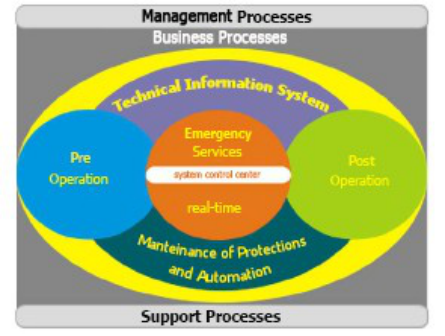
The main operational activities of an electricity distribution company are: (a) construction of networks; (b) maintenance to eliminate supply interruption flaws; (c) emergency services to restore the supply after a supply failure; (d) customers’ connections to the distributor system; (e) customers’ disconnections; and (f) rewiring of customers’ units (Melo, Lima, Gomes, & Soares, 2003). Figure 1 shows the basic procedures for the operation of the electrical system in the company studied.
The technical operation focused in this study is the emergency services sector, responsible for managing the operation of the low voltage network. Operators working in the system control center (SCC) are responsible for the
Safety Management (2019) job. They develop their activities in a control room, through monitoring screens, communication systems and specific software. Emergency occurrences are characterized by being unexpected, i.e. are not programmed, and can occur at any time or place, but require service recovery in the shortest possible time (COELCE, 2012).
Figure 1: Map of the electrical system technical operation processes (COELCE, 2012)
Technological advances in control rooms of electrical systems have brought growing amounts of information with an excessive number of screens, maps and alarms, contributing to increasing cognitive demands due to a greater work complexity (Almeida, Kappel & Gomes, 2007; Francisco & Rodrigues, 2006; Ferreira, 2012). Vitório, Másculo and Melo (2012) carried out a field research to evaluate operators’ mental load in an electric power control center. They identified as demands with higher weights in the resulting mental workload: (a) mental requirements (such as difficult, complex tasks, which require a lot of mental effort to achieve the goal) and (b) temporal requirements (such as fast-paced and intense work, with a lot of pressure to end the problem). Guttromson, Greitzer, Paget and Schur (2007), in the context of operations in electric networks, discuss the need for a shift from traditional studies on human factors and aspects of vision in human-computer interaction to focus on questions about situation awareness and shared knowledge. No doubt, the increased complexity of the energy industries requires a new look at the human factor. Operator’s performance in control rooms is crucial to reduce the consequences of incidents, insofar as they are the ones who take decisions on the functioning of the system, becoming the final link in the processes chain (Faria, Silva, Vale, & Marques, 2009).
METHOD
Hierarchical Task Analysis (HTA) Hierarchical task analysis (HTA) produces a hierarchy of plans and operations that the operator (or a team of operators) must perform in order to meet the goals of a system. The HTA starts with the establishment of the objective to be achieved in the activity. Then, the tasks are described in a set of sub-operations and arranged in levels, which can be more or less detailed according to the analyst’s purposes. Task analysis results, in general, in diagrams or tables with the collected data. A useful method that can be applied in conjunction with other techniques of tasks analysis, preferably in an early stage, which provides the context for using other approaches (Kirwan & Ainsworth, 1992; Annett, 2004).
In this study, the task analysis of the low-voltage operators was accomplished through interviews, analysis of the technical operational procedures manuals and observations in the workplace. A task overview in the form of a diagram has been developed using the data collected. A table with specific information including tasks, subtasks and plans for each step of the activity was also prepared. The tasks were numbered according to the order of operations, and the subtasks were numbered progressively. For example, the task 1 involves subtask 1.1, which is subdivided into 1.1.1, 1.1.2, and so on. The numbering system intends to facilitate the identification of operations and
Safety Management (2019) subsequent analysis.
Systematic Human Error Reduction and Prediction Approach (SHERPA) Developed by Embrey (1986, cited in Stanton, 2005) as a technique for predicting human error, systematic human error reduction and prediction approach (SHRPA) uses a behavior classification related to a taxonomy of error mode. While HTA serves as a basis for identifying possible failures in the performance of tasks, in SHERPA analysis each operation is classified according to the following categories: action, retrieval, verification, and information communication. After that, for each specific activity or operation, associated possible error modes are considered. The possible error modes are in Table 1. The next step is to identify if there is a later stage of the task where the error can be corrected. The probability of error occurrence, based on historical data and/or the judgment of an expert on the subject is then computed. Next, an analysis of the criticality of the error is made to indicate the severity in terms of damage or loss. The last phase refers to proposals for corrective measures for error reduction (Stanton, 2005).
Table 1: SHERPA error modes (Stanton, 2005) Error classification Code Error mode Action errors A1 Operation too long/short A2 Operation mistimed A3 Operation in wrong direction A4 Operation too little/much A5 Misalign A6 Right operation on wrong object A7 Wrong operation on right object A8 Operation omitted A9 Operation incomplete A10 Wrong operation on wrong object Checking Errors C1 Check omitted C2 Check incomplete C3 Right check on wrong object C4 Wrong check on right object C5 Check mistimed C6 Wrong check on wrong object Retrieval Errors R1 Information not obtained R2 Wrong information obtained R3 Information retrieval incomplete Communication Errors I1 Information not communicated I2 Wrong information communicated I3 Information communication Selection Errors S1 Selection omitted S2 Wrong selection made
Table available in the original PDF paper.
For the purposes of SHERPA, interviews with an experienced operator and a supervisor of the company were conducted. Subsequently, the supervisor validated the analysis results. The data obtained in SHERPA analysis is reported in a tabular form (see table 3).
RESULTS AND DISCUSSION
As already pointed out, the job of low-voltage operators is the management of unscheduled occurrences to restore the electricity supply. Operators receive communication of occurrences and determine steps to be followed by field teams, composed of electricians. Each operator controls a number of field teams and is responsible for a specific area. Control room operators are mainly men, although there are two female supervisors. There are 18 low-voltage
Safety Management (2019) operators, 5 medium-voltage and 5 high-voltage, with ages ranging between 19 and 52. Young operators are mainly low-voltage and the great majority are electricity technicians. High-voltage and medium-voltage operators are engineers. HTA results, operator’s job overview, is presented in figure 2. The figure diagram shows tasks subdivided into deeper levels of operations. Table 2 shows the summary of the highest levels of operations found in HTA. Due to the dynamic characteristic of the activities and the large number of occurrences, in practice, it is not possible to follow this flow exactly. That is, managing emergencies, managing teams and finalizing emergencies occur almost simultaneously.
SHERPA analysis identified 30 types of errors, distributed in: (a) action (43%), (b) checking (33%), (c) retrieval (13%), (d) selection (8%) and (e) communication (3%). The most frequent errors, according to taxonomy presented in table 1 were: (a) check omitted (C1, 27%), (b) operation omitted (A8, 17%) and, (c) operation misalignment (A5, 13%). 63% of errors with high probability and high criticality are action errors. An excerpt of SHERPA results is presented in table 3 to illustrate the task analysis. A results discussion, based on the stages of HTA, follows.
0 Low-voltage
emergency occurences management
Plan 0 1,2,3,4
3 Finalize emergency
4 Brief next operator
1 Emergencies management
2 Field teams management
2.1 Check field teams:
1.1 Look up list of
3.1 Check finalization of
their area and
4.1 Brief next operator on emergencies not
emergencies
service operation
finalized
3.2 Feed emergency
4.2 Brief next operator
2.2 Allocate a field team
details into the on localization of
1.2 Check critical level
for emergency system
field teams
2.3 Monitor work of field
3.3 Send reports to other
1.3 Decide on emergency priority
teams
sectors
1.4 Monitor emergencies
Figure 2. Hierarchical task analysis of emergency occurrences management of the low voltage electrical distribution system
Figure available in the original PDF paper.
Emergencies Management Low-voltage operators’ work shift begins with a verification of the occurrences list in the Client Attendance System (CAS), which is forwarded by the Relationships Center (RC). The operator identifies the occurrence and checks its priority level previously established by RC operators. Occurrence attendance must be made according to its priority level. Highest priority emergencies are the ones that involve life-threatening situations. When there is more than one incidence with same priority, the operator considers the number of affected customers to define the order of attendance. It is important to note that RC is an outsourced service, i.e. RC operators are not always sure about how to prioritize correctly, because RC operators change frequently.
To manage emergencies constant system updating is necessary in order to verify the input of new data, because the procedure is not yet automated. In addition to the CAS, it is also necessary to make queries to other support system Safety Management (2019) programmes for more information about customers’ complaints. As the number of occurrences with high priority tends to be high, the ordering of emergencies is a task that requires analytical skills and demands effort for the right decision-making. For example, the operator may have to decide first on solving the problem of a broken conductor in a public highway or on solving a customer “electrically dependent” complaint (who needs electrical equipment to survive). Both cases are life threatening.
At this stage, the operation requires continuous attention to the information that appears on the screens of the system and to system data search to aid in decision-making. Potential errors mainly involve checking failures or identifying information failures that have as a consequence not meeting priorities with greater impact or delays in the service. The construction of a unique system that allows integration of the necessary information for the development of the activities is a proposal that would facilitate access to data, reducing task overload due to the actual necessity to query different support programmes.
Table 2: HTA summary
Table available in the original PDF paper.
Check loose ends that have not been completed Transmit these for next shift operator
Task steps Description Sub-tasks 1 Emergencies management 1.1 Look up list of emergencies Identify occurrences of the previous shift backlog at the beginning of turn Identify new occurrences from CAS (Client Attendance System) Identify new occurrences from other sources of information in the system 1.2 Check critical level Check the CAS for occurrences priority classification Identify whether there are observations with priority notice Check occurrences with large amount of warnings resulting from the same incident Check registers of near regions to diagnose common incidences 1.3 Decide on emergency priority Define attendance order according to priority If any other demand with high priority occurs, reset order of services 1.4 Monitor emergencies Use support systems to verify the situation of the emergencies 2 Field teams management 2.1 Check field teams: their area and operation Check available teams Authorize the service of field teams for the work shift Organize work schedules of field teams 2.2 Allocate a field team for emergency Define the type of team to be forwarded to the customer service Estimate travel time for the team to meet up with the emergency Select team to attend the emergency If no team is available, define teams’ relocation or ask for extra team support 2.3 Monitor work of field teams Monitor teams movements and dislocations Monitor services runtime Verify difficulties for service completion Guide teams regarding procedures and technical questions 3 Finalize emergency Make referrals to other sectors, as needed 3.1 Check finalization of service Check the system information about service completion If the team does not have a tablet to send information directly to system, receive the information by radio or phone and transfer to the system 3.2 Feed emergency details in the system Check data inserted into the system by the team Fill in data on system to finalize the occurrence 3.3 Send reports to other sectors, if necessary Check need to request maintenance service Forward request by email to the maintenance sector 4 Brief next operator 4.1 Brief next operator on emergencies not finalized
Check the location of the field teams’ vehicles Transmit vehicles location to next shift operator
4.2 Brief next operator on localization of field teams
Safety Management (2019)
Safety Management (2019)
Table 3: Excerpt of SHERPA results for the "management of field teams" operation with some additional steps (L=Low; M=Medium; H=High)
Table available in the original PDF paper.
Description Consequence Recovery Priorit
Criticality Remedial measures
Task step Error mode
y M H Formal verification system Lack of field teams available for services
2.1.1. Check field teams C2 A9
Check incomplete Operation incomplete Failure in authorizing right field teams
L H Training
2.1.2 Schedule field teams for the shift
C1 A8
Check omitted Operation omitted Failure in checking and correcting error in the Work Order record
Authorize field teams with wrong record can lead to register the service to the wrong team or scheduling teams with no legal conditions
2.1.3 Authorize field teams for the shift
Have insufficient staff to meet the number of occurrences in the region
2.3.5 M H Expand the number of teams qualified to act in all areas of services
A3 Operation in wrong direction Miscalculation of the field teams number
Delay in solve emergency M H
2.2.1 Estimate field team travel time to the emergency area
A3 Operation in wrong direction Failure in estimating the travel time of field team
2.2.2 Select the type of field team to attend the emergency
Service not performed by the forwarded team
M H Improve communication between control center and Relationships Center
A5 Misalignment Forward the wrong type of team to attend
2.2.3 Define which team will attend a particular occurrence
Delay of arrival of the team to the site of the occurrence
2.2.4 M H Improve communication among operators and with the regional control center
S2 Wrong selection made Failure to select team with ability to get faster to the place of occurrence
Delay in service L H
2.2.4 If there is no team available, negotiate re-allocation of teams
A8 Operation omitted Failure to reassign teams for priority service
2.2.5 If there is no team available request further support
Delay in service H H Improve communication between operators in the control room
A8 Operation omitted Failure to identify extra team in another region for priority assistance
2.3.1 Monitor movements of field teams
Possible deviations in the teams' trajectory
H M Allocate field inspector to monitor services
C1 Check omitted Failure to monitor the movement of vehicles
M M Allocate a field Inspector
2.3.2 Monitor time for completion of services
Exceed the deadline for execution of the service
C1 Check omitted Failure to check the delay in the execution of the service
Exceed the deadline for execution of the service
M M Improve communication between operators and teams
A8 Operation omitted No communication with the team when there is delay in attendance
Service performed incorrectly 3.1 L L
2.3.3 Supervise difficulties for completion of service
C1 Check omitted Failure to check teams' difficulties
Proceedings of the 5th International Conference on Applied Human Factors and Ergonomics AHFE 2014, Kraków, Poland 19-23 July 2014 Edited by T. Ahram, W. Karwowski and T. Marek
Feld teams management After setting priorities for customer emergencies, the operator passes on to the next step, which is to forward a field team to the emergency site in order to run the service to re-establish energy supply. Each operator is responsible for a region of the city and coordinates the work of 7 to 11 field teams of electricians. The number of teams varies according to the shifts and depends on the operator's decision to maintain teams in operation during his shift. Thus, operator defines and authorizes the teams that will operate in his area during that shift. The teams are classified according to the type of vehicle: (1) truck for heavy operations; (2) truck for high services, fitted with a ladder with an air basket; (3) smaller vehicle for general services; (4) motorbike for smaller services in customers’ homes. All teams are composed of two electricians, with exception of the motorbike unit.
The operator initially analyzes the characteristics of emergency to define the type of team (car) that he will route to the site. For example, the fall of a pole requires a truck with a heavy operation mechanical arm. After that, he checks field teams available and their location. This is done to predict the teams' travel time to the site, considering, in addition to the distance, hour of the day, and traffic flow. The main purpose of selecting a field team is to give agility to customer service, so operator has to make use of his analytical skills, knowledge of the city and of the field team, to make a decision. He has to decide which team will be able to reach the destination in the shortest time and their ability to solve the problem. When no team is available, the operator needs to negotiate with other operators responsible for other city regions that may have staff free to do the service. During the execution of service, the operator monitors the location of vehicles, the time of arrival at the location, the time to do the job and the difficulties to perform procedures.
Communication tools used are tablets, radio and telephone. Currently, most teams use tablets, which facilitates the flow of communication with less waste of time. However, when there are difficulties to be solved, the radio is used because it enables a dialogue between operator and electricians. In this way, team’s supervision requires the concomitant use of different media. It is important to emphasize that besides tablet, radio and telephone communications with the various field teams in service, operators also have to communicate with other operators in the control room and other sectors within the company with another phone.
At this stage, the operator manages multiple demands that require attention, communication and coordination of field teams. Demands call on his memory skills, especially short-term memory in order to retain information about the processes progress, and on his supervisory skills to continuously detect and evaluate the flow of information. Furthermore, he plans, assess situations and makes decisions to better meet the needs for completion of services. Some of the possible errors that can occur are failures in the definition of teams’ schedule; inadequate selection of the necessary team type for service, failure in estimating team time to get to the location and insufficient monitoring of the services provided. Consequences imply, especially, inappropriate delays of service.
Of great importance is the fact that these operations are frequently performed under strong time pressure from managers and customers, or from the perception of risks to the people involved. An example of pressure from risk perception is the delay in the attendance of a broken cable on the floor, by increasing the possibility of a passerby to take a shock when walking on the street. Another example is when a power outage occurs in a high traffic of vehicles location, affecting the operation of traffic lights. In this case, there is the risk of causing traffic accidents. Pressure from managers are related to time to finalize the emergency. Both the company and the operators are rated according to time they take to solve a problem. These statistics are used to calculate salary bonuses, in the case of operators, and to rank the services of the company by the electricity supervisory government agency.
During the interviews, it was suggested that one possible remedial measure would be the allocation of one inspector in the field to monitor the services, facilitating the process of teams monitoring. Another suggestion was the implementation of a rotation system for field teams that could facilitate acquisition of spatial knowledge about all city regions, avoiding the preference of electricians to work in certain areas in which they are most familiar.
Finalize emergency Upon completion of the service, the next step is to finalize the occurrence in the Incidence Management System (SGI). To this end, the team passes the information on the conclusion of the service either by tablet, radio or phone. If the information is delivered by tablet, it goes directly to the computer and the operator has only to translate the codes to the correct description of the emergency (according to a system of codes), time of onset and end of service and other details related to the occurrence. If the information is delivered by radio or phone, the operator has to type
Proceedings of the 5th International Conference on Applied Human Factors and Ergonomics AHFE 2014, Kraków, Poland 19-23 July 2014 Edited by T. Ahram, W. Karwowski and T. Marek
all the information in the system. There is a special system screen for doing that. The operator needs to check if the data are correct and fill in the blank fields with instance-specific data. When necessary, he forwards a request to the Service Center in order to make a definitive repair.
The task requires operator’s attention to details to fill correctly the managerial report. Although it is a relatively simple task, many errors can occur at this stage due to failures in checking the information submitted by the teams, incomplete or incorrect data recording and others. Frequently, the volume of cases combined with the urgency to answer calls of further emergencies, takes the operator not to record the completion of service in real-time. Operators delay this stage and try to finalize services (complete the form) at the end of the shift, or when there is less emergencies in the list. Thus, forgetfulness and mistakes can happen due to time pressure and not necessarily due to lack of skill.
The preparation of managerial reports with inaccurate information may affect analysis for system improvements. The corrective measure suggested by the professionals interviewed was the establishment of a standard procedure where the registration of service completion has to be done immediately. However, the proposed measure may not be effective if the operator does not have the means to balance, properly, the tasks required and service demands.
Brief next operator Low-voltage operators work in shifts of 6 hours in a 6 by 24 scheme with one day off. There are four shifts: morning, afternoon, evening and night. They work with frequent rotation shifts, which means the operator who works the morning shift in a day, in the next journey will work in the afternoon, after that in the evening shift and then, in the night shift, thus progressively.
As the activity of the SCC is continuous (24 hours every day, including weekends and holidays), shift turn is an important step of the process because it is the time when one operator transmits to the next the information about incomplete occurrences. He also inform the next operator about field teams and location of vehicles that are acting in the region. The task requires attention and memory to convey important details of the occurrences. The most common error is the non-transfer of pending cases, but that appear in the system as finalized. That is, the operator sees on the SAC screen (list of occurrences) that the field team has finalized a particular service; however, the occurrence actually has not been effectively completed, because it depends on additional support to be completed. As a result, the operator can have difficulties to rescue the information and delay the service conclusion.
Interviewees suggested the implementation of a fixed procedure for shift change. However, it important to take into account the time available for performing this task. Fatigue is also a factor that needs to be considered, because there is a detrimental effect to the transmission of information due to tiredness by the end of the shift.
CONCLUSIONS
The results showed cognitive elements of operators’ tasks of an electric distribution system, which are relevant to the elaboration of simulator-based training design. From the HTA the task could be broke down and cognitive processes underlying the operations performed could be inferred, such as attention, memory, vigilance, planning, evaluation and decision-making. The SHERPA served to identify potential critical errors for the operations, pointing to aspects that need to be better exploited both in training as in an eventual work redesign. The observations and interviews with operators when developing the task and errors analysis enabled the observation of relevant aspects in the operators’ job context, such as resource constraints and time pressure.
From the analyses it can be concluded that electrical system operators are involved in planning actions and decision- making whose errors can result in serious consequences for the system (such as life-threatening situations, accidents, interruptions in the supply of energy etc.). The more frequent errors are related to omission of actions or verifications. This may be due to the nature of the work that involves large number of procedures and diversity of systems and control devices. It is possible that the large number of information to be analyzed in real-time decision- making, in the emergencies operators normally deal with, do influence significantly operators' errors.
A drawback of the methods used here is that they did not enable a deeper analysis of the work context and its implications for operators’ actions. Future research should include natural environment observations for cognitive task analysis. The intention is to clarify the strategies and resources used by operators to solve problems and deal
Proceedings of the 5th International Conference on Applied Human Factors and Ergonomics AHFE 2014, Kraków, Poland 19-23 July 2014 Edited by T. Ahram, W. Karwowski and T. Marek
with the work constraints and limitations, in order to build training scenarios with the highest degree of fidelity possible, which reflects the complexity of the operating environment of this company.
Acknowledgements
This research was funded by Companhia Energética do Ceará (COELCE), P&D program resources ANEEL (National Agency of Electric Energy), Resolution No. 504/2012 and Law 9.991/2000.
REFERENCES
Almeida, F. R., Kappel, G. B., & Gomes, J. O. (2007). Análise ergonômica do trabalho cognitivo dos operadores da sala de controle do COSR-SE. In Proceedings of the XXVII Encontro Nacional de Engenharia de Produção. Foz do Iguaçu, PR, Associação Brasileira de Engenharia de Produção. Recuperated from http://www.abepro.org.br/biblioteca/ENEGEP2007_TR670485_9258.pdf ANEEL - Agência Nacional de Energia Elétrica (2012). Procedimentos de distribuição de energia elétrica no sistema elétrico
nacional – PRODIST, Módulo 1, Introdução. Brasília, ANEEL. Recuperated from http://www.aneel.gov.br/arquivos/PDF/ Modulo1_Revisao_6.pdf Annett, J. (2004). Hierarchical task analysis. In D. Diaper & N. Stanton (Eds.), The handbook of task analysis for humancomputer interaction (pp. 67-82). London, Lawrence Erlbaum Ass. Annett, J., Stanton, N.A. (2000). Research and developments in task analysis. In J. Annett & N.A. Stanton (Eds.), Task analysis
(pp. 1-8). London, UK: Taylor & Francis. COELCE – Companhia Energética do Ceará (2012). Manual de gestão da qualidade da operação técnica - MGQ-001/2012 R-
09. Fortaleza, CE, COELCE. De Keyser, C. (2001). Evolution of ideas and actors of change. In C. De Keyser & A.B. Leonova (Eds.), Error prevention and well-being at work in Western Europe and Russia: Psychological traditions and new trends (pp. 3-23). Netherlands, Kluwer Academic Publishers. Donald, C. (2001). Vigilance. In J. Noyes & M. Bransby (Eds.), People in control: Human factors in control room design (pp.
35-45). London, UK, IET. DSST/MTE - Departamento de Segurança e Saúde no Trabalho, Ministério do Trabalho e Emprego (2002). Manual do setor elétrico e telefonia. Brasília, Ministério do Trabalho e Emprego. Embrey, D. (2000). Task analysis techniques. Human Reliability Associates Ltd. Recuperated from http://www.humanreliability.com/articles/Task%20Analysis%20Techniques.pdf Ericsson, K. A., & Simon, H. A. (1993). Protocol analysis: Verbal reports as data. (rev. ed.). Cambridge, MA, Bradford
books/MIT Press. Faria, L., Silva, A., Vale, Z., & Marques, A. (2009). Training control centers’ operators in incident diagnosis and power restoration using intelligent tutoring systems. IEEE Transactions on Learning Technologies, 2(2), 135-147. Ferreira, E. (2012). Relatório das condições de trabalho dos operadores do COSE e subestações, assistentes de operação,
técnicos de proteção e controle da Eletrosul. Relatório de pesquisa da Intersindical dos Eletricitários do Sul do Brasil – INTERSUL. Recuperated from http://pt.scribd.com/doc/113915006/Relatorio-Eletrosul Francisco, L. G., & Rodrigues, P.H. (2006). Análise cognitiva do trabalho: Estudo de caso com operadores do sistema de baixa tensão da Light S.A. In Proceedings of the XXVI ENEGEP. Fortaleza, CE, Associação Brasileira de Engenharia de Produção. Guttromson, R.T., Greitzer, F.L., Paget, M.L., & Schur, A. (2007). Human factors for situation assessment in power grid
operations. Pacific Northwest National Laboratory: Report PNNL-167803. Hoffman, R.R., & Militello, L.G. (2008). Perspectives on cognitive task analysis: Historical origins and modern communities of practice. New York: Taylor & Francis. Joskow, P. L. (2008). Lessons learned from electricity market liberalization. Energy Journal, (Sp. Issue), 9-42. Joskow, P.L (2008). Lessons learned from electricity market liberalization. The Energy Journal, Special Issue. The Future of
Electricity: Papers in Honor of David Newbery. Kirwan, B., & Ainsworth, L.K. (1992). A guide to task analysis. London: Taylor & Francis. Klein, G.A., Calderwood, R., & MacGregor, D. (1989). Critical decision method for eliciting knowledge. IEEE Transactions on Systems, Man, and Cybernetics, 19(3), 462–472. Melo, L. A., Lima, G. B. A., Gomes, N. D., & Soares, R. (2003). Segurança em serviços emergenciais em redes elétricas: Os
fatores ambientais. Revista Produção, 13(2), 88-101. Paternó, F. (2000). Model-based design and evaluation of interactive applications. London, UK: Springer-Verlag. Shepherd, A. (2004). HTA as a framework for task analysis. In J. Annett & N.A. Stanton (Eds.), Task analysis (pp. 9-24).
London, UK: Taylor & Francis. Stanton, N.A. (2005). Systematic Human Error Reduction and Prediction Approach (SHERPA). In N. Stanton, A. Hedge, K.
Brookhuis, E. Salas, & H. Hendrick (Eds.), Handbook of human factors and ergonomics methods. New York: CRC Press. Vitório, D.M., Másculo, F.S., & Melo, M.O.B.C. (2012). Analysis of mental workload of electrical power plant operators of control and operation centers. Work, 41, 2831-2839.
LISTED IN THE AHFE DIGITAL BOOKSTORE CATALOGUE
Explore the complete digital volume
Advances in Safety Management and Human Factors
Read this individual research paper free through the original publisher, or explore the full digital proceedings book.
ISBN 978-1-4951-2100-5
Explore this ISBN in the AHFE Bookstore ↗Listed in the July 2026 bookstore catalogue; search by ISBN to confirm current availability · Digital book purchase optional