Jingyi Zhang, Maryam Bathaeijavareshk, Sarah Fletcher (2025). Exploring Operator Requirements for Human-Robot Collaboration in A Composite Lay-Up Process. In: Human Aspects of Advanced Manufacturing, Production Management and Process Control. AHFE Open Access, vol. 184, pp. 48–57. https://doi.org/10.54941/ahfe1006449
Many industrial production processes continue to involve laborious manual tasks. Composite layup processes in aircraft interior manufacturing still rely heavily on lengthy and physically demanding manual task performance by skilled human operators. Applying a robot to work collaboratively with the operator in the composite layup process can be a promising solution to not only improve productivity and efficiency but also the operator’s well-being. To ensure human-robot collaboration achieves these benefits, it is important to design the new system taking user requirements into account. This paper describes a study that explores a new robot application design for composite layup from a Human-Centred Design perspective using a participatory design approach. A Hierarchical Task Analysis was first conducted to systematically review the traditional composite layup process that requires two operators’ manual work and identify task challenges to be addressed by the collaboration between one human and one robot. Then, a participatory design group workshop was conducted with experienced layup operators to capture user requirements, indicating expected robot applications to address the current task challenges. These expected applications are further classified into five types: Action, Retrieval, Checking, Selecting, and Information Communication, which reflect desirable cognitive capabilities and technology integration for the robot system. The findings provide insights for designing human-robot systems that align with human capabilities and requirements to facilitate seamless integration into existing layup workflow. Also, the research outcomes could be applied to develop a structured framework for advanced human-robot collaboration development in broader industrial operations.
Composite materials have been widely used in modern aircraft programs because of their superior material performance and lightweight strength. Boeing 787 and Airbus 350XWB extensively apply composite materials of more than 50% of their primary structure by weight, including fuselage, wings, stabilisers, and interior components (Dirk, Ward and Potter, 2011). Several advanced technologies, such as Ultrasonic Cutting Machines,
Exploring Operator Requirements for Human-Robot Collaboration 49
Automated Tape Layup (ATL), and Automated Fiber Placement (AFP) have been successfully employed to improve manufacturing productivity and efficiency in large complex structure construction of unidirectional prepreg tape materials (Sarh et al., 2009). However, the layup of prepreg fabric remains a labour-intensive manual process requiring meticulous human work for defect avoidance, especially in aircraft interior manufacturing. For the composite layup process for aircraft interior shell manufacturing, experienced human operators need to prepare, position, and place multiple composite fabric plies for the reinforcement prepreg using specific tools. Based on the number of composite plies required in different component assembly processes, the production rate can be varied from one to three per day. Furthermore, the production quality is vulnerable to discrepancies between plies or parts caused by human variations and errors (Elkington et al., 2015). Defects, such as wrinkles, voids, and inconsistencies, caused by human errors during the layup process can lead to production scraps, decreasing productivity and economic efficiency. Therefore, human-robot collaboration in the composite layup process is to be explored and developed to improve operational performance and reduce human operators’ workload.
With the rapid developments and achievements in technology, robots are progressively playing a relevant role in daily life and industrial environments. Human-robot collaboration, which allows humans and robots to co-exist in close proximity and co-work for a shared goal, is increasingly applied in numerous areas, such as manufacturing, aerospace, transportation, healthcare, education, etc. (Sheridan, 2016; Baratta et al., 2023; Lu et al., 2022). Robot manipulators can contribute to higher productivity and greater efficiency by relieving human operators from repetitive, unhealthy or dangerous jobs (Robla-Gómez, 2017). Also, by being adapted to advanced technologies such as Augmented/Virtual Reality (AR/VR), Artificial Intelligence (AI), Digital Twin (DT), etc., human- robot collaboration provides a more flexible operational environment and intuitive interaction modalities to improve user experience and performance (Ajoudani et al., 2018; Arents et al., 2021). To improve productivity and efficiency in the layup process of composite parts production, a robot system for protective film removal has been developed to mitigate tedious human work (Kermenov et al., 2025). Moreover, a robot for ply handling and compaction was developed, with the advantages of safety and usability in the human-robot collaboration process (Pickard and Elkington, 2024). However, there are still research gaps in Human- Centred Design (HCD) and Human-System Interaction (HSI) evaluation on the human-robot collaboration in the composite layup process. Previous robots addressed limited task steps to partially release human operators from challenging and monotonous manual jobs, whereas there is still a lack of an integrated robot system to work collaboratively and versatilely with humans in the whole process of composite layup. Moreover, the design, implementation, and evaluation of human-robot collaboration required systematic considerations with user involvement (Brovo, 1993). Prior research primarily focused on the technical performance of the robot, while human acceptance and relevant cognitive/psychological factors remained
unexplored and overlooked in the system design and assessment. Therefore, in the current study, the task-level challenges were identified in the whole composite layup process. The applications of the integrated robot system were also explored from an HCD perspective using the participatory design method. Participatory design is a broadly applied method in HSI research; compared to other rival approaches such as contextual design and human- centred design, which also value user participation, participatory design is characterised by the direct user participation as active roles in shaping the development of new systems (Dearden and Rizvi, 2008). Also, it showed significant advantages in not only articulating user desires for new technology applications but also investigating deeper effects beyond the tangible product; in-depth considerations of practical and tacit knowledge, updated working procedures, additional training, organisational arrangements, etc., could superiorly facilitate a seamless system integration in existing operations (Hansen et al., 2020).
METHODOLOGY
This study aimed to investigate an effective human-robot collaboration design to address the task challenges in the current composite layup process. The robot applications should meet user requirements with the capability to work collaboratively with one human operator to complete composite layup tasks. To achieve this objective, two main research questions were proposed: Research Question 1: What are the main task challenges to be supported by human-robot collaboration in the current composite layup process?
Research Question 2: How can the robot system be applied effectively to address the current task challenges in the composite layup process?
To address these two research questions, Hierarchical Task Analysis (HTA) was conducted to break down the composite layup process into simple human tasks based on the Manufacturing Support Document (MSD) and observation of the real-world layup process, with operators reviewing and approving the final HTA results. The HTA results provide a systematic step- by-step task description of the layup process, which serves as the context of the participatory design workshop for the human-robot collaboration design. Then, qualitative research based on the participatory design method was applied to investigate operators’ requirements for robot applications in the layup process. In the participatory workshop, a group semi-structured interview was conducted covering three main topics: (1) Review and update the HTA results. (2) Identifying task challenges. (3) Discussing requirements and considerations of human-robot collaboration.
In this study, five male operators from the composite centre in a leading aerospace technology and manufacturing supplier company voluntarily participated in the participatory design group workshop. Operators aged from 21 to 53 years old (M = 43.00, SD = 12.59), and had a range of experience in the composite layup process from 2 to 30 years old
Exploring Operator Requirements for Human-Robot Collaboration 51
(M = 12.00, SD = 11.29). The group semi-structured interview was conducted in person and lasted approximately 120 minutes. The discussions were audio-recorded with consent from operators and later transcribed for analysis. The research ethical proposal was submitted and approved by the research ethics committee in advance (CURES/24078/2024). The transcript of the interview in the participatory design group workshop was analysed using NVivo (version 1.7.1) software.
RESULTS AND DISCUSSION
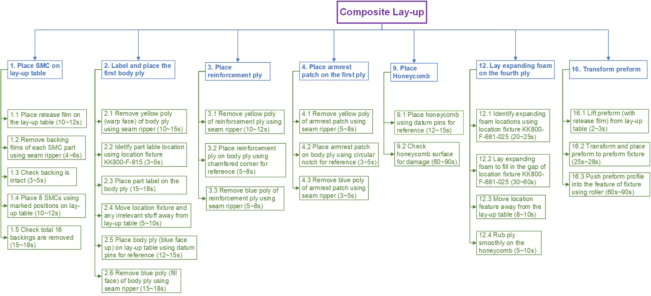
Current Task Challenges in the Composite Layup Process Based on HTA, the composite layup process was broken down into 16 sub-level steps. For each sub-level step, two to six bottom-level tasks were further decomposed. Figure 1 illustrated the HTA results in a tree diagram emphasising the sequenced workflow of the whole composite layup process. As six body plies were laminated in this layup process, the repeated steps of the second (Steps 5 & 6), third (Steps 7 & 8), fourth (Steps 10 & 11), fifth (Steps 13 & 14), and sixth (Step 15) body plies were left out in Figure 1. Following that, investigating effective robot applications started with understanding the current challenges in the composite layup process. Five main task challenges were identified by operators during the interviews and linked to specific bottom-level tasks (Table 1).
The current layup process still required the collaboration of two human operators due to the two main challenges of Both Hands Busy and Component Size & Shape, which could be a good starting point for human- robot collaboration design. Both Hands Busy occurred in tasks with tool usage, especially for the backing film removal; operators addressed the body plies using both hands while holding the seam ripper for removing the backing film. For the challenge of Component Size & Shape, the current process under analysis was placing big plies wider than arm reach on a flat surface, which requires two operators to hold the body ply together and maintain appropriate tension for locating and placing. Although not presented in the HTA results, layup on the curved surface was also an important but challenging process. Operators had to prepare and place similarly big body plies on more complex curvature shapes. Ensuring good consolidation between plies, especially into the corner, could be challenging and time-consuming even for two operators. Therefore, an initial task allocation strategy could be applying a robot to work collaboratively with a human operator to substitute the current two-operator process, for example, holding the big ply or passing the tool to the human operator. However, some specific awkward tasks, such as consolidation in curvature, would require a multifunctional and intelligent robot for more effective collaboration to improve productivity.
Sticky Material was another awkward challenge in the current layup process. The backing film removal tasks became more difficult; and worse, the sticky residue could stick to gloves or tools, as well as other components. MSD Following was required in the whole layup process. Currently, hard copies of MSD were used but not allowed to be put on the workstation.
Operators had to move to another table for MSD reference in the whole layup process. This challenge could be even harder for novice operators, leading to longer task completion times and more error-prone operations. The final challenge is Orientation for placing plies, patches, and honeycomb. Location fixtures were useful to avoid orientation issues for lamination; however, when operators pick up the big components, wrong orientation could be time- consuming to correct. These task challenges should be addressed by higher flexibility and usability from an advanced integrated robot system rather than simple substitutions of human work.
Figure 1: Key human tasks in the composite layup based on HTA.Table 1: Task challenges in the current composite layup process.
Table available in the original PDF paper.
Challenge Task No. Transcript Description ‘the material we were using this Sticky Material 1.2, 1.4, 2.1, 2.6, 3.1, 3.3, 4.1, 4.3, …, 15.1, & 15.3
‘you need to keep your hand down
morning was really sticky, so you really had to give a real good hook, because it was really sticky with that. Then you get heavy residue on your gloves when you go to lift all other stuff, it’s sticking to it’ Both Hands Busy 1.2, 1.4, 2.1, 2.6, 3.1, 3.3, …, 15.1, & 15.3
on the material. When you’re putting the seam ripper to pull the backing off, you need to hold it down with two hands’ MSD Following - (whole process) ‘tagging issue’ ‘So if you have a new operator, and they can’t really go wrong of it tells you where to put it. So it takes out that stop on if you look at this page’
Continued
Exploring Operator Requirements for Human-Robot Collaboration 53
Table 1: Continued Challenge Task No. Transcript Description
I’m talking about. So they’re wider than arms reach.’ ‘complex getting the play into complex curvatures. It’ll be similar to flat body ply on this job, but it’s just part partial layout on more complex tools than we currently use anything’ Orientation 1.4, 2.2, 2.3, …, & 9.1 (tasks related placing)
for supply orientation, particularly if it is a lot of smaller plies, and you position it so it’s location and orientation again’
Human-Centred Robot Applications in Human-Robot Collaboration To effectively address the current task challenges through human-robot collaboration, operators provided their requirements and considerations for robot applications (Table 2). To explore cognitive capabilities and technology integration issues for the robot system, these application requirements were further classified into five task types following the task taxonomy proposed by Stanton (2006). These five types of tasks - Action, Retrieval, Checking, Selecting, and Information Communication could be associated with the different stages and resources of information processing, revealing underlying cognitive components and processing (Wicken, 2002; Annett, 2004). The task taxonomy was originally applied to identify error modes for human performance evaluation (Companion and Corso, 1982). However, with the increasing development of advanced cognitive technical systems, such taxonomies demonstrated usability in modelling the cognitive functions of robot systems (Metzler and Shea, 2011). Therefore, in this study, via this task taxonomy, cognitive capabilities corresponding to robot applications were examined, which could provide insights into advanced technology integrations in human-robot collaboration.
Table 2: Expected robot applications in the composite layup process.
Table available in the original PDF paper.
Action Retrieval Checking Selection Information Communication Hold MSD reference Material stickiness Orientation Voice/gesture command Lift Work progress Material size/shape Tool Visual/audio feedback Roll Robot program Surface quality Position Vibration feedback Move Process quality Collision avoidance Clear handover Locate Safety margin Emergency stop
Action and Retrieval required a relatively low cognitive capability. In terms of Action, the robot was supposed to perform simple tasks preprogrammed by engineers to support a human operator in completing awkward tasks
during the composite layup process. These applications mainly revealed the hardware requirements of the robot development. To hold, lift, roll, and locate plies, the end effector of the robot should be dispatchable and changeable among a gripper, roller, sucker, etc., depending on different task scenarios. To move, a mobile manipulator provided usability and flexibility in navigating between workstations to collaboratively work with the human operator. Retrieval revealed requirements for task-relevant information presentation in human-robot collaboration. Digitising paper-based MSD for screen-based presentation and integrating it into the robot system enabled on- demand and instant accessibility to operating procedures without interrupted workflow. The cost of procedural training for new operators thus decreased. Advanced visualisation technologies like AR and Head-Up Display (HUD) could be integrated into the robot system for achieving Retrieval applications. Information related to the work progress and robot program settings was also desirable. The communication between human and robot differed significantly from human and human. In addition to directly communicating with the robot regarding task progress, the human operator needed readily available information presented in close proximity for monitoring and projecting the execution process of the robot. It was worth noting that the integrated display of multisource information can be a double-edged sword; except for the technical requirements and limitations, user perception and comprehension were critical factors to be considered from HIS perspective.
Checking, Selecting, and Information Communication indicated high cognitive requirements in human-robot collaboration. Checking, even for procedural check tasks, required multisensory perception to integrate different sensors, such as tactile, vision, etc. Accordingly, Checking outcomes should be effectively communicated with the human operator for correction actions. For example, being aware of material stickiness, the human operator could proactively prevent sticky residue impact by replacing gloves and cleaning tools before the next steps. Alternatively, materials with appropriate stickiness could be selected for layup tasks either by human or robot; more complex cognitive functions would be required for robot selection. Material size and shape checking by the robot equipped with vision sensors would help to improve time completion time and decrease scrapes caused by human errors. Quality checking by high-resolution cameras provided more precise and accurate detection over human vision limitations. Grounded in Checking, Selection equipped the robot system with decision-making capability. The four Checking applications in Table 2 were highly procedure-based; hence, the robot was able to automatically perform corresponding actions in MSD based on pre-programmed rules. Similarly, based on MSD, the robot would be able to select the specific tool correctly as well as position plies or patches accurately. The robot was also supposed to detect and select the correct orientation of materials. This application required the robot to automatically hold up one side of the material and correctly place it in the workstation, which was still MSD-based basic decision-making and automation. Apart from current task challenges, there were concerns caused by human-robot collaboration to be addressed. First, for potential technical failures or other unexpected situations in the workplace, it was suggested that the
Exploring Operator Requirements for Human-Robot Collaboration 55
robot could allow safety margins such as redundant systems, torque/force limits, and emergency stop mechanisms to proactively prevent unsafe events. As humans and robots worked together in close proximity, collision was another additional risk in the human-robot collaboration process. To ensure safety, the robot should timely detect and avoid potential collisions with human operators or other objects in the workplace. Basic collision avoidance could be achieved by pre-program and sensor feedback from predefined obstacles. However, advanced safety measures necessitated the integration of AI solutions. AI-based robots were able to dynamically adapt to unexpected collisions; especially for human safety, AI-driven systems would recognise and predict human behaviours to proactively respond. Furthermore, AI allowed iterative learning and optimising to accommodate changing scenarios and environments. AI-based robots enabled advanced decision- making capabilities in multiple applications beyond collision avoidance, thus serving as an optimal integration in human-robot collaboration to improve HSI effectiveness and operational performance (Doncieux et al., 2022).
Information Communication was more intricate involving control modality and system feedback. The information from Retrieval, Checking, and Selection should be well-integrated and timely communicated with human operators in an effective and efficient approach. Considering the characteristics and challenges of the composite layup process, AR could be a promising platform for augmented visualisation and HSI between robots and human operators. AR wearable technology was advantaged in its intuitive and multimodal interaction approaches, especially for hand-free voice input to address the Both Hands Busy challenge. In addition, presenting system information and MSD via the virtual screen surrounding the physical task environment was beneficial in improving situation awareness and task performance (Li et al., 2022). Furthermore, system output should be multisensory, including visual, auditory, and tactile feedback to provide clear handover between human and robot tasks; also, communication of operational processes and warnings were essential to ensure safety and productivity. Based on the task characteristics, different output modalities or multimodality of system feedback were expected.
CONCLUSION
This study provided valuable insights into the development of human- robot collaboration in the composite lay-up process for aircraft interior manufacturing. Through HTA and participatory design approaches, the application design of human-robot collaboration was investigated to address the main task challenges in the current composite layup process. The findings suggested that rather than simply substituting human work, the robot system should demonstrate higher flexibility and resilience with cognitive capabilities to improve task performance and ensure operational safety. Therefore, integrating AR and AI in human-robot collaboration could be a promising solution to enhance HSI effectiveness and layup productivity. Future work should focus on refining the HCD robot system for seamless integration of human-robot collaboration into existing layup processes.
Intangible influence factors in human-robot collaboration, such as additional personnel training requirements, operating procedures updates, robot ethics issues, etc., were also to be addressed in the near future. A structured framework based on the HCD perspective would also be further developed and implemented in wider industrial operations for advanced human-robot collaboration solutions.
ACKNOWLEDGMENT
This paper was based on the work performed in the JARVIS project sponsored by Horizon Europe (Project ID 101135708). The authors sincerely thank the layup operators for their valuable time, insight, and contribution.
REFERENCES
Ajoudani, A., Zanchettin, A. M., Ivaldi, S., Albu-Schäffer, A., Kosuge, K. and Khatib, O. (2018). Progress and prospects of the human–robot collaboration. Autonomous Robots, 42, pp. 957–975. https://doi.org/10.1007/s10514-017- 9677-2 Annett, J. (2004). Hierarchical task analysis. In Diaper, D. and Stanton, N. A. (Eds.),
The Handbook of Task Analysis for Human–Computer Interaction. Lawrence Erlbaum Associates, Mahwah, NJ, pp. 67–82. Arents, J., Abolins, V., Judvaitis, J., Vismanis, O., Oraby, A. and Ozols, K. (2021).
Human–robot collaboration trends and safety aspects: A systematic review. Journal of Sensor and Actuator Networks, 10(3), 48. https://doi.org/10.3390/ jsan10030048 Baratta, A., Cimino, A., Gnoni, M. G. and Longo, F. (2023). Human Robot Collaboration in Industry 4.0: A literature review. Procedia Computer Science, 217, pp. 1887–1895. https://doi.org/10.1016/j.procs.2022.12.389 Brovo, E. (1993). The hazards of leaving out the users, in Schuler, D. and Namioka,
A. (eds.). Participatory design: Principles and practices. CRC press, pp. 3–11. Companion, M. A. and Corso, G. M. (1982). Task taxonomies: A general review and evaluation. International Journal of Man-Machine Studies, 17(4), pp. 459–472. https://doi.org/10.1016/S0020-7373(82)80044-8 Dearden, A. and Rizvi, H. (2008). Participatory design and participatory development: A comparative review. In PDC’08: Experiences and Challenges, Participatory Design Conference, Indiana University, USA, October 1–4, 2008 Dirk, H. J. L., Ward, C. and Potter, K. D. (2012). The engineering aspects
of automated prepreg layup: History, present and future. Composites Part B: Engineering, 43(3), pp. 997–1009. https://doi.org/10.1016/ j.compositesb.2011.12.003 Doncieux, S., Chatila, R., Straube, S. and Kirchner, F. (2022). Human-centered AI and robotics. AI Perspectives, 4(1), pp. 1–14. https://doi.org/10.1186/s42467- 021-00014-x Elkington, M., Bloom, D., Ward, C., Chatzimichali, A. and Potter, K. (2015).
Hand layup: Understanding the manual process. Advanced Manufacturing: Polymer and Composites Science, 1(3), pp. 138–151. https://doi.org/10.1080/ 20550340.2015.1114801
Exploring Operator Requirements for Human-Robot Collaboration 57
Hansen, N. B., Dindler, C., Halskov, K., Iversen, O. S., Bossen, C., Basballe, D. A. and Schouten, B., 2019. How participatory design works: Mechanisms and effects. In Proceedings of the 31st Australian Conference on Human-Computer-Interaction, pp. 30–41. https://doi.org/10.1145/3369457.3369460. Kermenov, R., Foix, S., Borràs, J., Castorani, V., Longhi, S. and Bonci, A. (2025).
Automating the hand layup process: On the removal of protective films with collaborative robots. Robotics and Computer-Integrated Manufacturing, 93, 102899. https://doi.org/10.1016/j.rcim.2024.102899 Li, W. C., Zhang, J., Court, S., Kearney, P. and Braithwaite, G. (2022). The influence of augmented reality interaction design on Pilot’s perceived workload and situation awareness. International Journal of Industrial Ergonomics, 92, 103382. https://doi.org/10.1016/j.ergon.2022.103382 Lu, L., Xie, Z., Wang, H., Li, L. and Xu, X. (2022). Mental stress and safety
awareness during human-robot collaboration-Review. Applied Ergonomics, 105, 103832. https://doi.org/10.1016/j.apergo.2022.103832 Metzler, T. and Shea, K., 2011. Taxonomy of cognitive functions. In: DS 68– 7: Proceedings of the 18th International Conference on Engineering Design (ICED 11), Impacting Society through Engineering Design, Vol. 7: Human Behaviour in Design, Lyngby/Copenhagen, Denmark, 15–19 August 2011, pp. 330–341. Pickard, L. R. and Elkington, M. (2024). Laminator trust in human-robot collaboration for manufacturing fibre-reinforced composites. IET Collaborative Intelligent Manufacturing, 6(4), 12123. https://doi.org/10.1049/cim2.12123 Robla-Gómez, S., Becerra, V. M., Llata, J. R., Gonzalez-Sarabia, E., Torre-Ferrero,
C. and Perez-Oria, J. (2017). Working together: A review on safe human-robot collaboration in industrial environments. IEEE Access, 5, pp. 26754–26773. https://doi.org/10.1109/ACCESS.2017.2773127 Sarh, B., Buttrick, J., Munk, C. and Bossi, R., 2009. Aircraft manufacturing and assembly. In: S. Nof, ed., Springer Handbook of Automation. Springer, Berlin, Heidelberg, pp. 893–910. https://doi.org/10.1007/978-3-540-78831-7_51. Sheridan, T. B. (2016). Human–robot interaction: Status and challenges. Human
Factors, 58(4), pp. 525–532. https://doi.org/10.1177/0018720816644364 Stanton, N. A. (2006). Hierarchical task analysis: Developments, applications, and extensions. Applied Ergonomics, 37(1), pp. 55–79. https://doi.org/10.1016/ j.apergo.2005.06.003 Wickens, C. D. (2002). Multiple resources and performance prediction. Theoretical
Issues in Ergonomics Science, 3(2), pp. 159–177. https://doi.org/10.1080/ 14639220210123806
LISTED IN THE AHFE DIGITAL BOOKSTORE CATALOGUE
Explore the complete digital volume
Human Aspects of Advanced Manufacturing, Production Management and Process Control
Read this individual research paper free through the original publisher, or explore the full digital proceedings book.
ISBN 978-1-964867-60-1
Explore this ISBN in the AHFE Bookstore ↗Listed in the July 2026 bookstore catalogue; search by ISBN to confirm current availability · Digital book purchase optional