Indu Karki, Promila Sharma, S.K. Rastogi, Pratibha Joshi (2019). Common and Chronic Problems Among Nurses Working in Healthcare Units of Uttrakhand State of India. In: Advances in Safety Management and Human Factors. AHFE Open Access, vol. 5. https://doi.org/10.54941/ahfe100151
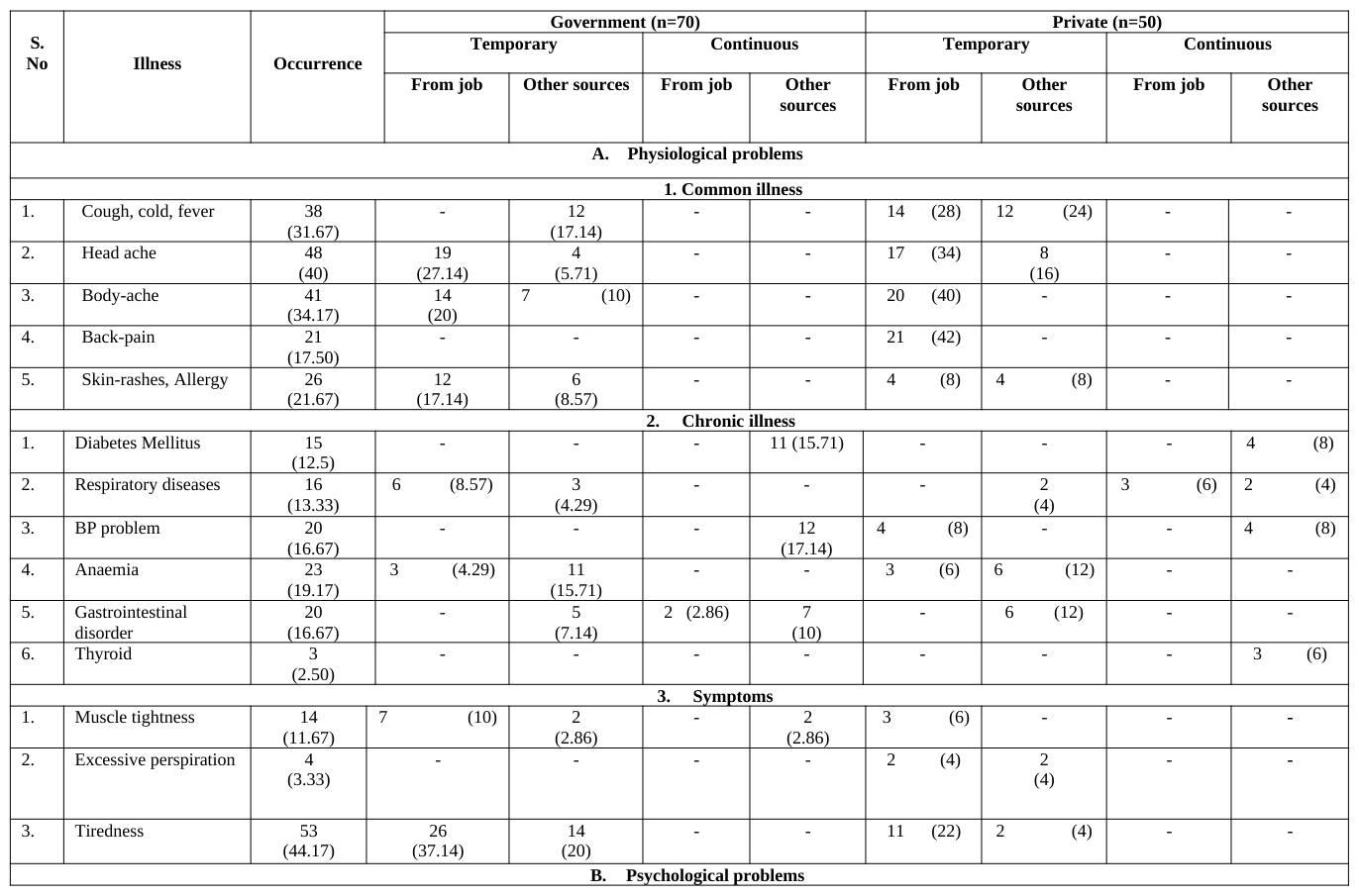
Nursing, the profession of caring for the sick and the convalescent, the disabled and the helpless, is one of the noblest professions throughout the world. From the general ward to the operation theatre in the hospital, nursing is the most important component of patient care. The process of restoring patients to normal health depends as much, if not more, on nurses as on doctors or surgeons. In fact, the availability of effective nursing services is an indicator of the health of a country's medicare system. Stress in the nursing profession is an ongoing worldwide problem. Of all health care professionals, nurses have been found to have especially high levels of stress. A study among a large sample of Swedish nurses revealed that more than 80 per cent of the nurses reported high or very high job strain. Job stress in the nursing profession has been associated with decreased job satisfaction, increased psychological and physical complaints and absenteeism. Work conditions that have been associated with stress outcomes are inappropriate levels of formalization of work procedures (too much or too little formalization of work procedures), lack of adequate communication within the organization, and organizational politic. On the whole, it was observed that 40 per cent of nurses were suffering from headache and few nurses i.e. 17.5 per cent having back pain. The individual observation of government nurses (27.14 per cent) reported headache from the job which were temporary in nature. However, skin rashes and allergy was reported by 17.14 per cent. Further, 17.14 per cent government nurses suffered from temporary cough and cold due to other sources then their work. Occurrence of common illness among private nurses reveals that maximum of 42 per cent nurses were suffering from temporary back pain from job and only 8 per cent reported skin rashes and allergy which was due to their job. Temporary cough, cold and fever were reported by 24 per cent of private nurses from other sources. Most prevalent chronic illness was anemia among 19.17 per cent nurses. A very few of 1.67 per cent of nurses were having thyroid problem. The prevalence of chronic illness among government nurses indicates that 8.57 per cent nurses suffering from temporary respiratory disease. Anemia due to other sources (apart from job) which was temporary in nature was reported by 15.17 per cent nurses. Continuous problem of blood pressure was prevalent among 17.14 per cent government nurses which were originated due to long hours of job. Again a few proportion of government nurses (15.71 per cent) reported problem of diabetes mellitus. In case of private nurses, each of 12 percent nurses reported problems of anemia and gastrointestinal disorder. Only, 4 per cent nurses were suffered from temporary respiratory diseases. However, 8 per cent nurses reported continuous problem of diabetes mellitus and blood pressure.
Nursing, the profession of caring for the sick and the convalescent, the disabled and the helpless, is one of the noblest professions throughout the world. From the general ward to the operation theatre in the hospital, nursing is the most important component of patient care. The process of restoring patients to normal health depends as much, if not more, on nurses as on doctors or surgeons. In fact, the availability of effective nursing services is an indicator of the health of a country's medicare system (Abdalkader and Hayajneh, 2008 ; Abraham et al., 2006).
Stress in the nursing profession is an ongoing worldwide problem. Of all health care professionals, nurses have been found to have especially high levels of stress. A study among a large sample of Swedish nurses revealed that more than 80 per cent of the nurses reported high or very high job strain. Job stress in the nursing profession has been associated with decreased job satisfaction, increased psychological and physical complaints and absenteeism. Work conditions that have been associated with stress outcomes are inappropriate levels of formalization of work procedures (too much or too little formalization of work procedures), lack of adequate communication within the organization, and organizational politic. Physiological problems show the medical history of nurses since last one year. It was crucial to diagnose the illness/sickness among nurses as it has an impact on health status of themselves as well as patients. It also affects the sickness absenteeism. Frustration and stress is an important psychological concept that can affect health, well-being and job performance in negative dimensions. Stress according to Arnold et al (1995), is a word derived from Latin word “Stingere” meaning to draw tight. It is regarded as a force that pushes a physical or psychological factor beyond its range of stability, producing a strain within the individual. Stress is the process by which environmental events (stressors or challenges) threaten us, how these threats are interpreted, and how they make us feel. According to Selye (1976), stress is a state within the organism characterized by general adaptation syndrome. In other word, it is the nonspecific response of the body to the demand made upon it. It suggests excessive demands that produce disturbance of physiological, sociological and psychological systems. Stress may be acute or chronic in nature (Akinboye et al., 2002). It exists in different forms. It may be psychological, emotional, social, occupation or job related. Stress experienced by workers at work is called job stress. It may be due to a number of factors such as poor working condition, excessive work load, shift work, long hours of work, role ambiguity, role conflicts, poor relationships, with the boss, colleagues or subordinate officers, risk and danger, to mention a few. Certain responses indicate the presence of job stress in an individual, or group. It may manifest by the presence of headache, sleep disturbances, difficulty in concentration, short temper, upset stomach, job dissatisfaction and low morale (NIOSH, 1998). Other manifestations or indications of presence of job stress include muscular tensions and ache, tightness in the chest, high blood pressure, heart problems, snapping and arguing with others, aggressive or hostile behaviour, blaming others or administration for tension, absenteeism and high staff on job turnover.
Common illness On the whole, it was observed that 40 per cent of nurses were suffering from headache and few nurses i.e. 17.5 per cent having back pain. The individual observation of government nurses (27.14 per cent) reported headache from the job which were temporary in nature. However, skin rashes and allergy was reported by 17.14 per cent. Further, 17.14 per cent government nurses suffered from temporary cough and cold due to other sources then their work. Occurrence of common illness among private nurses reveals that maximum of 42 per cent nurses were suffering from temporary back pain from job and only 8 per cent reported skin rashes and allergy which was due to their job. Temporary cough, cold and fever were reported by 24 per cent of private nurses from other sources(Table 1).
Chronic illness On the whole, most prevalent chronic illness was anemia among 19.17 per cent nurses. A very few of 1.67 per cent of nurses were having thyroid problem. The prevalence of chronic illness among government nurses as shown in indicates that 8.57 per cent nurses suffering from temporary respiratory disease. Anemia due to other sources (apart from job) which was temporary in nature was reported by 15.17 per cent nurses. Continuous problem of blood pressure was prevalent among 17.14 per cent government nurses which were originated due to long hours of job. Again a few proportion of government nurses (15.71 per cent) reported problem of diabetes mellitus.
In case of private nurses, each of 12 percent nurses reported problems of anemia and gastrointestinal disorder. Only, 4 per cent nurses were suffered from temporary respiratory diseases. However, 8 per cent nurses reported continuous problem of diabetes mellitus and blood pressure.
Proceedings of the 5th International Conference on Applied Human Factors and Ergonomics AHFE 2014, Kraków, Poland 19-23 July 2014 Edited by T. Ahram, W. Karwowski and T. Marek
Table 1: Medical history of nurses (during last one year)
Proceedings of the 5th International Conference on Applied Human Factors and Ergonomics AHFE 2014, Kraków, Poland 19-23 July 2014 Edited by T. Ahram, W. Karwowski and T. Marek
Proceedings of the 5th International Conference on Applied Human Factors and Ergonomics AHFE 2014, Kraków, Poland 19-23 July 2014 Edited by T. Ahram, W. Karwowski and T. Marek
Figures in parentheses indicate the percentage values
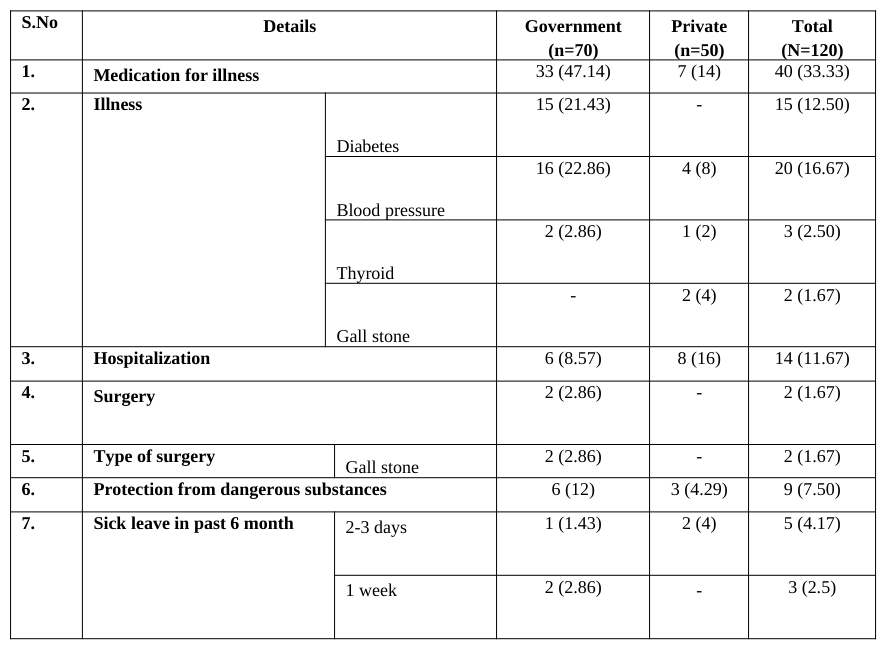
Table 2: Details about ailments of the nurses S.No Details Government Private
Proceedings of the 5th International Conference on Applied Human Factors and Ergonomics AHFE 2014, Kraków, Poland 19-23 July 2014 Edited by T. Ahram, W. Karwowski and T. Marek Symptoms
As far as symptoms of illness were concerned, most of the government nurses (44.17 per cent) felt tiredness and 22 per cent nurses who working in private hospitals. On the whole, muscle tightness was reported by 11.67 per cent of nurses and in it 10 per cent nurses from government hospitals were suffering temporarily from muscle tightness due to job and only 6 per cent nurses from private hospitals suffered temporarily muscle tightness.
Psychological problem Nursing job allows a lot of psychological problems like depression, arrogance, anger, emotional problem etc. Among all the psychological problems, fatigue from patient care was reported by maximum of the nurses (41.67 per cent) followed by 37.5 per cent nurses who reported postural fatigue, work related stress (29.17 per cent), low motivation (26.67 per cent), lack of energy (24.17 per cent), sleep deprivation (23.33 per cent) and fear of crowd (23.33 per cent). The problems which were less reported by nurses were poor communication (10.83 per cent) and frequent absenteeism. As data was analyzed for particular category, it was inferred that among nurses from government hospitals 38.57 per cent felt fatigue from patient care and postural fatigue (37.14 per cent) temporarily from job. It was further reported few nurses were feeling temporary short term memory loss due to job 7.14 per cent and from other sources (10 per cent). Again poor communication problem was perceived by 7.14 percent (other sources apart from job).
As far as nurses from private hospitals were concerned, it was found that 18 per cent each reported increased negativity and irritation, and greater physical demand which were temporarily in nature and because of work performance. Very few private nurses reported temporarily depression (4 per cent), inability to concentrate (4 per cent), poor communication (2 per cent) due to their long hour of job. Whereas, psychological problems originated temporarily from sources other than job were anger outburst, frequent bad mood, inability to concentrate (10 per cent in each case), memory loss (2 per cent) and arrogance in 2 per cent of nurses.
Detail about ailment of nurses It is very obvious from the Table 2 that a handsome proportion of nurses i.e. 10.83 per cent were receiving medication for illness and out of which 11.43 per cent from government hospitals and 10 per cent from private hospitals. The types of illness as reported by nurses were blood pressure (5 per cent), thyroid (2.5 per cent), gallstone (1.67 per cent) and diabetes (1.67 per cent). When analyzing the data in particular category, it was found that in government hospitals a commendable proportion of nurses were suffering from illness like blood pressure (5.71 per cent) followed by thyroid (2.86 per cent) and diabetes (2.86 per cent), whereas in case of private hospitals, nursing were suffering from blood pressure (4 per cent) and gallstone (4 per cent), which is important factor for the physical fitness. It was observed that maximum (18.33 per cent) nurses on the whole, were performing daily exercise and 5.83 per cent nurses performed exercise twice a week. Particularly with regard to government nurses 18.57 per cent performing exercise daily basis and approximately 18 per cent from private hospitals performed exercise daily. However, 2.86 per cent from government hospitals and 10 per cent nurses from private hospitals performed exercise twice a week.
The detail about nurses was related with sick leaves taken by nurses during past 6 months and it was observed that 4.17 per cent nurses on the whole had taken, day sick leave followed by 2.5 per cent nurses with 1 week leave. In particular 2.86 per cent nurses from government hospitals and 4 per cent from private hospitals took sick leaves for week and days respectively.
Occupation hazards, accidents, risks / injuries at work place Mechanical hazards
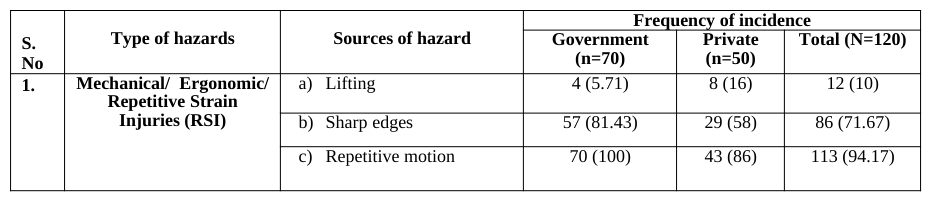
The results regarding mechanical hazards as experienced by nurses (on an average) reveals that majority of the nurses (94.17 per cent) were encountering with repetitive motion and awkward posture during work schedule
Proceedings of the 5th International Conference on Applied Human Factors and Ergonomics AHFE 2014, Kraków, Poland 19-23 July 2014 Edited by T. Ahram, W. Karwowski and T. Marek
followed by 71.67 per cent and 67.5 per cent nurses who reported injuries with sharp edges and accidents with manual handling, respectively. As far as data with regard to nurses from government hospitals was concerned, it was found that all the nurses were encountered with reported repetitive motion, and awkward posture followed by manual handling (84.29 per cent) whereas, very few (5.7 per cent) were committed injuries with lifting motion.
In case of private hospitals further repetitive motion and awkward posture were experienced by majority of nurses (86 per cent). A good proportion of nurses 16 per cent also reported accidents with lifting equipments manually.
Biological hazards Hazards may occur through contact with biological waste during pathological waste etc which may be infectious to the nurses who have to perform these tests. Biological hazards like allergy was reported by maximum of the nurses (54.17 per cent) followed by 34.17 per cent who encountered with skin infections. When data was analyzed with regard to government nurses particularly again allergy was the most common biological hazards among nurses followed by 22.86 per cent nurses having skin rashes. In case of private nurses, 58 per cent reported skin infections and allergy followed by a commendable proportion i.e. 24 per cent who were suffering from skin rashes.
Chemical hazards Chemical hazards may happen while using different chemicals (acids or alkalis), cleaning compounds, exhaustion of waste anesthetic gases through –ray machines, ultrasound machines etc. It can be envisaged from Table 3 that mostly nurses (40.83 per cent) got injured with solvents and dust allergy followed by 33.33 per cent who were having infections with cleaning compounds. It was further in relation to government nurses found that 38.57 per cent had injury through contact with solvents and cleaning compounds whereas, in case of private nurses 64 per cent felt allergy with waste anesthetic gases followed by dust allergy (58 per cent).
Physical hazards Physical hazards are a combination of hazards from noise, radiation, heat and cold. It is evident from the Table 4.15 that majority of nurses i.e. 60 per cent felt noise hazards followed by radiation, heat and cold (30.83 per cent each). Data pertaining to government nurses reveals that maximum of nurses (42.86 per cent) reported hazards with noise and very few were in problem with radiation hazards (4.29 per cent). In case of nurses from private hospitals, 84 per cent had physical hazards with noise followed by radiation i.e. 68 per cent.
Psycho-social hazards Hazards which increase the psychosocial cost of work of an individual are termed as psycho-social hazards. The data concludes that on the whole majority of the nurses (95 per cent and 94.17 per cent each) feel fatigue from shift work and over work followed by job pressure (89.17 per cent). Particularly with regard to government nurses, majority (91.43 per cent) feel fatigue from shift work, followed by 90 per cent each who reported problems related with over work and job pressure. In case of private nurses, fatigue from shift work and over work was felt by all the nurses followed by 88 per cent each with problems of job pressure and long working hours.
Table 3. Occupational hazards, accidents, risks, injuries at workplace (since last 1 year)
Proceedings of the 5th International Conference on Applied Human Factors and Ergonomics AHFE 2014, Kraków, Poland 19-23 July 2014 Edited by T. Ahram, W. Karwowski and T. Marek d) Awkward posture 70 (100) 43 (86) 113 (94.17)
CONCLUSIONS
The need of professional, skilled nurses will increase as the population ages while the shortage of nurses is the reality already. Nurses are stressed further by inconvenient working hours like extensive working hours, weekend work, evening and night-time work, insufficient breaks during working shift, and even having to take on two jobs in order to make reasonable pay. Stress experienced in the field of nursing is on the increase even though work-related strain in other fields is declining. The growing conflict between the demand and the resources available creates an increasing amount of overload
REFERENCES
Abdalkader, Hayajneh (2008), “Effect of night shift on nurses working in intensive care units at jordan university hospital”, European Journal of Scientific Research, 23(1):70-86. e-reference http://www.eurojournals.com/ejsr.htm (Retrieved on 1/Dec/2009) Abraham, I. Siebens, K. Darras, E., Dierckx, B. (2006), “Work environment and workforce problems: a cross-sectional
questionnaire survey of hospital nurses in Belgium”, International Journal of Nursing Studies, 43(6): 745-54. Akinboye, P.W. Stubbs, D. A. Randle, P., Nicholson, A. (2002), “Limitations in the applications of materials handling guidelines”, Ergonomics, 35(9), 955-964. Arnold, N. N., Brooks, S. M., Bernard, T. E., Nelson, A. (1995), “The physical workload of nursing personnel: association with
musculoskeletal discomfort”, International Journal of Nursing Studies, 41, 859-867. Selye, H. (1976). “The Stress of Life”. New York: McGraw-Hill.
Read this individual research paper free through the original publisher, or explore the full digital proceedings book.
ISBN 978-1-4951-2100-5
Explore this ISBN in the AHFE Bookstore ↗Listed in the July 2026 bookstore catalogue; search by ISBN to confirm current availability · Digital book purchase optional