Hema Bhatt, Promila Sharma (2019). Occupational Hazards Faced by the Agricultural Hill Population. In: Advances in Safety Management and Human Factors. AHFE Open Access, vol. 5. https://doi.org/10.54941/ahfe100173
Hill terrains have always posed enormous challenges for human habitation. India, being a vast subcontinent, has an extensive area of hilly terrain. This paper highlights the challenges faced and the need of improving the occupational safety of hill population. For the present investigation data was collected purposively from Bageshwar and Almora districts of the Uttarakhand state in India. t was reported that hill women performed various tasks including on farm activities like harvesting, weeding, land preparation, transplanting, sowing. The main off farm activities performed by them include making firewood, making fodder, carrying firewood, carrying fodder, carrying milk/food. The domestic activities performed by them include cooking, washing, mopping, milking, collecting dung. It was found that almost 96 per cent of these tasks were found to be performed by women only while men did just the 4 per cent of these tasks. While performing these tasks the hazards reported by the respondents were attack of wild animal, slip/trip/falls, fog, flood, temperature extremities, torrential rain, earthquake, thunderstorm, snowfall, landslide, road accidents, and forest fire.
India, being a vast subcontinent, has an extensive area of hilly terrain (Sundaram and Palanidurai, 1990). Hill terrains have always posed enormous challenges for human habitation. The hill regions are less developed in terms of public health facilities, employment opportunities, infrastructure, etc. The hill population lives in the villages and depends mainly on agriculture and other related occupations for their livelihood. Due to subsistence livelihood, migration and a remittance economy operate in the hill districts. While men predominate in urban areas, the interior rural districts are amongst the few in all of India that contain significant female majorities (Rawat, 2004). As men migrate in search of better-paid work, apart from the domestic chores of cooking, fetching fuel, fodder and water collection; looking after children, the tasks of caring for livestock and agricultural work fall on women’s shoulder.
So women play a significant and crucial role in agricultural activities in these interior rural hill regions too. She does the most tedious and back-breaking tasks in agriculture, animal husbandry and home. She carries a number of operations in agriculture which is usually repetitive and time consuming. Besides they also have many roles and responsibilities at home which puts a heavy pressure on their time and energy. The activities performed by women are often not counted as economic activities or are undervalued, and are typically excluded from analysis. The basic nature of work performed by women in rural areas falls under nonmarket economic activities. They work very hard, but live a poor life due to number of constraints, such as poor village community facilities and resources. The women who play a pivotal role in all types of household, farm and allied activities are deprived from most of the privileges of life. Their work is not recognized in any statistical terms.
STUDY SETTING Uttarakhand a state with 53483 square km area. This state is primarily a mountainous state comprised of 13 districts. Of these 13 districts, four districts have large areas in the plains, whereas the other nine districts (Alomra, Bageshwar, Pithoragarh, Chamoli, Tehri Garhwal, Pauri Garhwal, Uttarkashi, Rudraprayag, Champawat) comprise the hill region of the state. Of the total state area 92.57% is hilly region (Kaushik, 2004) and almost 70 per cent of the population lives in villages. The villages at hills are small and population is scattered over the hill slopes. Physical access is difficult, soils are poor and shallow, agricultural productivity is low (Ghosh and Dhyani 2005), animal husbandry is of poor quality (Krishna 2002), there is a lack of physical and social infrastructure (roads, water, electricity, telecommunication, schools, and hospitals), and forest (quality and quantity) and water resources are increasingly being depleted.
METHODOLOGY
Figure 1 Uttarakhand State in India
RESULT AND DISCUSSION
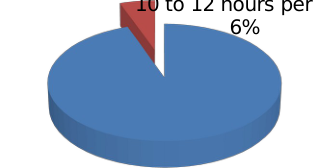
Time Spent The study found that the heavy work and adverse working conditions of women in hills is gruelling. The majority of respondents reported the never ending work starts early in the morning by about 5 am and stops only by about 10 pm managing all the household, farm, livestock, and other productive activities. Figure 1 depicts the time spent pattern of respondents per day. It was found the most of the respondents worked 13-15 hours per day i.e 94.5 per cent, followed by few (05.5 per cent)10-12 hours per day.
Time Spent 10 to 12 hours per day 6%
13 to 15 hours per day 95%
Figure 2: Time spent by the women per day on work
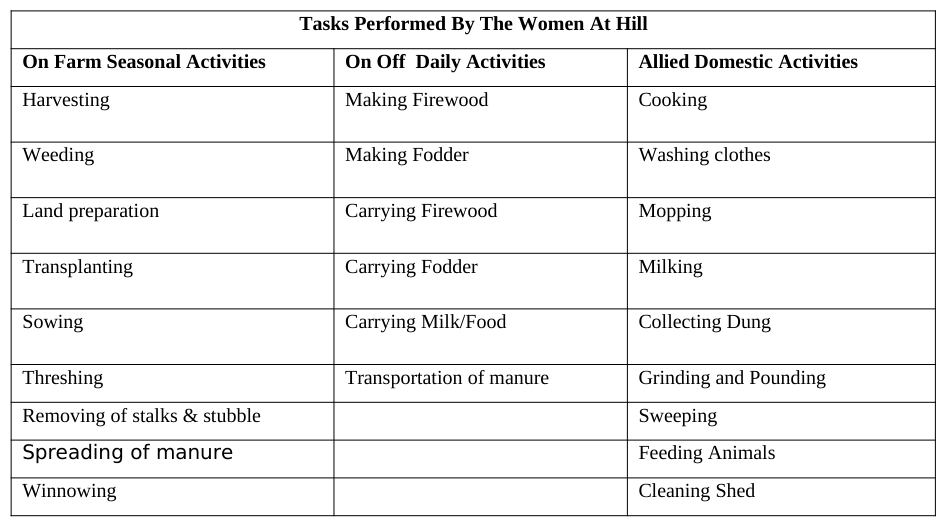
Types of tasks performed It was found in the investigation that the hill women daily lives include heavy tasks of cultivation, fuel and fodder collection by trudging along the mountainous roads and hilly slopes for as much as 10 to 15 kms a day, in search of necessities. Information was gathered regarding the type of activities in which the hill women are engaged. It was found that hill women are involved in three basic activities which are done at on farm, off farm and inside the house. On farm activities included harvesting (100%), weeding (100%), ploughing (26%), land preparation (96%), transplanting(100%), threshing (100%) and winnowing (100%). It was found that all the hill women are involved in these load carriage off farm activities including collecting firewood, collecting fodder, carrying firewood, carrying fodder and carrying milk/food.
Table 1: Type of tasks performed by the women at hills Tasks Performed By The Women At Hill
Type of hazards faced It was reported by the respondents that the various hazards faced by them includes attack of wild animal, slip/trip/falls, fog, flood, temperature extremities, torrential rain, earthquake, thunderstorm, snowfall, landslide, road accidents, and forest fire. Figure 3 depicts that the top five hazard reported by respondents included temperature extremities, slip, trip and falls followed by torrential rain, road accidents and attack of wild animal.
84.44
75
62.22 58.89 57.22 57.22 54.44
45.56 44.44 41.11
30 28.33
19.44
10.56
Figure 3: Top hazards faced by the respondents
Figure available in the original PDF paper.
CONCLUSION
Terrain and degraded environment makes women’s daily routine of collecting fodder, fuel and water a time consuming and daunting task They work very hard, but live a poor life due to number of constraints, such as poor village community facilities and resources. They are deprived from the right of decision-making in important household affairs, adequate food, proper education and recognition in household and social affairs. The women who play a pivotal role in all types of household, farm and allied activities are deprived from most of the privileges of life. Their work is not recognized in any statistical terms.
REFERENCES: Rawat R, 2004.`Chipko’s Quiet Legacy: Forest Rights, Women’s Empowerment,Peoples’ Institutions, and New Urban Struggles
in Uttarakhand, India’ York University, Ontario, Canada (mimeo). Sundaram, KV, and Palanidurai KV. "Xi Development Of Hill Areas In India—Some Lessons For Strategy Formulation And Planning." Environmental Geography 11 (1990): 144. Susheela Kaushik, 2004. A Situational Analysis Of Women And Girls In Uttaranchal , By Prof. National Commission For
Women New Delhi.
LISTED IN THE AHFE DIGITAL BOOKSTORE CATALOGUE
Explore the complete digital volume
Advances in Safety Management and Human Factors
Read this individual research paper free through the original publisher, or explore the full digital proceedings book.
ISBN 978-1-4951-2100-5
Explore this ISBN in the AHFE Bookstore ↗Listed in the July 2026 bookstore catalogue; search by ISBN to confirm current availability · Digital book purchase optional