Rakhi Saxena, Promila Sharma, Pratibha Joshi, Kavita Narwal (2020). Environmental Problems Among Rural Women and Management of Occupational Health and Safety. In: Advances in Social and Organizational Factors. AHFE Open Access, vol. 9. https://doi.org/10.54941/ahfe100341
Women have long occupied a central place in agriculture production in developing countries, ensuring food security for their household and communities, but this role is not performed without adverse consequences for health. The major consequences include health risks owing due to women’s use and exposure to hazardous agro-chemicals/pesticides, farm-related accidents or physical injuries and exposure to hazardous solid fuel in the interior house. Developing countries like India have many polluting sources that produce high level of human exposure. Indoor air pollution in developing countries from biomass smoke is considered to be a significant source of public health hazard, particularly to the poor and vulnerable women and children. Women and children face the greatest exposure to the harmful health effects of pollution. Women traditionally carry out most household chores and spend a considerable part of their time indoors. The pollution also affects young children under their mothers’ care. Another source of high risk of ill health in rural India is exposure to spray of pesticides in the fields. In India, 70% of the population is farmers and they are the target group to be affected by the hazards of pesticide applications. In India, 70% of the population is farmers and they are the target group to be affected by the hazards of pesticide applications. Moreover, in developing countries the users are rather careless in handling pesticides. The high risk groups exposed to pesticides include the production workers, formulators, sprayers, mixers, loaders and agricultural farm workers. During manufacture and formulation, the possibility of hazards may be more because the processes involved are not risk free. In India, 70% of the population is farmers and they are the target group to be affected by the hazards of pesticide applications. Moreover, in developing countries the users are rather careless in handling pesticides. All pesticides in a given chemical group generally affect the human body in the same way; however, severity of the effects varies depending on the formulation, concentration, toxicity and route of exposure of the pesticide. Descriptive cum experimental research design was chosen for the study. The study was carried out in two districts Udham Singh Nagar and Nainital. Purposive cum Random sampling design was used to select the study area. Total sample size was comprised of 240 women from rural areas of Uttarakhand state in India. Experimental data was recorded through various scientific instruments and descriptive data was collected through interview schedule, awareness scales, and observation sheet. On the basis of anthropometric measurements the 5th, 50th and 95th percentile was calculated for the designing of personal protective equipments (gloves and coverall) through CAD for reducing the hazards of pesticide spraying and designing of chimney for minimizing the hazards of smoke originated by traditional cooking source. It was found from investigation that indoor air pollution and pesticide hazards were almost same for the families of hill region but sufferings related to indoor air pollution and pesticide hazards were more in the plain region as compare to hill region. The healthy and natural environmental conditions in the hill region and less dense housing of this region were the cause of less suffering from cooking smoke and pesticide spraying conditions. Taking the above fact into account the chances of diseases, risks and hazards were less for families of hill region.
Women have long occupied a central place in agriculture production in developing countries, ensuring food security for their household and communities, but this role is not performed without adverse consequences for health. The major consequences include health risks owing due to women’s use and exposure to hazardous agrochemicals/pesticides, farm-related accidents or physical injuries and exposure to hazardous solid fuel in the interior house. Developing countries like India have many polluting sources that produce high level of human exposure. Indoor air pollution in developing countries from biomass smoke is considered to be a significant source of public health hazard, particularly to the poor and vulnerable women and children. Women and children face the greatest exposure to the harmful health effects of pollution. Women traditionally carry out most household chores and spend a considerable part of their time indoors. The pollution also affects young children under their mothers’ care. Another source of high risk of ill health in rural India is exposure to spray of pesticides in the fields. In India, 70% of the population is farmers and they are the target group to be affected by the hazards of pesticide applications. In India, 70% of the population is farmers and they are the target group to be affected by the hazards of pesticide applications. Moreover, in developing countries the users are rather careless in handling pesticides. The high risk groups exposed to pesticides include the production workers, formulators, sprayers, mixers, loaders and agricultural farm workers. Mayer and Korhonen (1999) found in their investigation that the lack of scientific and technical knowledge in certain complex fields, together with schedule constraints, have led to adopt others standards insufficiently validated tests, relying sometimes on an empirical approach. Brantingham et al. (1970) reported that the primary occupational symptoms and diseases related to prolonged constrained standing are pain, discomfort, fatigue, swelling of the lower extremities and foot, due to blood pooling and varicosities of the lower extremities. There is pronounced effect of posture of an individual on the energy expenditure (Gross and Crandall, 1973). Agriculture is the central to developing countries and rural women contribute substantial share to labor that goes into this sector as food producer in household sector and agriculture workers in agriculture sector. Developing countries have been the focus for several investigations of health outcomes in household-generated biomass smoke exposures, primarily from the use of solid fuels for cooking. It cook with solids fuels, approximately 95% of which consists of wood fuel or burning of agricultural residues ( Smith et al.,2004). Incomplete combustion and poor ventilation in biomass burning devices used for cooking or heating can result in extremely high PM exposures in these households( Naeher et al., 2007; Smith et al., 2000). In many homes in developing countries, however, a major source of exposure to indoor air pollutants is cooking smoke, when people rely on unprocessed biomass fuels such as wood, crop residues, and dung cakes for cooking and space heating. According to some estimates, more than half of the world’s population still relies on unprocessed biomass fuels for cooking and heating( Bruce et al.,2000).
Chaffin (1977) reported that the muscle fatigue starts with a feeling of discomfort, which is successively increased to a dull, burning pain that at least makes all further muscle activity impossible. A decreased muscle force characterizes the localized muscle fatigue on one hand and by discomfort pain on the other hand. Chaffin (1977) also reported the character of localized muscle fatigue as given below: Grade I: A study of tightening or slight cramp in the muscle.
Grade II: A sustained feeling of cramp, with a deep, intermittent burning pain.
Grade III: A continuous burning pain with a wish to cease the muscle work.
Grade IV: Impossibility to go on with the muscle activity.
Grandjean (1988) pointed out that static load is associated with a high risk of arthritis of joints, inflammation of the tendon and symptoms of chronic degeneration of the joints, painful muscle spasms and inter-vertebral disc troubles. Further Aaras and West Gaurd (1988), Keyserling et al. (1988), Ryan (1989) and Burdorf et al. (1991) supported the above said facts by stating that poor body posture was the major cause of musculoskeletal disorders. A good working posture reduces the physiological cost of work and fatigue to the minimum, whereas static muscular efforts and incorrect postures for long periods during performance of work can damage the inter-vertebral discs (Varghese et al., 1989). Genaidy and Karwowski (1993) investigated the discomfort associated with postures at joint, which deviated from the natural position. It was revealed that in standing position, lumber extension was perceived to be more uncomfortable than lateral lumber bending or rotation. In both standing and sitting posture, flexion of the back was least uncomfortable of the extreme postures. Boocock et al. (1994) reported that tasks involving lumber extended postures (overhead work) are relatively common, may incure moderately high compressive loads on the lumber spine and are a potential source of occupationally related back pain. It has been demonstrated that simple ergonomic intervention at the work place can result in a reduction of lumber extension required for overhead work. The values of such intervention, in terms of reducing load, remains to be determined.
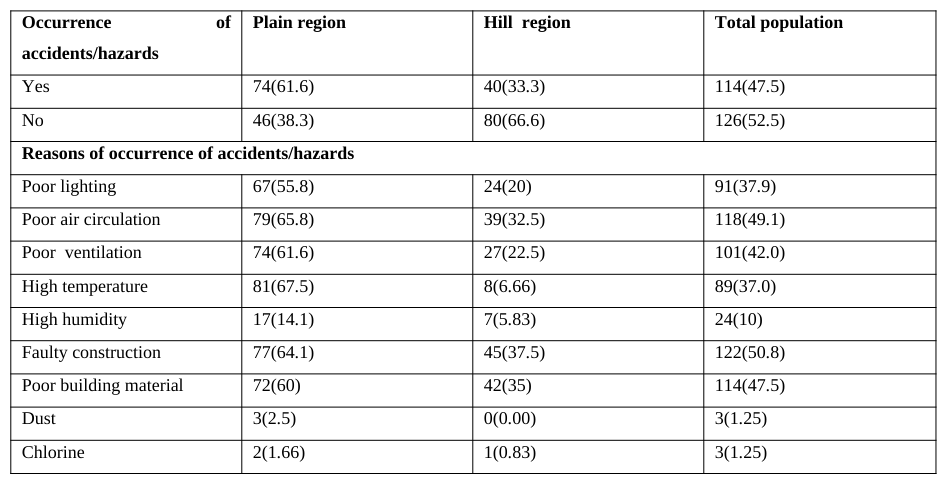
Occurrence of accidents/ hazards due to indoor air pollution and pesticides spraying The women facing following problems in the hill areas while occupational safety should be a major concern. The occurrence and magnitude of hazards presented in table 1, Which shows difference in hill and plain region.
Table 1: Occurrence of accidents/ hazards due to indoor air pollution and pesticides spraying N=240
Overall analysis of the study reported that more than 45 percent sample women were experiencing hazards in house. It was reported that in plain region 50.8 percent sample women were feeling that hazards or accidents occurred due to faulty construction and high humidity and 1.25 per cent were thinking that dust and chlorine created farm hazards and accidents.
When comparison was made of families of both regions, it was found that in plain region 61 percent sample women were experiencing hazards or accidents in house because of high temperature(67,5 percent) and 1.66 percent due to chlorine respectively. It was observed that in hill region 38.3 percent were experiencing hazards or accidents. About 37.5 percent were feeling that hazards or accidents occurred due to faulty construction and 0.83 percent were thinking that dust created farm hazards and accidents.
As data depicted earlier, people were having small and poorly ventilated house, so there was high chances of hazards or accidents in the house.
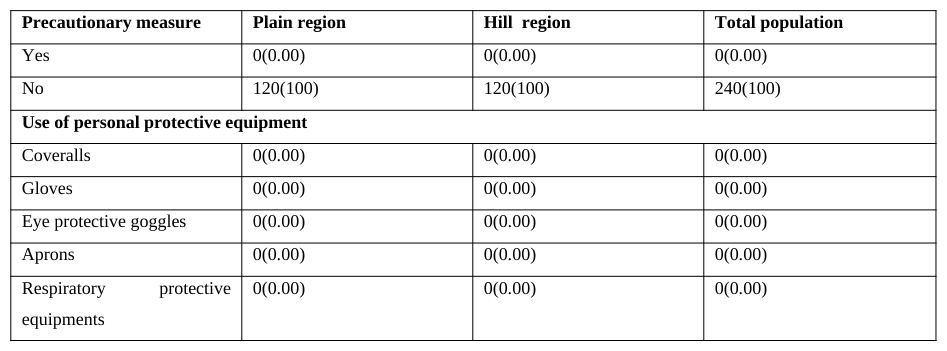
Precautionary measures and personal protective equipment used in cooking and spraying The data envisaged (Table 2) that nobody were using precautionary measures or personal protective equipments such as coverall, gloves, eye protector goggles, apron and other in cooking and spraying activity.
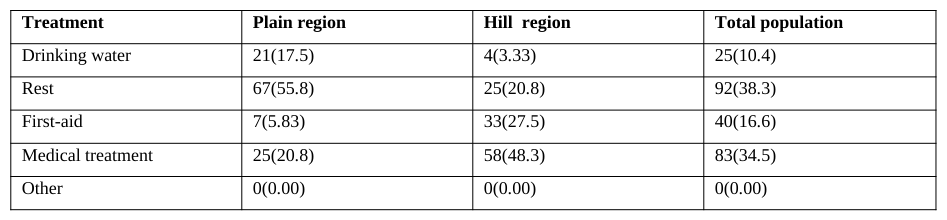
Table 2. Precautionary measures and personal protective equipment used in cooking and spraying N=240 Precautionary measure Plain region Hill region Total populationTable 3. Treatment of pesticide users N=240 Treatment Plain region Hill region Total population
The data pertaining to treatment of pesticide users revealed that 38.3 percent people were taking rest for minimizing the hazards of pesticides and only 10.4 percent were preferring drinking water. Comparative analysis stated that in plain region 55.8 percent were taking rest for reducing the pesticide hazards and only 5.83 percent were preferring firs aid. Contrary to this, in hill region 48.3 percent were taking medical treatment and only 3.33 percent preferred drinking water. As stated earlier that in hill region people were having more educational status and more monthly income. So, these people were more aware regarding the preventive measures of pesticide spraying.
REFERENCES
Aaras, A., Westgaurd, R. H. (1988), “The effect of improved workplace design on the environment of work-related musculoskeletal illness”, Applied Ergonomics, 16: 91-97. Boocock, M. G. Jackson, J. A. Burton, A. K., Tillotson, K. M. (1994), “Continuous measurement of lumber spinal posture using
flexible electrogonionmeters”, Ergonomics, 37: 175-85. Brantingham, C. R. Beekman, B. E. Moos, C. N.,Gordon, R. B. (1970), “Enhanced venous pump activities as a result of standing on a varied terrain floor surface”. J. Occupational Med, 12: 164-69. Bruce, N., Perez-Padilla, R., Albalak, R.2000.Indoor air pollution in developing countries: a major environmental and public
health challenge. Bulletin of the world Health Organisation.vol.78 (9).pp 1078-1098. Burdorf, A. Derksen, J. Naaktgeboren, B., Riel, M. V. (1991), “Measurement of trunck bending during work by direct observation and continuous measurement”, Appl Ergonomics, 23(4): 263-67. Chaffin, D. B. (1977). “Localized muscle fatigue definition and measurement”, J. Occupational Med, 15: 346-54. Genaidy, A. M. , Karwowski, W. (1993), “The effect of neutral posture deviations on perceived joint discomfort rating in sitting
and standing postures”. Ergonomic, 36: 785-92. Grandjean, E. (ed) (1988), “Fitting the Task to the Man – a textbook of Occupational Ergonomics”. Taylor and Francis Inc., London 35-36 pp. Gross, I. H., Crandall, E. W. (1973), “Management for modern families”. 3rd ed. Century Crafts, New York. Keyserling, W. M. Armstrong, T. J., Puneet, L. (1988), “Ergonomic job analysis a structure approach for identifying risk factors
associated with overexertion injuries”. Applied Occup Envir Hyg, 6: 253-63. Mayer, A., Korhonen, E. (1999), “Assessment of the protection efficiency and comfort of personal protective equipment in real conditions of use”. Int J. Occup Saf Ergon , 5(3):347-60. PubMed Result.mht. (Retrieved on 12/Aug/2010). Smith K.2000.National Burden of disease in India From Indoor Air pollution. Proceeding of the National Academy of Science of the United States of America.vol.97(24).pp13286-13293.
LISTED IN THE AHFE DIGITAL BOOKSTORE CATALOGUE
Explore the complete digital volume
Advances in Social and Organizational Factors
Read this individual research paper free through the original publisher, or explore the full digital proceedings book.
ISBN 978-1-4951-2102-9
Explore this ISBN in the AHFE Bookstore ↗Listed in the July 2026 bookstore catalogue; search by ISBN to confirm current availability · Digital book purchase optional