Erick Eduardo Lozano-Ramos, Martha Roselia Contreras-Valenzuela (2020). Development of QOC Matrix- The Worker's Voice (part 1). In: Advances in Social and Organizational Factors. AHFE Open Access, vol. 9. https://doi.org/10.54941/ahfe100355
2 Facultad de Ciencias Químicas e Ingeniería Universidad Autónoma del Estado de Morelos Av. Universidad 1001, Col. Chamilpa, C.P. 62209. Cuernavaca, Morelos. México ↗
The Faculty of chemical sciences and engineering form the Morelos University in México, has developed a tool called “QOC Matrix - the worker’s voice”. It is based on the logics of QOC (Questions, Options and Criterion), 6’s philosophy, ISO International Standers about Ergonomic guiding principles, National Institute for Occupational Safety and Health – USA publications, among others. Quality concepts like the Voice of Customer VOC (activity to meet the customer’s requirements), are used to obtain “The worker’s voice”, that will be used in the decision-making process about the design or redesign their workstation. The results obtained from the matrix have the objective to define if the workstations meet standards about cleanliness, organization and safety. Also, identify, the waste of “Talent” (underestimating as the creativity and intelligence of the workforce). All these having as a goal: “to create formal means to add value to the voice of the worker to express quality of working life that they want and need”.
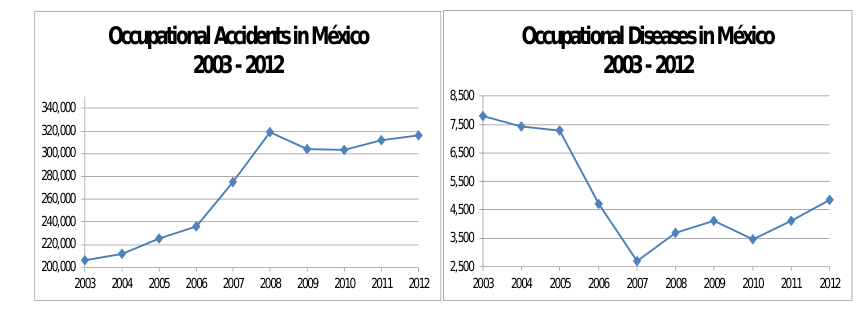
Mexico is one of the most important Emerging Markets in Latin America, second only to Brazil. The foreign industrial firms are located in the north of the country normally. These corporations have a business structure that allow them invest in safety and health issues indiscriminately. However, at the same time there are numerous of medium and small Mexican and international companies spread in all the country, that supply goods and raw materials to the large corporations, creating an invaluable supply chain that provides job to many people in Mexico. Unfortunately, these medium and small companies are trying to survive in a very competitive market and, they do not have enough economic resources to invest in safety and health. As a result of this, 316,271 occupational accidents and 4,853 occupational diseases were reported (STPS, 2013) in 2012 by the Secretaría del Trabajo y Prevision Social – STPS (Ministry of labor and Social Security). The Figure 1 shows the behavior of these issues for the last 10 years. The data comportment, indicate, there is no control about the working conditions inside the facilities for people whose work there. And the government has implemented a deficient regulation about that.
Figure 1. Occupational accidents and diseases reported by the Ministry of labor and Social Security from Mexico. (STPS, 2013)
Figure available in the original PDF paper.
At present, the legislation that can help to correct this health problem is poor and obsolete, compared to international standards. The Table 1, contains the national rules in place related with work design and environment control. Unfortunately they have not been updated, and contain incomplete ergonomic information.
Table 1: Mexican Official Standards issued by the Ministry of Labor and Social Security (STPS, 2013)
Mexican Official Standards issued by the Ministry of Labor and Social Security
According with Stephen Pheasant “Ergonomics is the science of work: of the people who do it, and the ways it is done; the tools and equipment they use, the places they working, and the psychosocial aspects of the working situation” (Pheasant, 2003). Thus, if Mexico wants, prevent occupational accidents and diseases efficiently it is necessary implement better polices to monitoring the working conditions. On the other hand, employers have not taken into account, the cost of lack safety. The productivity losses regarding incidents and disabilities are usually unknown. Fortunately, they can be identified, controlled and eliminated by the application of ergonomic considerations in the design of work and workplaces (Törnström, 2008).
Therefore, it is in this context, the Faculty of chemical sciences and engineering form the Morelos University in México, has developed a tool called “QOC Matrix - the worker’s voice”. It is based on the logics of QOC (Questions, Options and Criterion), 6’s philosophy, ISO International Standers about Ergonomic guiding principles, National Institute for Occupational Safety and Health – USA publications, among others. Quality concepts like the Voice of Customer VOC (activity to meet the customer’s requirements), are used to obtain “The worker’s voice”, that will be used in the decision-making process about the design or redesign their workstation. The results obtained from the matrix have the objective to define if the workstations meet standards about cleanliness, organization and safety. Also, identify, the waste of “Talent” (underestimating as the creativity and intelligence of the workforce). All these having as a goal: “to create formal means to add value to the voice of the worker to express quality of working life that they want and need”.
The work in this paper focuses in the building of The QOC Matrix - the worker´s voice, it use and validation in real Social and Organizational Factors (2020) industrial environment.
DEVELOPING THE QOC MATRIX - THE WORKER'S VOICE.
QOC notation The QOC notation is a Design Rationale representation for design artifacts which consist in two concepts: design space and evaluation space. The first one established the question design and its options (potential answers to the question), and the second define the “Criteria” the requirements for the final artefact (MacLean A. et. al 1989). Dutoit and Paech (Dutoit A. and Paech B., 2000) established the QOC notation. It represents the design rationale as arguments structured in rhetorical steps. Where: questions represent problems to be solved, such as a design issue, options represent considered alternatives for answering a question, criteria represent the qualities that are used to evaluate options in a certain context.
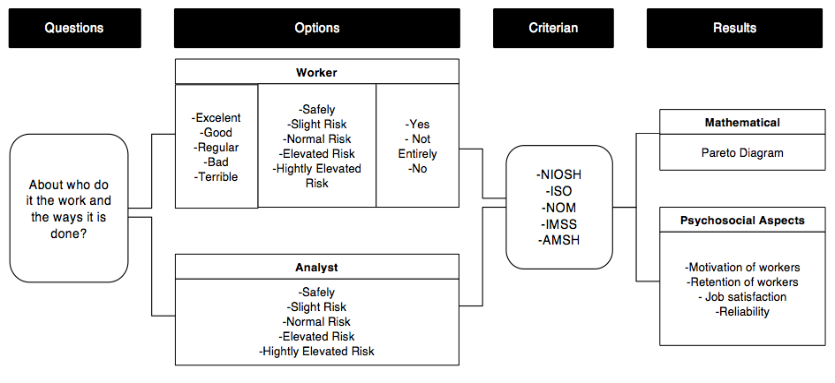
The QOC matrix Decision Support Systems (DSS) is an interactive computer-based system that help people use computer communications, data, documents, knowledge and models to solve problems and make decisions (Power, 2002). In the same way the QOC matrix help people use ergonomic information to solve problems and make decisions to design of work and workplaces. Based on international and national ergonomic standard, we use the QOC methodology to design the matrix content, where: a) Questions were performed looking for information about the work: of the people who do it, and the ways it is done. b) Options are a categorization of the risk about the way the work is done. In this section, the worker’s voice is stored. c) National and International standards related with the work design are used to evaluate the options. The Figure 2 shows the general design for the QOC Matrix.
Figure 2. General design for the QOC Matrix.
The options are evaluations about the workspace, work conditions, work procedures, and work environment. This assessment takes place in two stages. First, the workers take the opportunity to assess their working area and provide ideas about how it can be redesigned. Secondly, a specialized analyst evaluates the area and links the ideas proposed by the worker with the national and international standards. It is important define, that the analyst cannot change the worker assessment done.
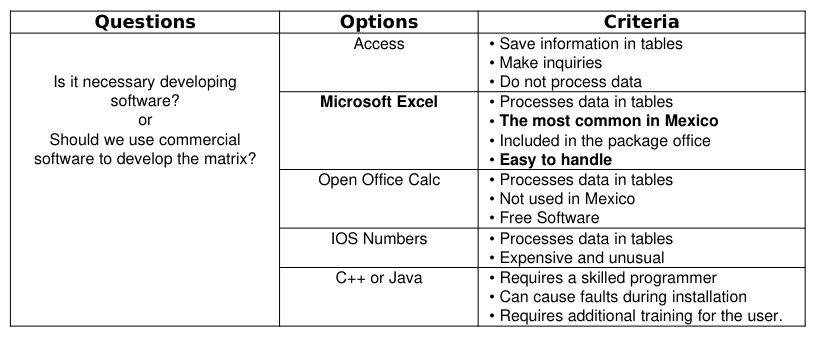
Building the QOC matrix The first important decision about building the QOC matrix was to define, the environment that should be it developed. We analyzed several alternatives; the important matter was “the more easily to handle better”. After a quickly analysis, we define developed it in an Excel Sheet. The table 2, illustrates part of this making decision. The objective was built a tool that helps people to use ergonomic information to solve problems and make decisions in the design or redesign of work and workplaces freedom of accidents and potential safety risk. The QOC matrix - the worker´s voice (English version) achieved is showed in the figure 4.
Table 2: Making decision on environment QOC matrix.
The tool developed is a book contained four excel tabs, ordered as follow: Analyst, worker, matrix and Pareto. The first tree tabs, enclosed the same questions for analysis, but the purpose is different for each one. The tabs called Analyst and worker are used as evaluation instrument. In Mexico the workforce is people whose has basic studies in the best case, thus it is difficult training them in ergonomics issues. Is for that reason the survey applied them are focused in their filings, complaints and motivations. Therefore, their evaluation answer is regards comfort sensation during the performance of their task. Accordingly, it is the moment when we get the “worker´s voice”, and now it represents the client requirements. The survey is applied to all workers in the area; we do not select people based in their skills.
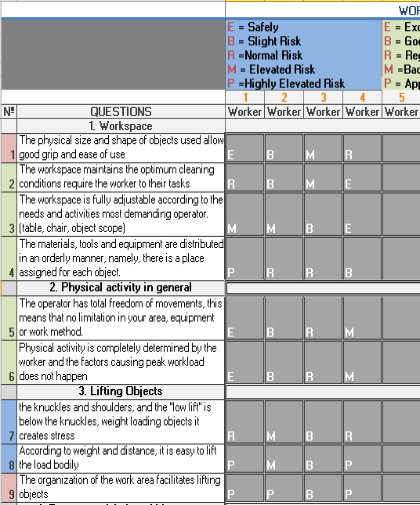
On the other side, the specialized analyst, is a person whose knows about ergonomics and has to evaluate the work and the workstation with the objective to find the ergonomic risk associated with the “worker’s voice”. The results of the both evaluations are gathering in tab called matrix, see figure 3. Finally, a Pareto chart is generated automatically, with data obtained from the results stored in the matrix of results. This chart, allow us identify the main problem defined by the assessment. Now, we have identified the vital few ergonomic problems. Consequently, the ergonomic intervention will be focused in resolve the first problem showed by the Pareto chart.
Assessment process
The evaluation activity was based in the methodology developed by the Mexican Association of Safety and Health (AMSH, 1996) where there are two points of view: the first one is the workers assessments who qualify the work conditions of his/her task. In order to choose an option, the workers select the letter that represents their evaluation, for example E for excellent or B for good (Bien). Each question and option is associated whit one color that indicates the kind of answer expected, see in figure 4 (a). The second point of view is presented by the specialized analyst who evaluates the risk of the task. The options that they have chosen are: Safety, slight risk, normal risk, elevated risk and highly elevated risk and each one is associated with a number code. See figure 4 (b).
Figure 3. The QOC matrix - the worker´s voice (English version).
Figure available in the original PDF paper.
Evaluation done by workers
Evaluation done by the analyst
(a)
(b)
Figure 4. Evaluation procedure.
VALIDATION OF THE QOC MATRIX - THE WORKER'S VOICE The validation process of the QOC Matrix, was implemented in two medium companies from Morelos State, Mexico. The first one is an auto parts manufacturing company. Therefore, we had the objective of confirm if the questions proposed in the matrix are adequate for developed an ergonomic intervention. The results obtained after apply the survey to 40 workers from ensemble area; indicate us that the questions were redundant and boring. Hence, we reduce the number of questions and implementing a colloquial language that can understand by the workers, making the survey more fluid and faster.
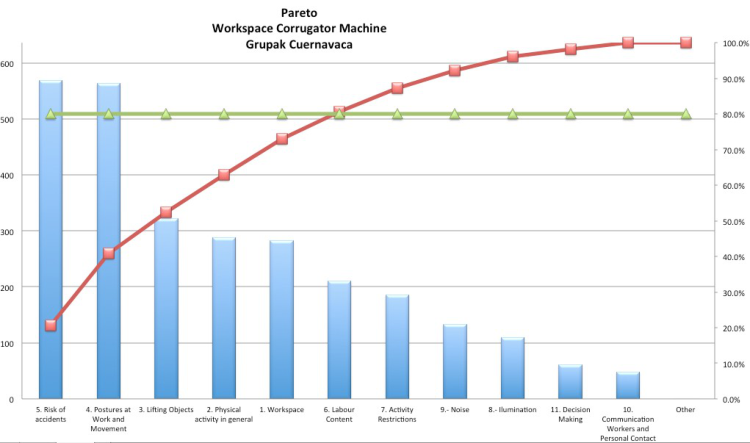
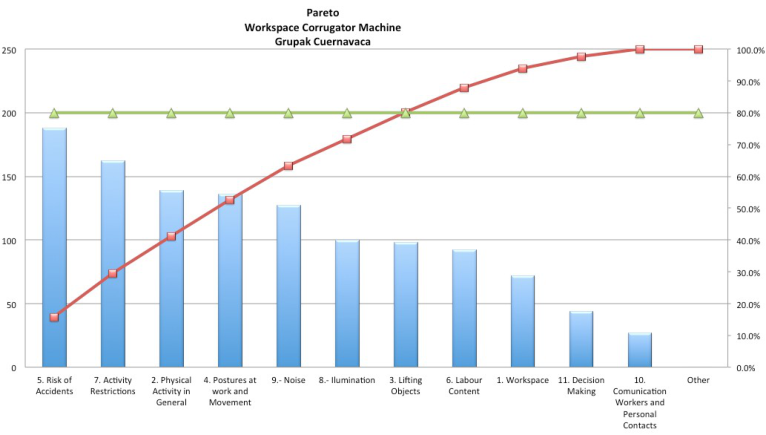
The second company is a producer of corrugated cardboard. In this company a total of 100 workers from three shifts were interviewed. We validate the results obtained from Pareto charts. In first instance, the chart was built using data summarized from each section in the matrix, but unfortunately each section has different number of questions, then the section with more questions has always the highest result. We change the formula In order to correct this situation. The chart obtained before is showed in the figure 5. The main problem identified is related with section 5 called “Risk of accidents” followed for section 4 “problems of work and movements”. The figure 6 shows the Pareto charts after formula correction. Now, we have a smoothed chart, however the main problem is the same. Then the ergonomic intervention has the objective to reduce the work accidents in the area.
CONCLUSIONS
The work in this paper is focused in the design and building of “The QOC Matrix - the worker´s voice”, an ergonomic tool to help people use ergonomic information to solve problems and make decisions to design and redesign work and workplaces. The instrument designed is a book contained four excel tabs, ordered as follow: Analyst, worker, matrix and Pareto. The result of the tab called worker is the identified as the“worker´s voice”. It will be used as client ergonomics requirements. A Pareto chart is generated automatically using the assessment that is stored in the matrix of results. The chart allow us identify the main ergonomic problem. Thus, the companies can save time and money during ergonomics interventions.
Figure 5. Pareto chart before formula correction.Figure 6. Pareto chart after formula correction.
REFERENCES
AMSH - Asociación Mexicana de Higiene y Seguridad A.C. (1996) “Boletin de Higiene y Seguridad, guía práctica para evaluaciones ergonómicas” en su Boletín Nº 36 del 8 de agosto de 1996. Social and Organizational Factors (2020)
Dutoit A. H. Paech B. (2000). “Rationale Management in Software Engineering”. Handbook of software and knowledge engineering vol 0, No.0 (2000) 000-000. p@World Scientific Publication. MacLean A., Young R. M., and Moran T. P. (1989). “Design Rationale: The argument behind the artifact”. Association for
Computing Machinery. ACM 0-89791-301-9/89/0004-0247 1.50 Pheasant S. (2003). “Bodyspace: Anthropometry, Ergonomics and Design of Work”. Second Edition. Taylor & Francis.(Ed). Pp
4. Power D. J., (2002) “Decision Support Systems:Conceptsan, resources for managers”. British library catalog. Card Number
20010488807. First edition. Greenwod Publishing Group. pp 1-6. STPS (2013). “Información sobre accidents y enfermedades de trabajo Nacional 2003-2012. The Secretaria del Trabajo y Previsión Social Website: http://www.stps.gob.mx/bp/secciones/dgsst/estadisticas/Nacional%202003-2012.pdf. Last update Oct. 2013 Törnström L., Amprazis J., Christmansson M., Eklund J. (2008). “corporate workplace model for ergonomic assessments and
Read this individual research paper free through the original publisher, or explore the full digital proceedings book.
ISBN 978-1-4951-2102-9
Explore this ISBN in the AHFE Bookstore ↗Listed in the July 2026 bookstore catalogue; search by ISBN to confirm current availability · Digital book purchase optional