Sandra Beltrana, Ildeberto Almeidab, Rodolfo Vilelac (2020). Work-Related Accident on Petroleum Industry: Beyond Human Errors and Immediate Causes. In: Advances in Social and Organizational Factors. AHFE Open Access, vol. 9. https://doi.org/10.54941/ahfe100345
In 2005, there was an explosion during a repair at Barrancabermeja refinery in Colombia. The fire that followed caused the death of two people, left seven wounded and caused losses estimated at nine million dollars. The company presented a video with the description of this accident, pointing as immediate causes of the explosion a dripping of propane-butane mixture from a heat exchanger and a spark generated when a man lift was switched off. The analysis done by the company identified unsafe acts (the use of an inadequate tool to correct the dripping), unsafe conditions (inadequate cap installed on the heat exchanger) and also included in the assigned causes disregarding of rules (not using Safe Isolation System). The objectives of this paper are: to approach this accident analysis from a different perspective, discussing new hypothesis based on organizational factors; to formulate new recommendations in order to contribute to accidents prevention; to encourage an organizational approach for analyzing work-related accidents that goes beyond human errors, technical causes or standards perspectives. This paper used an Analysis and Prevention of Accidents Model (MAPA) based on ergonomics of activity and other concepts used in accident analysis. Info sources were taken from the video, the presentation that summarizes the research done by the company, some press articles and interviews.
Throughout history, the analysis of accidents and disasters has blamed the victims or their colleagues. This has been the classical approach for analyzing industrial accidents in industrial safety departments, with support of a structure for practice in accordance with Health and Safety Management Systems. Nevertheless, the structure of the process with these steps does not represent a break in the essence of the traditional paradigm, as it maintains its features. The approach of Health and Safety Management System is anticipatory as if all risk factors were known, especially if the analysis can reveal, in a systemic view, the contradictions that lie at the root of these factors alone.
Reason (1993) described three periods of those approaches regarding their focus of safety. Wilpert and Fahlbruch (1998) added a fourth one. Dien et al (2012) mark these periods into recent decades according to the most important industry events: a) Technical period: up to the seventies, the source of safety problems was placed mainly upon technical reliability. During this period, the most used model to analyze and predict accidents was the so-called domino model (Heinrich, 1931). Hollnagel (2003) proposed to call it Sequential Accident Model. It describes accident as result of a string of clearly distinguishable events that occur in a specific order and illustrate it as a set of dominoes falling because of a single triggering event.
b) ‘‘Human error’’ period: during the eighties, the source of problem was/were the person/people and the Sequential Accident Model was still used. According to the domino theory of Heinrich, investigation should identify unsafe acts and conditions to analyze accidents. It is an approach that studies human actions through the analysis of the workers’ behavior from the perspective of human error, seeking to identify the types of errors that occurred and focusing on the removal of these errors – a behaviorist approach. There are some important limitations related to some of the assumptions adopted (Almeida, 2006).
Even today, human errors are identified as causes of accidents. However, errors are the consequences of a situation that did not allow operators to mobilize their skills in a relevant way (Daniellou et al., 2010). Based on the recognition of the inevitability of error, Llory (1999) advocates the need for changing the approaches proposed for human error. According to him, we have to assume that that to err is human.
c) Socio-technical period: during the nineties, the concept of ‘‘Safety Culture’’ emerged. In it, the source of problem is the interaction between social and technical subsystems. In behaviorism, still used in this decade, safety programs promote the implementation of observation practices that census unsafe or non-compliant behavior at work. Individual approaches are usually stimulated by practices that seek to obtain confession of the fault committed by the observed worker. Furthermore, this approach does not explore the history of the system, and possible contributions of aspects incubated in the origins of that behavior (Almeida, 2006).
For Llory (1999), the behaviorist approach does not clarify, but rather obscures the understanding of how the accident occurred. Although explained by the need for exploring the origin of human behaviors identified as immediate causes of an accident, these studies show that the interpretation of these findings continues to be based on the conception of the human being in the traditional paradigm. They begin with the assumption that there is one proper way of executing work, based on industrial safety procedures; workers are expected to take conscious decisions and consider several alternatives in complete control of the situation in progress. It disregards the context, the nature of the task demands, variability and history of the usual forms of work execution, the adequacy of standards in term of variability and associated psychic processes. Thus, this practice exacerbates the blaming of the victim and inhibits effective prevention practices (Almeida et al. 2006).
In that decade, new models to analyze and predict accidents start to be used. Hollnagel (2003) refers to them as Epidemiological Model, because of its analogy to a disease, that is, the result of a combination of factors. The classic example is the description of latent conditions (Reason, 1990). Another example is the model that considers barriers and carriers and pathological models of systems (organizations, states).
Hollnagel (2008) have discussed the features of different barrier systems and their relative advantages and disadvantages. Barriers are used as a reaction or as a response, but safety cannot be guaranteed only by reacting. Barriers are an effective mean against known risks, a way to prevent unwanted events from taking place and to protect against their consequences.
d) Inter-organizational relationship period: this decade is moving towards taking account of ‘‘Organizational Factors’’; the source of problem is a dysfunctional relationship between organizations.
According to Reason (1999) occupational accidents are organizational phenomena. Llory (1999) prefers to call psycho-organizational accidents. They use contributions of ergonomics, of psychology, of systems engineering and other sources of knowledge about cognitive aspects - individual and collective -, and about human reliability in open socio-technical systems; also contributions of the study of some aspects of production methods and of safety management in these systems.
Daniellou et al (2010), proposed an approach of Human and Organizational Factors of Safety (HOFS) to identify and implement the conditions that favor a positive contribution from the operators individual and collective work in the construction of industrial safety. The knowledge given by this approach would allow understanding what determines human activity and act on the design of work situations and the organization. This approach helps to develop the dimension of "safety on action" based on the skills of people, on organizations objectives and functioning and helps to promote compatibility with "normatized safety" within a culture of integrated safety.
Hollnagel (2003) describe a Systemic Model that attempts to describe the performance characteristics at the system level as a whole, rather than at the specific level of "cause and effect" mechanism. The symbol for the latter type is the analogy of swiss cheese (Reason, 1997).
In many industrial companies, the numbers of accidents do not decrease anymore and similar events seem to recur. Dien et al. (2012) shows some limits since current operating feedback and argue that weaknesses come mainly from analysis methodology.
In recent years there has been an increasing number of studies that criticize the limits of accident investigations conducted by professional teams of companies. One of the outstanding features is the high frequency of findings in which the event is not understood as socio-technical and systemic phenomenon, entailing accurate prevention recommendations: this limits organizational learning. This study is an example of such a situation in a company that clearly would benefit from using analysis practices supported by systemic conceptions.
OBJECTIVES
To approach the accident analysis with a different perspective to the one used by the company in its initial investigation
To discuss new hypothesis for the accident based on Human and Organizational Factors of Safety (HOFS)
To formulate recommendations that would help to accidents prevention
To encourage work-related accidents analysis to use an organizational approach going beyond human errors, technical causes or standards perspectives
METHOD
To make the description and analysis of the accident, we have used several sources of information: a video presented by the company, the presentation that summarizes the research done by the company, some press articles and some interviews with union members. The case was also sought for in the databases of the judiciary, without success.
To re-analyze this accident, we have used the Model of Analysis and Prevention of Accidents (MAPA). This model was developed, tested and perfected by Almeida and Vilela since 2008, and applied in various companies from different segments and in accidents of more or less gravity. MAPA’s major objective is to understand the work related accident as a result of a network of multiple interacting factors, overcoming the dichotomy of unsafe acts and conditions and thus, identifying factors related to organizational aspects.
The MAPA begins by describing the accident with the basic elements, who, where, when, how the accident did happen, and then, describe the usual work. This description does not take account only of the work’s established procedures, but also of how it is actually done, taking account of its variability and the worker’s know-how.
After this description, MAPA analyzes the changes that occurred in the usual work, at the level of individual, task, equipment and environment which could contribute to the occurrence of the accident. The third part of MAPA analyses the prevention or protection barriers, existing or not, for each energy, condition or event with hazard potential. If existing, it analyses the efficiency or the flaws on that barrier. This analysis must reach the origins of the eventual fault, the reasons for the absence of eventually prescribed barriers and why they were not implanted.
To analyze the Safety Management and the Production Management is the next step on the model. Here the focus is placed on organizational factors that came previous to the accident, trying to identify not only absences or failed elements, but latent causes like project and management decisions, rules, norms or procedures which by its nature could have hindered the usual way of executing work and have gotten the opposite result they were created for.
The last part of MAPA proposes an auto evaluation, through a series of questions that help identify if it is necessary to expand the concepts from analysis.
RESULTS
Description of the accident On December 18th, 2005, during a repair of the plant DEMEX at Refinery of Barrancabermeja in Colombia, there was an explosion and subsequent fire that caused the death of two people, left seven wounded and losses estimated at nine million dollars. The company presented a video with a detailed description of this accident. For this analysis, a translation to English was taken from the video report (see Table 1).
Table 1. Translation from the accident video report
Table available in the original PDF paper.
This is the DEMEX plant, responsible for processing funds from empty units toping. Here, on December 18th, 2005, a fire that left two dead and seven wounded took place. On Friday, December 16th, at 3:40 pm, the coordinator commissioning of the plant detected a drop of water attached to the cap of this heat exchanger. The function of this equipment was to cool the mixture of propane-butane required in the extraction process. After the discovery, the coordinator asked a maintenance worker assigned to the plant to eliminate the dripping. However, the worker told him he could not do anything because the plug threads were all in the hull of the heat exchanger and the cap was slightly tilted.
Two days later on December 18th, at 8:30 am, the supervisor of the work done to the heat exchanger detected a steady drip at the cap and called the coordinator to define what to do around the exhaust. The two decided to apply a sealant and the work controller undertook. He made contact with the supervisor of the outsourcing company to correct the anomaly, and they went together to the equipment. The supervisor of the outsourcing company told the work controller that that tightening the cap would fix the dripping, so he decided to process a work permit. Operations issued the permit without moving to the area or verifying the location and risks for the job. The permit was signed by the supervisor of the outsourcing company, who in turn asked a subordinate to take a pipe wrench and go with him and the work controller to the heat exchanger, in order to tighten the cap.
The contractor worker hit the cap twice with the socket wrench. Immediately an increased dripping was generated. However, both withdrew from the area for lunch. Between 1:00 p.m. and 2:00 p.m. that day, another company’s contractor performed radiation work, so all work was suspended in an area of 45 meters around it, including the exchanger with the exhaust. Around two in the afternoon the entry of personnel to the area was enabled again. Another worker in the contractor firm, more experienced, was sent by the supervisor to tighten the cap that was still leaking. By the time he got to the area to do the work, the expulsion of the body exchanger plug occurred. Immediately, solvent escaped, forcing the evacuation of the area.
In parallel to this, various tasks were being developed in the area, including the installation of heat shield pipe in an absorption tower, 12 meters high. Three workers were using a man lift or lift people. The cloud of the solvent from the exhaust exchanger shifted to the tower where the lifting equipment was and wrapped it. The elevator operator was ordered to evacuate, but before doing so he pressed the remote control to switch to the workers who were in height. At that moment, a spark was triggered inside the fuel cloud and caused an explosion that left two people dead, seven injured and nine million dollars in losses for the company.
Description of usual work During repair and maintenance, leaks detected are reported to the operations department through the work controller1, who requests the repair to outsourced company. This presents a diagnosis of the problem and one or
1 The word interventor is translated from Spanish as work controller in this paper. He/she is a person independent from outsourced company who audits the works.
more alternative solutions. Work controller and operators analyze these alternatives taking into account the need of electric, mechanical, process or other kind of isolation, among other factors. Many requests and presentation of these alternatives are made informally, as working conversations. After choosing an alternative, the outsourced company’s responsible makes an assessment and risk analysis, using a systematic description of the task and the list of tools to be used. The result of the risk assessment (very high, high, medium, low, very low) will define who reviews and approves the execution of the task. The higher the risk, the higher the hierarchic level within the organizations is necessary to approve it. It is a normal practice in the company to try and underestimate the risks during this evaluation exercise, for quicker agreements among the lowest levels of operation, thus preventing retardation of work. Sometimes, this analysis undergoes a review by the work controller, sometimes it doesn’t. The outsourced company processes a work permit to operations department. According to a member of the union, at that time an operator on projects like this could have up to 200 work permits in one day. It is also usual that the operator only makes a measurement of explosive gases in the process area at the beginning of their shift and then sign the work permit that start later without repeating this measurement. According to union, the operators repeat the measurement just when strange odors are detected.
Analysis of Changes Changes at Individual level
The hypotheses can be made that workers without much experience / knowledge did the repair work. According to the research done by the company, the higher the risk, the higher the level organizations approving the execution of work to operations department since December 11th (a week before the accident). This version corresponds to the statement given by the outsourcing representative to the press, which clarifies that maintenance hired by the company had already expired, and that on the day of the accident they were 'following orders of the company' (El Tiempo, 2005). Even so, the outsourced company, after accepting the job, designates a person to make the task before lunch, and then designates another employee to complete it after lunch. This research is unaware of the availability of experienced workers in the outsourced company during that weekend and when maintenance work had already finished. In the same newspaper article, a union worker points out that several weeks before, they had warned the company about the risks involved in employing people without knowledge and experience required for this maintenance. The 'lack of experience / knowledge' factor is analyzed as a change at individual level, and as an organizational factor, as it will be explained later. A second factor to consider at the level of individual changes is the Christmas season, which begins in Colombia in December 16th; on it, it is common that workers have many sources of distraction, for example, increased phone calls from family, logistics coordination for the activities that will be performed in the novena2 and conversations with coworkers about travel destinations, holiday’s family plans, etc.
Changes at Task level The task was unusual, because, as mentioned, the heat exchanger had been delivered. According to the information of the video, the first decision was to put a sealant, although it finished using a tool to tap directly the cap. Issues leading to changing the plan were not explored: Did they have sealant available? Was this sealant resistant to the type of product that was leaking? Neither were explored issues such as why an isolation process was not made to intervene at the heat exchanger: would it need a higher risk assessment, causing the need for the outsourcing company to wait until Monday to get the approval from the refinery manager? On the other hand, national standards for working at height were still not well-implemented that year: it requires, among other procedures, the preparation of a rescue procedure. The hypothesis here is that the company that performed the coating work had not foreseen the risk of a gas leak and therefore the evacuation procedures for workers who were on the man lift without having to activate the electric switch.
Changes at Equipment level The research done by the company showed that the cap installed was not suitable for the heat exchanger. The video presentation does not clarify when the cap was installed and why they decided to put it on. Nor it is asked how they came to the decision of using a pipe wrench to repair it and what they had specifically planned to make with it, for instance first removing the cap and then putting a new one.
2 Traditional catholic gathering during nine nights before Christmas.
Changes at Physical work environment The company does not report conditions such as heat and noise in the workplace as factors that could increase fatigue of workers, and this in turn, influence on decision-making. The temperature in the city of Barrancabermeja on that time of year can exceed 40°C (IDEAM, 2013) not counting that the wind chill can be increased because of the relative humidity and the heat radiation from the refinery machines. The noise level is unknown, even more because it is not known exactly which were the machines that were working and which were shut down inside the plant.
Changes at Organizational work environment It is reported that after hitting the cap and incrementing the product leakage, workers retreated to lunch. One can build the hypotheses that they had underestimated the risk by not knowing the contents of the product that was leaking, but also fatigue, hunger, and rushing to catch a bus to go out from refinery to lunch, could be added to this decision. Each company offers a bus to transport workers, as the refinery offers transport only to direct workers and controllers, not to outsourced people. The issue of overtime is not addressed in the presentation of the company, but according to the version of a union worker, the injured were doing rounds of 16 and 24 hours, and over the past 48 hours had only rested 2 hours (El Tiempo, 2005). Other factors such as time pressure to deliver the plant will be discussed in the analysis of production management.
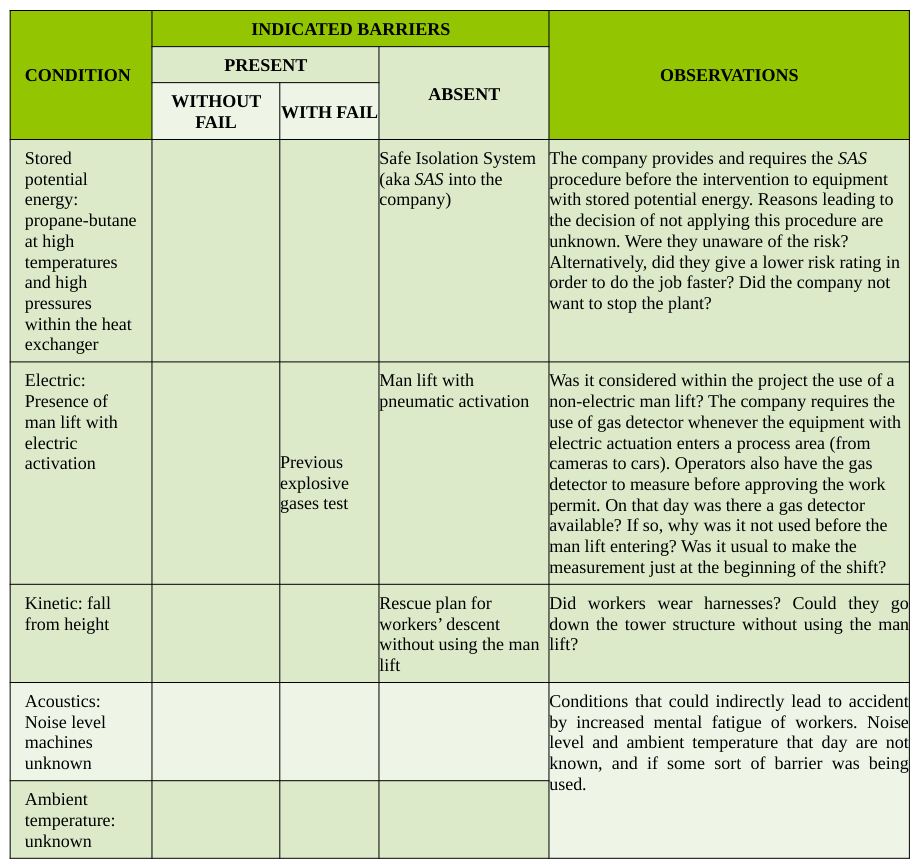
Analysis of Barriers In this analysis, two conditions with potential danger were identified as more proximal to the accident: a) the presence of combustible material classified as stored potential energy, since a highly flammable mixture was under high temperature and pressure within the heat exchanger and b) an electrical spark created when operating the man lift to descend workers who were in high. Prevention barriers analyzed for these two conditions are: a safe isolation system, the use of another type of man lift and previous monitoring of gases in the atmosphere. It is possible that the failure of those barriers are associated with the fact that the plant was very old – projects were made without as much care with safety as today – and also due to failures of safety management that, in their analysis, did not record the existence of these dangers and did not recommended corrections due.
Another distal condition of the accident is the potential of falls by working at height; prevention barrier analyzed is the rescue procedure, which could have been used to evacuate workers without operating the man lift. Other environmental conditions such as noise and heat are unknown, but an approximation of how they might have influenced the accident occurs.
Information on protective barriers in the consequences of this accident, as the fire control or rescue of wounded by the brigades are unknown and therefore are not discussed in this paper. The summary of the barrier analysis is presented in Table 2.
Analysis of Safety Management Safety Management in the company takes into account the occurrence of previous accidents for risk assessment. At the background, there is a record of a fire in the same plant in 1993 (because of a stolen pressure indicator). It would have been decisive to give a review of the high-risk intervention work on the heat exchanger. In the video it is mentioned that the operator did not go to the heat exchanger to analyze the risks, but it is unknown how many work permits (WP) he would have signed that day. However, as mentioned before, in this kind of projects inside this company and at that time, an operator could become responsible for signing 200 WP in one day. The high number of work permits granted to one employee not only suggests the existence of imbalance between the usual demands of the service and available workers of the plant: it suggests as well that the management is clearly favoring responses to short-term problems disregarding possible contributions of this situation for the continuous degradation of working conditions and safety in the plant.
There is no physical or temporal space for subcontractors to exchange information about simultaneous jobs. Finally, according to the press reports, the workers would have alerted their bosses on the exhaust and the union had warned about the risks to the company of employing people without experience and knowledge (El Tiempo, 2005).
Table 2. Analysis of barriers INDICATED BARRIERS
Analysis of Production Management According to press articles, the company hired 14 subcontractors to do the maintenance work of the plant that started in November (El Tiempo, 2005). Probably it hired just an outsourced responsible for all plant repair and this, in turn, hired the others for implementing specific jobs. Work controlling company is also outsourced. The company has a scoring system for procurement where aspects of the project’s cost and delivery time have higher values than other aspects such as experience in the petrochemical sector and implementing projects previously with successful safety results. The projects presented by the competitors do not take into account factors such as rain and strikes that delay the work. Even though this is a region with a high rainfall level (up to 300 mm) and strong presence of groups of legal left (unions) and illegal left (guerrilla) that organize strikes which could delay, for example, the arrival or the input of materials or workers to the refinery. The contractor for this work was foreign, with much experience abroad, but apparently new within this refinery and therefore, within the safety management of the contracting company and the socio-political conditions of the country. No one knows the appraisal system that this outsourced company used to outsource some of contracted services, but here one can highlight again that unionists would have warned the company about hiring inexperienced people for the implementation of this project.
It is necessary to mention, in order to have a dimension of time pressure on the completion of these jobs, that 30% of the country's largest refinery was stopped because of this repair. The delivery of the plant was due to December 20th. This analysis argues that if the leak was detected on Friday, December 16th and involved people knew that a review of high risk would request implementing a safe isolation system, it would entail more time to the adoption of risk analysis and work procedure. Finally, it would lead to postponement of the refinery delivery for operations; besides, it would have been necessary to rehire workers, who were only expected to stay on the plant until December 20 th. Probably there was also a conflict of interests because the outsourced company was no longer responsible for this equipment, but could have understood this work seemingly simple to please those in charge of receiving the plant (operations) and facilitating the closing of the project. Finally, it would be necessary to explore how the materials management led to the use of an inadequate cap. Was it known that the piece was not suitable for the equipment? Was its installation temporary? Would there be a delay if one waited for the arrival of a definitive cap?
DISCUSSION. EXPANDING THE CONCEPT FROM ANALYSIS In summary, retelling the events description and adding data collected from workers can show that the analysis presented by the company did not explored aspects that contributed decisively to the accident. This is visible both regarding the absence of barriers for the prevention of hazards identified easily in the plant and also with respect to the origin of the leakage that occurred in the plant: they were hardly explored for possible failures in the period immediately preceding the event. And that in a company that seems to accumulate problems in the management of materials, maintenance, safety and human resources, which could boost slow and progressive deterioration of working conditions in a process equivalent to what Rasmussen (1997) described as system migration to the accident.
The analysis of the accident made by the company assigns as causes the disregard of rules and procedures. Also the prevention recommendations were instructed to 'continue demanding tracking procedures' prescribed, although after the accident the company took more 'organizational' measures, such as including accident indicators in project directors’ evaluations, promoting safety audits made by project managers and adopting successful safety practices from other companies in the sector (Ecopetrol, 2007). Besides the new manual of work permits allows one operator be responsible just for 20 WP per day.
A bow tie model is presented below, marking a difference between the facts that have some evidence and those who are just hypothetical (red in the figure). The emergence of these assumptions would lead to a conceptual expansion of the analysis done by the company.
Figure 1. Bow tie model (From MAPA, 2010)
Figure available in the original PDF paper.
CONCLUSIONS AND RECOMMENDATIONS This study argues that searching for immediate causes actually is not enough to result in accident prevention. Investigation and analysis made by the company show some limits and that is probably why accidents do not decrease more. We focus on an organizational analysis of events and, even though there is lack of information, we try to construct hypothesis to point out not technical factors or human failures. It is necessary to explore aspects related to outsourcing, like the priority of the cost and time factors and the impact of this safety management on projects. Material management, delivery of equipment and the existence and content of the rescue procedure to work at heights should also be explored further.
Human factors such as the workload of plant operators, outsourced labor experience available at the end of projects and excessive overtime cannot be left out of the analysis of an accident such as this one. Safety barriers, such as work permits and risk analysis, should be discussed from its management point of view and if they actually are used as is expected or became just bureaucratic paperwork to fill out.
We would recommend not only to this company, but also to others that use learned lessons3 practice, to include the issue of shifts and overtime in all disclosures of accidents, so that other projects are able to appreciate the weight of this organizational factor in the accident analysis, and take effective prevention measures to reduce fatigue. Finally, this company could create a periodical meeting of risk analysis with representatives of all subcontractors that will run concurrent jobs, as it is already done in other companies from the same segment.
REFERENCES
Almeida, I.M; Vilela, R.A.G. (2010), “Modelo de Análise e Prevenção de Acidentes de Trabalho – MAPA.” CEREST Piracicaba website: www.cerest.piracicaba.sp.gov.br Almeida, I.M. (2006) “The path of accident analysis: the traditional paradigm and extending the origins of the expansion of
analysis”, interface - Comunic., Saúde, Educ. Volume 10 No. 19. pp.185-202. Daniellou, F; Simard, M; Boissières, I. (2011) “Human and organizational factors of safety: state of the art”, Les cahiers de la sécurité industrielle, ICSI. No. 2011-01. Dien, Y. Dechy, N. Guillaume, E. (2012), “Accident investigation: From searching direct causes to finding in-depth causes –
Problem of analysis or/and of analyst?”, Safety Science. 50. pp. 1398-1407 Ecopetrol. (2007), “Refinerias cerca del top” Carta Petrolera. Ed. 117. Ecopetrol Website: http://www.ecopetrol.com.co/especiales/cartapetrolera117/rev_refinacion.htm Ecopetrol. (2006), “Accidente en Ecopetrol Barrancabermeja”. Youtube Website: http://www.youtube.com/watch?v=UUc-bCp6YCMEl Tiempo. (2005), “Muere uno de los quemados en
incendio en Ecopetrol”. El Tiempo website: http://www.eltiempo.com/archivo/documento/MAM-1865830 El Tiempo. (2005), “9 heridos deja explosión en refinerías de Ecopetrol”. El Tiempo website: http://www.eltiempo.com/archivo/documento/MAM-1864965 Hollnagel, E. “Modelo de acidentes e análise de acidente”. In Almeida I.M. (2003) “Caminhos das análises de acidentes”.
Ministério do Trabalho e Emprego. pp. 99-105. Hollnagel, E. (2008), “Risk + barriers = safety?” Science Direct. 46. Pp 221-229 Instituto de Ambiente e Meteorologia IDEAM (2013), Cartas climatológicas – Medias mensuales (Barrancabermeja). Ideam Website: http://bart.ideam.gov.co/cliciu/barran/temperatura.htm Rasmussen, J. (1997), “Risk management in a dynamic society”. Safety Science. 27. Pp: 183 – 213.
3 In Colombia's oil sector also known as ‘lecciones aprendidas’.
LISTED IN THE AHFE DIGITAL BOOKSTORE CATALOGUE
Explore the complete digital volume
Advances in Social and Organizational Factors
Read this individual research paper free through the original publisher, or explore the full digital proceedings book.
ISBN 978-1-4951-2102-9
Explore this ISBN in the AHFE Bookstore ↗Listed in the July 2026 bookstore catalogue; search by ISBN to confirm current availability · Digital book purchase optional