N. Larsona, H. Wicka, T. Albinb, S. Hallbeckc, P. Vinkd (2020). Industrial Ergonomics: The Impact of aMacroergonomics Program with a Well-Defined Performance Goal in Reducing Work-Related Musculoskeletal Disorders. In: Advances in Social and Organizational Factors. AHFE Open Access, vol. 9. https://doi.org/10.54941/ahfe100315
This study describes a corporate macroergonomics program designed to identify jobs with work-related musculoskeletal disorder (WMSDs) risk exposure, reduce that exposure, and evaluate the subsequent effect upon WMSD cases. The adoption of a company-wide ergonomics program comprised of: a plan to address WMSDs (ergonomics plan), risk identification and reduction process, clearly defined responsibilities, and employee training is reviewed. Various technical initiatives facilitating program implementation including standardized job risk assessment tools, training and certification process for individuals performing risk analyses, central database to record assessment results, and management system to track progress are described. Between 2004 and 2008, 2020 jobs from 116 locations were analyzed, risks identified, interventions completed, and results documented. A statistical analysis of the results from 33 US locations showed a significant relationship between number of at-risk jobs addressed and a subsequent reduction in WMSD Incidence Rates (IRs) and lost-time IRs. The percent reduction of risks at each facility was also found to significantly reduce lost and restricted workdays. The reduction in WMSDs supports the effectiveness of the key program elements of management commitment, identification and improvement of problem jobs, and knowledgeable location-based resources and underscores the importance of well-defined performance-based metric for effective WMSD reduction.
Much has been written about what is required to have a successful industrial ergonomics program; these recommen- dations vary but essentially describe a core set of program elements. The US Government Account Office (GAO) re- port, Private Sector Ergonomics Programs Yield Positive Results (1997), identified these components of successful company programs: management commitment, employee involvement, identification of problem jobs, analysis and Social and Organizational Factors (2020)
Edited by T. Ahram, W. Karwowski and T. Marek development of controls for problem jobs, training and education, and medical management. The Occupational Safety and Health Administration’s (OSHA) Ergonomics Program Management Guidelines for Meatpacking Plants (1993) focused on management commitment and employee involvement, but also included worksite analysis, hazard prevention and control, medical management, training and education. Figure 1 summarizes the National Institute of Occupational Safety and Health (NIOSH) in Elements of Ergonomics Programs, which includes more specific ac- tions but also has similar categories of program requirements (1997).
Figure 1: Pathway to controlling work-related musculoskeletal disorders (WMSDs)(NIOSH, 1997) Many studies have proposed similar program elements as theoretical constructs (Vink, Imada, Zink, 2008; Haines et al., 2002). Additionally, there are applied studies that show the importance of elements such as widespread em- ployee participation and clearly defined goals (e.g., De Jong & Vink, 2002).
Figure available in the original PDF paper.
In applied settings, a company’s ergonomics program is influenced by where the program is positioned organiza- tionally (Vink, 2005), and its design must support the specific business-related objectives (Haines et al., 2002). It is important to distinguish ergonomics programs and WMSD programs as separate entities with separate strategies and objectives, although they commonly overlap. For example, an ergonomics program aligned with safety or health op- erations or risk management within a company will likely focus primarily on WMSD reduction (Molen et al., 2005). A program aligned with engineering or product development may focus more on operational efficiency or quality or customer requirements (Vink, 2005). Industrial ergonomics programs are frequently focused on WMSD reduction, using a variety of processes and strategies. In practice each company needs unique strategies and implementation tactics to implement their ergonomics efficiently and effectively, whether the objective is reduction of WMSD, oper- ational efficiencies, or customer experience. Macroergonomic concepts can provide guidance to designing and im- plementing an ergonomics program that supports a company’s business objectives (Hendrick, 1996).
Hendrick (1996) and Koningsveld et al. (2005), among others, propose a combination of applying macroergonomics principles to create a comprehensive program structure and to document company-wide benefits. Vink et al. (2008) and Noro & Imada (1991), have promoted participatory ergonomics strategies, which give explicit attention to the involvement of employees with their concomitant variety of expertise, knowledge, and skills and local autonomy as a critical factor for achieving success. In an industrial corporation, both macroergonomics and participatory er- gonomics work synergistically, leading to an ergonomics program that is both efficient and effective and demon- strates value across organizational structures.
Macroergonomics (Robertson, 2001) considers what is needed to obtain management support in the context of fac- tors, such as culture, mission, vision, business objectives, development of a comprehensive plan (including strate- gies, tools, and resources), and what business results to measure (WMSD reduction, production, cost reduction, cus- tomer satisfaction) to demonstrate value to the company. Macroergonomics provides guidance for practitioners to create and implement an ergonomics program that supports business objectives.
Participatory ergonomics (Noro & Imada, 1991) considers how to achieve the business objectives in the most effi- cient and effective manner through integration and collaboration with partners, including business units, health and safety, engineering, employees’ expertise, and others. It is also seen when employees are involved in the process of identifying problem jobs and providing the framework to make sure the right knowledge and skills are included at each key phase of an ergonomics intervention. In a complex organization with multiple locations, a prime challenge is balancing between the efficiencies realized through centralized programs and each location’s unique business re- quirements.
Edited by T. Ahram, W. Karwowski and T. Marek This paper describes how a company’s ergonomics program applied both macroergonomics and participatory er- gonomics in combination with a well-defined metric and reduced the number and severity of WMSDs. It describes the macroergonomic strategies of the organizational structure and ergonomics program, but focuses on management support, program strategies and tactics and the resources (participatory ergonomics) that executed the ergonomic WMSD risk reduction projects.
Management Commitment The company’s commitment to ergonomics has a long history (Larson 2006, 2008, 2012). Ergonomics has been a component of the company’s health and safety program for over 30 years. The company formal policy (3M website 2013) states the company “recognizes the importance of safety and health to business success and strives to continu- ously improve performance and be a leader in safety and health…and is committed to the safety and health of all its employees and will provide a safe and healthy workplace worldwide.”
A companywide Safety and Health (S&H) Policy and safety and health management system was adopted over 20 years ago and is comprised of over 30 technical elements. It defines the required safety and health performance re- quirements for all operations worldwide. Integrating the ergonomics (WMSD) program into the broader health and safety program provided many advantages, not the least of which was a common platform for communicating tech- nical information and assessing compliance, making it easier for the various operations to assess progress towards achievement of their objectives. As one element of the company’s health and safety program, ergonomics perfor- mance was reviewed annually, and continuous improvement opportunities were listed in each location’s annual S&H objectives. In the safety and health management system, every location’s ergonomics program requirements were defined and listed: a written program, performance of WMSD risk exposure assessments and intervention methods, identification of responsible individuals with appropriate knowledge and skills, and ergonomics training for all employees. Integration of ergonomics requirements into the S&H annual planning process ensures er- gonomics was consistently part of each location’s operational management.
For more than two decades OSHA’s WMSD recordable incidents comprised the single largest category of work-re- lated recordable and associated injury/illness costs in the US. As shown in Figure 2, the company had a similar ex- perience with WMSD data in its US operations, WMSD cases accounted for at least 50 percent of all reportable cases. This was true for all OSHA reportable categories: number of cases, the number of lost-time cases, the number of restricted time cases, and the total lost and restricted days.
80%
60%
40%
20%
Lost Days 0% Recordable Cases Restricted Cases Lost Time Cases Restricted Days
Figure 2: 2002 percent WMSD recordable vs. all recordable cases summary (US locations only) Additionally, WMSDs were also the largest category of Workers Compensation dollars. Therefore, the ergonomics program focused on reducing the prevalence and cost of these work-related illnesses throughout the company.
Figure available in the original PDF paper.
In 2000, as part of the company’s transition to a stronger centralized Safety & Health management system, the er- gonomics program was redesigned. This redesign included developing training programs, adopting standard job analysis tools, and adopting an internal ergonomics certification process. These changes set the stage for a transition to a robust macroergonomics approach, resulting in the company’s current comprehensive ergonomics program (Larson, 2008, 2012).
In 2002, the company’s management directed that three company-wide safety and health goals were to be devel- oped, one of which focused on WMSD reduction and ergonomics. A five-year ergonomics goal to implement the company’s Ergonomic Risk Reduction Process (ERRP) and reduce unacceptable WMSD risk exposures in specifi- cally targeted jobs by 75% by year’s end of 2008 was sanctioned by upper management and implemented globally in 2004.
Edited by T. Ahram, W. Karwowski and T. Marek The purpose of this study is to describe both the ergonomics program development actions and the implementation actions completed between 2004 and 2008. It provides a description of the company-wide ergonomics risk reduction process (ERRP), followed by a summary of the ergonomics training and certification process. Then, it provides an in-depth analysis of the impact upon WMSD incident rates at 33 US manufacturing locations chosen for the study.
Ergonomics Risk Reduction Process (ERRP) The Ergonomics Risk Reduction Process (ERRP) is a global, comprehensive process. The strategy supports the ap- plication of ergonomics in all company locations. However, local regulations or cultural differences can impact the availability of WMSD case data .
The ERRP process follows a traditional before-and-after research strategy, utilizing risk reduction data. Actual job assessment follows a Define, Measure, Analyze, Improve, Control (DMAIC) job assessment strategy, as shown in Figure 3, and is comprised of baseline analysis, identification of issues and solutions, implementation of solutions, and verification of results.
Ergonomics Risk Reduction Process Potential High Impact Ergonomic Risk Jobs Identified
Initial Job Screening
NO Note for Future Consideration Jobs with High Impact Ergo Risk Identified?
YES Plant Prioritization
Action Plan Determined Complete Ergonomic Assessment No Jobs with High
Impact Ergo Risk
Figure 3 Flowchart of risk reduction process
Job Assessment Tools A WMSD or ergonomics job assessment tool must be credible – sufficiently rigorous to accurately analyze the job activity and identify undesirable actions, yet not overly sensitive resulting in false positives that consume resources (Punnett & Wegmann, 2004). The results of the analysis must provide information helpful in identifying solutions, not just list data. It must be usable by the target user population, which may be professional ergonomists, health and safety professionals, or others. It must provide information that can be communicated to obtain management support and gain employee involvement.
The company’s ergonomic risk assessment tools needs to be applicable to a wide variety of manufacturing, convert- ing, processing, and packaging operations. It needs to be usable by health and safety staff that do not have advanced ergonomics education. The Ergo Job Analyzer (EJA) (Auburn Engineers, 2001) is used when conducting job analy- sis on existing equipment and processes. An additional tool, the Ergonomics Design Criteria Tool (EDC), was devel- oped and adopted for engineers’ use during the design and specification of new equipment and processes so that er- gonomic issues are designed out as much as possible. Both tools use a similar risk identification strategy and are based upon common WMSD risk exposure criteria.
This standard ergonomics assessment and improvement process (ERRP and the two analysis tools) facilitated the identification, remediation, and management of WMSDs, supported consistent and effective communication with Social and Organizational Factors (2020)
Edited by T. Ahram, W. Karwowski and T. Marek management and employees, provided operational efficiency, and finally, protected the assets of the corporation, in- cluding employee safety and health, product quality and productivity, and the company’s reputation.
Establishing Target Jobs A job prioritization strategy was adopted and implemented, and potential high-risk jobs were identified and placed in a location’s Potential High Risk Job Pool (PHRJP). Criteria for inclusion in the PHRJP included jobs with a his- tory of WMSD related injuries, employee complaints, high job demands, or considered by health safety personnel to have ergonomic concerns. Once identified, these jobs became the target jobs for the five-year improvement goal. In this way each applicable manufacturing, distribution, and laboratory location identified a specific number of Poten- tial Target Jobs (PTJs) to be considered for ergonomic improvement. The targeted jobs in this study were primarily from manufacturing locations but also included distribution operations and mining operations.
Personnel Resources Resource individuals with technical knowledge of ergonomics are necessary to achieve successful ergonomics inter- ventions. Because the majority of manufacturing locations in the company consist of fewer than 400 employees, hir- ing professional ergonomists at each location was not an option. However, each location had a professional safety, industrial hygiene, and/or occupational health resource person. The corporate ergonomics program relies on these location resources to lead and implement the ergonomics program and interventions at each location. Almost all the resources had a formal educational background in a health and safety area or engineering and were familiar with er- gonomics in general, but few had more than a basic working understanding of the field. The company’s internal er- gonomics training and certification process, created in 2003 focused on developing a common core of ergonomic job analysis and assessment skills. This training effort standardized and significantly increased the ergonomic expertise throughout the company and allowed for each location to have an ergonomics resource.
Training and Education In addition to the training created for the ergonomics certification process, numerous additional training modules were created: general employee ergonomic awareness, which includes WMSD information and guidance on manual material handling and workstation layout. Specific training was developed and made available online for plant engi- neers, maintenance departments, process and manufacturing engineers, and supervisors. Additional modules pro- vided guidance on project management, cost benefit strategies and measurement techniques, and creation and prepa- ration and presentation of project proposals to management.
Medical Management Not all musculoskeletal disorders (MSD) are work-related and may result from non-occupational factors. Due to the complex nature of MSDs and variability of employee physical capability and limitations, and the sometime diffi- culty of distinguishing between WMSDs and MSDs, it is unrealistic to expect to eliminate all MSDs from work- places. Medical case management has a significant impact upon WMSD severity.
Consequently, it is essential to educate employees about early signs and symptoms of MSDs and inform them about actions to take, including how to obtain assistance from a health care provider. Specific medical management proto- cols are useful but will vary based upon state and country regulations. During the study period, occupational medicine staff acted as a point of contact with employees experiencing symptoms of WMSD. As a result, they had unique information to help identify targeted jobs within a location, and often participated on project teams. Specific information about WMSD case management within the company is outside the scope of this paper. Its impact is un- measured but known to influence severity results.
OBJECTIVE The objective of this paper is to answer this question: In a complex, global company, what impact does a compre- hensive ergonomics program with a focused goal to reduce WMSDs risk exposures have on the reduction of WMSDs?
Edited by T. Ahram, W. Karwowski and T. Marek METHOD Program Performance Data
Each year every location provides an update of their ergonomics program implementation via a questionnaire which is part of the health and safety management system. By answering a series of questions specific to implementation of the four key program elements (plan, risk reduction, responsibilities, and training) each location’s compliance can be determined as a percent of compliance. 100% indicates all program elements are in place. In this case study, the an- swers from each year from 2005 - 2008 were averaged by region. Unfortunately, due to a change in the data soft- ware, the 2004 data was not available for analysis. The responses were averaged by region: Canada, Asia Pacific, Europe/Middle East, Central and South America, and US. Additionally, standard deviations were calculated.
Job Identification The locations varied from less than 20 employees with one type of manufacturing operation to those with more than 2,000 employees and dozens of assorted manufacturing operations and equipment, each with unique ergonomic-re- lated challenges. Each location established a list of target jobs using the following process.
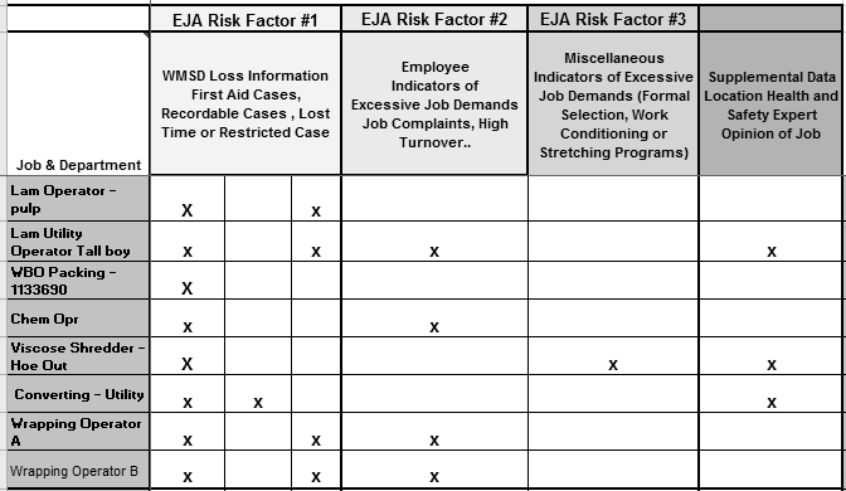
The first action was for each location to identify jobs with potential ergonomic issues and list them in a spreadsheet as shown in figure 4 as being a potential high risk job (PHRJ). Jobs were listed if there were recorded WMSD in- juries or employees had reported MSD signs or symptoms, if there were employee complaints or high turnover rates, or if the jobs required physical conditioning time or were restricted to a specific job population. Additionally jobs typically considered to be “hard jobs” were included in the spreadsheet. The jobs listed on the spreadsheet became the pool of jobs for each location’s 5-year goal objective. In this way the number of jobs for each location was inde- pendently determined by each location and was based upon their operations and potential WMSD risk.
Figure 4: Potential high risk job pool worksheet example
Knowledgeable and Skilled Personnel Resources Individuals from each manufacturing and distribution location completed a rigorous series of computer-based train- ing modules in biomechanics, physiology, anthropometry, and workstation design solution identification. Business justification and project management strategies were also required training for the ergonomic resource person at each location. Also, each resource individual participated in a 3-day, hands-on workshop conducted in a manufactur-
Edited by T. Ahram, W. Karwowski and T. Marek ing location and submitted three completed interventions, which were reviewed and critiqued by the corporate board certified (CPE) ergonomists (Larson and Wick, 2012; Larson, 2012). At the workshop, participants learned about and then practiced applying the standard job assessment tools to analyze manufacturing jobs for unacceptable WMSD risk exposures. They also practiced using measurement tools, such as force meters, goniometers, and pinch gauges, and learned how to video document the tasks to conduct more detailed posture analysis. By conducting the workshop at manufacturing locations, participants were provided hands-on practice analyzing actual jobs in situ. This formal training and EJA certification process were used to document that a core ergonomic knowledge base had been attained and that a verified ability to perform ergonomics job assessments had been developed. The num- ber of participants trained and certificates earned were enumerated for the period between 2004-2008.
Program Data Due to multiple causes, only descriptive data are available globally. Many locations did not fully participate in all five years of the project due to changes (e.g., acquired during the course of the project, closures, etc.). Similarly, during this time, the health and safety incident reporting system changed, which affected the consistency of the non- US WMSD data. However, it was possible to perform a more rigorous evaluation of the data from 33 plants located in the United States.
With regard to the program, 2004 was used as the baseline year for all data globally. During 2004, program actions were primarily preparation, completion of the initial training, and identification of the target jobs. The ergonomic in- terventions were primarily completed between 2005 and 2008. The following analyses were conducted to study the effect of the ergonomics program.
First, each location’s responses to the ergonomics program implementation questions were compiled and reviewed. Next, the number of participants attending ergonomics workshops and participating in the EJA Certification process was determined. Finally, the number of targeted jobs remediated and the percent of risk factors reduced in those tar- geted jobs were calculated and summarized for global company locations by region.
WMSD Data from US Plants In addition, four different measures of WMSD were collected at 33 different US locations between 2004 and 2008. These were: the incidence rate of WMSD cases (WMSD IR), the incidence rate of WMSD cases resulting in days off work (WMSD LT IR), the incidence rate of WMSD resulting in days off or restricted work (WMSD SR IR), and the incidence rate of days off or restricted work resulting from WMSD (WMSD SR Days IR). The four reporting categories are defined by OSHA.
RESULTS
Program Implementation Program implementation was evaluated by reviewing the location answers to the ergonomics program implementa- tion questions for each year between 2005 and 2008. Very high implementation results of over 80% were reported for the US, Canada, and Europe. Asia and Central America locations reported implementation score between 60% and 80%. The impact of business acquisitions appears to significantly confound the results and increase the vari- ability both within regions and among regions. Due to data limitations it was not possible to evaluate the specific impact of acquisitions upon program implementation.
Resources During the five years, over 200 company health and safety staff from over 20 countries completed the required cour- ses and attended the 3-day workshop. There were 25 workshops conducted at company manufacturing locations around the world. Fifty-one individuals completed the entire certification process within the 5 years, and 130 were still pursuing the certification after 2008. During these five years, there was approximately a 10% dropout rate pri- marily due to changes in job responsibility of work location.
Edited by T. Ahram, W. Karwowski and T. Marek
Job Analysis Locations applied the ERRP (conducted ergonomic job assessments, implemented ergonomic interventions, and conducted post job assessments) for target jobs listed in their potential high risk job pool (PHJRP). The target job distribution ranged from a low of 1 to a high of over 80 as showed in Figure 5.
0 20 40 60 Distribution of Target Jobs by Location
1 - 10
11 - 20
21 - 30
41 - 50
60 - 70
51 - 60
> 80 jobs
Figure 5: Distribution of target jobs (n=116)
Figure available in the original PDF paper.
Risk reduction was determined by completing before-and-after job analysis. The number of times a WMSD risk ex- posure exceeded the unacceptable level for any of the EJA 36 exposure elements was totaled and used as the base- line risk number. Subsequently, the same process was used to determine the number of risks present after remedia- tion. The percent reduction of risk elements was based on the post risk number divided by the baseline risk number.
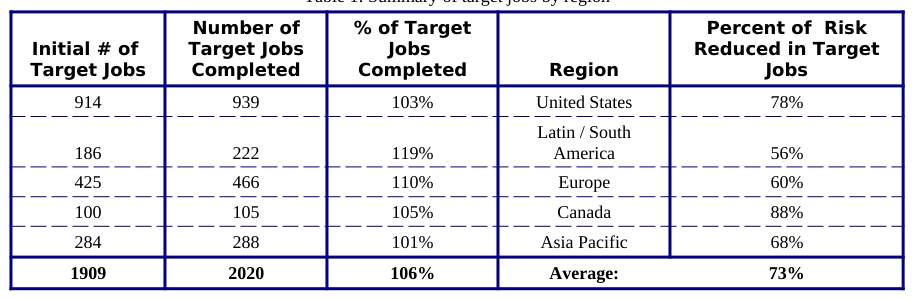
Globally, 116 locations participated in the Ergonomics Goal: 57 US, 16 Asian, 5 Canadian, 30 European, and 8 Latin and South American. Initially, the number of jobs identified for ergonomics analysis was 1909; however, a to- tal of 2020 jobs were completed during the five years as some locations exceeded their initial target number. The number of jobs targeted in US locations (48%) versus non-US locations (52%) is generally proportional to the com- pany’s overall operation distribution.
Table 1 summarizes by region the number of target jobs addressed and the percent of identified unacceptable WMSD risk exposure reduced.
Table 1: Summary of target jobs by region % of Target Number of Target Jobs
WMSD Case Incidence Rates Incidence rate data regarding WMSD cases were available from US based facilities. Incident rates are based on the following standard formulas, and represent the incidence of an event per 100 workers per year worked.
The number of WMSD cases per 100 workers per year worked is defined as (WMSD IR) = (WMSD cases * 200,000) / number of work hours. The number of WMSD cases resulting in days off work (WMSD LT IR) = (lost- time WMSD cases * 200,000) / number of work hours. The incidence rate of WMSD cases resulting in days off work or days restricted work (WMSD SR IR) = (lost-time WMSD cases + restricted time WMSD cases) * 200,000/number of work hours. The WMSD days severity incidence rate (WMSD SR Days IR) = (lost-time WMSD
Edited by T. Ahram, W. Karwowski and T. Marek
days + WMSD restricted time days) * 200,000/number of work hours.
As shown in Figure 6, for US locations there was a 28% reduction in all WMSD recordable cases, a 29% reduction in restricted time WMSD recordable cases, and a 59% reduction in lost time WMSD cases between 2004 and 2008.
2.00
1.50
1.00
0.50
0.00
Ergo IR Restricted Time Ergo Cases Ergo LT IR
Figure 6: US ergonomic recordable incident rates: 2004 - 2008
Figure available in the original PDF paper.
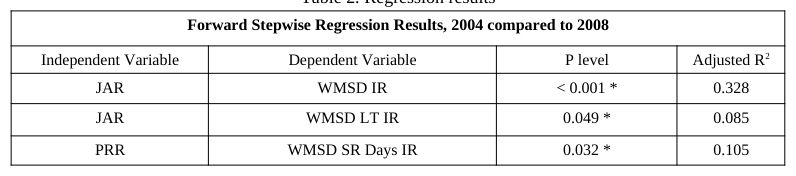
Regression Analysis The WMSD incidence rates described above were analyzed using forward stepwise regression to evaluate the impact of the program implementation and risk exposure reduction upon WMSD incidence rates at the beginning and end of the five year program for 33 US locations (2 mining operations, 2 distribution centers, 29 manufacturing operations) for whom data was available for all 5 years.
The effect of the number of target jobs completed and the percent of risk factors reduced (PRR) on the WMSD inci- dence rates was evaluated using forward stepwise regression. Both reduction of the number of target jobs and the percent reduction of risk factors were found to have significant effects in reducing WMSD incidence rates.
For this analysis, the number of target jobs was normalized to establish a job assessment completion rate for target jobs per 100 employees using this formula: Job assessment rate (JAR) = (Number of target jobs completed * 200000)/ number of work hours There were four significant results of the regression analysis, which are presented in Table 2.
The results demonstrate a significant effect between JAR and subsequent reduction of WMSD cases and WMSD LT cases. Specifically, the greater the number of jobs targeted per 100 employees (more employees impacted by inter- ventions), the greater reduction of both WMSD cases and WMSD LT cases. There is also a correlation between the overall percent of unacceptable risk (PRR) elements reduced and the WMSD Severity incidence rate: the greater the percent reduction in unacceptable risk elements the fewer lost and restricted workdays.
A suggestive, but insignificant relationship exists between WMSD Lost Days IR as a function of JAR with a p-value of 0.069. It is interesting that there was no significant relationship between WMSD Severity (lost and restricted) cases as a function of JAR. Why? Maybe quicker return to work?
Edited by T. Ahram, W. Karwowski and T. Marek DISCUSSION The research question this paper seeks to answer is: In a complex global company, what impact may the implemen- tation of a comprehensive ergonomics program in combination with a focused 5-year goal to reduce WMSD risk ex- posures have upon subsequent WMSD rates?
It is difficult to report scientifically whether this is successful as there is no research golden standard applied and no reference or control group. However, statistically significant reductions were reported in this paper and the effects are clear. The initial company intention was to reduce the number of unacceptable risk exposures in 1909 target jobs by 75%. The result was 73% of unacceptable risk exposure in 2020 jobs was accomplished. Other studies on this program clearly show financial benefits in operational efficiency as well as WMSD risk reduction (Larson et al., 2014). The estimated operational efficiency financial benefits of 18 internal award winning case studies from 2010 and 2011 was over $3,500,000. Caroly et al. (2010) also described that there are both hard, quantified, financial ben- efits and soft, non-financial benefits of these types of ergonomic interventions.
The program elements in this case study are based upon research identifying what a successful ergonomics program should include (GAO, 1997; NIOSH, 1997; OSHA. 1993). The strength of this case study is that these elements are as much as possible applied within one global company with a common perspective and support of health and safety. The in-depth analysis of the 33 US locations that participated throughout the 5 years of the study was also valuable as the remediation of target jobs and MSD risk factors was shown to reduce both the incidences of WMSDs and the lost or restricted work days associated with WMSDs.
However, real world data has gaps and variability; this is especially true in a global company’s data. In this review for example, the impact of acquisitions upon the program implementation results was not able to be researched. Also, the non-US and Canadian locations reported more variability in program implementation, which would have been interesting to understand, especially to research the program implementation and WMSD impact differences of various countries. The impact of program implementation is difficult to study given the real-world data limitations. Also, differences in country specific regulations led to inconsistent reporting of WMSDs. Due to these confounding influences, the global data analysis was limited to descriptive summary information of risk exposure reduction and percent program implementation by region. No formal analysis was possible regarding impact of program elements upon WMSDs. This is an area that needs further research in order to better understand the impact of each program element upon WMSD reduction.
Another issue in applied research is that there is no control group, and approaches of the trained and untrained ex- perts could be different, thereby having an effect on the outcome of the study. However, if too much is standardized in research and microergonomic solutions are prescribed like in the study of Driessen et al. (2011), the primary needs of employees are not tackled and effects could be small. This study is quite the opposite: large effects, but not much is standardized in the research design as it is a field study from many locations with independence to decide for the intervention process and solutions. In previous overviews of field projects with few implementation restric- tions, large effects are shown as well (e.g. Koningsveld et al., 2005). And, when we researched various microer- gonomic improvements after a comprehensive workplace improvement in an office organization, we found no sig- nificant additional effects upon WMSDs (Larson, 1996).
To increase the knowledge, there is a need for collaboration between research and practice, which is recognized within the ergonomics profession (Chung, 2011; Neumann, 2010; Buckle, 2011). The application of an ergonomics program is the world of practitioner. In the introduction it is shown that elements of the program are based on re- search, which could probably play a role in the success. But knowledge needs to be more specific and there is a need to find out which elements are crucial and which are less important. It seems that considering core ergonomics train- ing and job assessment training of persons on the work floor can impact WMSDs in industrial operations (Haydee, 2011; Herrera, 2011; Stanton, 2003; St. Vincent, 1997; Vink, 2005), but also the macroergonomic, man- agement commitment, and participatory ergonomics combinations seem useful for setting the stage for macroergonomics to be applied (Hendricks, 1996).
Edited by T. Ahram, W. Karwowski and T. Marek CONCLUSION This study shows that a real world application of ergonomics to reduce WMSDs within a complex global company can be successful. The results prove that an ergonomics program consisting of elements of management commit- ment, identification and improvement of problem jobs, and knowledgeable location-based resources to reduce WMSD rates and severity is useful.
REFERENCES
3M website. 2013. http://3msource.mmm.com Auburn Engineers, Ergo Job Analyzer User Guide, Auburn Engineers, 2003. Buckle, P 2011 Participatory ergonomics: From participation research to high involvement ergonomics. Ergonomics. 54: 1 – 11. Carolly, S., Coutarel, F., Landry, A., & Mary-Cheray, I. (2012). Sustainable MSD prevention: Management for con-
tinuous improvement between prevention and production. Ergonomic intervention in two assembly line com- panies. Applied Ergonomics, 41, 591–599. Chung, A.Z.O, Shorrock, S.T. (2011) The research-practice relationship in ergonomics and human factors - surveying and bridging the gap. Ergonomics: 54(5):412-429. Driessen MT, Proper KI, Anema JR, Knol DL, Bongers PM, van der Beek AJ. 2011. The effectiveness of
participatory ergonomics to prevent low-back and neck pain – results of a cluster randomized controlled trial, Scand J Work Environ Health, 37(5):383-393. US Government Accounting Office (GAO). (1997). Worker protection: Private sector ergonomics programs yield positive results (GAO/HEHS-97-163). Washington, DC. Haines H, Wilson JR, Vink P, Koningsveld EAP. Validating a Framework for Participatory Ergonomics. Er-
gonomics 2002; 45(4):309-327. Haydee Mejias Herrera, S, Huaccho Huatuco, L., (2011). Human Factors and Ergonomics in Manufacturing and Service Industries. 21(3) 227-243. Hendricks, H. (1996). The ergonomics of economics is the economics of ergonomics. In Proceedings of the Human
Factors and Ergonomics Society 40th Annual Meeting (pp. 1–10). Santa Monica, CA: Human Factors and Er- gonomics Society. Herrera S, Huatuco, L., Human Factors and Ergonomics in Manufacturing & Service Industries 21 (3), 2011, 227-
243. De Jong, AM de, Vink, P. Participatory ergonomics applied in installation work. Applied Ergonomics 2002; 33:439-
448. Koningsveld, J, Dul,,J. Van Rhijn, GW, Vink, P. 2005. Enhancing the impact of ergonomics interventions. Ergonomics 48 (5), 559-580. Larson, N, (2006). Macroergonomics in Global Corporations “Going Global” In O. Brown Jr. and H.W. Henrick
(Eds.), Human Factors in Organizational Design and Management – VIX. Larson, N, (2008). Macroergonomics in Global Corporations “How to Get it Done” In O. Brown Jr. and H.W. Henrick (Eds.), Human Factors in Organizational Design and Management – VIII. Larson, N., & Wick, H. (2012). 30 years of ergonomics at 3M: A case study. Work, 41, 1622–1624. Larson, N., 2012 Corporate Ergonomics: Its Musculoskeletal Disorder Management and System Optimization.
HFES Ergonomics in Design, 20:29-32. Larson, N, 2012, A New Way to Establish Ergonomics Expertise in Manufacturing Locations Without Ergonomists Applied International Human Factors and Ergonomics San Francisco Larson NJL. MS, Miezio,K., Shear, K., Ault, G.,Tepper, D., Gottleib, M.K. (1996) Pilot Study to Assess Strategies
to Reduce Work-Related Musculoskeletal Disorders Associated with Computer Work. Human Factors in Or- ganizational Design -V Elsevier Science Molen, HR, Sluiter, JK, Hulshof, CTJ, Vink, P. 2005. Scandinavian Journal of Work, Environmental & Health, 75- 87National Institute for Occupational Safety and Health NIOSH. 1997. NIOSH/OSHA Ergonomics Best Practice Conference. NIOSH. 1997.Elements of Ergonomics Programs. US. Department of Health and Human Services. Neumann W, Eklund J, Hansson B, Lindbeck L. (2010) On Effect Assessment in Work Environment Interventions – Social and Organizational Factors (2020)
Edited by T. Ahram, W. Karwowski and T. Marek A Literature Overview and Methodological Reflection. Industrial Engineering Publications and Research Pa- per 2. Noro K & Imada AS: Participatory Ergonomics, Taylor & Francis, 1991, London. Punnett L& Wegmann DH 2004 Work-related musculoskeletal disorders: the epidemiologic evidence and the de-
bate. Journal of Electromyography and Kinesiology 14 (2004) 13–23. Robertson, M., 2001. Macroergonomics: A work system design perspective. 2001 Conference – Ergonomics for changing work. Comptes rendus du congrès SELF-ACE 2001 – Les transformations du travail, enjeux pour l’ergonomie. Proceedings of the Self-ace Plenary Sessions 67.volume 1.. Stanton, N.A., Young, M.S. 2003 Giving ergonomics away? The application of ergonomics methods by novices.
Applied Ergonomics, 34: 479-490. St-Vincent M, Kuorinka I, Chicoine D, Beaugrand S. (1997) Assimilation and Use of Ergonomic Knowledge by Nonergonomists to Improve Jobs in Two Electrical Product t Assembly Plants. Human Factors and er- gonomics in Manufacturing. 7(4): 337-350. US Dept. of Labor Ergonomics Program Management Guidelines for Meatpacking, U.S. Department of Labor.
OSHA 3 123, 1993. Vink P, Ed. Comfort and design: principles and good practice. Boca Raton: CRC Press, 2005. Vink, P., Imada., A., Zink, K., Defining Stakeholder Involvement in Participatory Design Process, Applied Ergonomics, 39, 2008, 520 – 526.
LISTED IN THE AHFE DIGITAL BOOKSTORE CATALOGUE
Explore the complete digital volume
Advances in Social and Organizational Factors
Read this individual research paper free through the original publisher, or explore the full digital proceedings book.
ISBN 978-1-4951-2102-9
Explore this ISBN in the AHFE Bookstore ↗Listed in the July 2026 bookstore catalogue; search by ISBN to confirm current availability · Digital book purchase optional