Aleksandra Jasiak (2020). Macroergonomics in the Design of the Quality of Work Environment and of Human Life: Examples of Practical Applications. In: Advances in Social and Organizational Factors. AHFE Open Access, vol. 9. https://doi.org/10.54941/ahfe100335
The purpose of this work is explaining what is the essence of macroergonomics, on basis of the analysis of the world achievements from the scope of disciplines: human factors ergonomics, project studies, science studies, organization theory, psychology and sociology. Moreover, what is the role of macroergonomics in the formation of not only the quality of the technical environment or the work environment, but also the quality of life of individuals, as well as entire populations. Macroergonomics is, according to the classification recognized in world, the third phase of the evolution of ergonomics, which is the most current and modern generation of ergonomics. In other words, macroergonomics is an organization – machine interface technology. Elements of macroergonomics (criteria and determined scientific areas, as well as tendencies that contribute the creation of the essence of macroergonomics) are presented from two sides: the conceptual and methodological side and the side of possibilities for practical implementations (the set of works realized by the author along with works made under her direction). The paper is composed from four integral threads. The first part presents views on the quality of life and the quality of the work environment. The second part is dedicated to the genesis of macroergonomics and to prospects of its development. The third part, in view to its limited volume, illustrates the general image of different possibilities to apply macroergonomics into practice in determined areas of technique and economy. The paper presents an example of a demand of enterprises for ergonomic knowledge in relation to the process of designing the company’s strategy and marketing plan, presented for the case of authorized passenger cars dealer companies. The work ends with a conclusion on the role of macroergonomics in the creation of the man’s quality of life and possibilities of the development of this discipline in the future.
Before macroergonomics has been created, the traditional European ergonomics was focusing on problems of integrating man and technique using Maslow’s hierarchy of needs as a point of departure. This meant fulfilling basic needs, like physiological and safety needs. Macroergonomic interferes more in the area of so-called higher needs, like: belonging to a group, respect or self-actualization. In the process of designing manufacturing processes in accordance to traditional criteria, the human factor criteria had a very small share of proportion. Modern proportions assume that social, ecological and ergonomic criteria consist in total 25% of all – next to technical and economic criteria.
A concept of quality of working life QWF grew on the ground of organization theories and psychological and social sciences. The aim of this idea is to augment the participation of the staff in the process of making decisions that affect their everyday work and their quality of life in their place of work. Increasing efforts for raising the quality of working life results from the recognition (acceptance) of fundamental values, like: safety, justice, honesty, loyalty, partnership, tolerance, independence, freedom, satisfaction and self-actualization of an individual person (Misztal and Butlewski, 2012). The presented idea in a sense a challenge for macroergonomics, which should form rules of a design that would be “friendly” to a worker of the company, taking into account the external and internal environment, based on the system and holistic approach.
In practice, the application of macroergonmic theories can refer to various spheres of technique and economy, for example: elements of macroergonomics in companies following the pro-qualitative policy, within frames of ISO 9000 standards, including TQM implementations and their impact on macroergonomics. Next, elements of macroergonomics in the reduction of the stress at work – on basis of the example of the management of companies, and the concept of the examination method and results of research in practice. Moreover: economic transitions of the country’s region and changes of the structure of the labor market presented by the example of universities graduates in Greater Poland.
QUALITY OF LIFE AND QUALITY OF WORK ENVIRONMENT The term quality of life is used in many scientific disciplines. However, it is important to say that despite the variety of existing concepts, none of sciences (even psychology) had formed an unequivocal stand on the way to interpret the quality of life (Kowalik, 1993). Many scientists, especially from the area of economy, treat the quality of life as a indicator of the level of life standard for individuals or social groups. Thus, it might include different partial indicators, and each of them refers to one of arbitrarily selected spheres of the life, e.g.: family, psychical, professional, somatic, environmental or residential. The reduction of the global characteristic to only one dimension leads to an excessive simplification of the case. Therefore, objective indicators are supplemented by a similar set of subjective measurers, which encloses people’s opinions on the way they evaluate selected areas of their own life.
The work environment is a term difficult to define in a firm way. Each discipline focusing on man and his activity interprets this term in a way that fits to its scientific and methodological view (economy, law, work organization, occupational medicine, psychology, sociology, etc.). It is relatively easier to find certain categories and dimensions that would describe these terms, than to find their definitions. The author has found only one definition of the work environment. It determines it as natural physical and chemical parameters that characterize a technological process and the place, in which the process takes place, and biological and social elements, which often cannot be measured, added by man into production and organization of work as additional elements (Jethon and Krasucki and Rogoziński, 1982).
The work environment is mutually created by both categories (Bańka, 1985): the objective and subjective one. The so-called objective work environment is formed by physical and tangible criteria: room, machine, raw material, factor of the physical environment. Other category is immaterial criteria, independent of the will of the man, i.e. organizational criteria, like fast tempo of work, multiplicity of different tasks. The remaining category constitutes a set of criteria that can be called socio-technical and which come from the human environment, like the influence of the group to an individual that works in it, the ambience at work that is formed by the performance and attitude of others, etc. The so-called subjective work environment is shaped by a set of subjective factors, i.e. determined by people, which establish the final form of the physical and psychical structure of an individual and which decide on the personal perception of the quality of work.
Psychological approaches stress the subjective character of the quality of life, which means its dependency from the point of view of from the opinion of the assessing person on the physical and psychical reality. Therefore all psychologists and other scientists say most often about the sense of quality of life. Psychological normative approaches take under consideration external objective conditions and determined methods for dealing with stress, types of social relations, etc. (Derbis, 2002). People that have different level of accordance with determined psychological models are assumed to have a suitably higher or lower quality of life (fig.1).
Fig. 1. Prototype of the model of sources and quality of life measurement (Derbis, 2002) According to some authors, the term “work environment” is deceptively identified with a much wider term – work conditions. The author thinks that the present stage of development of ergonomics and macroergonomics already explicitly settled with holistic system including various environments that co-create the composite nature of the work environment of man as an individual.
At present macroergonomics does not have finally formed methodological output. However, taking under consideration scientific approaches consisting the found of modern trends for the economic development and achievements from other domains of human science, we could form following premises – criteria for design that would be friendly for the worker and his composite environment:
1. Preference of technologies safe for the man and the natural environment; 2. Safety on workplaces and their external environment (these criteria are affected mostly by: time of work, material and physical factors of the work environment); 3. Diversity of performed tasks and possibility of widening workers’ comprehensive tasks, which would enclose several stages of one process; 4. Possibility of continuous self-actualization – this category includes conditions for continuous formation and gaining new skills, as well as possibilities of implementing them in the workplace and chances for promotion; 5. Certainty of the place of employment (enterprises); 6. Interpersonal relations and the atmosphere of the workplace – with particular attention on following elements: level of tolerance for individual habits, the atmosphere in the team of employees, friendliness, openness, etc. 7. Range of participation in the decisive process within companies; 8. Preference of so-called „stress on a level acceptable by an individual” – it is about obtaining the effect of the projection of negative phenomena of the process of the work to other spheres of the life of the individual in order to allow a worthy way to fulfill other social roles; 9. Prestige of the enterprise in the opinion of the employee – this criterion refers to the way employees evaluates their company – e.g. whether it works in a legal and responsible way; 10. Appropriate and fair wages – this criterion concerns not only “the objective amount of the remuneration”; it also refers to the sense of justice in distributing wages among workers.
Presented suggested list of criteria does not exhaust the entire scale of criteria for a design that would be friendly for the worker and his composite environment. It is rather aimed at illustrating how much the problem of methodological frames in macroergonomics is different from the classic range and essence of first generation of ergonomic research and what problems should be in the center of interest of macroergonomics to make this area of knowledge useful in solving problems of the current and future economic and social reality.
GENESIS OF THE ERGONOMICS Ergonomics is a composite empirical science directed on many aspects of cognition of the man-to-technique system and on preparing a set of guiding statements for implementing in practice the bilateral adjustment of participants of the system, in order to guarantee the most profitable conditions of its functioning. W.F. Taylor, at the turn of the 19 th
and 20th centuries, was the first, who initiated attempts of organizing work on scientific bases and of research on forming possibly efficient tools and work conditions for man. The publication of work “The trait of the ergonomics, i.e. theories about work, based on truths taken from Natural Science” in 1857, written by Wojciech Jastrzębowski, Polish naturalist, was a fundamental fact for the history of ergonomics. Ergonomics in Poland is also connected with the name of Tadeusz Kotarbiński, who put ergonomics on the list of so-called ergo-logical sciences, even though he did not enriched significantly its theoretical or practical aspect (Pacholski, 1977). Ergonomics in Poland had a particular character, from the point of view of its methodology. In first years after the Second World War there was not many system approaches and initiated studies and implementations were initially connected with ideas of engineering psychology, industrial psychology, occupational medicine and anthropology. Polish scientists had a big input in the development of the theory and practice of ergonomics. However, their works were not entirely comprehensive and system character in the object scope. They were rather focused on partial problems of the system man-to-work. Problems associated with occupational medicine, psychology and anthropology were dominating research issues.
In the history of ergonomics, we can distinguish three stages of euduction: first, second and third generation of ergonomics. The first generation ergonomics (human – machine interface technology) was oriented on examining phenomena of the perception, issues of anthropometry and analysis and design of relatively isolated systems man- technical object. Enlarging this range of research and analysis with systems man-computer, including among others focusing on the study of cognitive and decisive processes of man constituted the beginning of a so-called second generation of ergonomics (user – system interface technology). The growing scale of automation in the process of production and computerization of clerical work and the increasing level of awareness on the impact of technique on industrial organizations accompanying these processes and, in consequence, affecting decisive processes, was the initial factor for creating the concept of a so-called macroergonomics, which constitutes the third generation of the ergonomics’ evolution.
It is accepted to call H.W. Hendricks a creator of macroergonomics because he has formed and justified the fundamental assumptions of this concept (Hendrick, 1987). Pioneering towards the macroergonomics concept of production systems design, which can be treated as an equivalent of socio-technical systems, was formed on the Polish ground relatively long time ago – in 1977. Leszek Pacholski and Konstanty Rogaliński have formed it; in their fundamental works from the year 1977, these authors formed a notional apparatus related to the study of socio- technical systems, called ergonomic industrial systems (Pacholski, 1977, Rogaliński, 1977). Pacholski is also the author of a methodology for ergonomic diagnosing and for the unique scientific instrument – the ergonomic problem list. Rogaliński focused on problems of formalization of parameters of the ergonomic industrial system and on forming mathematical models of its future states. Both scientists prepared methodological basis of the electronic processing of data and ergonomic information.
Macroergonomic design is a process based on the engineering design in its wide interpretation. The designer creates new production systems and enters into the role of an organizing and decisive person. Such form of design provides a fully efficient functioning of the system, not only because of its elements, but also in view to its users and their environment that affects them. This aim can be reached thanks to integrating different methods of designing. Methods, which recently were contradictory towards themselves, i.e. from one hand – product design, machine and device construction, and technological processes design, from another hand – organization design, co-create at present the macroergonomic design. Organization design is also a technical design with a much higher degree of complicating and difficulty. It results from the fact of existence of many criteria for examined systems. Macroergonomic design has the major advantage of making decisions in relations to all elements that form the system and perceiving them as mutually affecting and co-functioning with the environment subsystems instead of treating them as isolated objects.
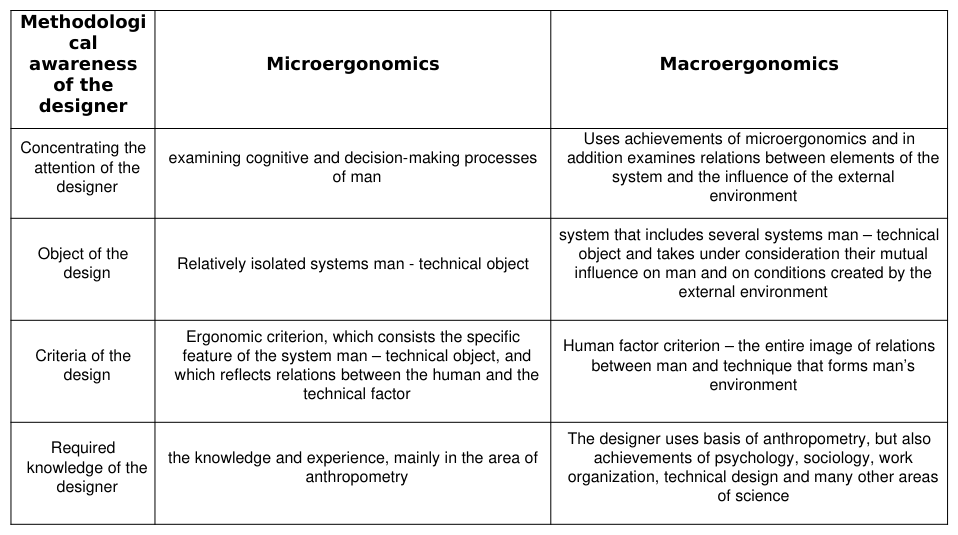
The table 1 presents a comparison of fundamental features of the micro- and macroergonomic design.
Table 1: Features diversifying the micro- and macroergonomic design (personal elaboration) Methodologi cal awareness
AREAS OF PRACTICAL APPLICATIONS OF THE ERGONOMICS Elements of macroergonomics, i.e. criteria and determined areas of research and tendencies that co-create the essence of macroergonomics, have been taken into two directions: from the side of the concept and methodology and from the side of possibilities for its practical application (a set of research works of the author or coordinated by the author). The fundamental motive for preparing the present work was that neither in Poland, nor in the world, there has been précised the methodological statute for macroergonomics and its essence and importance for the creation of the quality of the modern world. The essence of macroergonomics can be explicitly presented on examples from the practice. This requires presenting concepts and results of practical research referring to several spheres of elements of macroergonomics.
1. The first aspect refers to the strategy of the enterprise and its marketing activity. Therefore, the author presents a dissertation on the development of macroergonomics in view to modern strategies of the company.
2. The second example refers to enterprises that realize a pro-quality policy in accordance to ISO 9000 standards. The author paid attention on the impact that implementation of the TQM in companies has on the development of macroergonomics. The author also focused on work design in TQM systems in reference to needs of the human factor.
3. The third example from the practice shows elements of macroergonomics in the formation of the level of organizational stress at work on the example of the management of the company. The managers’ stress was determined as a form of barrier in exploiting the potential of the human factor for the development of the company.
REQUIREMENT FOR THE ERGONOMIC KNOWLEDGE IN RELATION WITH ENTERPRISE STRATEGY DESIGN AND FORMATION OF THE MARKETING PLAN FOR AUTHORIZED DEALERS OF PASSENGER CARS The problem of ergonomics constitutes a center of interest of industrial enterprises for years. These are particularly companies in a good financial shape and with a stabilized position on the market. Another problem that traditionally dominates the modern sphere of demand for ergonomic knowledge is the question of quality of work conditions in the range of work analysis and assessment of workstation, as well as preparing engineer solutions that would eliminate basic nuisances. In general, the need for this type of classical ergonomic topic comes from two groups of enterprises:
1) The first group encloses firms rich enough to invest in the improvement of the quality of work conditions and work environment. 2) The second group enlists companies with an expansive strategy of product, which maintain systems of quality management. In this case, an appropriate quality of work conditions and its periodical control constitutes an integral element of the system (determined by standards ISO 9001, OHSAS 18001, ISO 26000), and the improvement of the work environment is usually a consequence of modernization of technologies and production processes organization.
The presented characterization demand to the ergonomic knowledge on the market of enterprises explicitly shows two general, complementary conclusions result:
1. Enterprises are interest in problems of ergonomics as long as ergonomic knowledge is useful in solving problems directly or at least directly affecting the improvement of their profitability. 2. Companies focus only on aspects of ergonomics that integrally and naturally constitute components of their designed processes of modernization and reorganization. Looking at the problem from the wider scope – it means designing strategies for actions determining pattern for realizing established goals of the firm in accordance to the superior principle of maximizing the profit in determined periods of time.
The crucial difference between traditional and strategic planning is in the fact that the traditional planning accepted that all necessary information can be obtained in the beginning of the process of planning. The modern, strategic approach determines ways to use current pieces of information obtained in time and shows how to react to it and use it. A good marketing plan should determine specific market goals of the company and explicitly point at particular strategies and methods of reaching these goals.
Designing marketing activity is a very good example of both determined direction and possibilities of solving modern dilemmas from areas of human factors and ergonomics. It also illustrates the role that ergonomic knowledge can and should have in the domain of design of modern strategies of enterprises. Moreover, designing the marketing activity in reference to authorized dealers is an interesting problem because of the specification of these enterprises (relative autonomy in reference to the producer) and because of the multiplicity of forms of activity of the human factor. Presented characteristics cause that, in the process of designing, next to the so-called problem of industrial ergonomics, appear a whole range of questions concerning humanization of the technique and work that go significantly beyond the mentioned traditional area of ergonomics. All these problems or areas of ergonomics, both classic and modern, co-create the modern concept of macroergonomics.
Requirements for the marketing plan differ depending from the size of the company. A small enterprise does not have such means as a big company. Therefore, in comparison to a big firm, a small company’s marketing plan is suitably less developed or detailed. However, independently from the range, reach of the plan and degree of its Social and Organizational Factors (2020) accuracy, the procedure itself of preparing the design of a marketing plan, along with all components of its structure, can be presented in a form of a general graph, as shown on the figure 2.
Fig. 2. Generalized scheme of the preparation of the design of a marketing plan (personal elaboration)
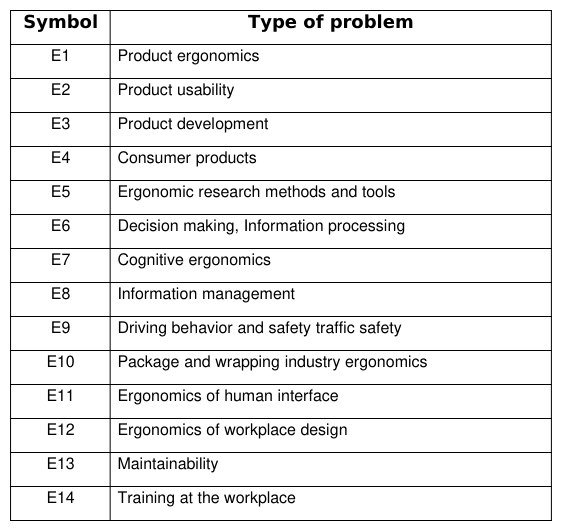
Distinct elements in the scheme of the ergonomic knowledge are integral elements of the knowledge necessary in designing a marketing plan for a company. The structure of these elements is presented in the table 2.
Table 2: Structure of problem co-creating the essential range of macroergonomics (personal elaboration) Symbol Type of problem
The table does not deplete all possible ergonomic criteria. It is being assumed that along with the development of macroergonomics and new needs appearing, new criteria will be also prepared.
CONCLUSIONS
Man and his intellectual capacities becomes the more and more important in modern social and economic processes realized in industrial enterprises. However, the shape of health of a modern society is constantly decreasing. This problem becomes particularly important in view to the growing number of freelancer professions, the rapid pace of life and work, information overload, great motivation for the fast professional career, and therefore: workaholism, inappropriate nutrition, insanitary lifestyle, lack of skill for organizing own life in a way to combine the professional and private life. These are problems, on which currently macroergonomics should focus on, interpreted both as a science, and as a practical discipline of knowledge.
Today’s human techniques of design are characterized with more and more psychology. This means that the organization approach combined with the macroergonomic design of work systems should focus mainly on: [Equation or mathematical symbol available in the original paper PDF] Changing ways of performing tasks,
• Changing physical work conditions, [Equation or mathematical symbol available in the original paper PDF] Introducing participation methods of management,
• Introducing possibilities of free deciding on choice of methods of wok by the employee himself,
• Introducing possibilities of choosing patterns of professional career and promotion, [Equation or mathematical symbol available in the original paper PDF] Analyzing the role assigned to workers and adjusting ranges of their responsibilities to individual expectations and abilities,
• Reinforcing connections between workers on levels: superior – subordinate – work partner.
It is not possible to present macroergonomic guidelines that would be internationally suitable. Every country has its own set of economic sectors and specific character of the level of technical civilization. Macroergonomics in a way solves current problems in specific localizations. However, that does not change the fact that macroergonomics remains an international discipline and its frames are still universal for workplaces all over the world.
REFERENCES
Anghel, D.C., Belu, N. (2013)„Contribution to Ranking an Ergonomic Workstation, Considering the Human Effort and the Microclimate Parameters, using Neural Networks”, Applied Mechanics and Materials 08/2013. Bańka, A. (1984), „Psychologiczne wyznaczniki metodologii analizy i projektowania systemów” seria Rozprawy nr 152,
Wydawnictwo PP, Poznań. Bańka, A. (1985), „Zarys koncepcji teoretycznej wprowadzania zmian w systemach zdeterminowanych zachowaniowo”, Zeszyty Naukowe Politechniki Poznańskiej seria Organizacja i Zarządzanie nr 12, Wydawnictwo PP, Poznań. Butlewski, M. (2013), „Extension of working time in Poland as a challenge for ergonomic design”, MACHINES,
TECHNOLOGIES, MATERIALS Issues 11/2013. Derbis, R. (2002), „Integracja psychologicznego i ekonomicznego pojmowania jakości życia”, (in:) Inżynieria jakości ’02, Grudowski at al. (ed.), Wydawnictwo Akademii Morskiej w Gdyni, Gdynia. Gołaś H., Mazur A. (2008) „Macroergonomic aspects of a quality management system”, (in:) Macroergonomic paradigms of
Management, Jasiak (ed.) to honour 40 years scientific activity of Professor Leszek Pacholski, Poznan University of Technology Editorial Board, Poznań. Górny, A. (2011), The Elements of Work Environment in the Improvement Process of Quality Management System Structure, (in:) Advances in Human Factors, Ergonomics, and Safety in Manufacturing and Service Industries, Karwowski, Salvendy (ed.), CRC Press, Taylor & Francis Group, Boca Raton. Hendrick, H.W. (1987), „Macroergonomics: A concept whose time has come”, Human Factors Society Bulletin Vol. 30 No 2. Jasiak, A. (1993), „Kryterium czynnika ludzkiego w projektowaniu systemów wytwórczych”, Wydawnictwo PP, Poznań. Jasiak, A., Misztal, A. (2004), „Makroergonomia i projektowanie makroergonomiczne. Materiały pomocnicze”, Wydawnictwo
PP, Poznań. Jasiulewicz-Kaczmarek, M. (2013), „The role of ergonomics in implementation of the social aspect of sustainability, illustrated with the example of maintenance” in: Occupational Safety and Hygiene, Arezes, Baptista, et al. (ed.), CRC Press, Taylor & Francis, London, pp. 47-52 Jethon, Z., Krasucki, P., Rogoziński, A., (1982), „Normy fizjologiczno – higieniczne w medycynie przemysłowej”, Wydawnictwo
Marcus, Łódź. Karwowski, W., Kantola, J., Rodrick, D., Salvendy, G., (2002), „Macroergonomic Aspects of Manufacturing” in: Macroergonomics : theory, methods, and applications, Hendrick, Kleiner (ed.), CRC Press, London. Kowalik, S. (1993), „Psychologiczne wymiary jakości życia”, in: Myśl psychologiczna w Polsce odrodzonej. Efektywność
działań człowieka (Ed. Bańka A., Derbis R.), Wyd. Gernini, Poznań – Częstochowa. Lewandowski, J. (1998), „Zarządzanie jakością. Jakość ergonomiczna, bezpieczeństwo pracy, ochrona środowiska”, Wydawnictwo Marcus, Łódź. Misztal, A. (2013), „The impact of leadership on the quality management systems”, (in:) Book of Proceedings of 8th
Research/Expert Conference with International Participation, University of Zenica, Neum, Bosnia and Herzegovina. Misztal, A., Butlewski, M. (2012), „Life improvement at work”, Publishing House of Poznan University of Technology, Poznań. Pacholski, L. (1977), „Metodologia diagnozowania ergonomicznego w przedsiębiorstwie przemysłu meblarskiego” seria Rozprawy nr 81, Wydawnictwo PP, Poznań. Pacholski, L. (2000, „Macroergonomic paradox of entrepreneurship and economic renewal”, (in:) Ergonomics for the new
millennium vol. 2, Human Factors and Ergonomics Society, Santa Monica, CA. Pacholski, L., Jasiak, A. (2011), „Makroergonomia”, Wydawnictwo PP, Poznań. Rogaliński, K. (1977), „Ergonomiczny system przemysłowy w przedsiębiorstwie przemysłu meblarskiego” seria Rozprawy nr 82, Wydawnictwo PP, Poznań.
LISTED IN THE AHFE DIGITAL BOOKSTORE CATALOGUE
Explore the complete digital volume
Advances in Social and Organizational Factors
Read this individual research paper free through the original publisher, or explore the full digital proceedings book.
ISBN 978-1-4951-2102-9
Explore this ISBN in the AHFE Bookstore ↗Listed in the July 2026 bookstore catalogue; search by ISBN to confirm current availability · Digital book purchase optional