in Automotive Industry (2020). Influence of Macroergonomic Factors on Production Systems Organizing. In: Advances in Social and Organizational Factors. AHFE Open Access, vol. 9. https://doi.org/10.54941/ahfe100333
Anna Stasiuk-Piekarska, Milena Drzewiecka and Grzegorz Dahlke, Department of Ergonomics and Quality Engineering, Poznan University of Technology, Poznan, Strzelecka 11 Street, POLAND ↗
The paper discusses the need to recognize factors determining the ergonomic conformity of production systems. The focus has been found to be vital for the design of such systems. To help adopt the approach, the authors have identified factors which affect the ergonomic conformity of production systems in the automotive industry and subsequently had them verified by experts. Furthermore, they employed the network thinking methodology to analyze the time and severity of impact of the individual factors. The studies carried out by the authors have made it possible to develop a model for the management of ergonomic factors. The authors additionally proposed conclusions on ergonomically-driven measures intended to eliminate barriers in designing production systems and on opportunities for enhancing the ergonomic conformity of working environment in manufacturing plants.
One of the roles of management is to ensure proper organization design. Such design combines the planning of activities and their proper deployment associated with carrying out and controlling of e.g. production. While organization sciences date back to the 19th and 20th centuries, their principles should continue to be upheld on par with the latest management methodologies and the proactive strife for continuous improvement.
Over forty five years ago, the classic human-machine model was redefined to produce a multi-faceted system better suited to embrace third generation ergonomics, i.e. macroergonomics [Pacholski L., Trzcielinski S., Wyrwicka M. K., 2011, pp. 147, 148 [based on:] Hendrick H.W., Kleiner B.M., 2002; Jasiak A., 1993, p. 15]. As an ergonomic science, macroergonomics deals with sets of physical and social factors encountered in the working environment. Its focus is on relationships among complex production systems. Such systems, which provide e.g. regional and local technical support, constitute classic examples of macroergonomics [Pacholski L., Trzcielinski S., Wyrwicka M. K., 2011, pp. 147, 148 [based on:] Pacholski L., Wyrwicka M.K., 2006]. Furthermore, macroergonomics is a study of the impact of technical subsystems on organizational and worker subsystems complete with the details of the related deployments. “Macroergonomics has come to focus on the design of organizational and work system structures and related jobs and human–machine, human–environment, and user–system interfaces of new technique to the interaction between organizational factors and the technology used in the organization” [Erensal Y. C., Albayrak E.,
2007, p. 6, [based on:] Hendrick H.W., 1994, pp. 713–718; Hendrick H.W., 1995, pp. 1617–1624]. Macroergonomics emphasizes the interaction between organizational and psychological and social factors as well as the implementation and operation of technical items in the overall system [Erensal Y. C., Albayrak E., 2007, p. 6, [based on:] Hendrick H.W., 1994, pp. 713–718; Hendrick H.W., 1995, pp. 1617–1624]. Socio-technical design of work and macroergonomics are closely related. [Erensal Y. C., Albayrak E., 2007, p. 6, [based on:] Ingelgaêrd A., Norrgren F., 2001, pp. 93-105]. At the level of the organization of production systems, macroergonomics is a pivotal factor for effectiveness.
Businesses and other organizations as well as the people involved in them in various capacities (such as as employees) operate in a complex environment of mutual interactions. The links among them can be analyzed by means of the network thinking methodology which is a total approach. Studies relying on that methodology adopt a systemic view of issues with proper account taken of any such specific factors as affect the environment in which a given focus of research is embedded. Penc noted that Polish enterprises do little management while focusing heavily on ruling. For that reason, the analysis centers on identifying approaches which enable one not only to operate a business but also to protect human health and lives, specifically those of the enterprise’s labor force. It is therefore the aim of this paper to find ways “to boost the significance of ergonomic compliance in the design of production systems of automotive plants”. The discussion highlights the role of any stakeholders for whom addressing such issues should become central as well as any decision-makers in a position to influence their plant’s conformity status. Further in the study, the authors defined the mutual interactions and links among factors affecting ergonomic conformity of production system design. The outcome of this exercise was a network of mutual interactions. Subsequently, experts were used to assess:
- the relationships and the nature of interactions among factors affecting the matter at hand (adversely or positively), - the type of such relationships and interactions (two- or one-way), - their intensity (ranging from no impact, defined as “0”, to very strong impact, assigned the value of “3”) - the duration of impact of individual factors on the matter at hand (ranging from short to long). All of these factors were brought together to devise an impact matrix featuring active, passive, critical and indolent factors, as well as an intensity map differentiating between managed and unmanaged factors. Today's business organizations operate in a network of relationships and links between themselves and the external environment. Similarly, affected by all-encompassing globalization, people are part of greater entities (such as universities or industrial plants) which also interact among one another. Such links can be researched by means of the network thinking methodology, which offers a comprehensive approach. Studies carried out by that methodology rely on the systemic approach to the issues at hand. They additionally recognize any factors which significantly affect the examined environment. When employing the network thinking methodology, it is essential to use precise and understandable language. Terms and notions should only be defined after a debate involving all concerned parties. This is essential to ensure that the resulting view is consistent across the board. The methodology helps identify barriers and limitations of various sorts as encountered in the decision-making process [Grzelczak A., Werner K., 2011, pp. 21-22; Zimniewicz K., 2003]. The network thinking methodology rests on 7 theoretical foundations which are [Grzelczak A., Werner K., 2011, pp. 21-22; Zimniewicz K., 2003]: - the whole and its parts, - network characteristics, - openness, - complexity, - order, - management, and - growth. Procedurally, the methodology is followed through six stages which, in addition to adhering to the sequential order of the stages themselves, require responses to feedbacks which allow one to make adjustments in any completed stages. The stages involve [Grzelczak A., Werner K., 2011, p.24]:
- defining goals and developing a model of issues, - analyzing mutual interactions, - identifying and interpreting opportunities to modify current status, - explaining options to gain control, - devising an action strategy,
- adopting solutions to problems in business practice.
PRODUCTION SYSTEM ANALYSIS Defining goals and developing a model of issues
The study consisted in analyzing the production system of a selected automotive enterprise based in the Polish Region of Wielkopolska. The organization is a member of a large corporate group which emphasizes extensive customization of products and exports its goods to a dozen plus countries around the world. In examining the system in macroergonomic terms, the authors set out to find ways to: “ensure better recognition of the importance of ergonomic conformity in the design of production systems in automotive plants”. Their intermediate aim was to define any factors affecting the ergonomic conformity of production systems in the selected enterprise and to examine such systems in depth. The intended outcome of applying the method is a set of measures (scenarios) indicative of the decisions that need to be taken to achieve the ultimate goal. Although universal in its design, the solution will nevertheless be company-specific.
Step one was to investigate the problem environment which is a complex process requiring a multifaceted approach. A roundup of the key issues is provided in Figure 1.
F
igure 1. The challenges faced (authors’ work).
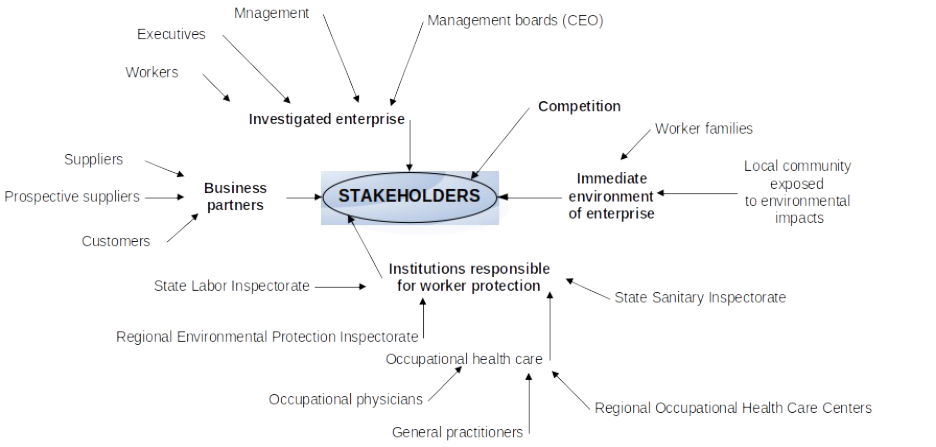
Defining scenarios The next stage of the study was to define scenarios by identifying any individuals and/or institutions having influence on the ergonomic conformity of production systems in Company X. The findings produced at this stage are summarized in Figure 2.
Figure 2. Individuals and institutions having influence on ergonomic conformity of production systems in Company X (authors' work)
In keeping with the above, the authors distinguished the following five key stakeholder groups:
- the enterprise in question – the persons concerned with the ergonomic conformity of production systems within the company are not only the workers (who are the target group directly exposed to the company's production system) but also the management (responsible for the choice of production methods and production system design as well as ergonomic compliance). A properly designed production system would benefit these stakeholder subgroups: the workers would see health improvements, the Management Board and other levels of management would achieve reductions in absenteeism and worker turnover (which has been high), the organization would gain a renewed image as a friendly employer and a company which cares for safe employment and ergonomically designed work; - the competition – interested in any ergonomic solutions that boost productivity and reduce production costs. With no ergonomic system in place on the production floor in the examined company, the competitors are in a position to attract workers who resign, distraught over serving an organization that shows little care for the health of its employees, experts in their respective fields; - business partners – as ergonomic conformity depends largely on machinery, tools, semi-finished products, etc. which the company procures from its suppliers, it is essential to incorporate ergonomic considerations at the stage of supplier selection. Customers, in their turn, have an interest in receiving a compliant product at a specified time, produced in an effective manner with full respect for ergonomic principles; - the company's immediate environment, which, for the purposes of this study, was defined as including worker family members (who ultimately want their close ones to suffer no health issues as a result of their work) and the local community whose members care to ensure the company does not pollute the local environment; - institutions responsible for worker protection – these include any institutions in charge of overseeing compliance with occupational health and safety requirements; the system is designed to reduce insured and uninsured costs which are borne by society at large.
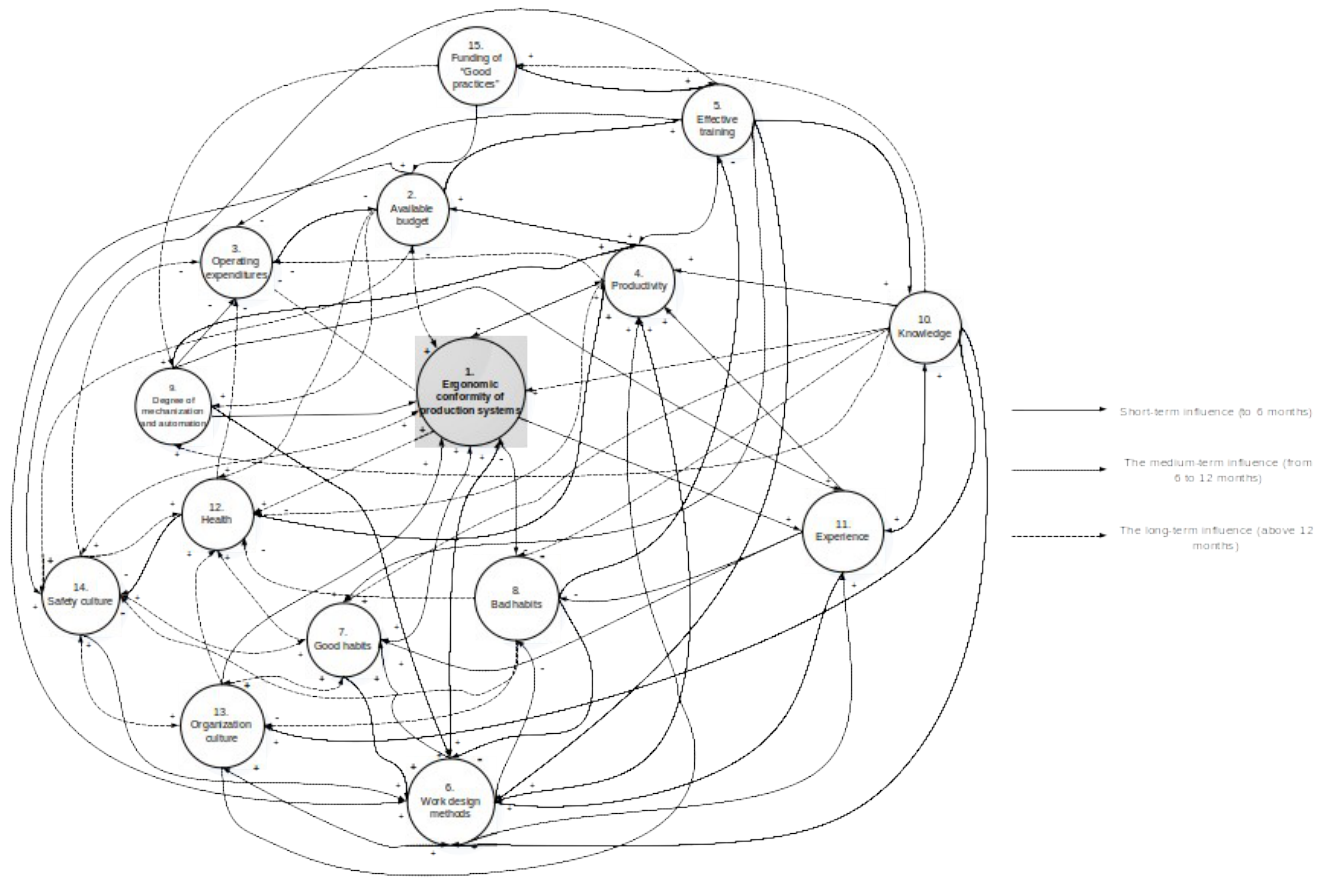
Analyzing mutual interactions The study of mutual interactions began with the pivotal factor. This was found to be the ergonomic conformity of production systems. Relationships among the factors at play are shown in Figure 3.
Figure 3. The network of interactions among factors at play (authors’ work)
Social and Organizational Factors (2020) https://openaccess.cms-conferences.org/#/publications/book/978-1-4951-2102-9
Figure 3 depicts the relationships and the nature of interactions among individual factors which affect the ergonomic conformity of production systems in the selected enterprise and mutually impact upon one another.
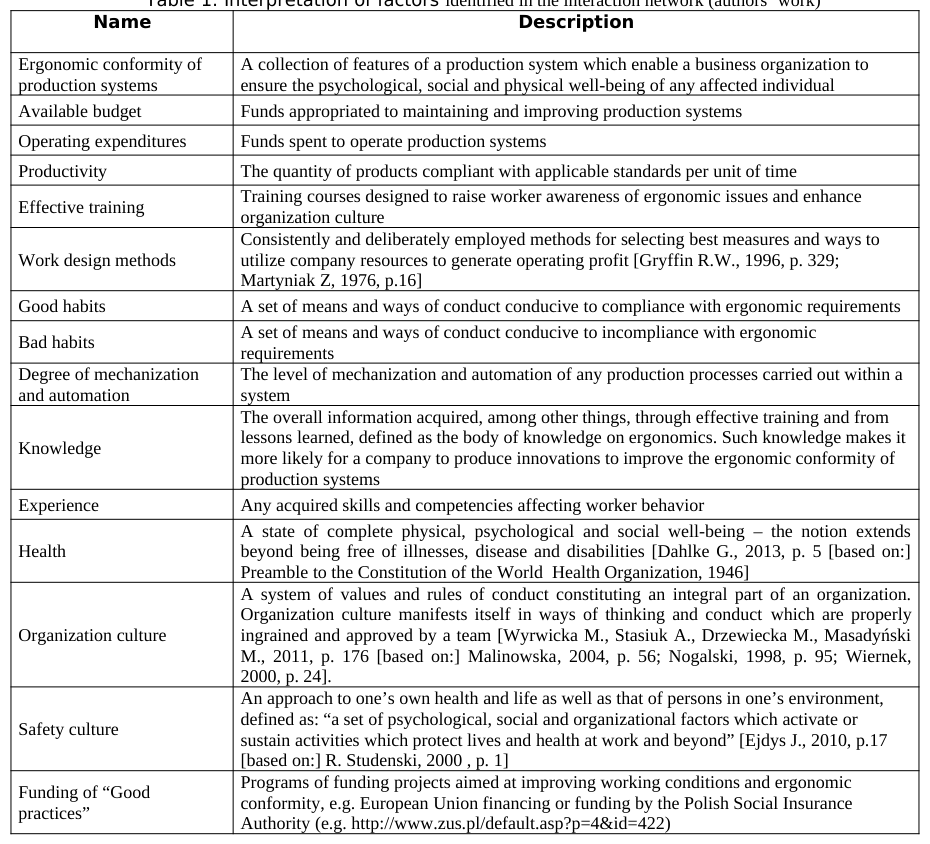
The influences have been denoted as “+” to denote any directly proportional impacts and “-” to denote any impacts found to be adversely proportional. The factors applied in developing the network of interactions were identified by examining the current status and by accounting for all stakeholders. In today's approach to ergonomics, ergonomic quality does not depend on any single factor or any set of multiple factors which a user may be able to influence. Rather, such quality is a function of multiple components in the macro-environment [Butlewski M., Tytyk E., 2012, pp. 298-306]. For that reason, the issue of quality was not dealt with separately. Instead, it was assumed to be an upshot of a well-functioning production system. Table 1 brings together the overall descriptions of factors which affect the ergonomic conformity of production systems complete with a numerical value of help at further stages of the study.
Table 1: Interpretation of factors identified in the interaction network (authors’ work) Name Description Ergonomic conformity of production systems A collection of features of a production system which enable a business organization to ensure the psychological, social and physical well-being of any affected individual Available budget Funds appropriated to maintaining and improving production systems
- the types of interactions (two-way, one-way), as marked with arrows in Figure 3; - the severity of impact measured on a scale of 0 to 3 (where 0 denotes no impact; 1: low impact; 2: high impact and 3: very high impact); - impact duration ranging from short (up to 6 months) to medium (6 to 12 months) to long (above 12 months).
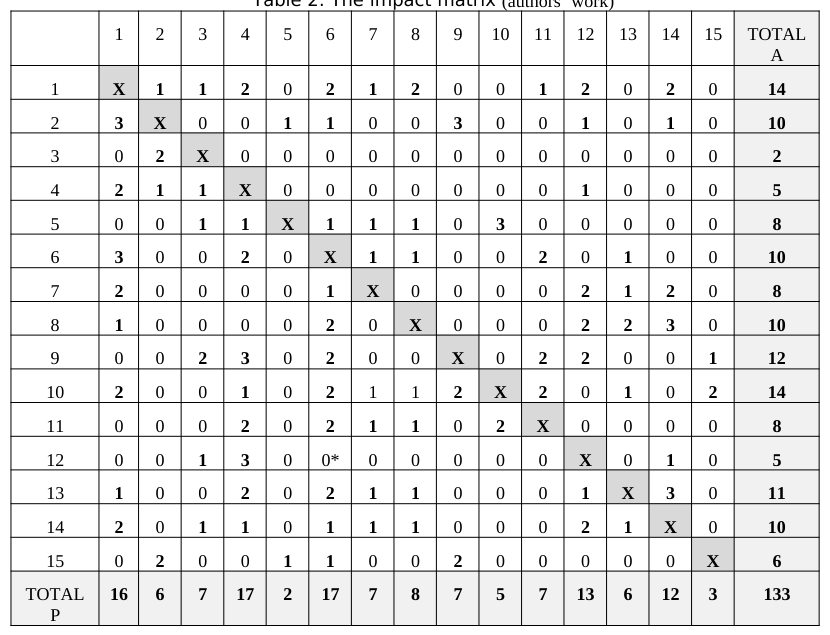
The following stage is to examine the impact matrix which divides all of the analyzed factors into the four groups of [Zimniewicz K., 2003]:
- active factors which very strongly affect other influences but which themselves are unlikely to succumb to any influences (great A total); - passive factors having little effect on others but likely to be influenced by them (low A total); - critical factors which strongly impact upon others and are strongly influenced by other factors (high P total); - indolent factors which poorly impact on others and are only slightly influenced by them (low P total).
An analysis of the impact matrix is shown in Table 2. The numbers assigned to individual factors correspond to the numbering given in Table 1.
Table 2: The impact matrix (authors’ work)
* no disabled persons are employed in the production system in question The selected factors should also be shown on an intensity map (Figure 4) which serves the purpose of identifying their nature. The position of a given factor is a value shown on the map by marking intersections between value A (severity of impact) and value P (factor responsiveness) [Ziemniewicz K., 2003]. At this stage, a decision needs to be made as to where to place the dividing lines (borders) to delineate on the severity map four fields which correspond to the individual factor categories. The simplest division would be to select the maximum A and P values and divide them by two [Ragin-Skorecka K., Grzelczak A., Werner K, Mroczek B. 2011, p. 106]. By following this presumption, the authors originally arrived at A = 7 and P = 8.5. This network line arrangement was then debated bringing the authors to the conclusion that the lines should remain unmoved. This choice was based on:
- a thorough analysis of all borderline factors, - the need for unambiguous assignment of all individual factors to a given category. The tool allows one to observe the characteristics of impact factors. Where active and critical factors prevail, the current situation may be modified to a great extent by means of these very factors. In the converse case, however, the options for interfering are considerably more limited. This is because the use of passive and indolent factors will, Social and Organizational Factors (2020) expectedly, result in little impact on the overall system [Piekarczyk A., Zimniewicz K., 2010]. The factor severity map is shown in Figure 4.
great P
low P
Figure 4. Factor severity map (authors’ work)
Figure available in the original PDF paper.
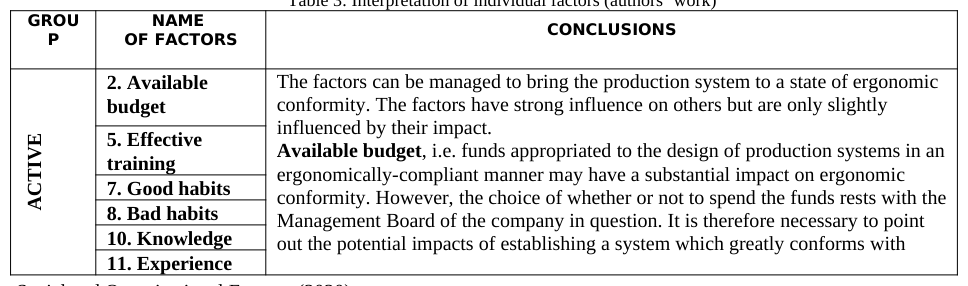
Once the findings of the factor severity study have been placed on the factor severity map, the distribution of factors turned out to be disproportional. The assignment of individual factors into groups and preliminary conclusions are shown in Table 3.
Table 3: Interpretation of individual factors (authors’ work) GROU P NAME OF FACTORS CONCLUSIONS
IDENTIFYING AND INTERPRETING OPPORTUNITIES TO MODIFY STATUS Explaining options to gain control
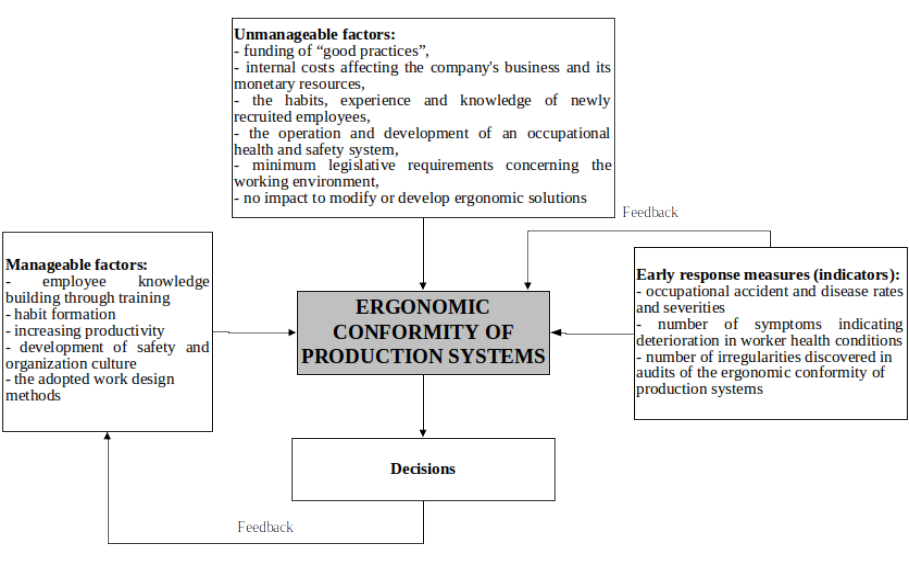
Once an issue has been analyzed (and the network has been developed and examined in terms of the types, durations and severities of impacts and the pace and aims of improvements), it is necessary to identify opportunities for managing change. A simplified management model is provided in Figure 5. To ensure proper change management, a management model has been developed made up of seven components: a manageable item (the ergonomic conformity of production systems), decisions (made by the automotive enterprise), manageable and unmanageable factors, indicators or early response measures, the feedback loop and a preemptive action system [Borowiec A., 2013, p. 66].
Figure 5. A model for managing the ergonomic conformity of production systems (authors’ work) The foregoing model shows the factors available to decision-makers to influence the ergonomic conformity of production systems as well as the measures they can use to assess the degree of such conformity. Also specified are unmanageable factors which will not allow decision-makers to modify the system.
CONCLUSIONS
The main goal of the paper has been described as aimed at: “identifying ways to foster the significance of ergonomic conformity in designing production systems in the automotive industry”. To achieve this goal, the authors have carried out a case study by the network thinking method. Although they adhered to the standard stages commonly applied in the method, the factors selected by the engaged expert team were specific for the enterprise in question. What is also notable is that, despite the fact that specific criteria differ from one company or industry to another, the solution presented in the paper may well serve as a basis for other (similar) studies.
Expectedly, the factors of great significance for the investigated issue included finance (“the available funds”) and “organization culture”. What was not foreseen, however, was just how powerfully “experience”, “knowledge” and “effective training” would affect ergonomic conformity. Of equal significance is the formation of good and bad habits which the literature rarely recognizes as central for the development of production system macroergonomics.
To build an awareness of ergonomics among individual stakeholders, it is crucial to promote positive and eliminate negative factors. It is not advisable, in this context, to dwell extensively on operating expenditures and the financing of “good practices”. While such practices may well attract extra funding, even the best tools, machinery and equipment will do little to improve the ergonomic compliance of systems without proper knowledge and employee training.
As a science of the future focusing on complex systems, macroergonomics brings together a wide range of issues associated with organizations’ activities. It is therefore best not to view increases in the level of ergonomic conformity as a single isolated set of characteristics but rather as components tied to a number of other factors which interact in various ways, at different times and with varying intensity. Social and Organizational Factors (2020)
REFERENCES
Borowiec A., (2013), „Perspektywy rozwoju przedsiębiorstwa branży transportowej poprzez wykorzystanie instrumentu zamówień publicznych”, in: Grzelczak A., Borowiec A., Górny A., Zastosowanie metodyki myślenia sieciowego. Tom II, Wydawnictwo Politechniki Poznańskiej, Poznań pp. 45-75 Butlewski M., Tytyk E. (2012), “The assessment criteria of the ergonomic quality of anthropotechnical mega-systems”, in:
Advances in Social and Organizational Factors, Edited by Peter Vink, CRC Press, Taylor and Francis Group, Boca Raton, London, New York, pp. 298-306. Dahlke G., (2013), Zarządzanie bezpieczeństwem pracy i higieną pracy, Wydawnictwo Politechniki Poznańskiej, Poznań, p. 5 Erensal Y. C., Albayrak E., (2007), “The Impact of Micro- and Macroergonomics Considerations on Appropriate Technology Transfer Decisions in Developing Countries: The Case of Turkey”, in: Human Factors and Ergonomics in Manufacturing, Vol. 17 (1), pp. 1-19. Griffin R.W., (1996), Podstawy zarządzania organizacjami, Wydawnictwo Naukowe PWN, Warszawa, p.329 Grzelczak A., Werner K. (2011), „Podstawy teoretyczne metodyki myślenia sieciowego”, in: Budowa scenariuszy transformacji
wiedzy wspierających innowacyjną Wielkopolskę, Tom II, Wyrwicka M. (Ed.), Wydawnictwo Politechniki Poznańskiej, Poznań, p. 22. Hendrick H.W. (1994). “Macroergonomics as a preventative strategy in occupational health: An organizational level approach”, in: G.E. Bradley, H.W. Hendrick (Eds.), Human factors in organizational design and management IV, Amsterdam: North Holland. pp. 713–718. Hendrick, H.W. (1995),“Future directions in macro-ergonomics”, in: Ergonomics, 38, pp. 1617–1624. Hendrick H.W., Kleiner B.M., (2002), “Macroergonomics: Theory,methods and applications”, Mahwah, NJ:Lawrence Erlbaum. Ingelgaêrd A., Norrgren F., (2001), “Effects of change strategy and top-management involvement on quality of working life and
economic results”, in: International Journal of Industrial Ergonomics, 27, pp. 93–105. Jasiak A., (1993), Kryterium czynnika ludzkiego w projektowaniu systemów wytwarzania, Wydawnictwo Politechniki Poznańskiej, Seria Rozprawy, nr 283, Poznań. Malinowska A., (2004), “Rola kultury i jej znaczenie w środowisku pracowniczym”, in: Kultura organizacyjna w teorii i
praktyce, Materiały na Ogólnopolską Sesję Studenckich Kół NAukowych, Leszno, p. 55-65 Martyniak M., (1976), Elementy metodologii organizowania, Państwowe Wydawnictwo Naukowe, Warszawa, p.16 Nogalski B., (1998), „Kultura organizacyjna, Duch organizacji”, TNOiK, Bydgoszcz. Pacholski L., Trzcielinski S., Wyrwicka M. K., (2011), ”Clustered Macroergonomic Structures”, in: Human Factors and Ergonomics in Manufacturing & Service Industries 21 (2), pp. 147- 155. Pacholski L., Wyrwicka M.K., (2006), “Macroergonomics factors in managing the development of local community – infrastructure system”, in: R. Pikkar, E.Koningveld, & P. Settels (Eds.),Meeting diversity in ergonomics, Maastricht: Elsevier Ltd. Piekarczyk A., Zimniewicz K. (2010), „Myślenie sieciowe w teorii i praktyce”, Polskie Wydawnictwo Ekonomiczne, Warszawa. Preamble to the Constitution of the World Health Organization as adopted by the International Health Conference, New York, 19
June - 22 July 1946 Ragin-Skorecka K., Grzelczak A., Werner K., Mroczek B., (2011), „Budowanie sieci zależności czynników oddziałujących na innowacyjną Wielkopolskę”, in: Budowa scenariuszy transformacji wiedzy wspierających innowacyjną Wielkopolskę, Tom II, Wyrwicka M. (Ed.), Wydawnictwo Politechniki Poznańskiej, Poznań, pp. 77-113 Wiernek B., (2000), „Kultura organizacyjna przedsiębiorstwa”, Oficyna Wydawnicza TEXT, Kraków Wyrwicka M., Stasiuk A., Drzewiecka M., Masadyński M., (2011) „Organizational culture diagnosis as an element of supporting
organizational change management”,in: Knowledge management and organizational culture of global organization, Grzybowska K., Wyrwicka M.K.(eds.), Publishing House of Poznan University of Technology, Poznań, pp. 175-192. Zimniewicz K. (2003), „Współczesne koncepcje i metody zarządzania”, Polskie Wydawnictwo Ekonomiczne, Warszawa. sjp.pwn.pl/lista.php?co=wiedza dostęp: 02.02.2014 www.zus.pl/default.asp?p=4&id=422 dostęp: 01.02.2014
LISTED IN THE AHFE DIGITAL BOOKSTORE CATALOGUE
Explore the complete digital volume
Advances in Social and Organizational Factors
Read this individual research paper free through the original publisher, or explore the full digital proceedings book.
ISBN 978-1-4951-2102-9
Explore this ISBN in the AHFE Bookstore ↗Listed in the July 2026 bookstore catalogue; search by ISBN to confirm current availability · Digital book purchase optional