Marcin Szpaka, Tomasz Szpakb, Nancy L. Larsonc (2020). 3M Poland Manufacturing: An Ergonomics Success Story. In: Advances in Social and Organizational Factors. AHFE Open Access, vol. 9. https://doi.org/10.54941/ahfe100316
As a member of the European Union (EU), 3M Poland must comply with both Polish and EU law. The primary Polish Health and Safety law and EU norm (EN 614-1:2006+A1:2009 - This paper describes two successful ergonomics case studies from two 3M manufacturing locations in Poland. It describes the job assessment process, details job assessment results, describes solutions implemented, and provides information about cost and benefits realized. In this session, two case study projects, one from Janinów and the other from the Rabka site, will be presented. One of these projects (Janinów) won 3M’s internal Applied Ergonomics Innovation Awards (AEIA) in 2012, and the second from Rabka will be nominated for this same prize in 2013. The projects describe the application of the Ergonomics Risk Reduction Program, which improved workers’ quality of life, productivity, and product quality, as well.
The intent of the 3M Ergonomics Program is to use ergonomics expertise consistently throughout the company in order to improve employee health and safety through development and use of standardized program elements, job analysis tools, and training programs. Ergonomics program requirements are defined in one element of an internal Global Health and Safety Plan. One aspect of the program, 3M’s Ergonomics Risk Reduction Process (ERRP), is a systematic process of identifying, prioritizing, assessing, and reducing unacceptable ergonomics risk in jobs throughout 3M’s manufacturing and distribution operations. The ergonomics assessment tool provides a consistent, objective methodology to identify and quantify ergonomics risk exposure in all 3M manufacturing and distribution operations (Larson 2012). 3M recognizes ergonomics improvement through an Annual Ergonomics Innovation Award (AEIA). Over the past 11 years, over 600 ergonomic improvements from around the globe have been submit- ted to an internal database that all internal ergonomics resources can access.
The experience in Poland demonstrates that the ERRP and ergonomics job assessment tool also help the company comply with the Polish and European law (norm EN 614-1:2006+A1:2009 - Safety of machinery - Ergonomic de- sign principles - Part 1: Terminology and general principles).
Two case studies, one from Janinow and the other from Rabka, will be presented. Job assessment results, solutions implemented, and information about costs and benefits realized will be detailed.
METHODOLOGY
The Ergo Job Analyzer (EJA) tool was used to evaluate jobs and identify unacceptable work-related musculoskeletal disorder (WMSD) risk exposures (Auburn Engineers, 2003). The EJA tool is 3M’s standard ergonomics risk assess- ment tool, which is applied at all manufacturing operations globally. A separate project team was established for each project. Team members observed, videotaped and photographed the activities of the workers, conducted a de- tailed assessment to measure forces and awkward postures, wrote descriptions of the main tasks, and interviewed the workers about their activities. After evaluating the job, the team, led by the location’s ergonomics resources, identi- fied and implemented appropriate controls. A follow-up assessment was conducted to verify all changes were suc- cessful in reducing WMSD risk.
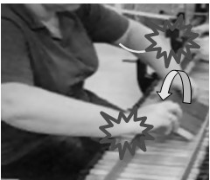
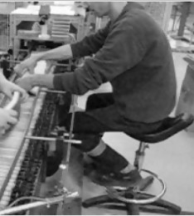
CASE STUDY 1: JANINOW FEMA LINE – AUTOMATIC TURNOVER OF SCOURERS Results from the ERRP review and listening to employee complaints suggested the FEMA line as having potentially unacceptable WMSD risk. The specific FEMA line required employees to manually turn over 40,000 scourers in or- der to properly orient the scourers for packaging. The primary employee complaints were related to extreme wrist postures, performing highly repetitive movements during the scourers production, and contact stress to the forearms. The location’s ergonomics resource applied the EJA, and the assessment results supported the employee’s com- plaints. Specifically, wrist postures – between 45 and 70 degrees [Equation or mathematical symbol available in the original paper PDF] were repeated over 3,600 times per hand each workday (see Figure 1). Additionally, neck flexion, contact stress to arms, and hand turned palm down were also identified as concerns (see Figure 2).
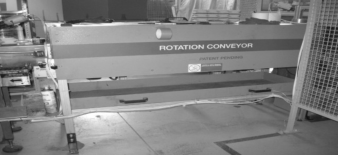
A multidisciplinary team, including a production engineer, project engineer, MU supervisor, and external company designers, worked to improve the equipment and eliminate the identified unacceptable WMSD risk exposures. It was decided that, due to the potential for wrist strain injury in the execution of this task, it was a priority to eliminate the manual process and design an automatic station to turn over the scourers.
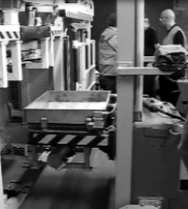
Figure 1: Repetitively turning over the scourersFigure 2: Wrist posture and contact stressFigure 3: New, Automated Machine
To verify the automation changes were effective at eliminating the unacceptable WMDS risk exposure, a new EJA assessment was completed. The assessment results indicated that the unacceptable risks for the operator from this line were eliminated by 80% (wrist flexion, repetition, mechanical stress to arms, hand palm down and neck flexion) and productivity was increased by 70%. Now the speed of the automatic conveyor is the same as the maximum speed of the whole line.
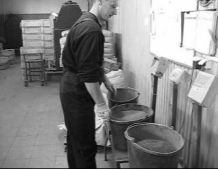
CASE STUDY 2: RABKA – MIXING AREA As with the first case study, this project also was identified and prioritized using the ERRP: a workstation at the manufacturing area had employee complaints about the difficult work. The EJA resource applied the EJA to identify the unacceptable risk exposures, which corroborated the employees’ complaints about lifting and carrying. Before the improvements, all the lifting and carrying tasks in the mixing were manual. There were three tasks in the mixing area that, when combined, resulted in an employee lifting and carrying over 9,000 kg each shift. The first task was transporting the resin in bags, which was delivered from a warehouse into the production area to the mixer; the sec- ond task was loading chemicals into the mixer; and the third task was transporting the material to the storage com- pound. Reducing or eliminating the lifting and carrying of the very heavy buckets weighing over 38 kg was the most important and critical issue for the Ergonomics Team (see Figure 4).
Figure 4: Weighing and transporting resin into mixer – 38kg per bucket A multidisciplinary team worked to improve the equipment and eliminate the primary issues of lifting and carrying the materials. Additionally, the job assessment also identified bending and contact stress to arms as actions of con- cern. The objective of the project team in Rabka was to eliminate all ergonomically unacceptable risk in the Mixing Area. There were several improvements made to this process.
The first improvement was to use an electric truck with an embedded scale to eliminate the manual lifting of buckets to weigh the material. This change also made it easier to transport the resin from the mixing area to the press and fa- cilitated the dumping of resin into the mixer. The new process is performed in one step by electric truck and elimi- nated three manual operations previously performed by an employee using buckets. Additional benefits were in- creased capacity and more accurate direct weighing of resin to the container as seen in Figure 5, thereby increasing process consistency and improving product quality.
Figure 5: Weighing and transporting resin into mixer using electrical forklift truck with scale The second improvement was eliminating lifting of bags weighing 25 kg from the pallet (see Figure 6) and installing mini-silos or supersacks, which empty the resin directly into the container located on the new forklift. This improve- ment eliminated the manual lifting of two big bags in the Mixing Area. An additional benefit was a reduction in manufacturing floor space needed for this operation, allowing for the possibility of better managing the workspace.Figure 6: Wooden pallet with 25 kg bags
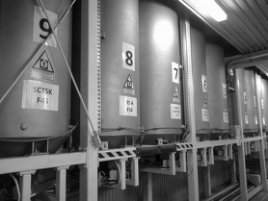
The third improvement focused on eliminating the existing storage system and installing a new, fully automated storage system, as shown in Figure 7. The new system eliminated lifting of containers from the floor and reduced the floor space needed for the operation.
Figure 7: Silos and automatic storage compound system
After implementing the improvements, a new EJA assessment was conducted and employees were asked to provide feedback: the unacceptable risk exposures were totally eliminated and employees were satisfied with the improve- ments.
RESULTS
The FEMA line won a 3M AEIA award in 2012 and the Mixing Area improvements will be submitted for award consideration in 2013. The projects describe the application of 3M Poland’s Ergonomics Risk Reduction Program. The results improved workers’ quality of life and increased productivity and product quality. Before modification, there were some quality problems with the proper proportion of raw materials that were added manually by opera- tors into mixer. After automating the process of mixing components, there are no more problems with quality.
CONCLUSION
These two case studies describe the application of 3M’s Ergonomics Risk Reduction Process and the ergonomics improvements made in two manufacturing operations. In both projects, unacceptable WMSD risk exposure was eliminated. The results achieved improved the workers’ quality of life, reduced overhead (reduced floor space for the operations), increased productivity, and increased product quality.
REFERENCES
Auburn Engineers. , Ergo Job Analyzer User Guide, Auburn Engineers, 2003. Larson N., Wick, H., (2012,) “30 Years of Ergonomics at 3M: A Case Study.” Work ,x, 41: 1622-1624.
LISTED IN THE AHFE DIGITAL BOOKSTORE CATALOGUE
Explore the complete digital volume
Advances in Social and Organizational Factors
Read this individual research paper free through the original publisher, or explore the full digital proceedings book.
ISBN 978-1-4951-2102-9
Explore this ISBN in the AHFE Bookstore ↗Listed in the July 2026 bookstore catalogue; search by ISBN to confirm current availability · Digital book purchase optional