Yuya Tanabe, Yusaku Okada (2020). Development of the Management Cycle and Supporting Tool for Assisting Organizational Workers in Learning Themselves How to Detect Safety-related Problems. In: Advances in Social and Organizational Factors. AHFE Open Access, vol. 9. https://doi.org/10.54941/ahfe100321
Publisher statistics will load when you open Metrics.
AHFE OPEN ACCESS OPEN ACCESS CONFERENCE PROCEEDINGS PAPER
Development of the Management Cycle and Supporting Tool for Assisting Organizational Workers in Learning Themselves How to Detect Safety-related Problems
For employees to allow the improvement of safety in their own organization, researchers have developed a learning cycle to enhance the ability to notice that it becomes a safety hazard. Safety is important aspect organization’s activities. Organization that had caused the accident has a sense of distrust. It will start losing users and customers as a result. It is necessary to have great safety promotion activities as an organization in order to avoid such a situation, but the activity can be conducted more efficient by personnel of a handful instead of driving, all employees to participate. However, some educators conduct safety training to all employees to avoid increasing costs. Therefore, by building a system that enables learning, employees devised a cycle to allow safety training while reducing the cost after finishing the initial training by building the software with the goal to enable employee to learn themselves. Finally, authors have devised a system that enables the safety training while reducing the burden on educators.This system consists in a "factor analysis" and "analysis software". Factor analysis is a technique that a phenomenon might cause an accident (extracted factors). It is necessary to consider in a variety of perspective like relationships and working environment and so on for analysis. However, it is possible to achieve without the feedback of the analysis it is difficult. By entering into analysis software factors that have been extracted, the software will give us information, such as trends and perspectives missing. To repeat the cycle is performed factor analysis with reference to the information, and to enter into further analysis software. Then employees are going to learn a way of thinking about safety. Taking advantage of it, the employee is going to notice and avoid mistakes and accidents themselves and able to review the day-to-day operations or near-miss cases, and accidents. When applied to five groups of participants who have no experience of factor analysis at all the following results have been obtained. First, researchers compared the number of factors to be extracted. The second run time added a factor of 182% delay on average compared to the first. Similarly, the third run time was the result 252% of the second, and 456 percent for the first time for a third time. Researchers concluded that as the number of factors to be extracted increase, the more the information will be needed serve as a reference when to take safety measures.
This system consists in a "factor analysis" and "analysis software". Factor analysis is a technique that a phenomenon might cause an accident (extracted factors). It is necessary to consider in a variety of perspective like relationships and working environment and so on for analysis. However, it is possible to achieve without the feedback of the analysis it is difficult. By entering into analysis software factors that have been extracted, the software will give us information, such as trends and perspectives missing. To repeat the cycle is performed factor analysis with reference to the information, and to enter into further analysis software. Then employees are going to learn a way of thinking about safety. Taking advantage of it, the employee is going to notice and avoid mistakes and accidents themselves and able to review the day-to-day operations or near-miss cases, and accidents. When applied to five groups of participants who have no experience of factor analysis at all the following results have been obtained. First, researchers compared the number of factors to be extracted. The second run time added a factor of 182% delay on average compared to the first. Similarly, the third run time was the result 252% of the second, and 456 percent for the first time for a third time. Researchers concluded that as the number of factors to be extracted increase, the more the information will be needed serve as a reference when to take safety measures.
INTRODUCTION
Safety is important in the organization’s activities. Organization that had caused the accident is having a sense of distrust. It becomes a losing users and customers as a result. That the level required in recent years, particularly sophisticated, small events would also be treated greater many. It is necessary to have great safety promotion activities as an organization in order to reduce such a situation. In addition, need to take measures to such incidents and near misses.
Rather than handful of personnel, it is possible to measure effectively all employees to participate in activities to do so. However, some educators to the safety training to all employees and to the measures of all cases take a great deal of cost. Therefore, by building a system that enables a learning own employees devised a cycle to allow safety training while reducing the cost after finishing the initial training. So By building the software with the goal to be able to learn own employees Finally, I have devised a system that enables the safety training while reducing the burden on educators.
ANALYSIS METHOD AND SUPPORT SYSTEM This system consists of “Evaluation Software” on your computer and “Root cause analysis” on paper.
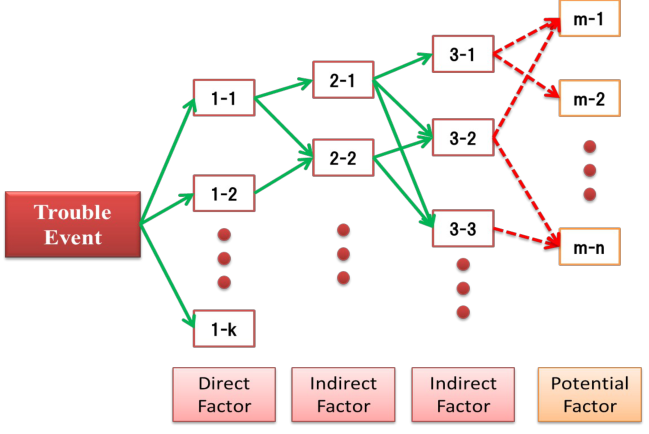
Root cause analysis is a method of extracting factors. And Factor is “Event that may cause an accident”. For example, work environments, Human relation and so on. When I analyze a factor, I start from the phenomena such as troubles and think "why it became so" "why the phenomenon happened". Furthermore, I apply analysis for the factor thought about.
Figure 1. Root cause analysis
I want you to be careful about not being a method to investigate a single "cause" . You must find a factor not a cause to aim at not only the prevention of recurrence of the trouble but also the prevention of before the fact.
For example, a trouble occurs in a certain factory, and the cause thinks about the case "that I attached a different part" to. Measures "to check whether you attached a right part" will be thought about for the prevention of recurrence. However, this remains in content to prevent "an installation error of the part”. When I scheme before the fact prevention, it is necessary to think about "the factor that I attached a different part" to. When a factor "not to be ready to carry out the rearranging order of the part" is found, and measures "to perform the rearranging order of the part" are made. Other than an accident to attach a different part to, before the fact may prevent a trouble such as the loss of the part if I carry out these measures. In this way, I can widen prevention of before the fact activity by thinking about a factor to hide behind in the background.
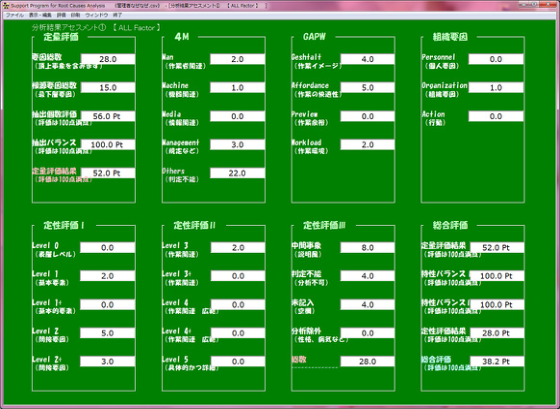
For reasons of the said article, a variety of viewpoints are necessary for analysis. However, it is difficult work for without the experience of the analysis or few people. Therefore I use evaluation software. Various evaluations are accomplished by inputting the contents of the factor analysis into evaluation software. I repeat a cycle that I perform factor analysis and input for analysis software while taking an evaluation into account.
It is summarized as follows:
1. Tutorial about Root cause analyses by educators
2. Factor Analysis by small groups
3. Enter the results in the evaluation software
4. Discussion or tutorial, was referring to the evaluation results
5. Go back to 2
Factor analysis is enabled while supplementing a former fault by maintaining this cycle. I review an accident and everyday duties by the factor analysis that is a high level and reduce an accident and a mistake. The employee during this cycle can observe things from various viewpoints ideally. Similarly, the employee can discover a factor to lead to danger by observing duties and before the fact can prevent a trouble. In brief, employees get ability to prevent a trouble by oneself.
Tutorial by Educators
Fihure 2. Management Cycle
IMPROVEMENT OF DIVERSITY AND QUANTITY AND QUALITY I aim for improving the quality of an extracted factor, quantity, variety by the support to achieve the above- mentioned ideal.
Figure 1. Evaluation software
Diversity and Quantity Using the classification methods of the factors as "4M" and "GAPWPO" in this support system, the system has advice on diversity of factors. Factors mentioned in the analysis are evaluated by the evaluation software, the classification is performed. If the bias of the point of view is found by classification, we analyze, taking care to correct the bias thereafter. For example, if factor that is classified as a "Media" in the 4M classification was small, do an analysis with a focus for the "Media" next time. Thus, the diversity of the factors to be found is ensured. A number of factors may increase further.
I will explain about the classification methods of each. Adopted taxonomies two types are classified factors in the evaluation software.
4M 4M is a classification method, which is named after the initials "Man", "Machine", "Media" and "Management". Classification is made in reference to the next point.
Table 1 :Point of Classification (4M)
GAPWPO GAPWPO is a classification method, which is named after the initials "Gestalt", "Affordance", "Preview", "Workload", "Personnnel" and "Organization". Classification is made in reference to the next point.
Table 2 :Point of Classification (GAPWPO)
Quality In this support system, are also evaluated quality as well as quantity and diversity of factors.
It is a "factor that is easy to measure and operations planning" and high-quality referred to here. For example, factors referred to as "thought it was medical records of women in their 60s" are extracted during the analysis. When planning measures you have finished the factor analysis here, measures referred to as "to prevent medical record seems 60s woman" can easily be set up. But measures to of "should not regard" depends on the individual, it cannot be said that effective measures. Therefore, by the factor analysis and further factors "devise that can be distinguished at a glance that no age" that has been extracted. Then measures can be operated across the organization and specifically of "the laborer who can be distinguished at a glance of the age" is set. Thus, it is possible to extract factors as specific as possible is to improve the quality.
It is determined word, a sentence length of the quality factor in the evaluation software. Database word is present, the level is set for each word in the software within. The Search for a word from a source input, evaluation software to determine the quality based on the length of the sentence and word combinations. In addition, quality is expressed level 0, level 1, level 1 + (1.5), level 2... as of level 5.
Analysis support Manual To facilitate further work was to create a "cause analysis support Manual". Evaluation software because only give an estimate only, I have the documentation and ideas specific method. By referring to this document, the analyst can know the concepts and specific techniques.
VERIFICATION OF BENEFITS I have created evaluation software, the documentation as a method to support the factor analysis, but verifying that give be an effective means.
I asked three railroad companies, oil producer one, drug industry one, 1 medical group for cooperation as a subject of this experiment. The railroad company assumes it railroad A, railroad B, railroad C each.I constituted a group each in companies. One group collects chief grade of each post in four people. There is little experience of the factor analysis, but is the employee that it is thought that you should learn about factor analysis in future.
I used a support system depending on a company and divided mint condition in two. It is the group which does not use these that there are no using both "evaluation system" and "support manual", support that there is support.
Table 3 : Having support or not Company Number of Groups Total Number of Groups
Experiment Method I work by a group unit. I prepared Japanese vellum and Post-it to have you analyze a factor and wrote in a phenomenon and a factor at Post-it and went by the method that I put on the Japanese vellum.
First, educators will be described briefly how the factor analysis.
Next, have one read examples of analyte prior to performing the factor analysis. In this study, the case was using the "electric shock of substation room" that is prepared here. It is a case without knowing that there's work is energized, that had an electric shock and would touch dangerous places.
And, subject to carry out the factor analysis actually. I was set to 2 hours’ time. The analysis while using the evaluation system only group that has support, it is possible to see from time to time support manual analysis and the results of the current situation.
Result
Consider the quality of the factors, the number, diversity whether improved by support tool.
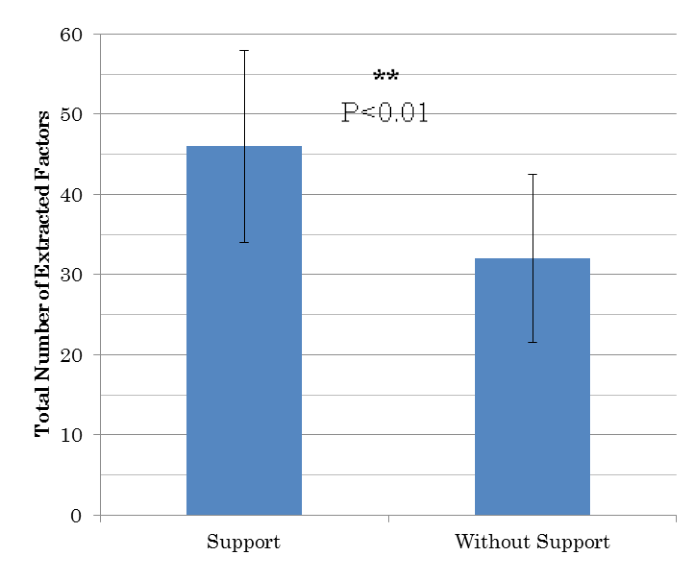
Quality The evaluation system counts the total number of factors extracted, and the results were compared. The following figure is obtained by averaging the total number of extraction factor of each team in the group without the assistance and support group there.
Figure 4. Comparison of the extraction factor total number
The result was a group there is support at 44.9 pieces, without the assistance group that 32.1 pieces. Is significant 1% the results of the analysis of variance, it can be said that the difference is that out of the average value by to help.
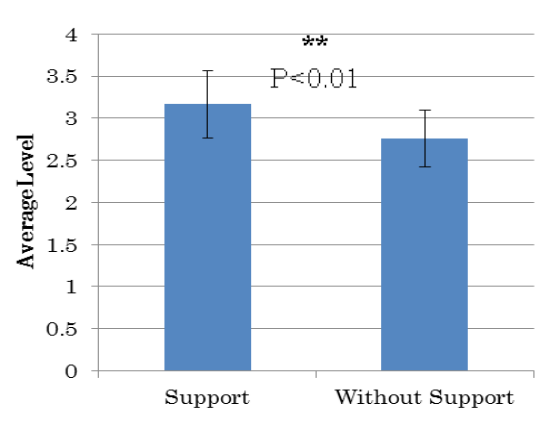
Quality Levels are respectively given by the evaluation software factors. To assess quantitatively, were weighted to be level 0 to 1, level 1 to 2, Level 1+ to 2.5, Level 2 to 3, Level 2+ to 3.5, Level 3 to 4, Level 3+ to 4.5, Level 4 to 5, Lever 4+ to 5.5,Level 5 to 6 .
Figure 2. Comparison of the Average level
It is a comparison of the average level of extracted factors of the group without support and support group there.
Average factor levels, resulted 3.17 points there support, without the assistance that 2.75 points. Results of analysis of variance, it is significant at 1%. But the difference is smaller than I expected initially.
Factor does not lead to effective measures "accidentally" and "vaguely" is evaluated to level 0. Only factor leading to recurrence prevention activities "Check shortage" and "lack of confirmation" is evaluated to level 1. Therefore, I can be considered for factor level points are two points even if you extract only the factors that lead only to relapse prevention activities, differences were small. Difference itself was small in value, but it can be said that it was a significant difference in the 1%, that the average factor for level and rises in it to support.
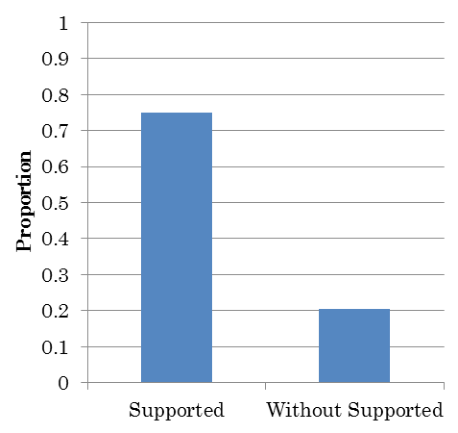
In view of the prevention activities further factor levels to be the target is 3 or more. Therefore, it is not an average factor level point, and to compare the ratio of the group factors average level becomes 3 or more.
Figure 3. Comparison of Proportion of group where is higher than mean level 3
The group was shown 75% of the support group that there is at most average factors level 3 and above. Average factors level 3 was the only team of more than 21% group without assistance. Given the average level of the group three or more were able to sufficient analysis, a significant difference can be seen in the support without support and that there is support. The said analysis has been improved by the support.
From this result, the possibility by performing the support, can be extracted factors level 3 or higher increases. Therefore, it can be said that the possibility of extraction factors that can take advantage of as well as relapse prevention activities, to prevent activities has increased.
The proportion of the group average factors level, the average level of factors becomes 3 or more, a difference was present both. In addition, major changes were observed for the percentage of the group with an average factors level becomes 3 or more.
By evaluation system, it is possible to identify the source level of the extracted own. That it has made a conceptual description by the manual, it should be what kind of thinking. I is believed these subjects can understand how, and made it easier to raise the factors level.
From the above, evaluation software in this study, with the help manual, level of extraction factor in the factor analysis was increased. Factors level improvement will lead to improvement in the quality of measures that are contemplated from the factors. In other words, it is considered to become the help of safety management activities of the organization.
Diversity
I verify a factor of six category "Gestalt", "Affordance", "Preview", "Workload", "Personnel" and "Organization”.
Figure 4 Comparison of the Diversity by GAPWPO
Figure represents whether the extracted what kind factors of the six kinds. According to the drawing, in the group have support, a group of 25% are able to extract factors all six. In addition, the group of 67% is to extract the five kinds, 8% is three kinds. On the other hand, without the assistance group is not able to extract the factors of only six group of 3% in the group. group of 46% has remained no more than three.
I also verify a factor of four category "Man", "Machine", "Media" and "Management".
Figure 5 Comparison of the Diversity by 4M
There are support groups that are able 92% to extract the factors of three kinds or more. Group No support is not able to extract the three kinds or only 28%.
More than half is two or less in the group without assistance. Therefore, the possibility that the subject is not aware of this category in performing analysis is suggested. It is believed that the analysis is performed without regard to categories, the bias would occur in the subject. Since the both groups are dealing with the same case, there is no possibility in this experiment, factors that were not present.
The group that is not able to extract the factors of all four of 4M or six of GAPWPO, have missed factors.
CONCLUSIONS
In this study, in order to support the factor analysis to be performed only by employees, we have proposed a support manual and evaluation software.
By the evaluation software, I evaluated the diversity of the factor, quality, and abundance. In addition, with the attached manual, I showed the important way of thinking in the factor analysis.
I used a support tool together at the time of factor analysis and, based on an evaluation index to be provided one by one, carried out a method to review factor analysis based on an attached manual. As a result, I became able to extract a variety of factors with most cases, and the level rose with the total number of the extraction factor, too.
I think that an evaluation system and the support manual which I developed in this study than the above help the factor analysis of the company. In addition, in what can extract a variety of factors by factor analysis, I can take a variety of measures and think that I help the safety management activity of the company.
REFERENCES
Robert.Latino, Kenneth C.Latino, Mark A.Latino (2011). “Root cause analysis (4th ed.)” Florida: CRC Press Swain,A.D., Gattman H.E.(1985).“Handbook of human reliability analysis with emphasis on nuclear power plant applications” ”U.S Nuclear regulatory commission” NUREG/CR-1278
LISTED IN THE AHFE DIGITAL BOOKSTORE CATALOGUE
Explore the complete digital volume
Advances in Social and Organizational Factors
Read this individual research paper free through the original publisher, or explore the full digital proceedings book.
ISBN 978-1-4951-2102-9
Explore this ISBN in the AHFE Bookstore ↗Listed in the July 2026 bookstore catalogue; search by ISBN to confirm current availability · Digital book purchase optional