Kumiko Takahashi, Ryoko Ikeda, Yusaku Okada (2020). An Evaluation of Human Factors on Confirmation/Check Tasks in Organizational Safety Management. In: Advances in Social and Organizational Factors. AHFE Open Access, vol. 9. https://doi.org/10.54941/ahfe100322
In organizations’ safety management, it is most important to ensure workers check their own work so that they can detect human error as early as possible. We study the checking task from the viewpoint of human factors with the aim of identifying factors impeding the performance of the checking task and proposing a method for mitigating the effects of such impeding factors. The checking task does not always play a good performance, making workers desirous of performance improvement. However, few attempts have been made to study the checking task beyond analyzing individual, concrete work contexts. We, first, identified and categorized problems regarding the checking task by statistically analyzing the result of the survey covering over 20,000 workers of 15 companies from several industries such as railway and general hospitals. The survey included distributing questionnaire and on-site interviews, both targeting site workers. We, next, got down on to further study the result of the above analysis as that we developed advice/tips data that can assist those who prepare a checklist. Based on the result of these analyses, we compiled a guideline on what to discuss and how to address it when adding new items to an existing checklist.
Background Today, Safety management in most industries in Japan is keeping a high standard, and they are considering measures for troubles and accidents from various angles. Thanks to their untiring efforts, the number of huge accidents such as the crash of a JAL MD11 aircraft in Japan which occurred in the late nineties is declining. The standard of Safety management is changing over the years, however, a slight incident far from serious accidents and troubles are handling as an object of Safety management. Therefore, many industries and organizations are facing with the challenging issue with work efficiency and confirmation/check tasks enhancement.Confirmation/check tasks play an important part before operators continue a following process, and regardless of skill which an operator possesses, you can finish a task completely with a last confirmation. Thus, confirmation/check tasks provide a work process management system that reliably confirms for errors and so, they can recovery and evade an accident and a trouble. Moreover, operations with checklists can avoid communication errors between an operator and his/her successor, omission errors and commission errors. That is why most organizations take it in every operation as the last process of it.I particularly put a focus on confirmation/check tasks in safety management, and considered and examined rearranging of the information of checklist, the process efficiency through the past study and the experiment of the human factor.
History HEP(Human Error Probability) is positioned in a human error assessment based on the theory of probability and used over various areas. It is not an evaluation system having a quantitative evaluation index, but it is one having a qualitative evaluation index, so operators can develop their ability to consider logically for human error and improve their sensitivity and recognition for the risks on their own initiative.Then, this section presents an introduction of TESEO(Tecica Empirica Stima Errori Operatori) and HEART(Human Error Assessment and Reduction Technique).
Tecica Empirica Stima Errori Operatori TESEO is a method to estimate a probability of human error. In 1980, Bello,G.c and Columbori V conducted it as a method to estimate errors made by operators in a power station based on experiential data. To lead the probability of human error, they defined identification of the error, quantification of the error and reduction of the error as main factors. And, based on these main elements, they evaluate the state of five following parameters and estimate the probability of human error of the whole operation by the product of five evaluation level.
K1: Type of Activity K2: Temporary Stress Factor for Routine Activities K2: Temporary Stress Factor for Non-Routine Activities K3: Operator Qualities K4: Activity Anxiety Factor K5: Activity Ergonomic Factor
TABLE 1. 1: TESEO Parameters Type of Activity K1 Simple, routine 0.001 Requiring attention 0.010 Not routine 0.100
Table available in the original PDF paper.
TABLE 1. 2 TESEO Parameters Time available Factor for routine activity K2 2 sec 10 10 sec 1 20 sec 0.5
Table available in the original PDF paper.
TABLE 1. 3: TESEO Parameters Time available Factor for non-routine activity K2 3 sec 10 30 sec 1 45 sec 0.3 60 sec 0.5
Table available in the original PDF paper.
TABLE 1. 4: TESEO Parameters Operator’s typological factor K3 Carefully selected expert, well trained 0.5 Average Knowledge 1 Little knowledge 3
Table available in the original PDF paper.
TABLE 1. 5: TESEO Parameters Activity anxiety factor K4 Situation of grave emergency 3 Situation of potential emergency 2 Normal situation 1
Table available in the original PDF paper.
TABLE 1. 6: TESEO Parameters Activity ergonomic factor K5 Excellent microclimate and excellent interface 0.7 Good microclimate and good interface 1 Discreet microclimate and discrete interface 3 Discreet microclimate and poor interface 7
Table available in the original PDF paper.
Poor microclimate and poor interface 10
Human Error Assessment and Reduction Technique HEART is a method developed by J.C.Williams working at central power center in the UK. And it is consisted of 5 steps to estimate the probability of error.
1. Select Generic Task 2. Select candidate: Error Producing Conditions (EPCs) 3. Check for GT with EPC 4. Calculate PoA for each EPC
5. Multiply GT by adjusted EPCs
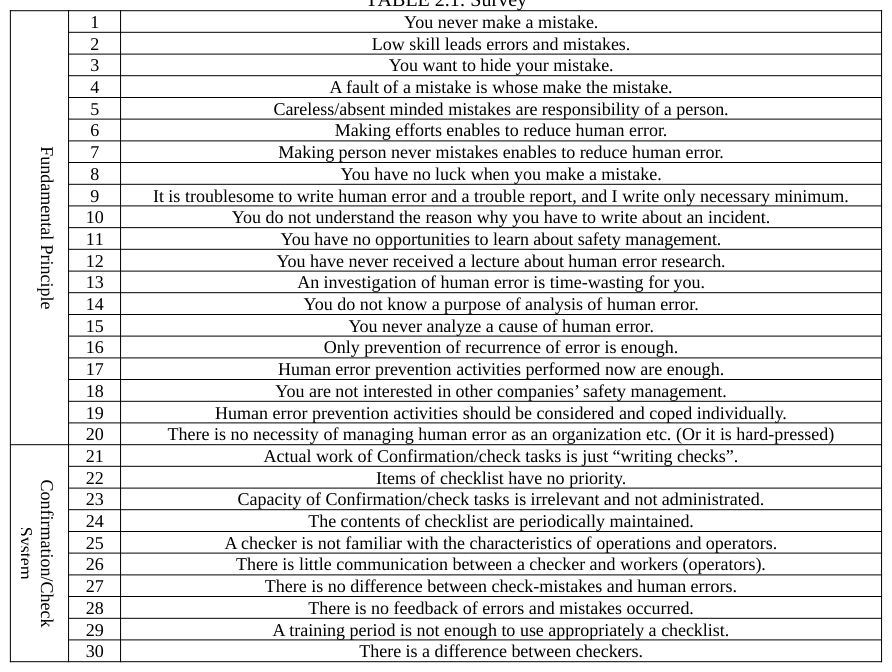
INVESTIVATION AND ANALYSIS Evaluate the Level of Human Error Management By evaluating the level of the safety management, we could know the workers’ motivation for confirmation/check tasks and find potential problems through it. For 7 steel companies, 5 railway companies, 7 general hospitals and 2 oil refining companies, we made survey of the workers’ understanding level about safety activities/management and confirmation/check tasks for all employees. A content of the survey is 20 questions (Fundamental Principle) to evaluate depth of understanding about safety management and 10 questions (Confirmation/Check System) to evaluate a system confirmation/check tasks. How to answer to these question is select a number (1~4); Disagree(1), Partly agree(2), Agree(3), Strongly agree(4).
TABLE 2. 1: Survey
THE RESULT OF THE SURVEY A totaling the results of the survey is below.
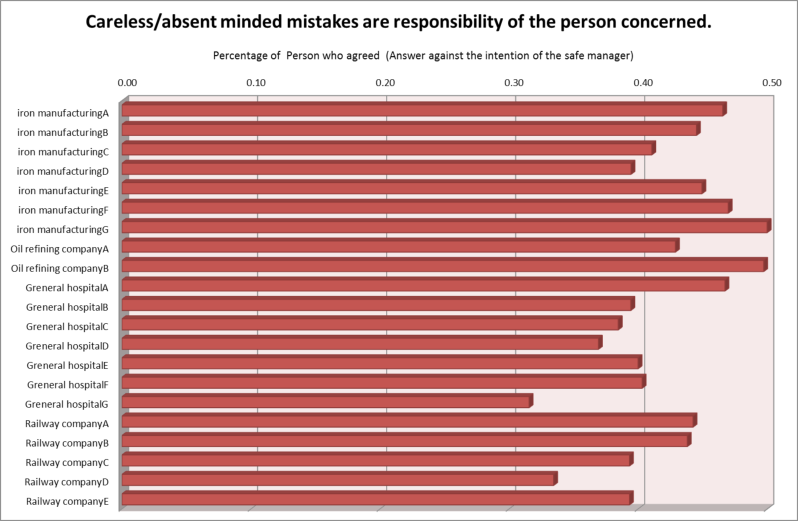
FIGURE 2. 1: Q5
You can see from Figure 2.1, most workers think that “a person who committed an error should responsible for it”, so errors are inclined to be dealt as individual problem and be thought none of concerns with other persons by them. Moreover, as safety management actively advances, lectures/instructions on human errors tend to increase, and so dissatisfaction “I am enforced the new countermeasure because of somebody made a mistake.” is increasing as well. Eventually, if a safety manager considers that human error belongs to the person concerned, he tends to make a new countermeasure to prevent it by reinforcing confirmation/check tasks. Then confirmation/check tasks are continuously gradually adding in volume. Too much capacity and too often alteration of countermeasures are hardly pressing workers, and in the result they are worn out from stress and have negative image for safety management.
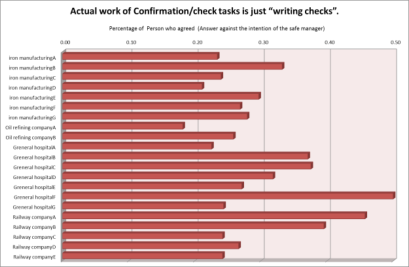
FIGURE 2. 2: Q21 FIGURE 2.3: Q22
The result showing by Figure 2.2 and figure 2.3 explains that most companies have a confirmation/check system that makes workers bored and soul-destroying.
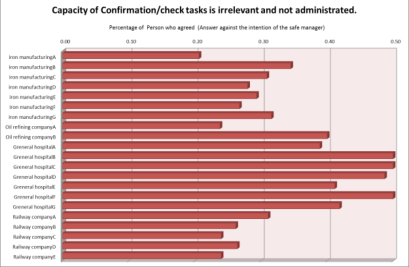
FIGURE 2. 4: Q23 FIGURE 2.5: Q24
According to Figure 2.4 and Figure 2.5, when it comes to confirmation tasks, there is no regular/routine maintenance and safety managers do not take capacity of site-workers into consideration. Then, an inappropriate quantity of confirmation/check tasks is left that as is all along. At least 20%, at most 60% of workers answered in the affirmative.
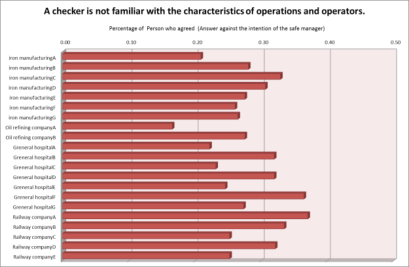
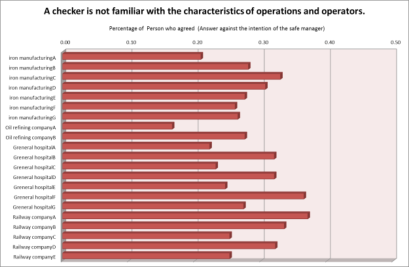
FIGURE 2. 6: Q25 FIGURE 2.7: Q26Figure 2. 6 and 2.7 explain that some workers who do not have enough skill play confirmation/check tasks. That is because training period is not enough long for workers and a safety manager who made checklists is not able to understand each workers’ situations. Insufficient skill leads commission errors.
INTERVIEWS WITH COMPANIES Railway Companies
• The number of confirmation/check tasks with checklist is increasing in these years due to troubles and accidents. That is because most departments easily put in force new countermeasures with checklists. [Equation or mathematical symbol available in the original paper PDF] Even though improvement plan of checklist are carried out, a similar accident and trouble could often happen. They felt limit on effects of checklist. [Equation or mathematical symbol available in the original paper PDF] Instead of increase of the number of items/types on checklist, it is necessary to change it understandable and easier to use. [Equation or mathematical symbol available in the original paper PDF] A problem of use of checklist is that workers are inclined to become mannerism. [Equation or mathematical symbol available in the original paper PDF] Double check does not completely perform. A second checker depends on the first checker too much. [Equation or mathematical symbol available in the original paper PDF] Young employees have never experienced serious troubles and accidents, so they are so ashamed of their own failure and mistake that they often hide it. Thus, a delay of their report of mistakes led a situation to grow more serious. [Equation or mathematical symbol available in the original paper PDF] There are a lot of types of checklist. It makes difficult to improve an existing checklist. General Hospitals [Equation or mathematical symbol available in the original paper PDF] There are many checklists to confirm a status before taking over. [Equation or mathematical symbol available in the original paper PDF] Because the number of checklists is getting more and more, employee have no time to spare to carefully check each items of checklist. [Equation or mathematical symbol available in the original paper PDF] A director of nursing service department notice that nurses are suffered from stupendous capacity of checklist, but he/she is resistant to any change of checklist because of a threat of accident. [Equation or mathematical symbol available in the original paper PDF] It is good for employee to responsible for what they have done with checklist because confirmation/check tasks enable to make clear who have done the operation. And then, they would perform with a high level of awareness.
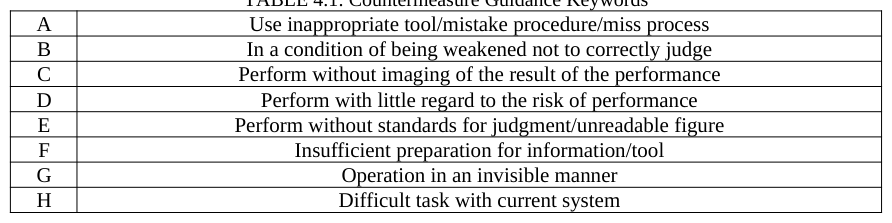
SUGESSION Countermeasure Guidance System We compiled keywords to guide countermeasures which were made by not only safety manager but also site- workers in case of consideration of measures to prevent recurrence.
TABLE 4. 1: Countermeasure Guidance Keywords A Use inappropriate tool/mistake procedure/miss process B In a condition of being weakened not to correctly judge C Perform without imaging of the result of the performance D Perform with little regard to the risk of performance E Perform without standards for judgment/unreadable figure F Insufficient preparation for information/tool G Operation in an invisible manner H Difficult task with current system Writing report with countermeasure guidance keywords makes easier that safety managers and employees can make up with countermeasures except for reinforcing confirmation/check tasks.
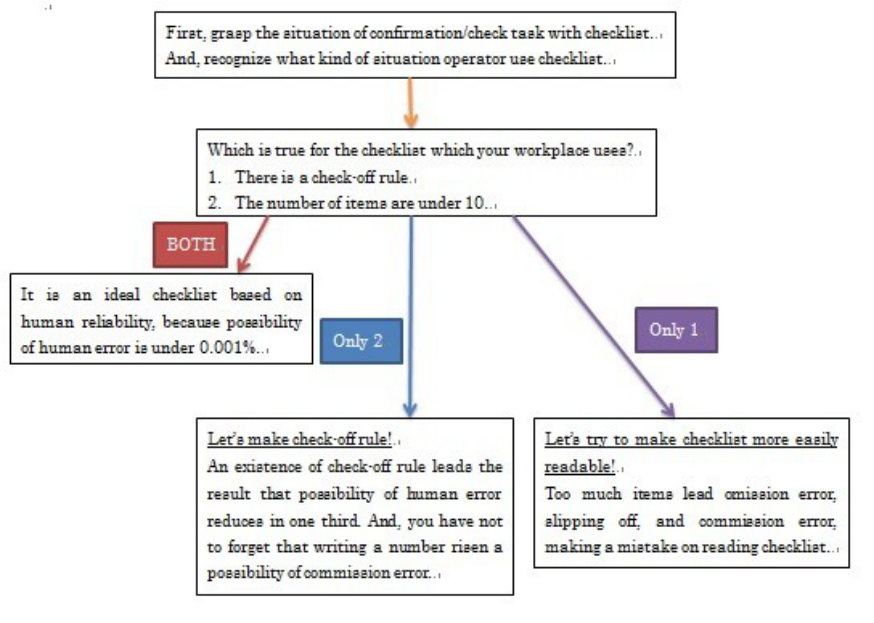
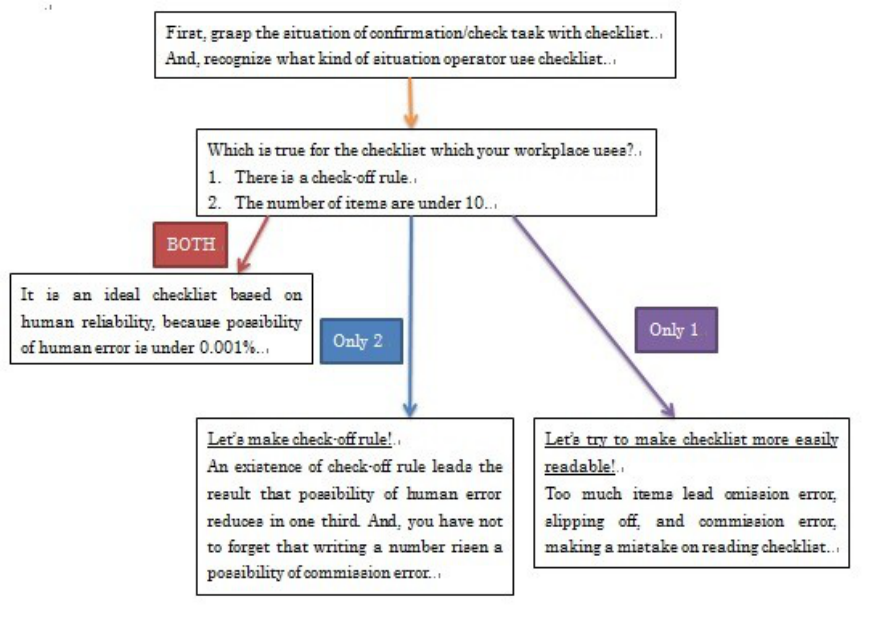
Guideline This guideline is composed in a case assumed, where employee want to make up with countermeasures to improve checklist based on human, reliability knowledge except to reinforce confirmation/check tasks. Therefore, the guideline has information on supplementation of past accidents and troubles. There two types of guideline.
FIGURE 4. 1: Guideline1- A Case Where Employee Have Enough Time To Set Up New CountermeasuresFIGURE 4. 2: Guideline2- A Case Where Employee Is Unable to Plan Countermeasure Except for Checklist Because of Lack of Time
CONCLUSIONS
In this study, we are focusing on confirmation/check tasks with checklist and analyzing factors that inhibit performance from different points of view, in the result, we could clarify them. Moreover, the compiled guideline has been presented to the surveyed companies and now put into practical use on a trial basis, assisting those who prepare checklists.
REFERENCES
Okada Yusaku.(2005).“Human Error Management of Performance Shaping Factors”, International Conference on Computer- Aided Ergonomics, Human Factors and Safety Rasmussen, J.(1986).”Information Processing and Human-Machine Interaction: An Approach to Cognitive Engineering”, in New
York: Elsevier Science Publishing Co., Inc. Takeo YUKIMACHI.(2004),"Reference List on Basis of GAP-W Concept and a Case Study”, Human Factors, Vol. 9(1), pp. 46-
62, Tomita Masahiro, Okada Yusaku, (2010), “Developing a Method to Evaluate the Employee Satisfaction on Safety Management”, AHFEI the 3rdd International Conference
LISTED IN THE AHFE DIGITAL BOOKSTORE CATALOGUE
Explore the complete digital volume
Advances in Social and Organizational Factors
Read this individual research paper free through the original publisher, or explore the full digital proceedings book.
ISBN 978-1-4951-2102-9
Explore this ISBN in the AHFE Bookstore ↗Listed in the July 2026 bookstore catalogue; search by ISBN to confirm current availability · Digital book purchase optional