Conne Bazley, Peter Vink (2020). Environmental Comfort Design Considerations for Future Control Room Interiors. In: Advances in Social and Organizational Factors. AHFE Open Access, vol. 9. https://doi.org/10.54941/ahfe100305
Today, there is a significant amount of research projects focusing on human health and well-being and the connection between the environment and human psychological responses. A holistic approach to integrating control room communications with comfortable interiors is emerging. This paper discusses the socio-cultural aspects of comfort and the sensory communication aspects of environmental comfort design for future control room interiors.
Environmental design The National Academy of Environmental Design (2009), states “Environmental design addresses the impact of the built environment on individuals and the natural world and creates a wide range of interventions informed by human and environmental systems. Environmental design comprises architects, planners, landscape architects, interior designers, preservationists, building technology specialists, and researchers from a wide range of disciplines. Their shared body of knowledge and professional skills affect communities, landscapes, buildings, products, and the individuals who occupy and use them.” The term has expanded to apply to ecological and sustainability issues (Szokolay, 2008). Most people relate the term to “green” buildings, global warming and sustainability and focus on the technical and efficiency aspects of environmental design. However, for this paper a human factors psychologist presents the term from a psychosocial viewpoint.
Humans need air, water, food and shelter to survive. Some of the early forms of shelter were caves. Caves are an excellent choice for steady temperature, protection from the elements and intruders. Some environmental designers believe the beginning of environmental design can be traced back to the drawings on cave walls during the early Social and Organizational Factors (2020)
Paleolithic to Neolithic period (35,000 to 4,000 B.C.). Researchers continue to study the true meaning of primitive rock art and cave drawings found in different cave locations around the world (Evans, 2014). According to the Maude Group (2013), “Contemporary environmental designers have long understood that sensory communication has remained the most meaningful way to connect to an audience since its invention in the Paleolithic period”. The drawings may be the beginning of communicating narratives visually (Figure 1.). Communicating narratives visually has profound influences on the viewer. Therefore, most building or room interiors perceived as ‘comfortable’ would comprise of elements that replicate some aspect of sensory communication.
Figure 1. Bison painting in the Cave of Altamira, near Santander, Spain.
Comfort The most common definition for comfort found in literature is “a state of physical ease and freedom from pain or constraint”, (Google, 2014). A Science direct review of 318 papers, with discomfort in the title, written from 2003 to July 31st, 2013, revealed that 52% of the papers related to patient pain studies. Emotional and psychological issues are not often mentioned in titles, although were sometimes mentioned in the papers. Helander & Zhang, (1997) note that discomfort is related to biomechanics and fatigue factors, and comfort to a sense of well-being and aesthetics. Comfort is a term that is often associated with a physical state or an environmental factor.
According to Looze, Kuijt-Evers & Dieën (2003) generally accepted definitions in comfort literature are; (1) comfort is a construct of a subjectively defined personal nature; (2) comfort is affected by factors of a various nature (physical, physiological, psychological); and (3) comfort is a reaction to the environment. Green & Jordan (2002) discusses how environmental sustainability interrelates between comfort, pleasure and the usability of products. Richards (1980), stresses that comfort involves the sense of subjective well-being. That is, the reaction a person has to an environment or situation. Slater (1985) defines comfort as a pleasant state of physiological, psychological and physical harmony between a human being and the immediate environment.
Chappells & Shove (2005) discuss comfort as a universal physiological construct or a negotiable socio-cultural construct. Kuijer & Jong (2012) argue the universal physiological construct is problematic for reducing energy consumption and negotiable socio-cultural construct offers novel opportunities for sustainable design for exploring practices of thermal comfort. A consequence of negotiable socio-cultural construct is that comfort is seen as an achievement rather than an attribute. Understanding the psychological and emotional connections between human and the environment goes beyond physical comfort (Ong, 2013).
INTERIOR DESIGN CONSIDERATIONS Control room
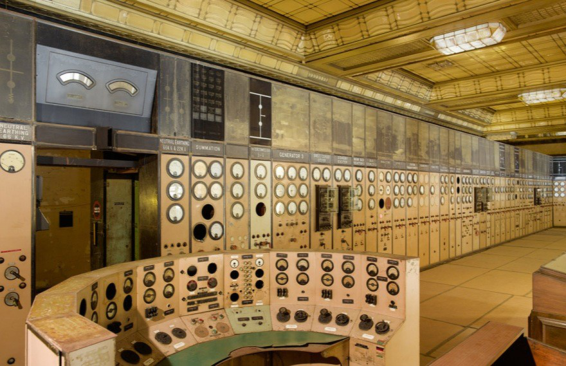
The control room originated around fifty years ago and its main purpose was to protect workers and equipment from harsh and often dangerous working conditions. Designs were rudimentary, lacked sound proofing, windows were a Social and Organizational Factors (2020) rarity and controls were limited to emergency stop buttons and evacuation alarms. After WWII, new technologies emerged and socio-economic changes occurred in industrialized countries (Figure 2.). The type of work and skills required to perform the new work brought about an increased interest in worker and workplace psychology.
Figure 2. A control room from the 1950’s.
The Information age, internet and aging population and emergence of the knowledge worker accelerated the need to develop control rooms based on engineering criteria and scientific frames of reference for the past thirty years.
In the late 90’s control rooms were purpose built and industrial and commercial control room standardization emerged. The nuclear renaissance and heightened interest in alternative power, i.e., solar, wind and bio-fuels provided the impetus for new control room design (Ivergard & Hunt, 2010). The purpose of a control room varies from a recording studio, a driver’s seat in a car, a plane cockpit or a rapid transit operations center. An important aspect to control room design is to understand the operators and the purpose and guide the operators through effective design to achieve the end purpose. With a renewed interest in thrift and sustainability, designing cost effective, low maintenance, sustainable, comfortable environmental interiors, for present day control rooms is a challenge (Ivergard & Hunt, 2010).
Today the implementation and construction of new, state of the art control room runs a risk of being outdated by the time it is built. New control rooms race against the expediential growth of new technology, world economic downturns, political and social unrest and climate change. The cost of space in a control room is at a premium and some control rooms are designed without the necessary human factor assessments and sacrifice space to offset costs. The resulting control room layouts are challenging and inadequate to provide productive, environmentally comfortable interiors. Retaining highly skilled operators in an environmentally uncomfortable interior is not optimum. Future control rooms may face the same issues with space and cost restraints.
In fifty years will we need control rooms? The need to control processes from a room may not be necessary. Imagine an operator monitoring a power plant from a remote device located off shore on a yacht. Future control rooms and maintenance may be operated and performed by robots or avatars.
There are many factors that affect future control rooms and control room interiors not included in this paper. Economic, political and societal decisions made today shape our co-existence with the environment for the future. This paper discusses the socio-cultural aspects of comfort and the sensory communication aspects of environmental design for future control room interiors.
Control Room Interiors The control room dimensions are usually determined by the task analysis. A task analysis is a multi-disciplined effort. Various task analysis methods are preferred depending on the functions and systems and purpose of the control room (Brown, 2001). With advent of screen technology Cognitive Work Analysis (CWA) is becoming more widely used. According to Lintern, (2012) resulting screen displays permit operators to deal more effectively with unexpected situations than the traditional display. However, CWA is an arduous process and requires a long lead time.
Maintenance is an area that will grow quickly as future control rooms are designed. Maintenance is often the last item to be addressed; however there are maintenance requirements in the control room. With the focus now on sustainability and risk assessment, maintenance should move to the forefront of sustainable design. More automation means less operators and more maintenance work. General and preventative maintenance, replacements, repairs, redesign installations work tasks are required by humans or machines. Sufficient space for tasks should be assessed for environmental comfort during the design phase.
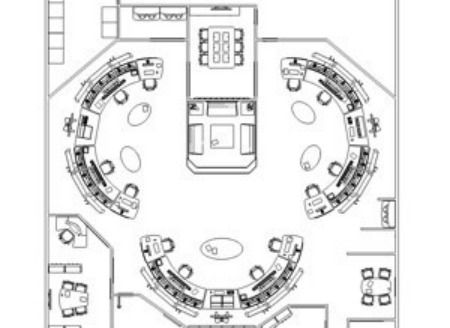
Traditional control room layouts (Figure 3.) have basic considerations (Salvendy, 2012; Stanton 2005). Going beyond the basics and layout considerations, additional environmental considerations are taken into account, e.g. lighting, and temperature.
Figure 3. Conceptual Layout for control room.
Environmental Comfort Environmental comfort is a new term, although the topic is taught at in all architecture schools. It is the comfort criteria in the design of the built environment in terms of heat, light and sound. Recently air quality was added and sometimes physical comfort. Environmental comfort is the middle space between the human and the environment beyond (Ong, 2013). Heat or thermal temperature is not considered one of our senses although it is complex and important. If we fail to maintain our body temperature within set limits, we face death. Thermal temperature in building design is fundamental and important. Temperature is the number one compliant by occupants and affects productivity and health (Vink, 2005). People prefer to be in control of their own temperature and will move in and out of varying temperatures not only for comfort but for social interaction. The connection between the two activities leads to overall satisfaction. Studies concluded that people are more adaptable to a wider range of environmental conditions than is acceptable within the current comfort standards (Heschong, 1979; Schiller, 1990). Light in this context is defined in terms of adequate brightness, lack of glare, neutrality of color. A sense of outdoor light or the actual daylight helps with the sense of time. There are lighting comfort standards but no visual comfort standards. Research continues on the health benefits of day lighting and an awareness of the external climatic conditions (Aripin, 2007). The human sensory system welcomes variety, some degree of randomness referred to as contrast pattern recognition, or sensory variability (Heerwagen, 1992). Unchanging environments are boring. Humans experience physiological and emotional daily cycles. We live through our senses and need changing patterns of stimuli to activate them (Humphery 1980; Platt 1961, Cooper 1968; Schooler 1984; Cabanac 2005). Sound is more true to the measurements than heat and light. Air quality is a growing issue in buildings as well as outdoors, especially in large cities. Circulating fresh outside air is best but not always practical depending on the
building location to outside noise or pollutants. Ong (2013) states, “Environmental comfort is not a scientific dispute but one that argues for a greater recognition of the diversity of human culture”.
Comfortable Interiors Comfortable interiors appear to have aspects of the outdoor environment. Throughout history the great wonders of the world are a blend of art, architecture, science and engineering, a form of usable beauty (Figure 4.).
Figure 4. Taj Mahal, India, completed in AD 1648 (2008).
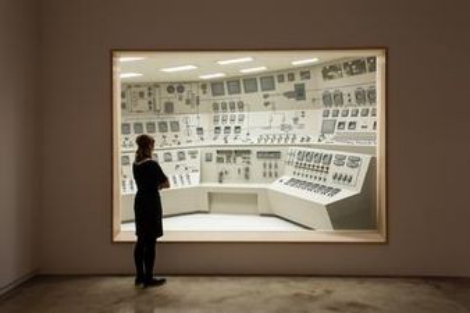
Beyond the visual aspects, the other senses (hearing, taste, smell, touch) are stimulated. Traditional control room interiors tend to be stark, perceived as cold or non-organic, shape edged and devoid of color. An artist’s replication of a traditional control room diorama, hand carved from birch and maple wood and formed from steel, encased and frozen in time, void of human presence, making the inherent function obsolete. The viewer of this diorama is to consider their pre-conceived knowledge of the mechanics and functions of a control room, as well as open up to the possibility of how this knowledge can, and will, change through time and context (Figure 5.).
Figure 5. Apparatus, by Roxy Paine, 2014.
New and retrofitted control rooms benefit from on-going innovations in lighting, air and temperature, flooring, acoustics, glass and building materials, screen design, chairs and workstations, and clothing fabric Brooker, Reynolds, & Martin, 2011; Lecher, 2012). All of these innovations provide options to the more traditional control room physical interiors. Additionally, the operator is realized as an integral part of the system and considerations are made to accommodate the operator’s physical, psychological, and emotional attributes in the design of future control room interiors.
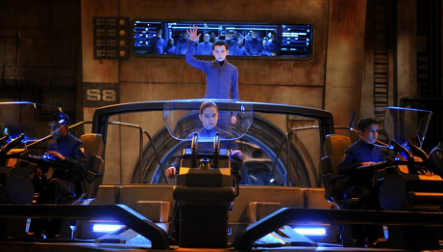
Future control room interiors Cinema, games, art, fantasy and science fiction provide us with a plethora of future possibilities for control room. The movies, “Enders Game,” “Iron Man”, and “Pacific Rim”, are visual representations of the futuristic control room interiors and integration of the sensory communication aspects of environmental comfort design and socio- cultural aspects of comfort for control room interiors (Figure 6a. & Figure 6b.)
Figure 6a. The control room in the movie, Ender’s Game. 2013.Figure 6b. The control room with a view, from the movie Ender’s Game. 2013.
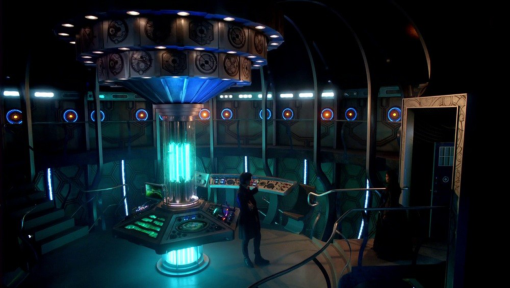
One of the most famous imaginative control rooms is Dr. Who’s TARDIS control room. The TARDIS has gone through updates and upgrades, not unlike real control rooms (Naser, 2005). The TARDIS features relatively open floor plans, in which the control console is vaguely in the middle of the room. Control rooms, interchangeably called console rooms, usually contains walls with roundels, scanners for viewing the TARDIS exterior, and have fairly sparse furnishings. No known TARDIS control room allows for the operation of the console from a seated position. The shape, size and ambience of a control room is highly variable, even within the Doctor's TARDIS, A control room's look can be changed over time. The process by which an operator can transform a control room is fairly simple, like changing a "desktop theme". On some occasions, a TARDIS manages the change itself. Once, the Doctor regenerated with extreme violence, destroying much of his control room; the TARDIS was able to completely redesign its interior and console room without the Doctor's assistance. The console room has gone through at least twelve redesigns, though the TARDIS reveals that she archived 30 versions. Once a control room is reconfigured, the TARDIS archives the old design "for neatness". The TARDIS effectively "curates" a museum of control rooms in the Doctor's personal past and future (Figure 7.).
Figure 7. Doctor Who’s TARDIS control room, 2012.
Imagination suggests that future control room interiors are a holistic blend of art, science, engineering, and human centric. Future control rooms feel organic, the temperature, lighting, color and shape of the room are optional, chairs and workstations regulate workload and situation awareness for the operators. Operators of the future enjoy customizing their work area for temperature, light, sound and color. Temperature, lighting and color variation and management keep operators alert and clear-headed. Future control room walls, floor and ceilings have individualized light and color schemes for different groups of operators or may change color by sensing mood changes or workload stress or situation awareness cues and direct operators to appropriate tasks. Sounds for alarms are easily recognizable due to accompanied vibrations. All the senses and environmental comfort elements are incorporated into future control room interiors design.
CONCLUSIONS
Since the earliest evolutionary phases of human life, we have had a visceral, survivalist need to be sensitive and responsive to our surroundings” (Bilchik, 2002). Today, there is a significant amount of research projects focusing on human health and well-being and the connection between the environment and human psychological responses. Environmental comfort is a new multidiscipline, and shares the middle ground between the human and the environment and addresses the socio-cultural aspects of comfort and the sensory communication aspects of environmental design (Ong, 2013).
Most of the predictions for future control rooms (Montague, 2012; Wood, 2013; Schwarz, Kehr, Herme & Reitere, 2012; Stedinger & Howard, 2010) envision a human centric design focusing on comfortable, seamless collaborative workspaces. The work is incident or crisis management and keeping up with technology. The workforce is diverse in culture, gender and age. The nature of work in the future itself will be holistic and collaborative rather than hierarchal and compartmentalized. Although, there is mention of new innovative products that serve to provide for physical comfort for temperature, air flow, and lighting, there is little mention of integrating the psychological aspects or all five senses in control room interiors. Therefore, the integration of environmental comfort to include socio-cultural aspects of comfort and the sensory communication aspects of environmental design for future control room interiors should be implemented and further studies are needed.
REFERENCES
Aripin, S. (2007), Healing architecture: daylight in hospital design. Conference on Sustainable Building South East Asia, 5-5 November, Malaysia. Bilchik, G. S. (2002). A Better Place to Heal, Health Forum Journal, Volume 45, No. 4, July-August, Chicago: Health Forum Inc Brooker, D., Reynolds, P., Martin, A. (2011), “The 2030 control room.” Slideshare Website: http://image.slidesharecdn.com/2030controlroomccdpresentation-110815144308-phpapp01/95/slide-1-1024.jpg? cb=1341483750. Brown, W. (2001), Control room and work place environment review guidance update of NUREG-700. Upton, New York:
Brookhaven National Laboratory. Cabanac M.(2005), Pleasure and joy, and their role in human life, in D.J. Clements-Croome (ed.) Creating the Productive Workplace, London: Routledge. CGM, (2014) “Control room layout”. CGM Website: http://www.cgm.se/images/planning/planning1.jpg. Chappells, H. and Shove, E. (2005) Debating the future of comfort: environmental sustainability, energy consumption and the
indoor environment, Building Research & Information, Volume. 33, No. 1, pp.32–40. Cooper, R. (1968), The psychology of boredom, Science Journal, Volume 4, No. 2, pp. 38-42. Dazeley, P. (1950), “Battersea power station”, MNC Website: http://content.messynessychic.com/wp-content/uploads/2014/02/PeterDazeley5.jpg. Evans, C. (2014), A remarkable rock art site, American Archaeology, Volume 18, No 1, pp. 44-45. Ender’s Game 1, (2013), AFSDN Website: http://a.fsdn.com/sd/firehose/052/695/319-1.jpg. Ender’s Game 2, (2013), Free Apple Wall Papers Website:
http://www.freeapplewallpapers.com/wp-content/uploads/2013/11/Enders-Game.jpg. Google search https://www.google.com/search?q=definition+of+comomfort&ie=utf-8&oe=utf-8&aq=t&rls=com.yahoo:en- US:official&client=firefox&channel=sb. Green, W. and Jordan, P. (2002). Pleasure with products: beyond usability, New York, NY: Taylor & Francis. Health and Safety Executive (HES). (2010), “Best practice applicable to the design of control rooms”. Health and Safety
Executive. Heerwagen, M. (1998), Productivity and well-being: what are the links? American Institute of Architects on Highly Effective Facilities. Cincinnati, 12-14 March. Helander, M.G. and Zhang, L. (1997), Field studies of comfort and discomfort in sitting, Ergonomics, 40, pp.895-915. Heschong, L. (1979), Thermal delight in architecture, Cambridge, MA: The MIT Press. Humphery, N. (1980), Natural Aesthetics, in B. Mikellides (ed.) Architecture for People, London: Studio Vista. Ivergard, T., Hunt, B. (2009), Handbook of control room design and ergonomics, Boca Raton: CRC Press. Knudsen, J. (2004), Taj Mahal, Wikimedia Website:
http://commons.wikimedia.org/wiki/File%3ATaj_Mahal_in_March_2004_(squared).jpg Kuijer, L. de Jong, A. (2012), Indentifying design opportunities for reduced household resource consumption: exploring practices of thermal comfort. J. Design Research Volume 10, No. ½. Lintern, G. (2012), “Cognitive Systems Engineering.” Cognitive Systems Design Website:
http://www.cognitivesystemsdesign.net/ Lecher, C. (2012) “Video: MIT Alumni Bring Spacesuit Tech to Temperature-Regulating Dress Shirts.” Fabric link Website: http://www.fabriclink.com/Presentations/index.cfm?id=90. Looze M.P. de, Kuijt-Evers L.F.M., Dieën J.H. van. (2003), Sitting comfort and discomfort and the relationships with objective
measures. Ergonomics, 46, pp. 985–997. Montaque, J. (2012), “The control room of the future - smarter reality.” The Control Global Website: http://www.controlglobal.com/articles/2012/montague-smarter-reality/. Naser, J. (2005), Guidelines for nuclear power plant control room and human –system interface modernization activities. EPRI,
Technical Meeting on Impact of Modern Technology on Nuclear Power Plant I&C Systems September 13-16, 2005 Chatou, France. National Academy of Environmental Design. (2009), “What is environmental design”? National Academy of Environmental Design Website: http://www.naedonline.org/design.html. Ong, B. (2013), Beyond environmental comfort, New York, NY: Routledge. Paine, R. (2014), “Apparatus.” Kavigupta Website: http://kavigupta.com/exhibition/146/apparatus Roxy Paine: Apparatus: Sep
20, 2013 – Jan 29, 2014. Platt J.R. (1961), Beauty; pattern and change, in D.W. Fiske and S.R. Maddi (eds) Functions of Varied Experience, Homewood, IL: Dorsey Press Richards, L.G. (1980), On the psychology of passenger comfort. In D.J. Oborne and J.A. Levis, eds., Human Factors in
Transport Research, London: Academic Press, Volume 2, pp.15–23. Rameessos. (2008), “Painting of bison in Spain.” http://upload.wikimedia.org/wikipedia/commons/c/cc/AltamiraBison.jpg. Salvendy, G. (2012). Handbook of human factors and ergonomics (4th ed.). Hoboken: John Wiley & Sons. Schwarz S.,Kehr F., Herme K., Reitere H. (2012), Holistic workspace: future control room design. Proceeding of HFES. Schiller, G. E. (1990), A comparison between measured and predicted comfort in office buildings. ASHRAE, Transactions, Volume 96, No. 1, pp.609-622. Schooler, C. (1984), Psychological effects of complex environments during the life span: a review and theory, Intelligence 8, pp.
259-281. Slater, K. (1985), Human comfort. Springfield, IL: Thomas. Stanton, N. (2005). Human factors methods a practical guide for engineering and design. Aldershot, England: Ashgate Pub. Co. Stedinger, J., Howard, C. (2010), “Control room II looking further into the future.” Hydro World Review Website: http://www.hydroworld.com/articles/print/volume-18/issue-3/articles/looking-ahead/control-room-ii-looking.html. Szokolay, S. K. (2008), “Introduction to architectural science: the basis of sustainable design (second edition).” London:
Architectural Press. Tardis. (2012), “Doctor who inside new tardis.” Tardis Wikia Website: http://tardis.wikia.com/wiki/File:DOCTOR_WHO_- _Inside_NEW_TARDIS!_Christmas_2012_BBC_AMERICA. The Maude Group. (2013), “The history of environmental design: prehistoric histories.” The Maude Group Website:
http://www.maudegroup.com/blog/2013/09/the-history-of-environmental-design-prehistoric-histories/ Website: http://www.hse.gov.uk/aboutus/insidehse.htm. Vink, P. (2005). Comfort and design: principles and good practice, Boca Raton: CRC Press. Wood, J. (2013), “The future of control rooms.” The Display Insight Website: http://www.displayinsight.com/the-future-ofcontrol-rooms/.
LISTED IN THE AHFE DIGITAL BOOKSTORE CATALOGUE
Explore the complete digital volume
Advances in Social and Organizational Factors
Read this individual research paper free through the original publisher, or explore the full digital proceedings book.
ISBN 978-1-4951-2102-9
Explore this ISBN in the AHFE Bookstore ↗Listed in the July 2026 bookstore catalogue; search by ISBN to confirm current availability · Digital book purchase optional