Sascha Stowasser (2020). Field of Actions of Industrial Engineering and of the Human Resource Management Influenced by Ageing People. In: Advances in Social and Organizational Factors. AHFE Open Access, vol. 9. https://doi.org/10.54941/ahfe100320
The demographic structural shift drives a change towards an increasing employee orientation, to which the German businesses have to find strategic and operative answers. Businesses acts and efforts are promising, if organizations make sure that ergonomic findings are kept. There is no unique standard approach to solve the demographic challenge yet. The following article represents core theses to a demographic personnel work, as well as possible fields of action, which guarantees businesses a solid handling of the demographic change. The consideration of due to the demographic change altered parameters at designing the qualification, personnel progress and career prospects, are an important field of actions and will be examined at full length as a result.
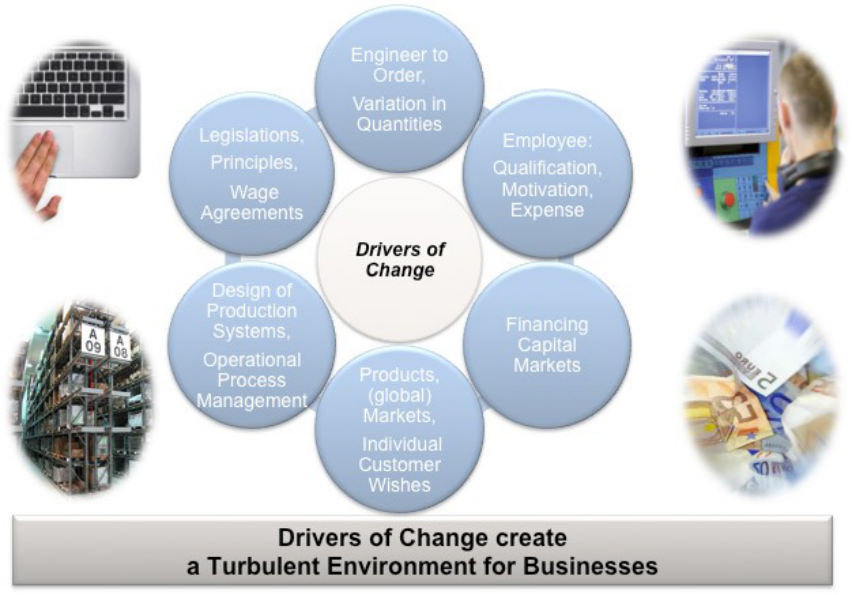
DRIVERS OF CHANGE FOR BUSINESSES Ever since businesses of all branches, dimensions and regions must be open to circumstances that are drivers of change. By the „drivers of change“, businesses are required to a consistent ability of reaction- and adaption. The nature of what drives the change varies and can be caused by external influences as for example legislative process´, customers, key- and finance markets, as well as being characterized or set off by internal circumstances, such as a change of the interior organization, leadership, availability of resources or performance fluctuations.
In the past decades the following drivers of change have mainly influenced the employment- and operation system of our German businesses (fig. 1):
market demands for superior products forces new designs, an expanded range of functions or superior capacity.
cost pressure forces the search for extravagance and measures of rationalization in all ranks.
a variable number of pieces cause frequent and short term adaptations of capacity.
individualization of customer wishes lead to a further more expanding number of varies and a shortened delivery time.
Figure 1: Drivers of change (Stowasser, 2012)
THE DEMOGRAPHIC STRUCTURE AS DRIVERS OF CHANGE FOR THE BUSINESSES AND FOR THE WORKING ENVIRONMENT Currently and in the future, one driver of change deserves a special attention in economy and in science: the changing of demographic structures in Germany (compare fig. 2).
For the businesses the demographic change can cause:
a growing absence of adequate skilled workers and work force as well as a shortage of education candidates/nominees as a consequence of the decreasing number of students;
a deferral of the age structure and an ageing work force;
a longer continuance in place for the employees in general, as a result of legal regulations – the elimination of government-funded partial retirement and the incremental elevation of the pensionable age to 65 or 67 years – to ensure the affordability of the social security systems.
The influence of the demographic development can be summarized in two core theses: a) finding suitable education candidates/nominees and junior staff will be increasingly difficult (younger people are missing) and
b) the preservation of the personnel capacity will be even more important (longer continuance in place in businesses for employees and a growing percentage of senior employees in the work force).
Fig. 2: Cascade of challenges in the recent past and in the presence.
THE CORE THESES FOR THE SECURE HANDLING OF DEMOGRAPHIC PERSONNEL WORK The core theses for the secure handling of the demographic personnel work could be verbalised like this: (compare Adenauer and Stowasser, 2008):
(1) Businesses are affected by the impact of demographic change in different ways. An inventory is necessary in order to reason the need of action for each business seperatelly.
Further factors are to be taken into consideration:
the initial starting position for the enterprises, namely the actual competitive position, its brand, its »attractivness as employer« as well as
the areal differences, such as the location of an enterprise (rural area, city), the areal development of population and availability of younger junior staff.
(2) Secure handling of demographic personnel work under ergonomic aspects not only refers to ageing employees, but starts preventive (präventiv) already with the younger employees. Creative measures (e.g. workplace, work environment, work hours) subserve senior and junior employees. There is no general need to differentiate work systems based on age, more important are ageing conform work places, an ageing conform work organisation and an ageing conform deployment .
(3) The employees working ability and performance isn´t determinated according to the calendar, but is influenced by the biological age. Measures to obtain working ability and performance until 67 require an operation- und employee specific implementation. The requirement for capability and qualification is individually different and depentend on concrete work content. That requires the consideration of a distinguished capacity development of aging employees with the secure handling of demographic personnel management. For example securing the demand of younger junior employees and the operational health management, which starts preventative (vorbeugend) with the younger employees, to support their performance from early on and obtain it sustainability.
(4) With the implementation of measures for industrial engineering, the same laws and principles apply for senior employees as for all the the others. (Landau et al., 2007).
(5) Individuals sustain responsibility for obtaining their working ability - and performance (health and skills) as well - not only social instances like e.g. the employer or politics.
The businesses competitiveness depends stronly on how accurately the business agrees on the demographic change. The demographic structural shift is an increasingly personnel oriented driver of change, on whom German enterprises must react.
Entrepreneurial ambitions and actions are promising, if the ergonomic regulations are regarded. A single exemplary approach to resolve the demographic challenges doesn´t excist yet! Different approaches for the entrepreneurial fields of action (compare fig. 3) are described in detail in the folder “Der demografiefeste Betrieb” (Adenauer et al., 2009). It´s about considering and picking up on demographic changes in entrepreneurial fields of action, like e.g. obtaining the capacity of the personnel as well as winning qualified employees, human ressources development and qualification.
Fig. 3: Fields of action of a demographic business (Adenauer et al., 2009)
Qualification and Human Resources Development as an Important Field of Action for a Demographic Business
Qualification, human resources development and creative career aspects, in the fact of ageing work force and flat hierarchy, supports the longterm operational capability and operational readiness. In the following, this field of action will be emphasized in particular (compare Adenauer et al., 2009).
Skilled worker shortage and ageing employees confront the businesses with the task to secure the capacity and motivation of the employees, an adequate actualization of operating relevant qualifikations and by longterm concepts for human resource development (compare fig. 4). That means e.g.:
Adjusting the qualification for ageing and middle age employees for their retention time in the business.
Updating knowledge and qualification to the status quo.
Counteracting dequalification and demotivation (the loss of aquiered qualification through non-application).
Preventing a loss of learning habits by an ongoing advanced education and training.
Creating alternative career perspectives and capabilities for ageing employees with an increasing of flat hierarchies Basic conditions and requirements are e.g.:
a management and corporate culture, which recognizes and supports senior employees´ potential;
the sensibilisation of employees, that the learning curve doesn´t end with finishing school or education and they therefor accept offers of the business to obtain their working ability- and employability.
Fig. 4: Five requirements on education, further education and human resources development.
Obtaining Change and Learning Abilities through „Lifelong Learning“ In general, learning up to a great age is possible, dependent on the individual qualifikations for benefit. The ability to learn has to be obtained and suported by training.
Lifelong learning means a continuous, independent of age, demand-orientated, human resource development and qualification to obtain the preservation of capacity- and capability until 67. It relieves the process of change for businesses and employees.
The parameters, which are often requiered for “lifelong learning”, are after all not age specific, but to the greatest possible extent correspond with generally accepted didactic principals. To these belong e.g.:
the selfmonitoring of learning is defined by a personal learning rate and individual opportunities for repetition and training;
the conjunction of the new with the practical knowlegde, the praxis orientation and the personal reference;
the proximity to enterprise- and workplace, which allows the immediate testing and usage of what has been learned;
the individual, on personal interests and living conditions responding preparation of the subject matter.
Qualification for (Ageing) Employees who have Lost their Learning Habits When ageing employees are having deficits in the qualification section, it´s less foundet in age, but rather in the missing training opportunities and poorly demanding operations, that lead up to the loss of qualification (so-called disuse-effect resp. dequalification) and can lead up to a loss of learning habits.
The willingness to a further education is less a question of the biological age, but rather of the individual learning habits and of the self-image. Employees, whose learning ability is not prompted by the business, understand/see themselves without learning abilities and have even lost parts of their learning abilities over time. Ageing employees learn unlike younger employees, if they haven´t taken part in qualification measures for a longer time and if their past occupation has not been connected with a learning incentive. In general it then get´s hard to getting used to a learning situation. So to speak, learning has to be learned all over again.
The employees integration into designing a learning method, the connection to excisting knowledge and shorter learning units, simplify the learning comback.
Preventive Approach to Human Resource Development: Demand-Oriented and Independent of Age Human resource development should start with the younger employees and be of an age indepentend design. To these belong e.g.:
Preventive approach with the young employees Developing learning abilities as well as the ability and willingness to change from early on, starting with the younger employees; raising the young employees´ awareness that there excists a necessity for lifelong learning. They can prepare themselves and wont have trouble with changes and alterations.
Supporting lifelong learning Ageing, not elders, lifelong development instead of the seniors/elders learning are at focal point.
Securing the promotion of young employees Continuous promotion of young employees in order to secure the demand of qualified workers with the buisinesses own employees.
Individual promotion of young employees e.g. with sponsorships, whereby the direct supervisor accompanies the person of high potential by regular feedbacks and milestones. Some enterprises lay out an so called goldfishpond (Heinzelmann, 2004), which is a pool of young qualified workers, who will be prepared for their coming excecutive functions by a directed expansion of their field of duty and by assosiated external educations . It makes sense, to expand this pool by older qualified employees, so that careers don´t have to end at the age of 45. The past career model assumed that, if one had not reached an attractiv position in the business until 40, one wouldn´t manage to do so after. Especially for the generation 40+, in the context of a tessellated (mosaikartig)-employment with associated personnel development, inducements for further education and new fields of application should be offered. In this it orients on the demand of qualification and the fielding of skills and knowledge (Seitz, 2005).
Career Creating Personnel that is Growing older Because of flat hierarchies an upward promotion will not always be possible. It is possible, that ageing employees do not have the motivation or the opportunities, to come further to the top on their career ladder. Though for motivation and employee loyalty it is more important to create the professional way for this employee group furthermore interessting and challenging in order to avoid resignation. There are two kinds of career pathes: vertical („normal career“) + horizontal (job rotation on horizontal level). The horizontal career pathes gain importance.
In the future the longterm career planning will be an important aspect in the field of employee loyalty and the employee motivation. Beside that, the longterm career planning gains importance for operations with a higher physical load, whereby it´s a known fact right from the beginning, that the employee will not be able to accomplish this operation until the retirement age. This is where action is needed from early on, for instance by mixed operations, the change of work place etc. These facts should be taken into consideration, as convelescent (oder less demanding) workplaces generally don´t excist anymore in businesses and in case of loss of efficiency, a job rotation will be made non-systematic and ad hoc, so that this is where the work process often is disturbed sustainably.
Essential are horizontal development potentials -examples therefor and characteristics are:
the acceptance of special tasks, e.g. project management, the responsibility and companianship of the process of change;
the responsibility for the training, the further education;
the operator as consultant for teams of experts;
the granting of privileges, which to that point has been reserved only for excecutive personnel, such as accepting responsibility or taking part in management meetings.
REFERENCES
Adenauer, S. et al. (2009), “Der demografiefeste Betrieb”, Cologne: Bachem Verlag. Adenauer, S., Stowasser, S. (2008), “Arbeits- und Leistungsfähigkeit bis 67 erhalten”, in: Arbeitsgestaltung für KMU, Scharff, Peter (ed.), pp. 155-162. Heinzelmann, M. (2004), “Goldfischteich anlegen. Nachwuchskräfteentwicklung bei der Homag-Gruppe”, Personalentwicklung,
Volume 6. Landau, Kurt et al. (ed.) (2007), “Altersmanagement als betriebliche Herausforderung”, Stuttgart; Ergonomia Verlag. Seitz, C. (2005), “Motivierte Mitarbeiter, die im Unternehmen bleiben”, in: Demografische Analyse und Strategieentwicklung in Unternehmen, Institut für angewandte Arbeitswissenschaft (ed.), pp. 83 – 90. Stowasser, Sascha (2012): “Gegenwärtige Wandlungstreiber der Unternehmen erfordern starke angewandte
Arbeitswissenschaft”, in: Angewandte Arbeitswissenschaft für kleine und mittelständische Unternehmen, Gesellschaft für Arbeitswissenschaft (ed.), pp. 3-8.
LISTED IN THE AHFE DIGITAL BOOKSTORE CATALOGUE
Explore the complete digital volume
Advances in Social and Organizational Factors
Read this individual research paper free through the original publisher, or explore the full digital proceedings book.
ISBN 978-1-4951-2102-9
Explore this ISBN in the AHFE Bookstore ↗Listed in the July 2026 bookstore catalogue; search by ISBN to confirm current availability · Digital book purchase optional