Jennifer Link, Sascha Stowasser (2025). Acceptance of AI in the workplace: Literature analysis and process-oriented methods to foster organizational acceptance and trust of AI. In: Human Factors in Design, Engineering, and Computing. AHFE Open Access, vol. 199, pp. 1144–1154. https://doi.org/10.54941/ahfe1006926
The use of artificial intelligence (AI) in manufacturing can increase productivity, improve decision-making, reduce routine tasks, and enhance both workplace safety and job satisfaction. However, our studies indicate that employees without managerial roles often express reservations toward AI, while managers identify acceptance as a major obstacle. The aim of this paper is therefore to identify interventions that foster acceptance of AI in manufacturing. A systematic literature review was conducted following the PRISMA approach. Out of 295 initially identified publications, nine were analysed in detail using qualitative content analysis based on Mayring. This process yielded twelve categories with a total of 44 interventions, which were mapped onto a process-oriented model for fostering acceptance and trust. The interventions focus strongly on the early stages of implementation and emphasize qualification, demonstration of added value, participation, internal communication, cooperation, and corporate culture. While technical characteristics of AI systems remain relevant, they are outweighed by human and organizational factors. The findings suggest that companies should not rely solely on technical solutions but must also invest in employees, communication, and culture to secure sustainable acceptance.
INTRODUCTION AND MOTIVATION Artificial intelligence (AI) is increasingly embedded in daily life through generative models such as ChatGPT. In industrial production, AI is linked to productivity gains as well as more precise decision-making (Plathottam et al., 2023), and the reduction of routine tasks (Stowasser, 2023). As an assistance system, it enables employees to focus on tasks that require human skills (Stowasser and Neuburger, 2022) and contributes to job satisfaction (Lane et al., 2023). Despite these advantages, companies in the German manufacturing sector cite employee concerns as one of the three main barriers to AI adoption: in a survey of 332 respondents, 39% considered such concerns a major obstacle and 12% a very major obstacle (Harlacher and Ottersböck, 2023). Employees are also more critical than managers,
Acceptance of AI in the Workplace: Literature Analysis and Process-Oriented Methods 1145
with 78% of managers reporting positive emotions about AI at work, while 55% of employees expressed negative emotions (Link and Stowasser, 2024). Acceptance depends on factors such as generation and technological competence (Chaudhry et al., 2022), as well as organizational structures and culture (Narukonda et al., 2020). Practice-oriented guidelines emphasize fostering a positive attitude (Pokorni et al., 2021) as well as transparency and participation, targeted training, and data protection (Lukyanenko et al., 2022). However, a systematically developed, process-oriented set of interventions to promote AI acceptance in industrial production is still lacking. This paper therefore develops a model based on a systematic literature review. The research questions are:
Research question 1 (RQ1): Which interventions to promote acceptance of AI in manufacturing industry are reported in the literature or can be reasonably derived?
Research question 2 (RQ2): How can these interventions be positioned along the phases of employee acceptance and trust development during AI implementation?
To address these questions, the paper first outlines the theoretical foundations of technology acceptance in manufacturing companies and the chosen methodological approach, before presenting the results of the literature analysis, the process model, and the subsequent discussion.
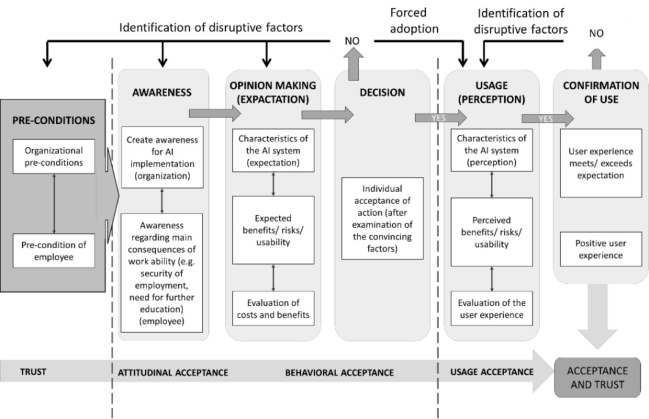
THEORETICAL BACKGROUND The process-oriented model by Jung and von Garrel addresses AI acceptance in manufacturing by fostering employee trust and providing insights into how acceptance of technological innovations emerges (see Figure 1) (Jung and Von Garrel, 2021).
Figure 1: Process-oriented model for creating acceptance and trust among employees with regard to AI (based on (Jung and Von Garrel, 2021)).
1146 Link and Stowasser
Structurally, the model builds on Rogers’ innovation-decision process and comprises the phases knowledge, persuasion, decision, implementation, and confirmation (Rogers, 1983). It integrates elements from established TAM approaches (Gefen et al., 2003; Pavlou, 2003) as well as the concepts of work ability (Ilmarinen et al., 2002) and user experience (Norman et al., 1995). The process begins with organizational preconditions, such as innovation capability and culture, and individual employee characteristics. In the knowledge phase, awareness of the AI implementation is created. During persuasion, employees develop attitudinal acceptance, defined as a stable cognitive and affective orientation, coupled with a readiness to respond’ toward the technology (Müller-Böling and Müller, 1986). The subsequent phase of decision and implementation marks the transition to behavioral acceptance, characterized by the shift from attitude to concrete behavior, namely the active decision to try out or apply the innovation (Kollmann, 1998). In this phase, employees compare initial expectations (should-be) with actual experiences (as-is). Finally, in the confirmation phase, usage acceptance emerges, representing the sustainable integration of the AI system into daily work (Kollmann, 1998). Meeting or exceeding expectations strengthens trust, the central outcome of the process, whereas unmet expectations require systematic identification and resolution of barriers.
METHOD
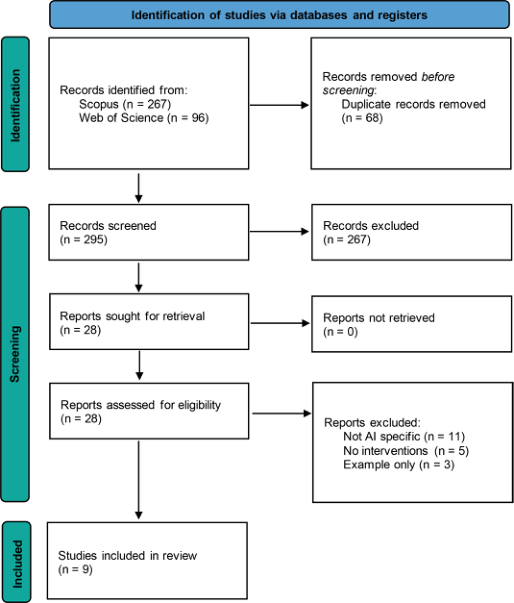
To address the research questions, a literature review was conducted using the PRISMA method (Page et al., 2021), followed by a content analysis to identify relevant interventions (see Figure 2). These were mapped onto a process-oriented framework for fostering acceptance and trust in AI in manufacturing. The review, carried out in August 2025, used Scopus and Web of Science for their academic relevance. An abstract and keyword search was performed with: “(‘artificial intelligence’ OR ‘AI’) AND (‘acceptance’ OR ‘adoption’ OR ‘attitude’) AND (‘workplace’ OR ‘employee’ OR ‘workforce’ OR ‘job’) AND (‘industr’ OR ‘manufacturing’ OR ‘production’)”. No time restrictions were applied, but only open-access articles were included. The search yielded 267 records in Scopus and 96 in Web of Science. After removing 68 duplicates, 28 articles were screened; eleven were excluded for covering multiple technologies (e.g., Blockchain, IoT, Robotics), five for lacking explicit interventions and three for focusing only on case examples. To answer RQ1, nine remaining studies were analysed using Mayring’s qualitative content analysis (Mayring and Fenzl, 2019). For the literature analysis, relevant statements were extracted from the papers, with sentences as the smallest and paragraphs as the largest unit of analysis. Inclusion criteria were direct or indirect mentions of interventions, while exclusions concerned statements limited to the measurement of acceptance, general content, or methodological descriptions. Quotations were paraphrased and reduced to a uniform level (3–5 words).
Categories and subcategories were then inductively formed, with a pilot coding after 30% of the material, followed by deductive review of all papers to identify further implications. Finally, the categories and subcategories were mapped onto the acceptance model to answer RQ2.
Acceptance of AI in the Workplace: Literature Analysis and Process-Oriented Methods 1147
Figure 2: Prisma flow chart of the literature process (based on (Page et al., 2021)).
RESULTS
The following section presents the results of the literature review and the inductive content analysis. First, the identified interventions to foster acceptance of AI in industrial context will be presented. In a second step these findings are structured and arranged within a process model to foster acceptance of AI in the workplace.
Identified Interventions to Foster Acceptance of AI
Table 1 summarizes the categories and subcategories derived from the inductive content analysis, thereby addressing RQ1. The results were grouped in twelve overarching categories (see Table 1, column 1). Each category includes specific subcategories that reflect concrete interventions, practices, or requirements identified in the analysis. In total, 44 subcategories were identified. The distribution of quotes across subcategories varied, with certain topics appearing more frequently in the reviewed papers. For instance, aspects such as the importance of workers’ technical qualification and iterative testing, feedback loops, and the inclusion of domain- specific knowledge were highlighted in more than half of the studies. The communication of (net)-benefits was explicitly addressed in four papers, with a related subcategory - the use of demonstrators or practical examples - being mentioned twice as a solution for communicating or illustrating these benefits. Further recurring themes, each mentioned in three studies, include user-friendly systems, explainable AI, non-technical training, the formation of interdisciplinary teams, the development of a trust-based corporate culture, innovative and visionary leadership practices, stakeholder participation across all organizational levels, and the implementation of an AI strategy.
1148 Link and Stowasser
Table 1: Interventions to foster acceptance of AI in industry (categories and subcategories found in qualitative content analysis) Note: To improve readability, the sources in this table are represented by numbers. [1] (Tursunbayeva and Chalutz-Ben Gal, 2024); [2] (Xu et al., 2025); [3] (Chatterjee et al., 2021), [4] (Dey et al., 2024); [5] (Alhammadi, 2025); [6] (Jung and Von Garrel, 2021); [7] (Werens and Von Garrel, 2023); [8] (Wanner et al., 2022); [9] (Son et al., 2024).
Table available in the original PDF paper.
Category Subcategory Sources Design of the AI implementation process
[1, 3, 4]
Recognition and incentive systems [1, 2] Development of an AI implementation strategy [4] Implementation of data management strategies
[1, 4]
Development of a topic-specific training strategy [1] Establishment of AI-related knowledge management structures
[1]
Application of change management methods [3] Operative work design Design of the work system and adaption of processes
Provision of modern infrastructure [3, 5] Definition of user and AI roles [1]
Technical characteristics of the AI system
[6]
User-friendly system [3, 6, 7] Use of explainable AI (global and local) [1, 7, 8] Rapid elimination of system errors and usage barriers Ensuring reliability of AI results [1] [7, 8]
Ethical, legal and social aspects (ELSI)
Guidelines for data protection and trust-builidng [1, 2] Development of responsible AI systems (fairness, no discrimination)
[1, 3-5, 9]
Re- and Upskilling Training in AI system usage [8] Technical training of employees (AI basics and digital skills) [1, 2, 5] Leadership development [5] Non-technical training of employees (empowerment, creativity, and innovation training)
[2, 5]
External cooperation Inspiration from best practices [5] Knowledge exchange with research institutions and universities [3, 5] Participation in knowledge-sharing networks
Internal cooperation Establishment of interdisciplinary teams [1, 2, 9] Establishment of mentoring programs [1] Continued
Acceptance of AI in the Workplace: Literature Analysis and Process-Oriented Methods 1149
Table 1: Continued Category Subcategory Sources
Table available in the original PDF paper.
[1]
Establishment of internal knowledge sharing platforms and collaborative learning environments [1, 2]
Innovation-oriented corporate culture
Promoting a learning and experimentation culture
[1, 3, 6, 7]
Establishment of a trust-based corporate culture [1, 5]
Innovative and active leader-ship culture
Visonary and strategically aligned leadership [3, 5] Supportive leadership fostering motivation and adoption
[1, 3, 6, 7]
Demonstration of AI added value
Communication of net benefits (benefits vs. risks) [6-8] Expectation management and illustration of AI limitations
[1, 6]
Practical examples and demonstrators to clarify benefit [1] Illustration of workload reduction through automation of monotonous tasks
Pilot projects and prototypes [1]
Internal Communication
[1, 6]
Clarification regarding job security [6, 7] Transparency, honesty and openness [1, 6-8] Explaining the strategic importance of AI [3] Early clarification of AI system content and its impact on work tasks [6, 8] Individual adaption of communication style and content to employees
[1]
Establishment of communication channels for concerns [1] Continuous updates on progress in system development
[1, 4, 6, 8, 9]
Participation Iterative testing, feedback loops, and inclusion of domain-specific knowledge [9] Co-creation in the initial development phase
[3, 4, 8, 9]
Stakeholder participation across all affected company levels
Methods Within a Process-Oriented Model to Foster Acceptance
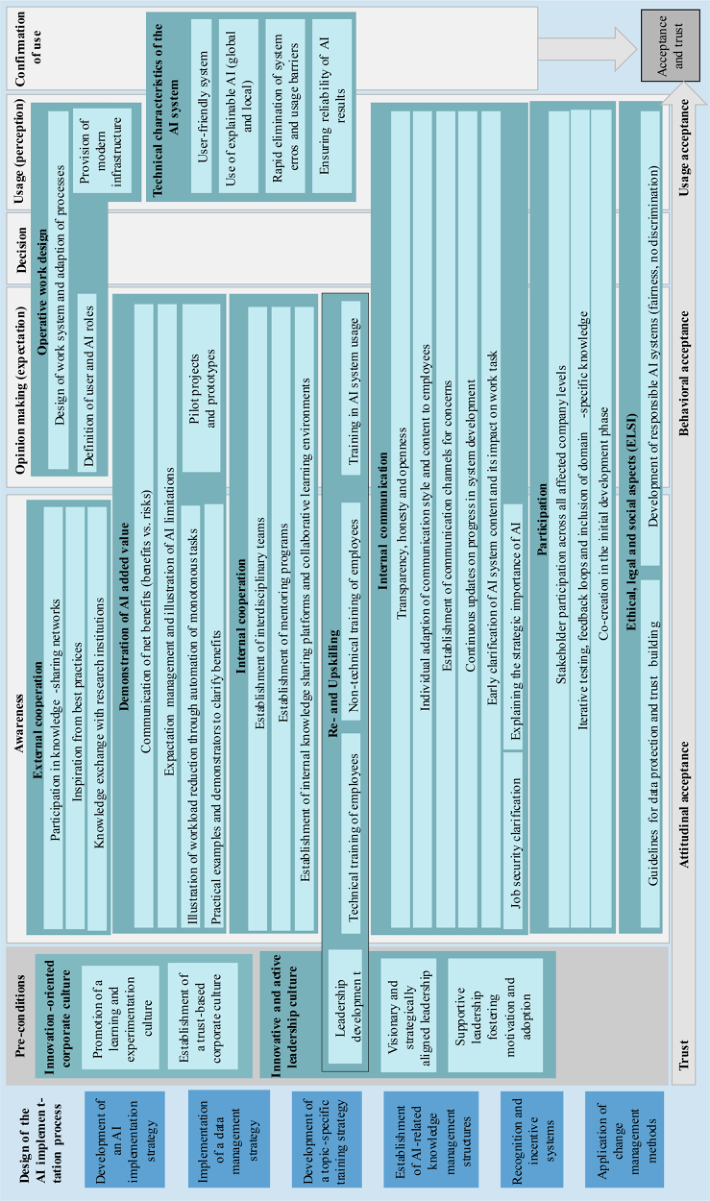
Figure 3 maps the identified categories and subcategories onto the process- oriented model of Jung and von Garrel, offering a response to RQ2. Design of the implementation process spans the entire model as a cross- cutting intervention shaping all subsequent phases. The culture-related categories fall within Pre-Condition, reflecting their role as organizational
1150 Link and Stowasser
prerequisites. Re- and Upskilling, Demonstration of AI added value, and Internal cooperation extend into Opinion-Making, enhancing competence, illustrating benefits, and fostering collaboration. External cooperation aligns mainly with Awareness, supporting early exposure and knowledge building. Participation, Internal communication, and ELSI span all phases, ensuring continuous involvement, transparency, and ethical-legal safeguards. Finally, Operative work design and System characteristics are most influential during Opinion-Making and Usage, where work practices and usability perceptions shape behavioral acceptance; the latter also extends into Confirmation and Trust, where realized or unmet expectations determine long-term acceptance.
DISCUSSION
The analysis highlights a concentration of interventions at the beginning of the implementation process and shows that the identified topics span the three dimensions of human, technology, and organization. For example, categories such as Participation or Internal communication address the human dimension, whereas Technical characteristics of AI systems represent the technological perspective. The organizational dimension is reflected in categories such as Corporate and Leadership culture. Most interventions, however, emphasize human factors: technical design matters but is outweighed by “softer” aspects. Companies should therefore strengthen human and organizational measures alongside technical development. Particularly relevant are employee qualification, demonstration of added value, participation, cooperation, and corporate culture.
Another recurring aspect concerns the communication of (net) benefits, linked to the related subcategory of demonstrators and practical examples. These interventions were frequently mentioned as important levers for fostering attitudinal acceptance, as they help employees to better understand the added value of AI. However, despite their perceived importance, the literature provides little guidance on how net benefits can be effectively and practically communicated or how accessible demonstrators and practical examples should be designed. This indicates a relevant gap for future research.
The use of the PRISMA approach ensured a structured literature search. However, the inclusion of only Scopus and Web of Science may limit coverage, as additional databases or gray literature—often containing practice-oriented insights—were not considered. Another limitation is that only publicly available articles were analyzed, with nine papers directly addressing the research question after excluding studies on other technologies or domains. Nevertheless, identifying twelve categories and 44 subcategories provides a solid overview of current literature on interventions to foster AI acceptance.
CONCLUSION AND OUTLOOK This paper analyzed interventions to foster AI acceptance in the manufacturing sector using a process-oriented model for employee-centered implementation. A systematic literature review following the PRISMA approach identified 295 publications, of which nine were analyzed in depth and inductively categorized according to Mayring. The analysis revealed twelve categories and 44 subcategories, including Design of the AI Implementation Process, Operative Work Design, Technical Characteristics of the AI System, ELSI, Re- and Upskilling, External Cooperation, Internal Cooperation, Innovation-oriented Corporate Culture, Innovative
Acceptance of AI in the Workplace: Literature Analysis and Process-Oriented Methods 1151
Figure 3: Process-oriented interventions to foster acceptance from AI in industry.
1152 Link and Stowasser
and Active Leadership Culture, Demonstration of AI Added Value, Internal Communication, and Participation. These categories were mapped onto the process-oriented model by Jung and von Garrel. While Design of the Implementation Process provides the overarching framework, the remaining categories correspond to specific phases of the acceptance process. Future research will particularly address the Demonstration of AI Added Value, especially through the design of demonstrators, as this aspect is often highlighted yet remains insufficiently explored in current literature.
ACKNOWLEDGMENT
AI tools were used for translation and linguistic refinement. All decisions regarding content, interpretation, and argumentation remained the responsibility of the authors.
The authors express their gratitude to the Federal Ministry of Research, Technology and Space for funding the project WIRKsam (02L19C600), within the framework of which this contribution was developed. The responsibility for the content of this publication lies with the authors.
REFERENCES
Alhammadi, A., 2025. Measuring the antecedents of employees’ intention to use artificial intelligence in the manufacturing sector. Problems and Perspectives in Management 23, 557–568. https://doi.org/10.21511/ppm.23(1).2025.42. Chatterjee, S., Rana, N. P., Dwivedi, Y. K., Baabdullah, A. M., 2021. Understanding
AI adoption in manufacturing and production firms using an integrated TAM- TOE model. Technological Forecasting and Social Change 170, 120880. https:// doi.org/10.1016/j.techfore.2021.120880. Chaudhry, I. S., Paquibut, R. Y., Chabchoub, H., 2022. Factors Influencing Employees Trust in AI & its Adoption at Work: Evidence from United Arab Emirates, in: 2022 International Arab Conference on Information Technology (ACIT). Presented at the 2022 International Arab Conference on Information Technology (ACIT), IEEE, Abu Dhabi, United Arab Emirates, pp. 1–7. https:// doi.org/10.1109/ACIT57182.2022.9994226. Dey, P. K., Chowdhury, S., Abadie, A., Vann Yaroson, E., Sarkar, S., 2024. Artificial
intelligence-driven supply chain resilience in Vietnamese manufacturing small- and medium-sized enterprises. International Journal of Production Research 62, 5417–5456. https://doi.org/10.1080/00207543.2023.2179859. Gefen, D., Karahanna, E., Straub, D. W., 2003. Trust and TAM in Online Shopping: An Integrated Model. MIS Quarterly 27, 51–90. https://doi.org/ 10.2307/30036519. Harlacher, M., Ottersböck, N., 2023. ifaa-Studie: Künstliche Intelligenz in produzierenden Unternehmen. Institut für angewandte Arbeitswissenschaft e.V. Available at: https://www.arbeitswissenschaft.net/ki-studie-ergebnisse (Accessed: 10 November 2025). Ilmarinen, J., Tempel, J., Giesert, M., 2002. Arbeitsfähigkeit 2010: was können wir
tun, damit Sie gesund bleiben? VSA-Verl, Hamburg.
Acceptance of AI in the Workplace: Literature Analysis and Process-Oriented Methods 1153
Jung, M., Von Garrel, J., 2021. Mitarbeiterfreundliche Implementierung von KI–Systemen im Hinblick auf Akzeptanz und Vertrauen: Erarbeitung eines Forschungsmodells auf Basis einer qualitativen Analyse. TATuP 30, 37–43. https:// doi.org/10.14512/tatup.30.3.37. Kollmann, T., 1998. Akzeptanz innovativer Nutzungsgüter und-systeme. Gabler
Verlag, Wiesbaden. https://doi.org/10.1007/978–3-663–09235-3. Lane, M., Williams, M., Broecke, S., 2023. The impact of AI on the workplace: Main findings from the OECD AI surveys of employers and workers (OECD Social, Employment and Migration Working Papers No. 288), OECD Social, Employment and Migration Working Papers. https://doi.org/10.1787/ea0a0fe1- en. Link, J., Stowasser, S., 2024. Negative Emotions Towards Artificial Intelligence in the
Workplace – Motivation and Method for Designing Demonstrators, in: Degen, H., Ntoa, S. (Eds.), Artificial Intelligence in HCI, Lecture Notes in Computer Science. Springer Nature Switzerland, Cham, pp. 75–86. https://doi.org/10.1007/978–3- 031–60611-3_6. Lukyanenko, R., Maass, W., Storey, V. C., 2022. Trust in artificial intelligence: From a Foundational Trust Framework to emerging research opportunities. Electron Markets 32, 1993–2020. https://doi.org/10.1007/s12525–022- 00605–4. Mayring, P., Fenzl, T., 2019. Qualitative Inhaltsanalyse, in: Baur, N., Blasius,
J. (Eds.), Handbuch Methoden Der Empirischen Sozialforschung. Springer Fachmedien Wiesbaden, Wiesbaden, pp. 633–648. https://doi.org/10.1007/ 978–3-658–21308-4_42. Müller-Böling, D., Müller, M., 1986. Akzeptanzfaktoren der Bürokommunikation, Fachberichte und Referate. Oldenbourg, München Wien. Narukonda, K., Bojja, G. R., Bishop, D., 2020. Factors Influencing the Adoption of
Artificial Intelligence in Organizations - From an Employee’s Perspective. Norman, D., Miller, J., Henderson, A., 1995. What you see, some of what’s in the future, and how we go about doing it: HI at Apple Computer, in: Conference Companion on Human Factors in Computing Systems - CHI ‘95. Presented at the Conference companion, ACM Press, Denver, Colorado, United States, p. 155. https://doi.org/10.1145/223355.223477. Page, M. J., McKenzie, J. E., Bossuyt, P. M., Boutron, I., Hoffmann, T. C., Mulrow,
C. D., Shamseer, L., Tetzlaff, J. M., Akl, E. A., Brennan, S. E., Chou, R., Glanville, J., Grimshaw, J. M., Hróbjartsson, A., Lalu, M. M., Li, T., Loder, E. W., Mayo- Wilson, E., McDonald, S., McGuinness, L. A., Stewart, L. A., Thomas, J., Tricco, A. C., Welch, V. A., Whiting, P., Moher, D., 2021. The PRISMA 2020 statement: an updated guideline for reporting systematic reviews. BMJ n71. https://doi.org/ 10.1136/bmj.n71. Pavlou, P. A., 2003. Consumer Acceptance of Electronic Commerce: Integrating Trust and Risk with the Technology Acceptance Model. International Journal of Electronic Commerce 59, 69–103. https://doi.org/10.1080/ 10864415.2003.11044275. Plathottam, S. J., Rzonca, A., Lakhnori, R., Iloeje, C. O., 2023. A review of artificial
intelligence applications in manufacturing operations. J Adv Manuf & Process 5, e10159. https://doi.org/10.1002/amp2.10159. Pokorni, B., Braun, M., Knecht, C., 2021. Menschzentrierte KI-Anwendungen in der Produktion - Praxiserfahrungen und Leitfaden zu betrieblichen Einführungsstrategien.
1154 Link and Stowasser
Rogers, E., 1983. Diffusion of Innovations. University of Illinois at Urbana- Champaign’s Academy for Entrepreneurial Leadership Historical Research Reference in Entrepreneurship. Son, A., Apachite, C., Petcu, A., Schuurman, D., 2024. Corporate AI Living Labs:
A Structured Approach to Accelerating AI Adoption and Transforming Towards AI-Empowered Employees for Operational Excellence. Journal of Innovation Management 12, XV–XX. https://doi.org/10.24840/2183–0606_012.003_L002. Stowasser, S., 2023. Successful Introduction of AI in the Company: Building Blocks for Change Management, in: Knappertsbusch, I., Gondlach, K. (Eds.), Work and AI 2030. Springer Fachmedien Wiesbaden, Wiesbaden, pp. 133–141. https:// doi.org/10.1007/978–3-658–40232-7_15. Stowasser, S., Neuburger, R., 2022. Führung im Wandel: Herausforderungen und
Chancen durch KI. Lernende Systeme – Die Plattform für Künstliche Intelligenz. https://doi.org/10.48669/PLS_2022–4. Tursunbayeva, A., Chalutz-Ben Gal, H., 2024. Adoption of artificial intelligence: A TOP framework-based checklist for digital leaders. Business Horizons 67, 357–368. https://doi.org/10.1016/j.bushor.2024.04.006. Wanner, J., Herm, L.-V., Heinrich, K., Janiesch, C., 2022. The effect of transparency and trust on intelligent system acceptance: Evidence from a user-based study. Electronic Markets 32, 2079–2102. https://doi.org/10.1007/ s12525–022-00593–5. Werens, S., Von Garrel, J., 2023. Implementation of artificial intelligence at the
workplace, considering the work ability of employees. TATuP 32, 43–49. https:// doi.org/10.14512/tatup.32.2.43. Xu, L., Cherian, J., Alturise, F., Alkhalaf, S., Mikhaylov, A., Comite, U., 2025.
Artificial Intelligence Attitude and Innovative Performance in Emerging Economy: The Mediating Roles of AI Supportive Autonomy, AI Big Data Analytics. Journal of Global Information Management 33, 1–35. https://doi.org/10.4018/ JGIM.384084.
LISTED IN THE AHFE DIGITAL BOOKSTORE CATALOGUE
Explore the complete digital volume
Human Factors in Design, Engineering, and Computing
Read this individual research paper free through the original publisher, or explore the full digital proceedings book.
ISBN 978-1-964867-75-5
Explore this ISBN in the AHFE Bookstore ↗Listed in the July 2026 bookstore catalogue; search by ISBN to confirm current availability · Digital book purchase optional