Marcin Butlewski, Edwin Tytyk, Kamil Wrobel (2020). Macroergonomic Model of the Quality of Life of Elderly Employees for Design Purposes. In: Advances in Social and Organizational Factors. AHFE Open Access, vol. 9. https://doi.org/10.54941/ahfe100339
In the lives of the elderly, work and the related socio-economic conditions are a significant, and often essential, part of life. The quality of life is a cumulative and multifactorial indicator. Therefore, to evaluate it, macroergonomic analysis is particularly applicable. Quality of life is thus an aggregating factor, which generally describes factors in an undoubtedly subjective manner. Currently existing methods propose to ask questions about the quality of working life in categories such as: wages, incentive systems, relations with supervisors and co-workers, market position of the company, opinions on the organization expressed by others, and organization and nature of the work. However, the evaluation of individual categories helps to a small extent to identify particularly important systemic relationships as well as expectations directed at the technical and organizational environment. Therefore, this paper presents a synthesis of methods, utilizing, among others, Macroergonomic Organizational Questionnaire Survey (MOQS), Karasek’s Job Content Questionnaire (JCQ), NIOSH Job Stress Questionnaire and NASA Task Load Index. This combination results in a research tool that not only assesses the fulfilment of each category, but also recognizes the needs of people surveyed in the specific areas.
The issue of working in elderly age is a matter of controversy. This is due to a perceived decline in strength as one ages, while also to the sentiment that one deserves a rest after a lifetime of working. The quality of life is a cumulative and multifactorial indicator. Therefore, to evaluate it, macroergonomic analysis is particularly applicable. It allows to not only attain an assessment of specific dimensions of satisfaction with the experienced work conditions, as is the case with currently existing methods, but also to reveal relationships between various technical and organizational systems which are present in the workplace. The macroergonomic approach seems even more appropriate when designing for groups with specific needs, such as the elderly, because of the development of a number of approaches and methodologies in the realm of design such as: universal design, inclusive design, design-for-all, barrier-free design and accessible design (Goldsmith 2000, Meyer et al., 1998, Branowski and Zabłocki, 2006); however, despite the existence of these methods, the widely used solutions still to a small degree address the needs of a wide range of users, and are limited to at most one of the most obvious needs (e.g., physical access), with no regard to the less visible, but not necessarily less important, needs (Eichhorn et al., 2007). The elderly are selected as the target group, because they constitute a specific group of recipients, for whom the technical environment is often not very amiable, and the time of acquisition of certain solutions – considerably longer.
In the article it is assumed that quality of life (Misztal and Butlewski, 2012) is the result of many factors, such as satisfaction with the achieved social status, professional stability, achieved income, social relations at work and the characteristics of the performed activities, technical environment and safety culture, yet simultaneously it is also a function of aspirations, personal determinants and experiences. An additional matter essential to consider when describing the quality of life of elderly people are the factors adversely affecting them, such as health problems, decreasing psychophysical abilities, and in the subsequent stages of life – traumatic experiences such as the death of loved ones or the loss of an achieved position to younger co-workers. Quality has both a measurable as well as unquantifiable nature, one can make a very parameterized description of it or leave a qualitative description (Mazur, 2013). Quality management, also in terms of the quality of life of workers, can be a way for companies to achieve perfection, setting targets and consistently striving for their achievement, but simultaneously their omission does not give any added value (Jasiulewicz-Kaczmarek, 2012).
Quality of life is thus an aggregating factor, which generally describes factors in an undoubtedly subjective manner. Currently existing methods propose to ask questions about the quality of working life in categories such as: wages, incentive systems, relations with supervisors and co-workers, the market position of the company, opinions on the organization expressed by others and organization and nature of the work. However, the evaluation of individual categories helps to a small extent to identify particularly important systemic relationships as well as expectations directed at the technical and organizational environment. Therefore, there is a need of synthesis of methods, utilizing, among others, Macroergonomic Organizational Questionnaire Survey (MOQS), Karasek’s Job Content Questionnaire (JCQ), NIOSH Job Stress Questionnaire and NASA Task Load Index.
The weight of the undertaken subject also arises from the fact that the demographic situation not only encourages people to undertake various activities (including work) but also creates the necessity for them to work. The question of whether elderly people should work to function as part of society is of the past - the present question is how they can work efficiently and at an optimal psychophysical cost. In order to answer this question it is necessary to know the model of the quality of life of elderly people, which the macroergonomic approach can help discover.
DESIGN FOR THE ELDERLY Problems of old age and their scale
According to the WHO organization starting at the age of 60 years we can consider the border of old age (Steuden, 2012). However, this border is contractual, thus some data refers to the border of 65 years, while others point to the beginnings of the division of old age from adulthood at 50 and 45 years (Bromley, 1969). Regardless of the accepted boundaries, the problem of old age, perceived as the ratio of elderly people in society, is growing in the vast majority of European countries. Currently in Poland there are nearly 20% of people over 60 years of age. In the year 2035 the percentage of those over 65 years of age will reach 38%, and for all of Europe this factor, the so-called demographic load, will achieve a level of 43% (CSO, 2009). The estimated life expectancy of people over 65 years (until recently the retirement age) is 17.3 years for men and 20.9 years for women (IIASA, 2012).
The problem of an aging population has at least a few dimensions. One of them is revealed at the economic level and results from the load on the adopted social security system, which assumed only a progressive age pyramid in society. In this growing population model the vast majority of working people through deducted premiums supports a minority that has stopped working (assuming no accumulation of the contributions). In such populations, the elderly accounted for a relatively small burden on a significantly growing population of active people. The problem of an aging society manifested itself at a time when the relationship began to turn, and the means of people who ended their professional activity had become inadequately protected. This problem of an economic nature does not remain in traditional ergonomic design for the elderly, but is included in the issues of macroergonomics. As part of its approach, one may consider organizational models of work throughout life, and the validity of the existing solution which causes some of the most effective years of life to be spent outside of the labour market during studies, after which often the knowledge gained is not applied.
Another group of problems is the quality of life in old age. The increasing life expectancy will result in the need for a range of supporting and mobilizing aids especially during advanced old age. Some researchers even suggest that it is quite possible to achieve the age of 120-130 years for a significant portion of the female population (Duda, 2013). This will raise almost Gulliverian problems and will trigger the need for an economic and social consensus, which will prevent possible perversions such as "encouraging" euthanasia or activities with similar effects to euthanasia (no treatment due to the patient's age).
With the demographic changes there will be more problems, such as elderly workers' labour, which itself also has many dimensions. In addition to the economic and moral (forcing elderly people to work) as well as medical problems (impact of work factors on an age-weakened body), ergonomic problems also appear. One of them is the ergonomic dimension of adaptation to a safe and efficient working environment for the elderly. This is inevitable, because during the collapse of the current system of financing the elderly will be forced to stay longer in an employment or monetary situation. On the side of ergonomic design lies the problem of the technological divide resulting from ubiquitous technological measures and the decreasing psychomotor and cognitive properties of the elderly. Ergonomic quality influences productivity (Butlewski and Tytyk, 2008). Increased work efficiency through an improved ergonomic quality takes place at the same or lower human cost. One can also achieve the same profit without consequences (Górny, 2012). Ergonomic design must therefore replace regular design, and all other forms, such as the approach to the problem by placing an age limit for the use of individual measures, are no longer sufficient (e.g., proposals for a maximum age limit of persons entitled to drive), which had previously been doubtful "only" morally.
Specificity of ergonomic design for the elderly Contrary to appearances, designing for the elderly is not easy due to several methodological problems. The first one is a fairly obvious problem of a decline in physical and mental faculties with age. Aging is associated with changes such as (Duda, 2013): decreasing adaptation to various physical, biological and psychosocial loads, decreasing organ reserves, increasing morbidity, and rising mortality. The changes of a physiological and psychological nature also cause personality changes, the course of which is largely defined by elusive factors such as self-assessment of personal performance and satisfaction with life (Halicka, 2004, Steuden, 2011). These changes will have an impact on the demand for quality of products and services. The problem in this respect consists of mapping needs without stigmatization, in such a way that the proposed solutions allow for development and not act as a barrier. In terms of problems related to the decline of intellectual properties it should be noted that if it is scientifically detected and physiologically determined (Bromley, 1969, Lewandowski, 2013), it is still the subject of scientific discourse (Steuden, 2011).
Another factor next to the issue of matching the technical environment to the identified needs of the elderly is to obtain information on unquantifiable characteristics, needs and specific modes of action of the elderly. This problem is solved, among others, by design methodology from the realm of ethnographic design (Richard et al., 2013). However, despite the utilitarian use of these methods, there are a number of objections to the generality and reliability of the results obtained with their use (Vinck, 2003). Certainly, the use of information obtained from small design groups should be approached with caution. However, the observation used by ethnographic design is a much better form of obtaining information regarding the operation of elderly people than interviews and questionnaires.
Another important factor in ergonomic design is the scale of the results achieved by a suitably deep redesign of the considered systems. Achieving the desired effect using the traditional approach is too inefficient hence the opportunities offered by heuristic methods (Butlewski, 2013). These methods are partly reflected in the above- mentioned ethnographic design, but the scale of the effect achieved is dependent on the innovation of the changes, and these are often faced with constraints in the case of the older and more conservative audience. This means that in the case of the elderly, ergonomic design must also take into account the cultural context and habits, which will involve overcoming considerable resistance and thus the reluctance to proposed solutions. This again begets opportunities for macroergonomic methods.
The specificity of ergonomic design for elderly people is also apparent from the fact that certain properties of a group of elderly people may arise not so much from the aging process, but from the specific conditions to which the given human society was subjected to. In other words - each cohort is aging in a different way (Riley, 1987). This implies the need for adaptation and for not predetermining specified differences.
MACROERGONOMIC APPROACH TO QUALITY OF LIFE OF THE ELDERLY Macroergonomics represents a new approach in the activities of ergonomics, whose objects of interest are complex socio-technical systems (Pacholski 1995, Pacholski 2000, Pacholski and Jasiak, 2011). The macroergonomic approach takes into account not only the physical work environment factors but also the elements that form the broader context of the design situation in the fields of (Butlewski and Tytyk, 2012): sociology, economics, politics, culture, religion and ecology. This means that in this sense macroergonomic design must use a number of different tools to achieve its goals. It is this wider context which provides the opportunity to respond to the needs of elderly people and to deal with the problem of the "greying" of the workforce (Stanton et al., 2004). The macroergonomic principle which consists of considering a multi-faceted problem at each stage of design (Hendrick, 1995) allows to refer to not only a particular position or object for an elderly person, but also to the indirectly and directly related objects and organizations. From the macroergonomic viewpoint, in the case of ergonomic design for the elderly the identification of the limits of the elderly should serve the application of these properties so that it is possible to obtain a greater efficiency of the system than would be the case for other users. For example, one can indicate that ergonomic measures for people with a limited level of auditory perception are associated with the adjustment of the level of emitted signals, and the macroergonomic activities are associated with the answer to the question of where such restrictions can be used (work in environments with specific acoustic characteristics), how these limitations affect the other actions of the user, what changes should be made to turn the dysfunction into an advantage rather than a disadvantage, how to manage older and younger employees. It should be remembered that the macroergonomic approach requires not only participation in the design processes themselves, but organizational and managerial processes as well. Only then can ergonomics reach its full potential (Hendrick, 1997).
The quality model, and thus the reflected needs of the various dimensions of life, allow for choosing specific design courses of action to improve the quality of life in general, including satisfaction from the performance of activities such as work. In terms of the latter, various models are adopted of groups of factors indicating job satisfaction (skill variety, task identity, task significance, autonomy, and job feedback) (Lepper et al., 2012). It should also be noted here that the general cognitive theories of quality of life for design purposes have a low value. The indicated groups of factors (Hyde et al., 2003): Control, Autonomy, Self-realization, Pleasure, which were obtained from 19 questions of CASP 19 have a rather low value when it comes to the needs of design, but they do represent an interesting cognitive model in psychological terms. The low cognitive value of the model results from the grouping of questions about completely different characteristics such as: “I choose to do things that I have never done before” and “I feel satisfied with the way my life has turned out” which are included in Self- realization, while from the design point of view, these two sentences have completely different consequences. As a useful model questions could be used from the fields of Control and Autonomy (Hyde et al., 2003): “My age prevents me from doing the things I would like to; I feel that what happens to me is out of my control; I feel free to plan for the future; I feel left out of things; I can do the things that I want to do; Family responsibilities prevent me from doing what I want to do; I feel that I can please myself what I can do; My health stops me from doing the things I want to do.”
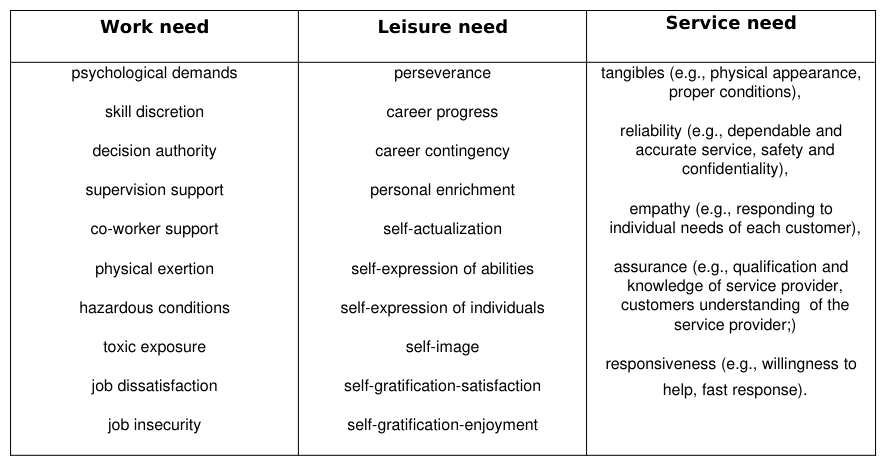
The carried out studies point to different targets perceived by elderly people because of the changing perception of self. The needs for development as well as the possibility of promotion are reduced as well, while larger needs occur in the social context. Needs and assessment categories for the elderly are listed Table 1.
Table 1: Elderly ergonomic needs model (Parasuraman et al. 1993, Stroms et al. 2001, Heo et al. 2013,
Butlewski et al., 2014
The presented three categories can provide a list of requirements for the model proposed later in this article. Differences in perceptions of each category will be only partially dependent on the age, because other variables will include gender, education, experience, and the previously mentioned cohort effect.
The macroergonomic perception of the quality of life of the elderly should therefore, in the author’s opinion, be due to the identified needs of the general public (such as CASP 19), but giving the idea regarding the individual components of the environment (Butlewski 2014 in press): relationships, technical and IT environment, level of understanding of the environment and the desire to learn, a feeling of the importance of the goal – task in society, a sense of prestige and dignity, compliance of own activities and work with own interests and development opportunities. This model better reflects the design needs, although it still operates at a fairly high level of generality.
MACROERGONOMICS AND DESIGN FOR ELDERLY Macroergonomic methods aiding design for the elderly
Specific macroergonomic tools can be used for design purposes for the elderly, e.g. by identifying environmental factors related to the work and leisure of the elderly. One of the most frequently cited methods is MOQS (Macroergonomic Organizational Questionnaire Survey). This method is used to collect information on various aspects of the work system (Salvendy et al., 1997) and it is recognized that it is very useful in determining the quality of working life (e.g., job satisfaction). MOQS does not have a specific structure of questions while the recommended steps in the method are (Carayon et al., 2001):
1. Conceptualization
2. Operationalization
3. Sources of questionnaire
4. Constructing the questionnaire
5. Pretesting of the questionnaire
The source of questions that can be used to assess the quality of working life of elderly people in terms of macroergonomics is Karasek's Job Content Questionnaire (JCQ). Assessment shall be subject to the standard set of questions that measure these two job dimensions (Karasek, 1985), including questions on psychological demands and nine questions on decision latitude. These two scales of the JCQ are partly based on the IS-item questionnaire of the three U.S. Quality of Employment Surveys (QES) (Brisson et al., 1998). The JCQ method has many modifications, using different sets of questions. The aim of the method is to evaluate job strain, which according to researchers translates into cardiovascular diseases (Karasek et al., 1988, Hall et al., 1993, Steenland et al., 1997). The degree to which the test subject agrees with the provided questions is evaluated in specified areas and sub-areas:
2. Decision authority (Ability to make decisions, Freedom of choice, “a say”)
3. Psychological demands, Work fast, Work hard mentally, No excessive demands, Having enough time, No conflicting demands, Continuous concentration, Tasks unexpectedly broken off, Hectic job, Wait on others to complete tasks.
Macroergonomic methods have a holistic way of action, however, to assess differences between groups of younger and older users we need comparative studies. Thus, research relating the differences deserves attention – for example between design features and performed activities of younger and older workers (Kupritz, 2000), which show that older and younger workers associate similar design features with facilitating work activities. However, these studies do not overlap with other related factors causing the desire for further work by the elderly (McNair, 2006). The question then arises whether the described methods allow to reveal the real needs of the elderly and whether it is an adequate way to obtain information regarding factors indicating satisfaction with the undertaken actions.
Proposed method for assessing the needs of the elderly A disadvantage of the previously listed methods is a limited valuation of individual characteristics and the often occurring in elderly people lack of the ability to recognize certain criteria (Butlewski et al. in print in 2014). This results in the validity of using a method of comparing individual factors. Helpful in this situation are the assumptions of the NASA TLX method, modified for the needs of perception of elderly people. This tool can be used as a verification of the identified needs of the elderly (quality of life model) and to identify differences in perception of individual factors. In the first part, an assessment would be made of non-compliance with the individual requirement parameters, on a 5-point scale (according to the author's experience a greater number of categories is difficult to assess for the elderly). Next, the individual pairs of characteristics are evaluated, which will indicate their level of importance. The product of the level of non-compliance and importance presents a picture of the gaps in the perceived quality by the elderly.
CONCLUSIONS
The macroergonomic approach to the problem of ergonomic design for the elderly offers a wide field of possible solutions and provides answers to problems which are currently without a proper solution. Even the most tailored positions and items will not provide an adequate level of desired quality without the adjustment of content and the surrounding environment to the needs of the elderly. The proposed model of study will determine the needs for individual groups of elderly people, however, the author believes it is not possible to obtain it in a universal way. The diversity of the aging process makes it impossible to find a universal solution for the needs of the elderly, however, the development of methods for their investigation will yield significantly improved results in the achieved ergonomic quality of the designed solutions.
REFERENCES
Bichard, J.-A., Greene, C., Ramster, G., Staples, T. (2013) Designing ethnographic encounters for enriched HCI Lecture Notes in Computer Science (including subseries Lecture Notes in Artificial Intelligence and Lecture Notes in Bioinformatics), 8009 LNCS (PART 1), pp. 3-12 Branowski B., Zabłocki M., (2006) Kreacja i kontaminacja zasad projektowania i zasad konstrukcji w projektowaniu dla osób
niepełnosprawnych, (w): Ergonomia produktu. Ergonomiczne zasady projektowania produktów, (red.) Jan Jabłoński, Wyd. Politechniki Poznańskiej,, ISBN: 83-7143-238-0 (in polish) Brisson C., Blanchette C., Guimont C., Dion G., Moisan J., Vézina M., Dagenais G.. Macaronsse L. (1998) Reliability and validity of the French version of the 18-item Karasek job content questionnaire, Work and Stress: An International Journal of Work, Health and Organisations, 12:4, 322-336, Bromley, D. (1969) Psychologia starzenia się,Warszawa Państwowe Wydawnictwo Naukowe, Butlewski M., (2013) Heuristic Methods Aiding Ergonomic Design, Universal Access in Human-Computer Interaction. Design
Methods, Tools, and Interaction Techniques for eInclusion, Lecture Notes in Computer Science Volume 8009,, pp 13-20 Butlewski M., Tytyk E., (2008) The method of matching ergo-nomic non-powered hand tools to maintenance tasks for the handicapped. 2nd International Conference on Applied Human Factors and Ergonomics, Las Vegas, Nevada, USA,;
Confer-ence Proceedings, Edited by Waldemar Karwowski and Gavriel Salvendy Butlewski M., Tytyk E., (2012) The assessment criteria of the ergonomic quality of anthropotechnical mega-systems; p. 298-306, [in]: Advances in Social and Organizational Factors, Edited by Peter Vink, CRC Press, Taylor and Francis Group, Boca Raton, London, New York, 2012, ISBN 978-1-4398-8 Carayon, P. and Hoonakker, P. (2001), Survey design, in International Encyclopedia of Ergonomics and Human Factors,
Karwowski, W., Ed., Taylor and Francis, London, pp. 1899–1902. CSO (Central Statistical Office) (2009). Population projection for Poland 2008–2035 [Internet]. Warszawa (Poland): GUS; [cited 2013 July 30]. http://www.stat.gov.pl/cps/rde/xbcr/gus/PUBL_L_prognoza_ludnosci_na_lata2008_2035.pdf CSO (Central Statistical Office) (2012). Average monthly salary in the national economy in the years 1950-2012 [Internet].
Warszawa (Poland): CSO; [cited 2013 July 30]. Available from: http://www.stat.gov.pl/gus/5840_1630_PLK_HTML.htm Duda K., (2013), The aging process [in], Marchewka A., Dąb-rowski Z., Żołądź J.A., (2013) Physiology of aging: Prevention and Rehabilitation / red. nauk.. Publishing house PWN, Warszawa (in Polish) Eichhorn, V, Miller, G., Michopoulou, E.,Buhalis D. (2007) Enabling Disabled Tourists? Accessibility Tourism Information
Schemes - Annals of Tourism Research - http://epubs.surrey.ac.uk/1090/ Goldsmith S. (2000), Universal design, Architectural Press, Oxford-Auckland-Boston Gołaś H., Mazur A., (2008), Macroergonomic aspects of a quality management system, [in:] Macroergonomic paradigms of Management, Jasiak A. [red.] to honour 40 years scientific activity of Professor Leszek Pacholski, Poznan University of Technology Editorial Board,, s. 161 – 170 Górny, A. (2012), Ergonomics in the formation of work condition quality. Work: A Journal of Prevention, Assessment and
Rehabilitation, 41, 1708-1711. Halicka M. (2004), Life satisfaction of the elderly: a study of the theoretical and empirical, Białystok (in Polish) Hall, E. M., Johnson, J. V. Tsou, T. (1993), Women, occupation, and risk of cardiovascular morbidity and mortality, Occupational Medicine, 8, 709-719. Hankiewicz K., (2012), Ergonomic characteristic of software for enterprise management systems, in: Advances in social and
organizational factors, Vink Peter (ed.), Boca Raton: CRC Press, pp. 279-287 Hendrick, H. W. (1997). Organizational design and macroergonomics. In G. Salvendy (Ed), Handbook of Human Factors and Ergonomics, 2nd Edition. New York: Wiley, 594-636. Hendrick, H. W. (1995), Future direction s in Macroergonomics, Ergonomics, 38, 1617 ± 1624. Heo J., Robert A. Stebbins, Junhyoung Kim and Inheok Lee (2013) Serious Leisure, Life Satisfaction, and Health of Older
Adults, Leisure Sciences: An Interdisciplinary Journal, 35:1, 16-32 Hyde, M., Wiggins, R. D., Higgs, P., and Blane, D. B. (2003). A measure of quality of life in early old age: The theory, development and properties of a needs satisfaction model. Aging and Mental Health, 7(3), 186–194. Jasiulewicz-Kaczmarek M., (2012), Socio-technical integrity in maintenance activities, In: Vink P. (eds.): Advances in Social and
Organizational Factors, CRC Press 2012, pp. 582–592 Karasek, R. A., Theorell, T., Schwartz, J. E., Schnall, P. L., Pieper, C. F. Michela, J. L. (1988), Job characteristics in relation to the prevalence of myocardial infarction in the US health examination survey (HES) and the health and nutrition examination survey (HANES), American Journal of Public Health, 78, 91C918 Kupritz, V., (2000) "The role of the physical environment in maximizing opportunities for the aging workforce", Journal of
Industrial Teacher Education, vol. 37, Leppel K., Brucker E. and Cochran J. (2012) The Importance of Job Training to Job Satisfaction of Older Workers, Journal of Aging and Social Policy, 24:1, 62-76, Lewandowski M. H., (2013) Ośrodkowy i obwodowy układ nerwowy - starzenie się fizjologiczne i profilaktyka [w],
Marchewka A., Dąbrowski Z., Żołądź J.A., Fizjologia starzenia się : profilaktyka i rehabilitacja / red. nauk.. Wydawnictwo PWN, Warszawa 2013 Mazur, A., (2013) Application of Fuzzy Index to Qualitative and Quantitative Evaluation of the Quality Level of Working Conditions, Springer Berlin Heidelberg 978-3-642-39475-1 McNair, S. (2006). How different is the older labour market? Attitudes to work and retirement among older people in
Britain.Social Policy and Society, 5,485 – 494 Meyer, Beth, Rogers, Wendy A., Mead, Sherry E., Guidelines for age-inclusive design, (1998) Proceedings of the Human Factors and Ergonomics Society, 2, p. 1629. Misztal A., Butlewski M., (2012) Life improvement at work, Wyd. PP, Poznań, ISBN: 978-83-7775-177-0 Pacholski L., (1995) Macroergonomic evaluation of the work process quality of the multiagent manufacturing system; [in]:
Ergonomics Design: Interfaces – Products – Information; p. 445-448, ABEGRO, Rio de Janeiro, Pacholski, L., (2000) Macroergonomic paradox of entrepre-neurship and economic renewal, in: Ergonomics for the new millennium, Human Factors and Ergonomics Society, pp. 185 – 188, Santa Monica – San Diego CA Pacholski, L.. Jasiak A. (2011) Makroergonomia, Wydawnictwo Politechniki Poznańskiej, Poznań Parasuraman, A., Berry, L.L., Zeithaml, V.A., (1993) More on improving service quality measurement Journal of Retailing, 69
(1), pp. 140-147 Riley, M W.,(1987) On the significance of age society. American Sociological Review, 52 Salvendy, G. and P. Carayon, (1997) Data-collection and evaluation of outcome measures, in Handbook of Human Factors and Ergonomics, G. Salvendy, Editor., John Wiley and Sons: New York. p. 1451-1470. Stanton, N. A., Hedge, A., Brookhuis, K., Salas, E. and Hendrick, H. (2004) Handbook of Human Factors and Ergonomics
Methods, ISBN 0-415-28700-6, CRC PRESS Boca Raton London New York Washington, D.C Steenland, K., Johnson, J. And Nowlin, S. (1997), A follow-up study of job strain and heart disease among males in the Nhanes population, American Journal of Industrial Medicine, 31, 256-260. Steuden S. (2011) Psychologia starzenia się i starości. PWN. Warszawa
Storms G., Sarah Casaer, Rein De Wit, Omer Van Den Bergh and Guido Moens (2001) A psychometric evaluation of a Dutch version of the Job Content Questionnaire and of a short direct questioning procedure, Work and Stress: An International Journal of Work, Health and Organisations, 15:2, 131-143 Vinck D., (ed.) (2003) Everyday engineering: an ethnography of design and innovation., Taylor and Francis, ISBN 0-262-22065-
2
LISTED IN THE AHFE DIGITAL BOOKSTORE CATALOGUE
Explore the complete digital volume
Advances in Social and Organizational Factors
Read this individual research paper free through the original publisher, or explore the full digital proceedings book.
ISBN 978-1-4951-2102-9
Explore this ISBN in the AHFE Bookstore ↗Listed in the July 2026 bookstore catalogue; search by ISBN to confirm current availability · Digital book purchase optional