Małgorzata Sławińska, Marcin Butlewski (2020). Efficient Control Tool of Work System Resources in the Macro-Ergonomic Context. In: Advances in Social and Organizational Factors. AHFE Open Access, vol. 9. https://doi.org/10.54941/ahfe100336
The article analyzes macro-ergonomic methods in order to build a model that will enable the creation of patterns used during the monitoring of system resource deficits. Usage of ergonomic approach for this purpose has proved to be necessary due to the fact that the character of the system implies not only a very detailed knowledge of the various subsystems (e.g., technical subsystem, biological subsystem, psychological subsystem, ecological subsystem, etc.), but also above all knowledge about the relationship between the various subsystems and the overall structure of the whole system, such as an organizational unit. The tool obtained in this manner includes the following areas of activity: defining the problem, modeling the work subsystem structure, creating event scenarios, and gathering information during experiments using the previously established at the first stage work situation models and models of the course of objective tasks. The results of these experimental studies are the basis for the creation of systematic mechanisms of work system resource control, taking into account the context of tasks and the environmental influence on the organizational unit. The developed method of system analysis taking into account macro-ergonomic aspects is also presented in the form of a practical example.
In the anthropocentric approach to technical design, the human is treated as a specific element of the system, responsible for its organization and achievement of preset objectives. Accomplishing objectives in an efficient manner requires the application of complex technical-organizational structures. In such structures, the technical elements of the designed system are considered as a means of implementation of planned activities and may also provide information about the effects of operation of the system. Due to the high complexity of most human centric systems, it is necessary to use holistic analyses, which can be performed using macro-ergonomic tools. The macro- ergonomic approach includes aspects of resource management of interdependent structures, while taking into account the dynamics of phenomena occurring in socio-technical systems and ensuring a high efficiency of human activities. Understood by the term “resources” are the variables of the system whose properties can be selected (amount of space in the workplace) and that will have a potential impact on other parts of the system, particularly on the operator. Controlled resources may have a technical and/or organizational character and by their modification one can pursue the achievement of objectives during the implementation of work processes, while simultaneously observing the impact of changes on the other components of the system.
Evaluation of the costs that were suffered while fulfilling one's tasks is essential for managing the resources in work system. A decrease in the quality of performed tasks, worsened state of being, a threat to life or safety (followed by Tattersall, 2003, pg. 205) are also classified as such costs. The main goal here is for management over human resources becomes planning this process in such a way that tasks are performed at a satisfying cost level – in other words estimate all cost of work performed (including indirect cost). It becomes important to prevent the outcome of work overload in the situation when human resources become insufficient in order to meet demands of a technical object. If rational management is used, this means to reach once set goals and get the best possible results by using https://openaccess.cms-conferences.org/#/publications/book/978-1-4951-2102-9 the tools one already has then and only then one must presuppose accomplishing the highest productivity of the chain of action. This is a systems characteristics that shows all the possibilities of the system for achieving goals. The level of reaching goals, ergo the effectiveness or relation between expenditure and gain (the economics itself) might be an indicator of effectiveness. It also can be expressed by the following (Niziński, 2003, pg. 333):
Equation reproduced from the original PDF.
where Wu stands for the characteristics of the appliance that are technical, dynamic, provision property functions and so on; WR stands for the set of conditions for usage, i.e. a group of chosen effects of the surrounding that influence the appliance; PS stands for the set of steering activations, for example activations generated by the decision maker and ones that force the appliance to accomplish all goals.
Knowledge of the effectiveness function allows the designer to select such a set of stimuli so that one may achieve the desired or at least close to desired effectiveness in a defined group of conditions as well as with a defined set of appliance characteristics. Thanks to this it is possible to conduct a system analysis that's goal is to recognize a possibility to ensure a balance in the system of work through among others: ensuring that the process of exploiting machine objects is in line with ergonomics. Evaluation of effectiveness is considered the first stage to ensure basic ergonomic standards or to define needs in order to modify the human-machine object relation. Macro-ergonomic analysis seems to be the perfect instrument to investigate effectiveness in ergonomic systems because of the considerably complicated structure of such relations as well as them being oriented on the human factor.
In the article it was decided to use human efficiency-oriented methods, due to the fact that the human is the weakest and most unreliable part of the system, and simultaneously is the last to conclude activities. This analysis is further justified by the fact that human reliability is a feature closely related to the systematic context of human operation, thus employee tasks are treated as the reference plane in the assessment of the effects of management and efficient control of work system resources.
REVIEW OF RELEVANT LITERATURE Macro-ergonomics is a new approach in ergonomic actions. It is oriented on complex social engineering systems (followed by Pacholski, 1995, Pacholski 2000; Pacholski and Jasiak 2011). Macro-ergonomics takes hold of the work system design. Macro-ergonomics allows us to manage resources with respect to mutual dependencies and also the dynamics of phenomena occurring in complex social-technical structures and in the same time ensuring conditions for high effectiveness of most fallible part of the system which would be the human (followed by Wrzesińska, 2012). One may observe the following results after a macro-ergonomic modification (Sławińska M., 2010, pg. 212): increase in productivity, decrease in work time loss, a decreased number of accidents and employee injuries. The increase in productivity is happening with a decrease in cost of human resources (followed by Górny, 2012). As a result the macro-ergonomic approach boosts the ergonomic quality of work (followed by Misztal and Butlewski, 2012). On the other hand quality management can be a path to achieving business excellence by setting goals and consistently striving to achieve them, but in the case of its abandonment it does not yield any added value (Drożyner et. al. 2011, Jasiulewicz-Kaczmarek 2012). This results in a connection of ergonomic quality issues, managing quality and macro-ergonomics which allows us to use exchangeable the developed methods.
Well known research on employee organization and behavior are reflected in the most commonly used and at the same time are the most effective methods. Macro-ergonomic Organizational Questionnaire Survey (MOQS) is a suitable tool for a quick and inexpensive way to find problematic issues in working system design. Questionnaire research can be an integral part of the ergonomic organization program. Other, partially structuralized surveys are used to recognize the level of mutual adaptability for such system elements as: interface, man-machine system, man- environment interactions. The organizational unit imperfections are discovered while research and experiments and carried out in the field of macro-ergonomics. Experiments are a effective way for validating respective modifications in both micro- and macro-ergonomic range in respect to the defined work system. The obtained results can be a guide how to reorganize as well it can show which technology improvement design will benefit the organizational unit as a whole. The MOQS method is helpful in identifying the cause and effect relation between elements and pairing them with practical problems in the organization itself. In this method the key is to let the experiment take its own course. Participatory Ergonomics (followed by Brown, 2002) can also play a identifying role. During the work system analysis it checks participation of employees that are hired on the researched job positions. Thanks to this the developed changes are more acceptable and supported by employees. This can be observed when one https://openaccess.cms-conferences.org/#/publications/book/978-1-4951-2102-9 carefully looks at macro-ergonomic implementations (followed by Imada, 1991) and the work system safety culture. A comparison of methods is provided in Table 1.
In macro-ergonomic work system projects Cognitive Walkthrough Method (followed by Sears, 1999) is also applicable. It assumes that designers are capable of adapting the user's point of view as well as they can go over the scenario from a potential contractor's point of view. They also estimate the designed system. Thanks to this one may successfully identify various problems in the prototype and pre-commissioning or pre-implementation. The method is highly structuralized and it requires careful planning as well as preparation for every step of the project. Design and analysis of ergonomic features is conducted in an environment specially designed for evaluation (with the distinction to group and individual evaluation). Another method – Computer- Integrated Manufacturing, Organization and People (Karwowski et. al. 2002) is used for practical reasons in plants where a technical, https://openaccess.cms-conferences.org/#/publications/book/978-1-4951-2102-9 organizational and human factor integration is at a high level. This works on the basis of IT technology integration of all these elements serving this purpose. The method needs employees involvement in the designing process. It provides specialized knowledge concerning management of changes in a working environment in the range of for example: work system structure, evaluation of effectiveness of rationalization as well as in the range of motivating to introduce and acceptance expected changes considering estimation in the profitability.
The next method is the System Analysis Tool (SAT; followed by Mosard, 1982) and it is a instrument for system analysis which gives the grounds for choosing the best strategy for implementing changes in a work system. The methods is designed for macro-ergonomic evaluation of work processes. It is focused on well-balanced design and the adaptation of the traditional approach to task assignments in the workplace. In consolidates theory of analysis and systems design in the process of organizational decision-making policy. SAT gives grounds in the macro- ergonomic approach to defining problems occurring in the work system and their relation to employees occupational environment. This method creates potential alternative work system solutions and delivers the profit and loss sheet. Is serves as a evaluation tool looking for compromises on the level of macro- and micro-ergonomic interventions and modifications. Graphic display of the goals and alternative solutions often leads to hybrid solutions, which determine traits of preliminary formulation. Modeled solutions are based on case studies, on experimental research and extensive work in the researched field. Each alternative is evaluated in terms of defined set of conditions as well as various affordable level of financing. Ambitious projects are developed for a high level of financing, often with drastic solutions. For low level financing a more practical approach is recommended. An additional leverage of SAT is creating timetables with B plans. It provides plenty of data for ergonomics. It requires multifunctional group of specialists, which provide different points of view during system analysis and during making economic decisions, they take under consideration multiple factors and measurements in evaluation of organization functioning.
One must also mention the Macro-ergonomic Analysis of Structure (MAS; followed by Stevenson, 1993) which enables to evaluate work structure in the sense of compatibility with individual socio-technical conditions. It encompasses key aspects of technology, personnel subsystem also the outside environment considering which the organization must act on in order to manage through and accomplish success. MAS makes it easier to detect loopholes in the system and provides data in order to design improvements to them for the purpose of accomplishing maximum effectiveness in the work system. It is set to recognize variations between the designed structure and the one existing in the organization and simultaneously provides tips for correction. In evaluation work system structure often three dimensions are taken into consideration, and they are: the level of intricacy, the level of formalization and the level of centralization.
MODELING WORK PROCESSES System analysis
System analysis is the creative procedure of research which is to recognize the standing of the process of human labor with machine object. Basic characteristic is complex describing of researched occurrence, modeling subsystems and the associated with them processes. Also very important is to create conditions for concurrent evaluations of enterprises and evaluation of the introduces rationalizations. In the scheme procedure of system analysis (Figure 1) the first place takes considering the problem: what problem needs to be solved and what is the goal of its solution? Answers to the following questions are looked for: how does the current system work? What are the defects in its function? What limitations and demands are important in the system?
Overload of tasks intentional https://openaccess.cms-conferences.org/#/publications/book/978-1-4951-2102-9
The problem
The thesis
Lower load level by: 1. organization of information, 2. an active strategy of the operator.
Models
1. Structures subsystem of operators work 2. Relations in the chain of use 3. Environmental information 4. Relations with the external environment
Scenarios
Experiments with variables ergonomic
1. Estimating the costs of uncompleted ergonomic modifications 2. Statistics (risk and effects)
Recommendatio n
Figure 1. Diagram of system analysis of actions chain [own elaboration].
Figure available in the original PDF paper.
Knowledge about the subject of interest essence is supplemented with function analysis. Answers to hereby questions are being sought: what is the operational concept of the system? What functions should the system cover? What are the imperative factors which are essential in fulfilling certain functions? What are the relations among essential factors? Due to knowledge obtained in this field schemes of solving system problems are being worked on and the awareness of competitive systems is on the raise. It is important to state that the domain of system analysis is creating a model allowing to evaluate the system. With that comes developing evaluation criteria, the identification of essential system relation, and establishing characteristics of the environment impact. All of these above is the starting base for next initiatives: estimating the quantity's worth for a model, testing the model, appraising the proportions of costs, risk and insecurity analysis. Additional alternative solutions are expected for the researched system and finally substantiation of the rational choice of most adequate system. System analysis is especially useful in fast paced changing environment which is typical in our times. The purpose of that is achieving appropriate actions and or the direction of action by considering and recognition available options and comparing them to the predictable outcomes.
While conducting research according to the system analysis scheme it is required from the researcher to carefully formulate the issue, a clear line of action, precise hypothesis. In the attempt for solution attention has been focused on the problem and not on the model, and what is important not to overrate the mathematical model and results obtained from calculations. In solving the problem using system analysis is also important to develop solutions' options and conduct comparison analysis (followed by Quade, 1985). While choosing the right option, it is important to predict the cost of it. It has been assumed that the new way has significantly higher value; insignificant number of evaluations conducted non-system.
Linguistic modeling in ergonomic engineering processes In the human-machine object we are dealing with non-linear multidimensional processes. These are unfolded processes specifications. As compared to industrial processes there is no quantity and quality repetition of conducting various biological or biochemical processes. In complex social-technical relations interferences occurred. Which cannot be measured nor we are aware of what created lesser or greater unpredictability of system. The number of reasons which may cause such system functioning increases with its level of complexity. At that point combinatorial solution explosion emerges. Such complexity cannot be contained into mathematical model. In such circumstances less essential reasons are abandoned contributing to wrongs (margin of definiteness) in a model. In such situation seems reasonable the use the theory of fuzzy set in modeling processes and steering working conditions. Fuzzy systems are used mainly there, where we do not have sufficient knowledge of exact mathematical model of the developed system or there is a need to make decisions uncertain or incomplete information about the environment. Getting acquainted with the system by easy-imaginable rules of linguistics is easier in many cases than implementing the strict mathematical formulas by which it is govern by. Fuzzy information creates numerous
https://openaccess.cms-conferences.org/#/publications/book/978-1-4951-2102-9 possibilities. We can name:
- creating artificial intelligence similar to human one and equipping with it technical objects
- using the information about optional grit in modeling, steering, optimization and diagnosing systems and object
- a grater grit enables reduction of processed and stored information and acceleration in algorithm functioning
- fitting the grit of information depending on required precision of the model, steering, optimization, diagnosing, and so on
Figure 2. Function of membership of a fuzzy set on the stage of data collection [own elaboration].
Figure available in the original PDF paper.
For the description of processes having place in the chain of action we can successfully use the structure of predictable linguistic model of recommended by Takagi and Sugeno (Yager and Filec, 1995). The starting point during forming processes model is the knowledge of the measurement results measuring effectiveness of set goals, for example: longativity of performance, reaction time to feedback, traditional ergonomic factors such as: the timeframe for standing up without excessive tiredness, the extend of peripheral vision for designed work process, the correlation between the tiredness and the excessive time of using a machine objects, etc. The function model inherent to fuzzy set in the stage of gathering information is shown in Figure 2.
OUTCOME OF EMPIRICAL STUDIES Ergonomical reengineering (ER)
The subject of ER is the chain of action: man-interface-technical object and the relation of this system with the environment. Essential for the research are processes which have influence on human effectiveness, that is goal- orientated action. The engineering problems are concentrated around finding the ways to help the user, in most cases easing his strained physical effort as well as mental, or sometimes adding more effort if diagnosing specified it was too low.
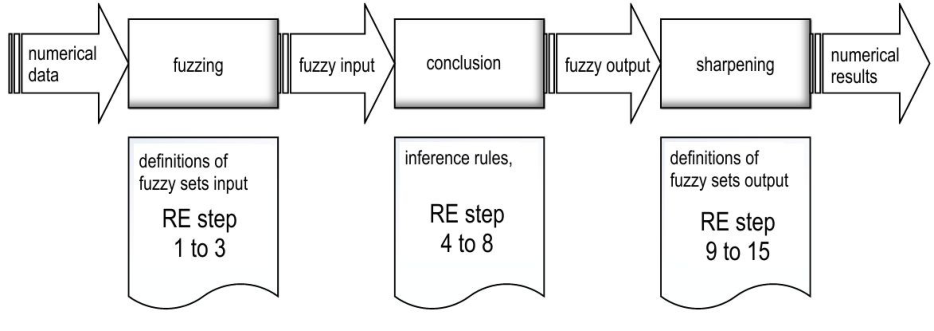
In the beginning phase of algorithm ER (Sławińska, 2011, pg. 59) in the first step there occurs an analysis of a specific situation and setting a goal which after modification the elements enables us to achieve the desired workload. Considering the nature of mental load it is necessary (step 2) to create an environment for projected changes. During the simulation of projected goals the regularity is being checked and various means of increasing or decreasing worker's load. Because there might be too many ways to achieve beneficial changes, the range of ergonomic modification should encompass only the essential factors (step 3). The more precise the set goals are the more successful will the team work be. During the 4th step the modeling ER goal context is done and preliminary https://openaccess.cms-conferences.org/#/publications/book/978-1-4951-2102-9 hierarchy of ergonomic factors is made for the established previously design. Then, we base on workplace documentation, interviews and surveys. Accuracy of characteristics planned for existing systems has impact on effectiveness of the ergonomic engineering. Next, in the 5th step mapping of the goal context is done; and because of that we gain information confirming reasons for mental overload. Knowledge of this should be systematically enlarged. Simultaneous modeling of work situation is done and first attempts to reconfigure chain of actions. During the 6th step characteristics of the state emerge. Basis of merit are established for projecting strategy of action designed for difficult situations at work and their preliminary verification of prototype solution. Step 7 is related to modeling of information structure about work environment and leads to recognition of psychological mechanisms in developing mistakes of men. Then one deals with modeling of information structure working environment. During 8h step one gains experience and additional information. Ergonomic subsystem is built and data of ergonomic knowledge. Step 9 is connected with choosing tools to evaluate the level of mental load of employee coexisting with technical object and conducting numerous experiments (followed by Sławińska, 2011, pg. 161). Step 10 seeks optimal solutions. One can achieve satisfactory level towards set goal, but simultaneously recognize additional and better solutions; insignificantly differentiating in the frame of research and acceptable cost. In the next step (11) more experiments are conducted on the research station, also for the extreme conditions; due to which precise strategic actions are developed, for example active operator. Then occurs using programing projected for ER in the system of exploiting the technical object. Ergonomic modifications are conducted for planned reconfiguration of chain of users. The estimated budget is necessary to accept the technical organizational offers for ergonomic modification. Ergonomic variables are analyzed in that respect, also are connected with minimum critical potential allowing to keep the system safe. The economic character is revealed also in the step 13, where are the estimated sets of predicted profits and losses which substantiate the next action in ER practice. The 14th step is implementing ergonomic variables essential for leading the safety of usage of system. In most cases it applies to information system structure and means to present the information. The simulations of work conditions of the experimental site enables evaluation of required modification. During the 15th step multiple tries for optimizing ergonomic stress load are conducted. In each instance chain reconfiguration of the user in relation to economic conditions occurs.
Figure 3. Diagram showing how FLC (fuzzy logic controller) works [own elaboration].
Implementation of load evaluation methods is imperative during introducing new technology also for evaluating severe impacts which are imposed on employee by automated work processes. ER in technical object design is a chance to introduce regulations mechanism of employees actions based on fuzzy deduction – Figure 3.
Ergonomic knowledge base Macro-ergonomic actions allow to create ergonomic knowledge which gathers data concerning work system structure, characteristic elements of work system such as: 1) requirements concerning installations; 2) work processes requirements; 3) systems relation. Gathering data is useful for creating goal-orientated functional structure of work system. Because of that one can precisely present planned goals and evaluate level of technical objects' effectiveness. Designing technical elements are being analyzed and organizational elements of technological process are being analyzed as well. The gathered data can be used to examine extreme conditions.
The next important element of the data is knowledge about what information a worker is using in the decision- making. The information should be precise and relate to specific flow of interaction. This data can also be used to https://openaccess.cms-conferences.org/#/publications/book/978-1-4951-2102-9 evaluate conditions of planned load for which the programing and interface are design. A subset of leading stimulations recognized during evaluation of reliability of set goals using modeling is connected with said set. Research of stimulations allows us to set the man-technology reliability factor. It is very important for the completeness of the data is the information about users' conditions which are gained during modeling work situation. Operator's ability evaluation to meet harsh situation in work system (stress, physical overload, overload of the informational channels) allows to simulate conditions of the utilization process and securing from degradation of the work system (followed by Bajda et. al., 2011).
CONCLUSIONS
The dynamic development of technology creates a situation where in most working positions change of occupational character of responsibility is observed. Most working goals has a decisional character: it requires quick orientation and making immediate decisions. A man is overloaded with information, and in the working process he is accompanied by numerous undesired events causing mental overload which puts his health and/or life at risk, economic losses, natural environment contamination or distraction of the production installation. Thanks to ergonomic approach in modeling working places limiting the above risks and leading working conditions are developed. Increasing mental load in work processes develop the need for mechanisms stimulating keeping the right level of load during work. Considering such situations system solutions are being introduced based on macro- ergonomic methods which are designed as optional projects and alternative processes for fulfilling set objectives. Because of that the system effectiveness in on increase not only in terms of ergonomics (expressed in cost assuring well-balanced relation between requirements and gained efficiency improvement) but also in the categories of strict economics.
REFERENCES
Bajda A., Wrażeń M. Laskowski D.: Diagnostics the quality of data transfer in the management of crisis situation, Electrical Review 87(9A), pp. 72-78, Sigma-Not, Poland, (2011). Brown O., Jr., 2002, Macroergonomic methods: participation, In Macroergonomics: Theory, Methods, and Applications, Hendrik
H.W. and Kleiner B.M., Lawrence Erlbaum Associates, Mehwah, NJ, p. 25-44. Carayon P., Hoonakker P., 2001, Survey design, [in:] International Encyclopedia of Ergonomics and Human Factors, Karwowski W., (ed.) Taylor & Francis, London, p. 1899-1902. Drożyner P., Mikołajczak P., Szuszkiewicz J., Jasiulewicz-Kaczmarek M., 2011, Management standardization versus quality of
Rehabilitation, 41, 1708-1711. Jasiulewicz-Kaczmarek M., (2012), Socio-technical integrity in maintenance activities, In: Vink P. (eds.): Advances in Social and Organizational Factors, CRC Press 2012, pp. 582–592 Karwowski W, J.Kantola, D.Rodrick (Ed.) Hal W.Hendrick, Brian M.Kleiner, 2002, Macroergonomic Aspects of Manufacturing,
(In:) Macroergonomics, Theory, Methods, and Applications, Human Factors and Ergonomics, p. 223- 247. Łunarski J.,2010, Inżynieria systemów i analiza systemowa, Oficyna Wydawnicza Politechniki Rzeszowskiej, Rzeszów 2010. Misztal A., Butlewski M., (2012) Life improvement at work, Wyd. PP, Poznań, ISBN: 978-83-7775-177-0 Mosard G.R., 1982, A generalized framework and methodology for systems analysis, nst. of Safety & Systems Management, Univ. of Southern California, Los Angeles, CA, USA Niziński St., Elementy eksploatacji obiektów technicznych, WUW-M, Olsztyn 2000. Pacholski L., (1995) Macroergonomic evaluation of the work process quality of the multiagent manufacturing system; [in]:
Ergonomics Design: Interfaces – Products – Information; p. 445-448, ABEGRO, Rio de Janeiro, Pacholski, L., (2000) Macroergonomic paradox of entrepre-neurship and economic renewal, in: Ergonomics for the new millennium, Human Factors and Ergonomics Society, pp. 185 – 188, Santa Monica – San Diego CA Pacholski, L.. Jasiak A. Makroergonomia, Wydawnictwo Politechniki Poznańskiej, Poznań 2011. Quade ES., 1989, Analysis for Public Decisions (3rd edn) Elsevier Science Publishers: New York. Sears A., Hess D.J. 1999, Cognitive walkthroughs: understanding the effect of task-description detail on evaluator performance,
Int. j. Hum.-Comput. Interact., 11, 185-200. Sławińska M., Operator interaction with control devices – Ergonomic design in industrial automatic, Ergonomia, An International Journal of Ergonomics and Human Factors, pp. 147-163, Publish by the Committee on Ergonomics of the Polish Academy https://openaccess.cms-conferences.org/#/publications/book/978-1-4951-2102-9 of Sciences Vol. 33 No. 1-4 January-December 20011, Kraków, ISSN 0137-4990, p.161. Sławińska M., Organization of supply chain decision-making processes in the strategy of time competing, M. Fertsch, K.
Grzybowska (eds.) Logistics in the enterprises-selected aspects, pp. 187-214, Publishing House of Poznan University of Technology, Monograph, Poznan 2010,ISBN: 978-83-7143-946-9, p. 212. Sławińska M., Reengineering ergonomiczny procesów eksploatacji zautomatyzowanych urządzeń technologicznych (ZUT), Rozprawy Nr 462, Wyd. Politechniki Poznańskiej, Poznań 2011, ISSN 0551-6528, ISBN 978-83-7775-100-8, p. 59. Stevenson W.B., 1993, Organizational design, [in] Handbook of Organiyation Behavior, Golembiewski T., Ed., Marcel Dekker,
New Zork, p. 141–168. Tattersall A.J., 2002, Obciążenie pracą i przydział (alokacja) zadań, [w:] N. Chmiel (red.), Psychologia pracy i organizacji, GWP, Gdańsk. Wrzesińska J. (2012)„Czynnik ludzki jako determinanta występowania wypadków przy pracy”, w: Bezpieczeństwo zdrowia
publicznego w zagrożeniach środowiskowych. Postępy metodologii badań, pod red.: Konieczny J., Garmond Oficyna Wydawnicza, Poznań, ss. 569-581.
LISTED IN THE AHFE DIGITAL BOOKSTORE CATALOGUE
Explore the complete digital volume
Advances in Social and Organizational Factors
Read this individual research paper free through the original publisher, or explore the full digital proceedings book.
ISBN 978-1-4951-2102-9
Explore this ISBN in the AHFE Bookstore ↗Listed in the July 2026 bookstore catalogue; search by ISBN to confirm current availability · Digital book purchase optional