Lucas Paletta, Andreas Peer, Markus Öttl, Georg Aumayr, K. Wolfgang Kallus, Joachim Brandtner, Gudrun Walter, Patrick Luley, Alexander Almer, Daniela Weismeier-Sammer, Christian Schönauer, Benjamin Schuster, Martin Söllner, Martin Müller, Michael Schneeberger, Martin Pszeida, Wolfgang Weiss, Anna Weber, Stefan Ladstätter, Florian Haid, Jochen A. Mosbacher, Silvia Russegger, Markus Bergen (2025). A Framework for Mixed Reality-supported Training of Conflict Resolution and First Responder Skills in International Crisis Situations: SmartSkills. In: Cognitive Computing and Internet of Things. AHFE Open Access, vol. 165, pp. 136–148. https://doi.org/10.54941/ahfe1006097
Military first responders and also civilian experts in international peace missions must act quickly and unerringly in complex and dangerous situations under stress. Basic skills must be trained in advance as realistically as possible in order to be able to use them efficiently in later, real-life deployment situations and to reduce the risk potential when deployed to crisis areas. Simulations of concrete conflict scenarios are applied in the biannual “Native Challenge” workshop within a military camp area in the Austrian Alpes that is based on the idea of a cooperation between the “UNESCO Chair for Peace Studies” and the Military Command Tyrol. The representation of these simulations where participants experience in exercise scenarios the surprises, conflicts and dangers they can be confronted within a real mission is very costly which prohibits repeated, personalised and focused skill training.The Austrian project SmartSkills aims at providing standardised scenarios from the most diverse areas (behaviour at the checkpoint, negotiation, accident in the minefield, care of the wounded, etc.) interactively, tailored to the participants in terms of stress load, leadership ability and communication behaviour. A Mixed Reality training system allows unlimited repetitions, especially with personalised difficulty adaptations of the scenarios, and provides corresponding content for in-depth debriefings. SmartSkills will offer a highly innovative automated digital analysis of the human factors of the assignment, in particular the decisive situational awareness in critical situations, and uses biosensors to point out cognitive-emotional problem areas that require special attention in skill development. The associated Decision Support System will translate scientifically validated data into pragmatic risk estimates for the attention of the training management.This presentation will for the firstly describe the conceptual outline of the “Native Challenge” which integrates several levels and feedback loops of operational and strategical challenges. Secondly, the setting and the results of the initial requirement study detailed including information about the selected scenarios and use cases, with roles, objects of interest and training objectives. Furthermore, we will describe the technical specification for the Mixed reality system, its general system architecture, with the outline of wearable bio-signal sensors for psychophysiological monitoring, the graphical processing including realistic object visualisation and digital twins that were scanned from the real operational sites. We will provide details about the study plan, its research hypotheses, in particular, in the context of the evaluation of the training and psychophysiological key performance indicators. Finally, we will describe the anchoring in the international context and the acceleration of developments through exchange with European initiatives.SmartSkills is researching a new dimension of particularly realistic visualisations through the use of innovative digital twins: with highly accurate measurement technology and AI-supported evaluation software, internationally relevant environments can be experienced directly in the simulation centre, thereby increasing the realistic immersion.
A Framework for Mixed Reality-Supported Training of Conflict Resolution 137
INTRODUCTION
Military first responders and also civilian experts in international peace missions must act quickly and unerringly in complex and dangerous situations under stress. Basic skills must be trained in advance as realistically as possible in order to be able to use them efficiently in later, real-life deployment situations and to reduce the risk potential when deployed to crisis areas. Simulations of concrete conflict scenarios are applied in the biannual “Native Challenge” workshop within a military camp area in the Austrian Alpes that is based on the idea of a cooperation between the “UNESCO Chair for Peace Studies” and the Military Command Tyrol. The representation of these simulations where participants experience in exercise scenarios the surprises, conflicts and dangers they can be confronted within a real mission is very costly which prohibits repeated, personalized and focused skill training.
The Austrian project SmartSkills aims at providing standardized scenarios from the most diverse areas (behavior at the checkpoint, negotiation, accident in the minefield, care of the wounded, etc.) interactively, tailored to the participants in terms of stress load, leadership ability and communication behavior. A Mixed Reality (MR) training system allows unlimited repetitions, especially with personalized difficulty adaptations of the scenarios, and provides corresponding content for in-depth debriefings. SmartSkills will offer a highly innovative automated digital analysis of the human factors of the assignment, in particular the decisive situational awareness in critical situations, and uses biosensors to point out cognitive-emotional problem areas that require special attention in skill development. The associated Decision Support System will translate scientifically validated data into pragmatic risk estimates for the attention of the training management.
This presentation will for the firstly describe the conceptual outline of the “Native Challenge” which integrates several levels and feedback loops of operational and strategical challenges. Secondly, the setting and the results of the initial requirement study detailed including information about the selected scenarios and use cases, with roles, objects of interest and training objectives. Furthermore, we will describe the technical specification for the Mixed reality system, its general system architecture, with the outline of wearable bio-signal sensors for psychophysiological monitoring, the graphical processing including realistic object visualization and digital twins that were scanned from the real operational sites. We will provide details about the study plan, its research hypotheses, in particular, in the context of the evaluation of the training and psychophysiological key performance indicators. Finally, we will describe the anchoring in the international context and the acceleration of developments through exchange with European initiatives.
SmartSkills is researching a new dimension of particularly realistic visualizations through the use of innovative digital twins: with highly accurate measurement technology and AI-supported evaluation software, internationally relevant environments can be experienced directly in the simulation center, thereby increasing the realistic immersion.
RELATED WORK
Training for high-stakes decision-making in complex, high-stress environments—such as peacekeeping missions or first response operations— has increasingly turned to simulation-based methods. Traditional live-action simulations, while immersive, are costly and lack flexibility for repeated, individualized training (Schneeberger et al., 2022). Advances in Mixed Reality (MR) technologies offer promising alternatives, enabling controlled, repeatable, and adaptive scenarios that mirror real-life complexity (Farra et al., 2015).
MR systems have been explored in military training contexts for tactical decision-making and stress inoculation. For example, the U.S. Army has leveraged immersive virtual environments to improve soldiers’ cognitive readiness and situational awareness (Enders et al., 2024). Similarly, civilian disaster response training has benefitted from simulations integrating physiological monitoring to adapt scenarios in real time, increasing trainee resilience and competence (Di Loreto & Gouaïch, 2017).
The SmartSkills project builds upon this foundation by combining MR simulation with biosignal-based sensor feedback to evaluate and adapt training scenarios dynamically. Such integrations of psychophysiological monitoring—e.g., heart rate, heart rate variability and galvanic skin response—have been shown to enhance understanding of stress responses and guide more effective debriefing (Setz et al., 2010). However, SmartSkills specifically provide psychophysiological sensing from eye tracking for multimodal stress and situation awareness analytics.
Furthermore, digital twins are emerging as a transformative technology in simulation design, enabling hyper-realistic and context-specific virtual environments (Negri et al., 2017).
SmartSkills also addresses a notable gap in existing systems by introducing an automated Decision Support System that translates biosignal data into actionable insights for instructors—an area still underrepresented in applied human factors research (Endsley, 2015). The project thereby contributes to the field by enhancing adaptive training efficacy, situational realism, and evidence-based feedback, critical for both military and civilian peacekeeping preparation.
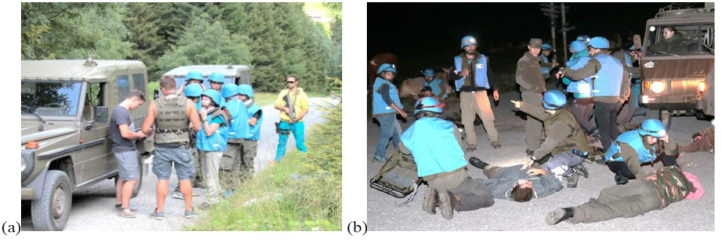
Figure 1: (a) Typical exercise for the crisis operation (“Illegal Checkpoint”) at the native challenge in Tyrol (Vzlt Hörl, MilKdoT) to deal with a dangerous situation. (b) Practicing medical care (triage) in a crisis operation with injured persons after a traffic accident.
A Framework for Mixed Reality-Supported Training of Conflict Resolution 139
THE NATIVE CHALLENGE FRAMEWORK The UNESCO Chair for Peace Studies at the University of Innsbruck and the Tyrolean Military Command (MilKdoT) have been working together since 2008. As part of the “Native Challenge”, which takes place twice a year, students take part in a week-long exercise in which specific conflict scenarios are simulated. In the role of UN members, the participants experience the surprises, conflicts and dangers they may be confronted with in a real mission in exercise scenarios (Figure 1). The presentation of these simulations requires extensive planning and presentation activities to ensure that the environment is as realistic as possible.
The training of international operations and the preparation for foreign missions present the operational organizations with considerable difficulties and expenses, as the personnel and training costs for the players are excessive. In addition, the use of training dummies (in the sense of injury modeling) is always associated with considerable material costs, both in terms of acquisition and maintenance.
In terms of the tender objectives, this project makes it possible to interactively provide standardized scenarios from a wide variety of areas (behavior at the checkpoint, negotiation, accident in the minefield, care of the wounded, etc.) tailored to the participants in terms of stress levels, leadership skills and communication behavior. A mixed reality (MR) training system enables unlimited repetitions, especially with personalized difficulty adaptations of the scenarios and provides corresponding content for in-depth debriefings.
SmartSkills offers a highly innovative, automated, digital analysis of the human factors of the assignment, in particular the decisive situational awareness in critical situations, and uses biosensor technology to point out cognitive-emotional problem areas that require special attention in skill development. The associated Decision Support System translates scientifically validated data into pragmatic risk assessments for the attention of the training management.
The tendering objective is also supported in the best possible way by introducing medical service requirements and the basic equipment for the operational exercise. The development of material and personnel-saving deployment exercises is a benefit for the volunteer organizations. The standardization of training is also a major advantage. Furthermore, project results are anchored in an international context and developments are accelerated through exchange with EU projects. The savings in material costs and the working time of trainers for the medical area during exercises allow economic benefits to be quickly quantified.
Real-life presentations are associated with a high logistical effort and also tie up a lot of resources in all phases (preparation, execution, follow-up) with limited repeatability.
In this context, SmartSkills is researching a new dimension of particularly realistic visualizations with the use of innovative digital twins: with high- precision measurement technology and AI-supported evaluation software,
internationally relevant environments can be experienced directly in the simulation center, thereby increasing realistic immersion.
OBJECTIVES OF THE TRAINING SYSTEM The overall objective of SmartSkills is to research highly innovative components for an internationally pioneering training framework that can be used to intelligently and efficiently train key skills for use in crisis areas within the framework of the UN or NGOs (Non-Governmental Organizations). This is to be achieved through the following sub-goals:
SmartSkills will develop an intelligent Decision Support System (DSS) for exercise management under the scientific direction of the IFB. For this purpose, relevant human factors of the trainees - vital parameters and psychological variables - will be automatically collected and categorized for monitoring, real-time intervention and efficient post-processing. The necessary sensor data is collected during training using sensor equipment (biosensor shirts, smart patches, wearables, eye tracking) that is as unobtrusive as possible. Important variables for training progress and training effectiveness – psycho-mental stress, cognitive load, concentration and fatigue (Mathews et al., 2019) - are displayed in real time. Critical episodes can thus be assigned to individual decision-making behavior and clearly displayed on the dashboard for the trainer. In particular, information on “situation awareness” (Endsley, 1995) of the trainee, which is susceptible to stress and needs to be trained, is automatically recorded. The resulting perception and interaction of the trainee is compared with the expected values for successful situation management and evaluated with AI support (Taylor, 1990; Salmon et al., 2009). The innovative collection of digital twins - highly realistic, high-precision digitally recorded functional models of training scenarios - is intended to achieve a new dimension of realistic simulation. Scientific studies indicate that realistic training conditions can eliminate the risk of “negative training” (Groen, 2021). SmartSkills researches which detailed categories have functional relevance for the special field of application and how the data can be optimally represented in real time. The objective is to increase the score of the Immersion Experience Questionnaire (IEQ; Jennet et al., 2008) by 30%.
Challenging skills are trained with MR technology, using real objects (emergency manikins, aids, devices, etc.) to create an immersive overall experience, with a focus on realism and variation in the representation of the simulated stressful situation. In addition, a recording of actions and events during the training enables an efficient review. The focus of the innovative development is on the routine and successful completion of the task under the influence of relevant, challenging situations and associated stressors presented as realistically as possible.
Another focus is on the challenges of safety and security training for foreign missions of humanitarian aid organizations or paramedic training in crisis situations in order to cope with the difficult situations in urban areas and potential crises. Emergency medical care in the medical service is
A Framework for Mixed Reality-Supported Training of Conflict Resolution 141
becoming increasingly demanding in a more violent environment. There is a cooperation between the Military Medical Center, Medical Center East of the Ministry of Defense (BMLV) in Vienna and the Johanniter Training Center. The development focus is on exercises in the MR framework and realistic wound and accident presentation, which will be integrated into the training concepts of the emergency services.
BIOSIGNAL BIOMARKERS FOR LEARNING ANALYTICS SmartSkills aims to explore training strategies through the application of various stressors and bio-signal-measured stress in order to achieve optimal, individualized training success. Bio-signal-based evaluation of emergency responders has historically focused on physical stress (Bu et al., 2015, Tartare et al., 2018). Body-worn sensors enable measurements of psychophysiological data, which have been shown to be reliable indicators for monitoring stress in high-risk occupations (Meina et al., 2020; Klinger et al., 2020) recognized the potential for stress-oriented evaluation schemes in virtual training environments, for example to enable targeted triggering and easier detection of certain stress values. With the Smart Health Lab, the University of the German Armed Forces (Munich) is striving for AI-supported immersive learning environments; an initial implementation was successful with the 3D SanTrain Serious Game. In the predecessor project VR-Responder (Reim et al., 2021; Paletta et al., 2022) we were able to successfully validate that the physical strain as well as the cognitive-emotional stress of real training could be simulated very well in comparable use in virtual environments. A first version of a human factors analysis platform provided real-time insights into psychophysiological processes including predictive models based on multimodal bio-signal data in the context of cognitive performance.
In SmartSkills we focus on the central aspect of continuously measuring and evaluating the (i) situation awareness of the individual operator: the decision maker’s focus on the currently necessary objects in the environment at the currently relevant moment (Dini et al., 2017). Automated tracking of gaze behavior will enable to analyze attention to relevant details of the environment in particularly at critical, mission-critical moments - potential weapon concealment; activities in the “background”; timely perception of wounded and wound location. Furthermore, the influence of stressors on (ii) cognitive-emotional stress is registered using bio-signal technology (Schneeberger et al., 2022; Paletta et al., 2022). Other control variables such as concentration and fatigue are also taken into account. Intelligent textiles, wearables and mobile eye tracking enable non-invasive, unobtrusive but highly transparent monitoring of key psychomotor variables. The perception and interaction of the trainee derived from this will be compared with the expected values for successful situation management and evaluated.
Stress probes are standardized stimuli designed to elicit stress responses (Figure 2). The respective reaction can then be measured and compared in a suitable standardized time window. Each scenario is given several such probes, which - cleverly placed at defined, unavoidable key scenes or
checkpoints - can be evaluated and compared using measurement technology. Ideally, the same probes can be used in different scenarios in order to measure and compare the stress reactions of the test subjects not only between the MR and real scenarios, but also between our three different scenarios.
Figure 2: Stress probe structure for the collection of comparable measurements in the test trials, in the field and in the simulation environment.
Figure available in the original PDF paper.
FIRST RESULTS In the first stage of the project, the scenarios and the use cases were developed in detail and the technical specification was determined. The second stage of the project will involve a pilot study in the Simulation Centre at the Johanniter Österreich Ausbildung und Forschung gemeinnützige GmbH, in Vienna in order to quantify the training performance.
Development of Scenarios A total of three scenarios, each containing different mixed reality components, were developed for the SmartSkills system: Illegal Checkpoint (CP), Mine Awareness, and Mine Accident.
Illegal checkpoint. Checkpoints are used to control the movement of people and goods in an area along a road, border or similar. Legal checkpoints are operated by parts of an organization (local executive, internation- al/military police, military) if they are authorized to do so under the legal framework. Illegal checkpoints are therefore operated by unauthorized persons (militia, armed civilians). The overall training objective of the scenario is the correct behavior at an illegal checkpoint. Illegal CP pose a high risk to the personal safety of the field team. Stress and nervousness can quickly lead to an escalation of the situation for both the “hostile”actors and the field team. Trainers should be made aware of the situation in which they find themselves and practice appropriate behavior as described in the next point. It is crucial for the safety of the field team that all members behave cooperatively and as de-escalating as possible. It is important to carry out the instructions of the enemy players in this threatening situation without contradiction. No attempts at negotiation should be made and everything demanded by the CP actors should be handed over. The aim is for the entire field team to be freed from this situation as quickly as possible and to be able to move to safety. In order to ensure that all necessary documents are to hand in the event of an illegal checkpoint, the trainees must ensure that ID cards and documents, passports etc. relevant to the mission are carried on their person when preparing for a reconnaissance mission, for example. In the event of a threat with a weapon by a CP actor, this is to avoid having to search for the required ID cards and documents in the vehicle or rucksack.
A Framework for Mixed Reality-Supported Training of Conflict Resolution 143
During the scenario, subtleties in conducting conversations, especially with a focus on de-escalation and obedience, should be trained in order to avoid an escalation of the situation.
CP implementation. The element (hereinafter: field team) arrives at an illegal CP a) on foot or b) by vehicle. This is set up at a blind spot in the form of a roadblock by a vehicle parked across the road. This means that evasion and retreat are not an option for the approaching field team. The CP actors are armed and search the vehicle, luggage and clothing of the field team members, who are also separated from each other. The team members are threatened with weapons, questioned about the purpose of their mission, instructed to kneel, sit or lie down. They have to put down their luggage, identify themselves and all means of communication (radios, telephones) are taken away from them. The CP actors have the opportunity to physically interact with the trainees (push, pull up, search, etc.). The trainees may have to lean against the vehicle, a tree or a rock with their hands up to be searched. The hostility of the CP actors depends on the obedience of the field team members and is controlled by the trainer using stage directions. Figure 1 shows a photo of the simulated illegal checkpoint in the real exercise as part of the Native Challenge in May 2024.
A digital twin of an area in the military training area of the Austrian Armed Forces is to serve as a virtual environment. The virtual scenario area is located in a confusing place (behind a bend, a rock) and there are no alternative options for the team. The space required for the virtual training is approx. 10 × 10 meters. A communication option between the trainer and role player is desirable so that they can receive instructions. Of course, these should not be audible to the trainees. The overall mood in the scenario (CP can have different variants from “friendly” to “hostile”) depends strongly on the behavior of the CP personnel and is mainly reflected in tone of voice, facial expressions, gestures (from friendly to threatening). How the CP personnel (i.e. the role players) act is in turn directly dependent on the reactions of the field team. The more cooperative, compliant and de-escalating the trainers are, the more accommodating the role players will be. The trainer has the opportunity to control the behavior of the role players with appropriate instructions. The same applies to the behavior of the NPCs.
Mine awareness scenario. Situational awareness is an important aspect that can increase the safety of operational forces, whether civilian or military (Endsley, 1995). Especially in the area of civilian forces, which, in contrast to military forces, are rarely confronted with immediate dangers in their everyday work, it is necessary to strengthen situational awareness during training. This ensures that emergency personnel gain a comprehensive impression of the circumstances in which they are operating as quickly and reliably as possible (Stanton et al., 2006). Situational awareness must be comprehensively trained and consolidated (Soll et al., 2016) and new technologies such as virtual and mixed reality are one way of integrating regular exercises into everyday training without great effort (Weismeier- Sammer et al., 2024). The type of danger that forces are confronted with is very heterogeneous; mines are certainly far less relevant for civilian
paramedics than for military forces. Furthermore, recognizing mine hazards requires specific knowledge. Nevertheless, the basis for the safety of the forces is the same: the timely recognition of any kind of danger and thus the assessment of one’s own safety at the deployment site. The basic question that arises is: Can the team safely enter a certain location and carry out its mission there or is it necessary to retreat (and call in special forces)?
System Specification for the Training Environment
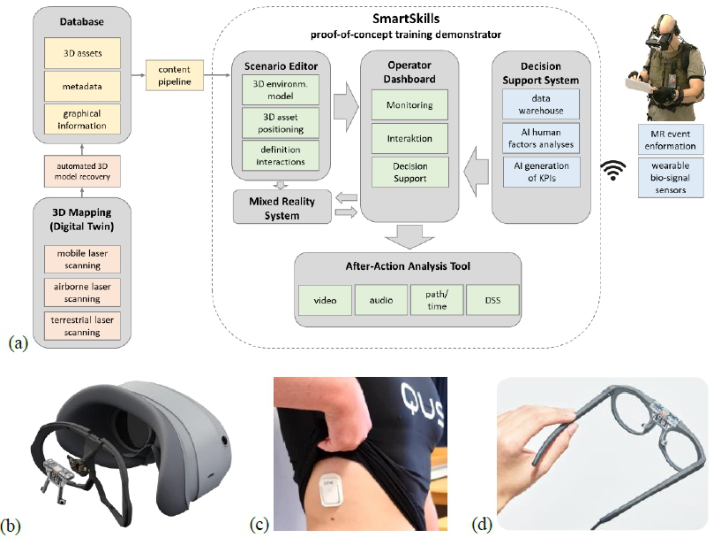
Figure 3a shows a schematic sketch of the components of the SmartSkills system architecture that would configure the “Simulation Center for Native Challenge Training”. The user principally observes an environment configured by human actors, avatar actors, artificial 3D objects and a digital twin-based environment. Artificial items were selected and positioned in the 3D scenario editor by the training operator who also defines the use case and possible interactions. The operator receives decision support by a KPI- generating AI-based status analysis by the Decision Support System. The user (right) provides event- and wearable bio-signal sensor-based data to the system. The human factors analysis system integrates these data to estimate the level of stress, situation awareness and mental fatigue – these parameters are categorized into risk levels and visualized for the operator. In after-action analysis, the operator can watch the archived activity patterns and human factors information and decide about future actions. During the interaction, the content pipeline visualizes with high frequency the graphical processing results for the user to enable natural interactions without delay and avoiding cyber-sickness.
The sensor components are displayed as follows, Figure 3b shows the mixed reality component with an embedding for a high precision, self-calibrating eye tracking component; Figure 3c denotes a smart textile cardiovascular measurement unit (QUS) with temperature sensor (greenTEG), and Figure 3d refers to eye tracking glasses (video, audio; Pupil Labs GmbH) to collect data in the field at the real Native Challenge.
Digital Twins for Realistic Environments Highly accurate realistic digital twins of the training environments are developed which will be seamlessly utilized in the real-time MR-based simulation environment for a realistic training simulation. For this purpose, the following will be realized,
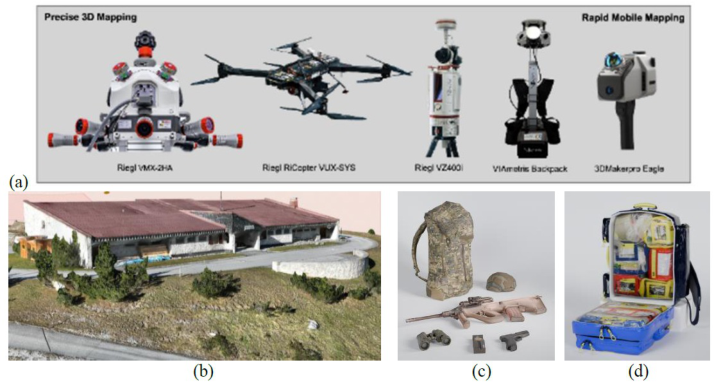
(i) Data acquisition by means of mobile laser scanning using the different mobile mapping systems (drone, backpack, vehicle) for seamless high- precision measurement of real training environments (Figure 4a).
(ii) Processing of measurement data to derive point clouds and anonymized measurement images. Fusion of measurement data from different mapping systems (drone, backpack, vehicle) using self-developed AI-based methods for the automated fusion of data of different quality, resolution, density, which are further developed for the use case in SmartSkills.
(iii) Derivation of detailed textured 3D models in a semi-automatic workflow using self-developed AI-based methods for object detection and
A Framework for Mixed Reality-Supported Training of Conflict Resolution 145
Figure 3: Design of the (a) SmartSkills system architecture with innovative digital twin (orange), human factors analysis (blue), MR training simulator (green), and 3D visualization (yellow). Wearables for the training environment are (b) mixed reality headset (meta quest 3) with eye tracking embedding (Pupil Labs HmbH) and (c) smart textile cardiovascular measurement unit (QUS) with temperature sensor (greenTEG). In the field, we collect data with eye tracking glasses (video, audio; Pupil Labs GmbH).Figure 4: Development of the content pipeline. (a) Mobile mapping technologies. (b) Digital twin of the scenario. (c,d) Typical 3D objects scanned for interaction.
classification, which will be further developed for the specific use cases (Figure 4b).
(iv) As part of 3D authoring, reconstructed objects and environmental data such as vegetation are integrated into a seamless 3D model, which must be optimized for use in simulation environments with regard to real-time requirements (level of detail vs. data volume). Finally, the corresponding data formats are prepared for seamless use in the MR training system.
(v) The aim of the content pipeline for future training scenarios is to make the import of existing content as user-friendly as possible. Meaningful annotations of 3D assets were be identified in order to integrate various information relevant to the scenarios into the system. This is done in order to accelerate the creation of scenarios via drag-and-drop and to take the first steps towards automated scenario generation (Figure 4c,d).
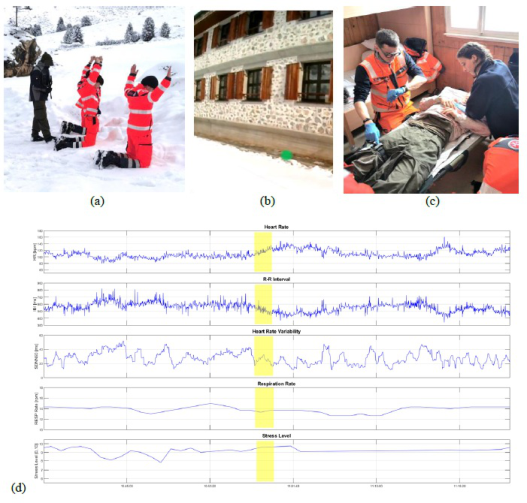
Exploratory Field Trials Exploratory measurements were collected at the native Challenge in December, 2024, in the mountains of Tyrol, Austria. Figure 5a shows a stress- inducing scene within the Illegal CP scenario, Figure 5b the investigation on mine awareness with (green) gaze on the environment, Figure 5c treatment of paramedics after a mine accident. Figure 5d shows an enduring high level of stress with a specific stimulus when the armed operator at the Illegal CP threatened the participant.
Figure 5: Exploratory measurements were collected at the native hallenge in December, 2024, in the mountains of Tyrol, Austria. (a) Stress-inducing scene within the Illegal CP scenario. (b) Investigation on mine awareness with (green) gaze on the environment. (c) Treatment of paramedics after a mine accident. (d) Enduring high level of stress with a particularly stressful event when the armed operator at the Illegal CP threatened the participant.
A Framework for Mixed Reality-Supported Training of Conflict Resolution 147
CONCLUSION AND FUTURE WORK SmartSkills presents a novel Mixed Reality training framework that enhances conflict resolution and emergency response skills through immersive simulations, biosignal monitoring, and digital twins. Initial developments demonstrate the feasibility of adaptive, high-fidelity scenario training tailored to individual stress responses.
Future work will involve empirical validation through pilot studies, refinement of biofeedback-driven adaptation, and international collaboration to standardize training protocols. Scaling the system for broader applications, including humanitarian missions and civilian first responder programs, will be a key objective to maximize real-world impact.
ACKNOWLEDGMENT
This work was partially funded by the SmartSkills project under grant No. FO999905346 of the Austrian FFG KIRAS programme, co-financed by the Austrian Federal Ministry for Climate Action, Environment, Energy, Mobility, Innovation, and Technology (BMK).
REFERENCES
Bu, Y., Wu, W., Zeng, X., Koehl L., and Tartare, G. (2015). A wearable intelligent system for real time monitoring firefighter’s physiological state and predicting dangers, 2015 IEEE 16th International Conference on Communication Technology (ICCT), 429–432. Dini, A., Murko, C., Paletta, L., Yahyanejad, S., Augsdörfer, U., and Hofbaur, M.
(2017). Measurement and Prediction of Situation Awareness in Human-Robot Interaction based on a Framework of Probabilistic Attention, Proc. IEEE/RSJ Intl Conf. on Intelligent Robots and Systems, Vancouver, Canada. Di Loreto, I., & Gouaïch, A. (2017). Serious Games for Training First Responders: Mixed Reality Systems and the Integration of Biosensors. Intl J. of Serious Games, 4(3), 3–21. Enders L. R., Gordon S. M., Roy H., Rohaly T., Dalangin B., Jeter A., Villarreal J.,
Boykin G. L., Touryan J. (2024). Evidence of elevated situational awareness for active duty soldiers during navigation of a virtual environment. PLoS One. Endsley, M. R. (1995). Toward a Theory of Situation Awareness in Dynamic Systems.
Human Factors, 37(1), 32–64. Endsley, M. R. (2015). Situation awareness: Operationally necessary but cognitively fragile. Theoretical Issues in Ergonomics Science, 6(4), 377–392. Farra, S. L., Miller, E. T., Timm, N., & Schafer, J. (2015). Improved training
for disasters using 3-D virtual reality simulation. Western Journal of Nursing Research, 37(3). Groen, E. (2021). Research Methods for Understanding Spatial Disorientation in Pilots. In Kogelbauer, I. & Biede-Straussberger (Ed.). Aviation Psychology. Applied Methods and Techniques. Hogrefe, pp. 69–94. Jennett, C., Cox, A. L., Cairns, P., Dhoparee, S., Epps, A., Tijs, T., &
Walton, A. (2008). Measuring and defining the experience of immersion in games. International journal of human-computer studies, 66(9), 641–661.
Klingner, S. et al. (2020). Firefighter Virtual Reality Simulation for Personalized Stress Detection. In: Schmid, U., Klügl, F., Wolter, D. (eds) AI 2020: Advances in Artificial Intelligence. Lecture Notes in Computer Science, vol. 12325. Springer, Cham. Matthews, Gerald, Ryan W. Wohleber, and Jinchao Lin, ‘Stress, Skilled Performance,
and Expertise: Overload and Beyond’, in Paul Ward and others (eds), The Oxford Handbook of Expertise, Oxford Library of Psychology (2019; Online edn., Oxford Academic. Meina, M. et al. (2020). Heart Rate Variability and Accelerometry as Classification Tools for Monitoring Perceived Stress Levels-A Pilot Study on Firefighters. Sensors, 20. Negri, E., Fumagalli, L., & Macchi, M. (2017). A review of the roles of Digital Twin
in CPS-based production systems. Procedia Manufacturing, 11, 939–948. Paletta, L., Pszeida, M., Schneeberger, M., Dini, A., Reim, L., Kallus, K. W. (2022).
Cognitive-emotional Stress and Risk Stratification of Situational Awareness in Immersive First Responder Training, 2022. IEEE-EMBS International Conference on Biomedical and Health Informatics (BHI), Ioannina, Greece, 2022, pp. 1–4. Reim, L., Kallus, K. W., Pszeida, M., Schneeberger, M., Schönauer, C., Peer, A., Feischl, R., Aumayr, G., Wallner, D., Dini, A., Ladstätter, S., Weber, A., Almer, A., Paletta, L. (2022). Evaluation of Virtual Reality-based First Responder Training under Physiological and Cognitive-Emotional Strain, In: Paletta, L., Ayaz H., eds, Cognitive Computing and Internet of Things, AHFE International Open Access. Salmon, P. M., Stanton, N. A., Walker, G. H., Jenkins, D., Ladva, D., Rafferty, L., Young, M. (2009). Measuring Situation Awareness in complex systems: Comparison of measures study, International Journal of Industrial Ergonomics, Volume 39, Issue 3, 2009, Pages 490–500. Schneeberger, M., Paletta, L., Kallus, K. W., Reim, L., Schönauer, C., Peer, A., Feischl,
R., Aumayr, G., Pszeida, M., Dini, A., Ladstätter, S., Weber, A., Almer, A., Wallner, D. (2022). First Responder Situation Reporting in Virtual Reality Training with Evaluation of Cognitive-emotional Stress using Psychophysiological Measures, In: Paletta, L., Ayaz H., eds., Cognitive Computing and Internet of Things, AHFE international open access, doi: http://doi.org/10.54941/ahfe1001841. Setz, C., Schumm, J., Lorenz, E., Arnrich, B., Tröster, G., & Ehlert, U. (2010).
Discriminating stress from cognitive load using a wearable EDA device. IEEE Transactions on Information Technology in Biomedicine, 14(2), 410–417. Soll, H., Proske, S., Hofinger, G., Steinhardt, G. (2016): Decision-Making Tools for Aeronautical Teams: FOR-DEC and Beyond. In: Aviation Psychology and Applied Human Factors 6/2: 101–112. Stanton, N. A. et al. (2006). Distributed situation awareness in dynamic systems: Theoretical development and application of an ergonomics methodology. Ergonomics, 49(12–13), 1288–1311. https://doi.org/10.1080/ 00140130600612762 Tartare, G., Zeng, X., and Koehl, L. (2018). Development of a wearable system
for monitoring the firefighter’s physiological state, 2018 IEEE Industrial Cyber- Physical Systems (ICPS), 2018, pp. 561–566. Taylor, R. M. (1990). Situational Awareness Rating Technique (SART): The development of a tool for aircrew systems design (AGARD-CP-478) pp. 3/1-3/ 17. In: Situational Awareness in Aerospace Operations. NATO-AGARD, Neuilly Sur Seine, France. Weismeier-Sammer, D., Murtinger, M., Peer, A. (2024): SURVIVE-R: Situational
Awareness und Virtual Reality im Rettungsdienst. In: Elsevier Emergency 3/24.
LISTED IN THE AHFE DIGITAL BOOKSTORE CATALOGUE
Explore the complete digital volume
Cognitive Computing and Internet of Things
Read this individual research paper free through the original publisher, or explore the full digital proceedings book.
ISBN 978-1-964867-41-0
Explore this ISBN in the AHFE Bookstore ↗Listed in the July 2026 bookstore catalogue; search by ISBN to confirm current availability · Digital book purchase optional