Jochen A Mosbacher, Michael Schneeberger, Lucas Paletta, Martin Pszeida, Julia Tschuden, Anna Weber, Florian Haid, Silvia Russegger, Alexander Almer, Markus Bergen, Wolfgang Rausch, Gerald Bauer, Thomas Hölzl (2025). The Impact of Physical Strain on Performance in Basic Shooting Drills. In: Cognitive Computing and Internet of Things. AHFE Open Access, vol. 165, pp. 149–157. https://doi.org/10.54941/ahfe1006098
There are many situations in the daily routine of military personnel and first responders where tasks that require a high degree of concentration and calm are performed during or immediately after strenuous physical activities. The resulting physical exhaustion and fatigue can affect performance in such tasks. While special training and general fitness might mitigate the impact on performance and outcome quality there still are open questions regarding the factors influencing the magnitude of an impact physical strenuous activity has and how such performance changes can be predicted.To get new insights, we analysed the shooting performance of 137 highly trained military personnel before and after a set of physically highly strenuous tasks. Questionnaires were used to assess, among other variables, amount of weekly physical training, pre-experience with the specific shooting drills, sleep quality, daily mood, and the rate of perceived exertion.The results indicated significant associations between the perceived exertion after the strenuous tasks and the change in the amount of false hits. Furthermore, there are correlations between the amount of physical training that participants conduct regularly and the amount of false hits after the strenuous tasks. Seeing false hits as an indicator of inhibitory processes, it is, from this kind of explorative study, conceivable that that good training status might mitigate detrimental effects of highly strenuous tasks on inhibitory ability. The study motivates for focusing future work on clarifying open questions and to provide more details.
While the required abilities and specific skills expected from soldiers have developed significantly in the past decades physical fitness still is the crucial foundational capability. Especially as the load soldiers have to carry has increased instead of diminished, even if technology has advanced (Knapik et al., 2004; Orr et al., 2015). Furthermore, besides carrying heavy loads on longer marches, soldiers are also tasked with other duties posing physical
demands like material handling, position construction, or evacuation of casualties. All of these pose a significant physical load on the body and a clear understanding of the demands and their impact on other aspects (e.g. decision making, or targeting abilities) is essential for determining appropriate preparatory and maintenance training programs for recruits and active soldiers.
While the long-term positive effects of regular exercise and physical activities are long known (Etnier et al., 1997) the short-term impact of physical strain and exhaustion on cognitive functions is still a point of discussion (Browne et al., 2017; Sudo et al., 2022). Intuitively, it could be assumed, that physical strain and exhaustion will have some detrimental effects on psychomotor and cognitive functions affecting reaction times, attention, memory, executive functions like inhibition, and possibly marksmanship. However, while some persons even report disorientation and impairments in decision making, others do report increased functionality. Theories regarding the effects of physical activity on cognitive performance would allow for expectations in both directions (Lambourne & Tomporowski, 2010), and prior research produced evidence supporting detrimental effects, positive effects and the absence of effects of physical activities on subsequent tasks. In the late 1990s, Etnier and colleagues (Etnier et al., 1997) analyzed over 100 studies on the effects of physical exercise on cognition and found a small but positive effect. However, the type of task was a moderating factor. More recently, there have been several reviews and meta-analyses published reporting performance improvements even after exhausting physical activities (Lambourne & Tomporowski, 2010; McMorris & Hale, 2012), but size and direction of effects vary and depend on various factors like timing of the tasks and fitness level (Browne et al., 2017; Sudo et al., 2022). While task performance is impacted negatively during physical exercise it seems to be improved after some delay (Lambourne & Tomporowski, 2010). However, at certain points, e.g. after two days of intensive training, there are clear detrimental effects. Costello and colleagues (Costello et al., 2022) for example found reduced executive functions after two days of high-intensity interval training. Decision making performance has also been assumed to be negatively affected by physical strain, as research found physical activity to impair performance, especially when the activity was exhausting and in more complex decision tasks (Féry et al., 1997). However, there also is evidence for performance improvements in decisional tasks during physical exercise, with heightened arousal being one potentially beneficial effect (Brisswalter et al., 2002).
For marksmanship however, recent results have been more clearly negative. There are some studies showing no effects of activities like marches on marksmanship performance, grenade throwing accuracy or cognition (Knapik et al., 1997), and Simas and colleagues (Simas et al., 2022) did not find any negative effects of physical exhaustion on marksmanship performance in police officers. However, Simas and colleagues already discussed possible effects of physical differences and stress related anxiety regarding the impact on marksmanship. But recent studies provide clear evidence for prolonged impairments of neuromuscular function after
The Impact of Physical Strain on Performance in Basic Shooting Drills 151
strenuous tasks like a 30k loaded march (34kg of equipment), with significantly lower performance even 48 hours after the task and reduced performance in shooting tasks (Cáceres-Diego et al., 2025). For example, Frykman and colleagues (Frykman et al., 2012), conducting research on the effects of exhaustive bodily work on marksmanship, found detrimental effects on latencies and accuracy, especially when work is done under heavy load. In 2022, Buskerud and colleagues (Buskerud et al., 2022) found that even a short but strenuous run at 90% maximum heart rate (HRmax) reduced accuracy and increased spread, while shooting time decreased. And even in highly trained individuals like US Marines marksmanship was significantly impaired after physical tasks with impairments increasing with fatigue and load (Jaworski et al., 2015). Furthermore, negative effects of military field training on shooting performance have been linked to training induced changes in hormone levels (Ojanen et al., 2018).
Various marksmanship tasks require good performance of several functions, as they require calm, concentration, fast decision-making, and precision among others. Hence, there might be a heightened complexity that makes them more susceptible to detrimental effects of physical exhaustion. The present study was planned with the aim to get a better understanding of the impacts of physical strain on marksmanship and the role of factors like training status and sleep quality. To this end, data of 137 soldiers conducting a shooting drill prior and after five critical tasks reflecting essential physical requirements of the infantry. The changes in shooting performance were assessed and the relation between physiological strain indicators and information about individual condition and training background on the one hand and shooting performance and its change from before to after the critical tasks was analyzed.
STUDY DESIGN The present study was designed to assess the impact a prolonged physically strenuous activity has on the performance in shooting drills. In brief, the assessment was conducted as part of the Austrian national project “RT-VitalMonitor” researching options to monitor physiological states of soldiers during critical infantry tasks (see below) in real time (testing methods and procedures for the data collection in this project were developed and carried out by SMEs of the Austrian Armed Forces Sports Centre; Joanneum Research collected questionnaire, wearable sensor, and performance data, and conducted data processing and analysis). The data used here consist of assessing, among others, physical training habits, experience with the tasks conducted, and perceived sleep quality and current condition and performance in shooting drills prior to and after the physically exhausting critical tasks. The final sample consisted of 137 soldiers (mean age: 22.0 years; SD = 3.5; 3 female). All gave written informed consent.
Questionnaires The questionnaires were presented to the participants before the first shooting session. They consisted of questions assessing training habits
(weekly hours of strength, endurance, and combined training), years of consistent training, perceived condition and sleep quality on the specific day, amount of experience with the shooting simulation, and amount of experience with weapons not related to duty. Additionally, the Borg RPE scale (Borg, 1982) was presented at the beginning and after each part of the study procedure, and before the second shooting simulation the participants were asked whether they think that they would show better or worse performance in this round compared to before the critical tasks.
Critical Tasks Based on previous national and international research findings, the Austrian Armed Forces have identified five task elements (“Critical Tasks”) that represent some of the key physical demands placed on infantry soldiers. These consist of (1) an 8 k forced loaded march (total load 43 kg), simulating the approach to an attack target, (2) scaling a high wall, representing the ability to overcome obstacles and breach an objective, (3) fire and movement task, consisting of 15 sprints of 6.6 meters with changing firing positions, simulating combat engagement, (4) casualty evacuation, dragging a 123 kg dummy for 15 meters out of the battlefield, and (5) lifting and carrying sandbags, representing tasks related to fortification construction, transport, and supply activities. During the critical tasks wearables collected physiological data (see below) and the time needed was recorded as performance marker. The critical tasks were conducted consecutively in a single session under a “best effort” command. The participants rated them as strenuous to very strenuous.
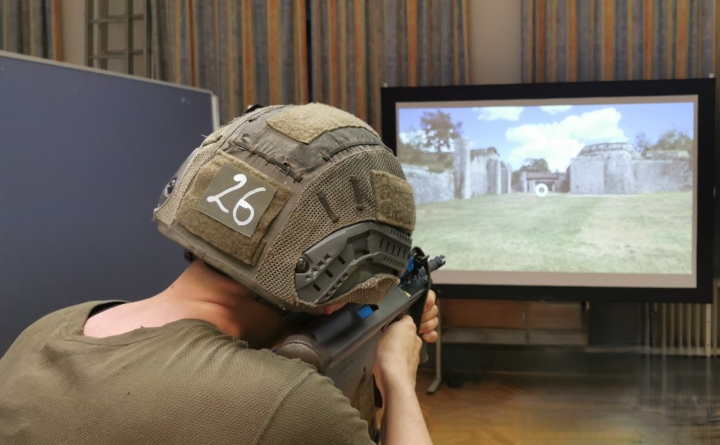
Shooting Drills The shooting drills were conducted with the Small Arms Tactical Trainer (SATT) System (Guardiaris) and consisted of two different types. In the first part, participants were required to fire 10 rounds with the standard service rifle of the Austrian military (Steyr AUG as STG-77; Figure 1) on a simulated 50-meter shooting range, aiming at 10-ring targets. After each shot, they had to briefly lower the barrel before reacquiring their target. Accuracy was determined based on the total number of rings scored (STG Total Score; minimum = 0; maximum = 100 points). Additionally, total shooting time and time taken to fire the first shot were recorded as performance parameters. In the second part, participants engaged in a pistol (standard service pistol Glock 17 as P80) shooting simulation, where they had to neutralize armed individuals while avoiding hits on unarmed persons. Performance was measured using a scoring system with +1 point for each correct hit, –1 point for a missed shot (hitting nothing), and –2 points for accidentally hitting an unarmed person. As in the first part, total time taken and time to first shot were also recorded as additional performance parameters.
DATA ANALYSIS Data analysis was conducted using SPSS (IBM Corp. IBM SPSS Statistics for Windows, NY: IBM Corp). After data cleaning, the first analysis were
The Impact of Physical Strain on Performance in Basic Shooting Drills 153
repeated measurements ANOVAs, conducted to assess whether performance in the shooting drills changed from prior to post physical strain. In a second step, correlational analyses (Pearson) were conducted to assess the relations between age, experience, training habits, and form of the day (perceived condition and sleep quality) on one hand, and performance in the two sessions as well as performance change on the other. Additionally, we assessed whether prior experience with the shooting simulation or experience with weapons additionally to the military training had an effect on shooting performance by the use of t-tests for independent groups. All analyses were conducted with a significance level of α = .05. Descriptive statistics cannot be presented because the performance and training data are considered security-relevant by the Austrian Armed Forces.
Figure 1: Soldier aiming at the simulated 50-meter target.
RESULTS
Performance Change The results of the repeated measurements ANOVAs are given in Table 1. Analyses indicate significant changes in all assessed parameters, except STG Total Score. All significant changes indicate performance improvements from prior to post critical tasks.
Associations Between Shooting Performance, Current Condition and Training Experience Regarding associations between shooting performance and questionnaire data, before the critical tasks, more years of regular physical training were associated with lower total shots (r = −.256; p = .003) and times to the first
shot (r = .180; p = .035) in the pistol shooting task. Furthermore, higher reported sleep quality was associated with longer total times needed in both, pistol (r = 187; p = .029) and STG (r = .244; p = .004) shooting tasks and better daily condition was associated with longer total times (r = .182; p = .033) and times to first shot (r = .178; p = .037) in STG shooting.
Table 1: Results of the repeated measurements ANOVAs.
Table available in the original PDF paper.
Variables F df p ηp2 Pistol Total Shots 5.24 . 024 . 037 Pistol Total Hits 17.96 < . 001 . 117 Pistol Total Misses 14.33 < . 001 . 095 Pistol False Hits 10.70 . 001 . 073 Pistol Total Score 32.75 1,136 < . 001 .194 Pistol Total Time 10.34 . 002 . 071 Pistol Time to First Shot 7.91 . 006 . 055 STG Total Score 3.22 . 075 . 023 STG Total Time 119.16 < . 001 . 467 STG Time to Frist Shot 19.72 < . 001 . 127
After the critical tasks, results indicate that higher amounts of strength training are associated with more hits (r = .182; p = .033) and a better total score (r = .182; p = .033), as well as fewer false hits (r = −.178; p = .038) and faster times (r = −.183; p = .033) in the pistol shooting task and also faster total times in the STG shooting task (r = −.193; p = .024). Furthermore, the number of false hits is also negatively correlated with the amount of combined training (r = −.204; p = .017), total training (r = −.210; p = .014) and the years of regular physical training (r = −.202; p = .018). In addition, more hours of total training relate to better total scores in the pistol shooting task (r = −203; p = .17). Finally, better sleep quality relates to a higher total score in STG shooting (r = .195; p = .022) but also longer total times (r = .200; p = .019) and better daily condition relates to longer total times in the STG shooting task (r = 170; p = .047).
Regarding the changes in shooting performance, higher RPE scores related to higher change scores in false hits (less decrease, more increase) in pistol shooting (r = .191; p = .025), more strength training is associated with a higher decrease in total times in the pistol shooting task (r = −.176, p = .039), and the total amount of weekly training hours relates to the change in total shots (r = .185; p = .031).
All other correlations between shooting performance markers and questionnaire data were non-significant.
Prior Experience There were 42 participants reporting additional experience with weapons outside of the military training and 91 participants reported prior experience with the simulation system. The additional analyses however, only yielded two significant results. Participants with prior experience had more pistol total hits in the session prior to critical tasks than participants without
The Impact of Physical Strain on Performance in Basic Shooting Drills 155
additional experience (t = 2.98; df = 133.03; p = .03). Furthermore, participants with prior experience using the simulation system had higher pistol total hits than participants without prior experience (t = 1.99; df = 135; p = .048).
CONCLUSION
The results of the present work show a general increase in marksmanship after a set of strenuous to very strenuous tasks. While an increase in cognitive performance after physical tasks, even exhausting ones, has been repeatedly found there also have been some studies showing performance decreasing effects (Lambourne & Tomporowski, 2010; McMorris & Hale, 2012). Regarding marksmanship, prior results indicate detrimental effects. Various studies found reduced accuracy and increased latencies after physical tasks (Buskerud et al., 2022; Frykman et al., 2012) and even highly trained persons seem to be affected (Jaworski et al., 2015; Ojanen et al., 2018). Hence, the present results are highly interesting as performance increased in all but one marker of marksmanship. However, it needs to be mentioned, that there was no control group performing the shooting sessions without physical strain in between, but this will be part of additional investigations within the project. It is possible, that training effects lead to large performance increases in the shooting tasks used and that the physical tasks actually had detrimental effects, but not strong enough to reduce performance but only training gains. This limitation will be an interesting research question for future studies.
Interestingly, the main aspect of marksmanship to be influenced by the physical tasks and the physical training status were the amount of false hits in the pistol-shooting task. While there were no associations prior to the physical tasks, there were significant relations between the number of false hits after the physical tasks and the amount of strength training, combined training, the total time of physical training per week, and the time since a person is conducting regular training. There is some recent evidence for reduced inhibitory functions after acute physical exhaustion (Zhao et al., 2024). False hits (here hitting a target that should not be shot at) can be assumed to depend on inhibitory function. While misses can occur while aiming for correct targets, false hits specifically indicate shooting before ascertain that the current target is a correct target. A process that arguably requires inhibitory processes. The correlations between higher amounts of physical training and lower amounts of false hits only in the second round of shooting might indicate positive effects of frequent physical training on the amount of exhaustion after physical strain and/or the speed of regeneration from exhaustion, and by that on the amount of impact of the strain on inhibitory functions. Hence, it seems plausible, that higher amounts of physical training in the daily lives of the participants might reduce the exhaustion experienced after the critical tasks and hence reduce the effects of the physical strain on inhibition. In the first round, exhaustion is not yet a relevant factor and hence, the correlation between amount of training and false hits is absent. This is further supported by the change in false hits being directly related to the RPE score before the second shooting session. Higher
scores related to less decrease/more increase in false hits. However, so far, this is only speculative and further analysis, ideally including physiological data will be needed to clarify the effects and associations.
ACKNOWLEDGMENT
This work was funded and supported in part by the Austrian Defense Research Programme FORTE, the Austrian Research Promotion Agency (FFG), the Austrian Federal Ministry of Finance, the Austrian Federal Ministry of Defense, and the Austrian Armed Forces.
REFERENCES
Borg, G. a. V. (1982). Psychophysical bases of perceived exertion. Medicine & Science in Sports & Exercise, 14(5), 377. Brisswalter, J., Collardeau, M., & René, A. (2002). Effects of Acute Physical Exercise
Characteristics on Cognitive Performance: Sports Medicine, 32(9), 555–566. https://doi.org/10.2165/00007256-200232090-00002 Browne, S. E., Flynn, M. J., O’Neill, B. V., Howatson, G., Bell, P. G., & Haskell-Ramsay, C. F. (2017). Chapter 9 - Effects of acute high-intensity exercise on cognitive performance in trained individuals: A systematic review. In M. R. Wilson, V. Walsh, & B. Parkin (Eds.), Progress in Brain Research (Vol. 234, pp. 161–187). Elsevier. https://doi.org/10.1016/bs.pbr.2017.06.003 Buskerud, J. E., Abrahamsen, F. E., & Solberg, P. A. (2022). Physical Stress
and Determinants of Shooting Performance Among Norwegian Special Forces Operators. Frontiers in Psychology, 13, 894169. https://doi.org/10.3389/ fpsyg.2022.894169 Cáceres-Diego, B., Marín-Pagán, C., Martínez De Baños, P., & Alcaraz, P. E.
(2025). Effects of a 30 K Military Loaded Carriage on the Neuromuscular System in Spanish Army Marines. Sports, 13(3), 76. https://doi.org/10.3390/ sports13030076 Costello, S. E., O’Neill, B. V., Howatson, G., van Someren, K., & Haskell-Ramsay, C. F. (2022). Detrimental effects on executive function and mood following consecutive days of repeated high-intensity sprint interval exercise in trained male sports players. Journal of Sports Sciences, 40(7), 783–796. https:// doi.org/10.1080/02640414.2021.2015946 Etnier, J. L., Salazar, W., Landers, D. M., Petruzzello, S. J., Han, M., & Nowell, P. (1997). The Influence of Physical Fitness and Exercise upon Cognitive Functioning: A Meta-Analysis. Journal of Sport and Exercise Psychology, 19(3), 249–277. https://doi.org/10.1123/jsep.19.3.249 Féry, Y.-A., Ferry, A., Hofe, A. V., & Rieu, M. (1997). Effect of Physical Exhaustion
on Cognitive Functioning. Perceptual and Motor Skills, 84(1), 291–298. https:// doi.org/10.2466/pms.1997.84.1.291 Frykman, P. N., Merullo, D. J., Banderet, L. E., Gregorczyk, K., & Hasselquist, L.
(2012). Marksmanship Deficits Caused by an Exhaustive Whole-Body Lifting Task With and Without Torso-Borne Loads. The Journal of Strength & Conditioning Research, 26, S30. https://doi.org/10.1519/JSC.0b013e31825cedfa Jaworski, R. L., Jensen, A., Niederberger, B., Congalton, R., & Kelly, K. R. (2015).
Changes in Combat Task Performance Under Increasing Loads in Active Duty Marines. Military Medicine, 180(suppl_3), 179–186. https://doi.org/10.7205/ MILMED-D-14-00432
The Impact of Physical Strain on Performance in Basic Shooting Drills 157
Knapik, J. J., Ang, P., Meiselman, H., Johnson, W., Kirk, J., Bensel, C., & Hanlon, W. (1997). Soldier Performance and Strenuous Road Marching: Influence of Load Mass and Load Distribution. Military Medicine, 162(1), 62–67. https://doi.org/ 10.1093/milmed/162.1.62 Knapik, J. J., Reynolds, K. L., & Harman, E. (2004). Soldier load carriage: Historical,
physiological, biomechanical, and medical aspects. Military Medicine, 169(1), 45–56. https://doi.org/10.7205/milmed.169.1.45 Lambourne, K., & Tomporowski, P. (2010). The effect of exercise-induced arousal on cognitive task performance: A meta-regression analysis. Brain Research, 1341, 12–24. https://doi.org/10.1016/j.brainres.2010.03.091 McMorris, T., & Hale, B. J. (2012). Differential effects of differing intensities
of acute exercise on speed and accuracy of cognition: A meta-analytical investigation. Brain and Cognition, 80(3), 338–351. https://doi.org/10.1016/ j.bandc.2012.09.001 Ojanen, T., Kyröläinen, H., Igendia, M., & Häkkinen, K. (2018). Effect of Prolonged Military Field Training on Neuromuscular and Hormonal Responses and Shooting Performance in Warfighters. Military Medicine, 183(11–12), e705–e712. https://doi.org/10.1093/milmed/usy122 Orr, R. M., Pope, R., Coyle, J., & Johnston, V. (2015). Occupational loads carried
by Australian soldiers on military operations. Simas, V., Schram, B., Canetti, E. F. D., Maupin, D., & Orr, R. (2022). Factors Influencing Marksmanship in Police Officers: A Narrative Review. International Journal of Environmental Research and Public Health, 19(21), 14236. https:// doi.org/10.3390/ijerph192114236 Sudo, M., Costello, J. T., McMorris, T., & Ando, S. (2022). The effects of
acute high-intensity aerobic exercise on cognitive performance: A structured narrative review. Frontiers in Behavioral Neuroscience, 16. https://doi.org/ 10.3389/fnbeh.2022.957677 Zhao, S., Ait-Belaid, K., Shen, Y., & Zhou, K. (2024). The neurological effects of acute physical exhaustion on inhibitory function. Physiology & Behavior, 284, 114641. https://doi.org/10.1016/j.physbeh.2024.114641
LISTED IN THE AHFE DIGITAL BOOKSTORE CATALOGUE
Explore the complete digital volume
Cognitive Computing and Internet of Things
Read this individual research paper free through the original publisher, or explore the full digital proceedings book.
ISBN 978-1-964867-41-0
Explore this ISBN in the AHFE Bookstore ↗Listed in the July 2026 bookstore catalogue; search by ISBN to confirm current availability · Digital book purchase optional