Alexander Almer, Anna Weber, Florian Haid, Lucas Paletta, Michael Schneeberger, Stefan Ladstätter, Dietmar Wallner, Paul Glanz, Philipp Klöckl, Dominik Eder, Thomas Hölzl (2023). Real-time remote stress monitoring based on specific stress modelling considering load characteristics of different military forces. In: Cognitive Computing and Internet of Things. AHFE Open Access, vol. 73, pp. 83–92. https://doi.org/10.54941/ahfe1003977
An ongoing challenge for the Military Task Forces is the management of personnel to optimise and maintain performance, whilst also ensuring ongoing health and wellbeing. In the course of intensive training and exercises as well as in real operational scenarios, soldiers often suffer physiological and psychological borderline stresses and also injuries during physical and combat-related training, with overuse injuries often occurring here. Innovative developments and research projects for the physiological monitoring of soldiers arise, based on innovative developments in the field of biosensor technology. Soldiers are at the center of deployed sociotechnical systems despite major innovations in the field of autonomous systems and artificial intelligence (Swiss, 2020). These are aspects and development approaches that are of great interest to military as well as civilian task forces. Motivation and Requirements: Military training and exercise missions as well as real deployment scenarios are often associated with a high degree of physical stress and responsibility and require a high level of mental performance and concentration. Reduced concentration and reaction cause delayed or possibly even wrong decisions, which can have fatal consequences. The research project VitalMonitor therefore focuses on the development of a (i) real-time monitoring system, which analyses changes in physiological parameters from heart rate, heart rate variability, skin conductance, core body temperature, etc., (ii) decision support tool for mission commanders to determine optimal work-rest-cycles preventing physical overstraining in trainings and missions (iii) personalized physical fitness training for soldiers to control their individual stress situation in a targeted manner avoiding poor performance. Methods and Results: In order to be able to make concrete statements about a current, individual stress situation for the soldiers of different task forces, it is necessary to characterize the work stress and to develop specific load and stress models. Basically, here is a relevant difference in the stress models if we compare e.g. CBRN group, light infantry forces and special military forces in the operational loads. In a first step, an attempt was made to create a so-called expert model for the load characteristics on the basis of extensive expert knowledge and measured values collected in the context of various stress tests with various military task forces. The focus was initially on the CBRN task force and further extensive tests were carried out as part of the VitalMonitor project.The basis for the creation of a specific stress model is the comprehensive analysis of the scenario-related work conditions, the psychological and cognitive stress as well as the physiological stress and the interrelationships that occur. The use of an available innovative bio-sensor technology must enable the remote measurement of vital values of the soldiers in the different deployment scenarios. Conclusion and Outlook: Soldiers are at the center of deployed sociotechnical military systems, while requirements in the physiological and cognitive field have increased significantly. Therefore, optimized capability and performance development for soldiers is a key focus for military organizations. Innovative biosensor technology, which is currently available on the commercial market, enables the monitoring of physiological parameters during physical strain and thus basically also during different military deployment scenarios. A targeted use for military tasks, which provides soldiers, executives and medical personnel with meaningful, real-time situation-relevant information, requires an intelligent analysis of the sensor data. These analysis methods take into account, on the one hand, the load characteristics of the operational scenarios and, on the other hand, the individual fitness and stress situation of the persons.
An ongoing challenge for the Military Task Forces is the management of per- sonnel to optimise and maintain performance, whilst also ensuring ongoing health and wellbeing. In the course of intensive training and exercises as well as in real missions, soldiers often suffer physiological and psychological bor- derline stresses and also injuries during physical and combat-related training,
with overuse injuries often occurring here (Corrigan, 2020). Innovative deve- lopments and research projects for the physiological monitoring of soldiers arise, based on innovative developments in the field of biosensor technology. Still, soldiers are at the center of deployed sociotechnical systems despite major innovations in the field of autonomous systems and artificial intelli- gence (Swiss, 2020). These are aspects and development approaches that are of great interest to military as well as civilian task forces.
A major challenge is to record as comprehensive as possible the stress on soldiers in the context of different deployment scenarios and military acti- vities (Almer et al., 2022). This requires the recording on the special stress characteristics and the definition of a tailor-made stress model in order to be able to carry out an individual stress analysis on the one hand and to make an assessment of the stress situation available to the operations manager as decision support on the other. The development of a stress model and the real- time capability of an analysis system necessary for decision support requires bio-sensor solutions that record and permanently monitor the essential vital parameters with sufficient accuracy and a corresponding communication solution to enable data transfer and near-real-time data analysis.
MOTIVATION AND REQUIREMENTS Military training and exercise missions as well as real deployment scenarios are often associated with a high degree of physiological stress and respon- sibility and require a high level of mental performance and concentration. Reduced concentration and reaction cause delayed or possibly even wrong decisions, which can have fatal consequences (Witzki et al., 2011). Statistical evaluations from the U. S. Army Combat Readiness Center (Thomas et al., 2006) show that approximately 80-85% of all military accidents are directly related to cognitive performance degradation. High physiological stress may increase cognitive performance in critical situations (Hancock and Vasmatzi- dis, 2003; Bermejo et al., 2019). In many operational scenarios, soldiers and civil special forces are expected to be resilient, with a high level of training, paired with peak physical and mental performance. Activities carried out in special military functional clothing, such as CBRN (Chemical-Biological- Radiological-Nuclear) protective equipment or bomb/blast suits for EOD (Explosive Ordnance Disposal), inhibit highly intensive physiological loads. Those activities require a specific stress parameter modelling for a targeted risk and stress management (Eßfeld, 2008).
The research project VitalMonitor therefore focuses on the development of (i) a real-time monitoring system, which analyses changes in physiologi- cal parameters from heart rate, heart rate variability, skin conductance, core body temperature, etc., (ii) a decision support tool for mission commanders to determine optimal work-rest-cycles preventing physical overstraining in trainings and missions and (iii) a personalized physical fitness training tool for soldiers to control their individual stress situation in a targeted manner avoiding poor performance. This project is focusing on two specific army branches, CBRN defence and explosive ordnance disposal. A critical stress parameter for special forces performing their activities in an CBRN or bomb
Real-Time Remote Stress Monitoring Based on Specific Stress Modelling 85
suit is the core body temperature and its associated heat stress. Physical per- formance and the individual heat tolerance depending on several factors are important parameters in this context (Glitz et al., 2018).
METHODS
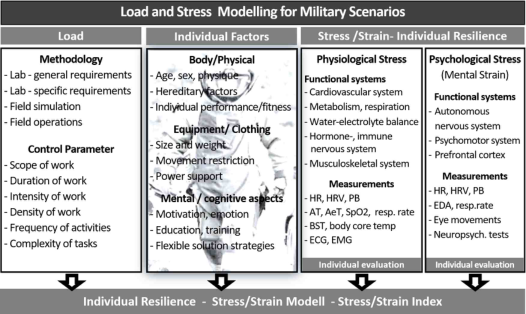
In order to be able to make concrete statements about a current, indivi- dual stress situation for the soldiers of different branches, it is necessary to characterize the work stress and to develop specific load and stress models. Basically there is a relevant difference in the stress models if we compare e.g., CBRN defence, light infantry and other forces in the operational loads. Figure 1 shows an overview of the generally relevant parameters and factors.
In a first step, an attempt was made to create a so-called expert model for the load characteristics based on extensive expert knowledge and measured values collected in the context of various stress tests with soldiers various military branches. The focus was initially on CBRN defence tasks and further extensive tests were carried out as part of the VitalMonitor project.
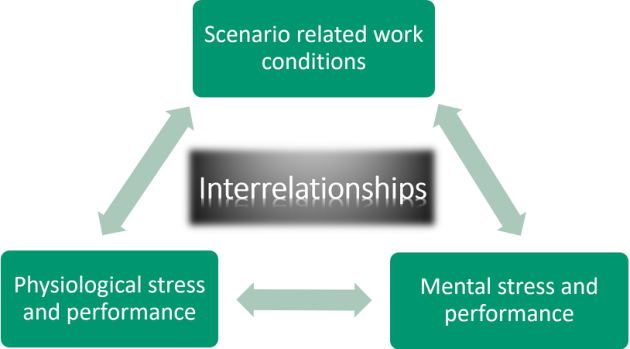
The basis for the creation of a specific stress model is the comprehensive analysis of the scenario-related work conditions, the physiological stress as well as the psychological and cognitive stress and the interrelationships that occur (see Figure 2). The use of an available innovative bio-sensor technology must enable the remote measurement of vital parameters of the soldiers in the different scenarios. When selecting the bio-sensors, it is essential to consider the characteristics of the stress model and to ensure a high level of wearing comfort as well as robustness during intensive missions. The near-real-time results from the vital measurements and the data analysis based on the stress model must support the following tasks:
Decision support for military commanders
Real-time assessment of physiological status
Prevention of physical overstraining in training & missions
Figure 1: Overview of relevant parameters and factors as basis of the development of an individual stress model and derived situational stress index.Figure 2: Comprehensive analysis of all interrelationships as a basis for developing a stress model and deriving a stress index.
Data acquisition to improve performance
Determination of optimized work-rest-cycles
Personalization of physical fitness training.
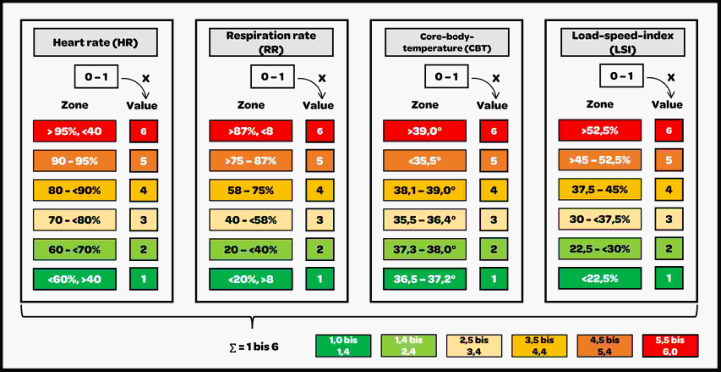
MODEL DEVELOPMENT As already mentioned in the methods, the intention was to develop a model, which, based on different externally and internally measurable parameters, is able to make an unbiased assessment of individual physical stress in military training, exercise and combat scenarios. For this purpose, the available para- meters heart rate (HR), respiration rate (RR), core-body-temperature (CBT) and load-speed-index (LSI) were divided into zones based on literature and knowledge from various experts. This knowledge must be combined with further information, such as, the clothing of the soldiers, external load, etc., to be able to calculate a final score at the end, which allows an adequate sta- tement about the stress of each individual soldier. Each parameter included in the stress model was categorized into 6 different zones and additionally com- bined using a specific logic. More information about the zone classification and the calculation of the total score will follow in the next sections.
Heart Rate (HR) For the HR the 6 zones are classified in percentage of the maximum heart rate for each soldier individually. For the classification into the 6 zones, the concept of “3-phase energy supply”and the limits (lactate turn point 1 - LTP1 and lactate turn point 2 - LTP2), which are located at 70% of the maximum heart rate and 90% of the maximum heart rate, respectively (Wonisch & Ledl-Kurkowski, 2017), were used as a basis to make a separation into the heart rate zones LOW, MID and HIGH. In the next step, these zones were divided again for better differentiation. Thus, the heart rate of the soldiers can
Real-Time Remote Stress Monitoring Based on Specific Stress Modelling 87
Table 1. Classification of the zones of the different parameters.
Table available in the original PDF paper.
Parameter Unit Zone 1 Zone 2 Zone 3 Zone 4 Zone 5 Zone 6 HR-Heart rate bpm <60%,>40 60 - <70% 70 - <80% 80 - <90% 90 - 95% >95%,<40 RR-Respiration rate brpm <20%, >8 20 - <40% 40 - <58% 58 - <75% 75 – 87% >87%, <8 CBT-Core bodytemp.
be compared to their maximum HR and divided into 6 zones (see Table 1). The maximum heart rate of the soldiers, if known, can either be stored in the system or calculated according to Tanaka’s formula (Tanaka et al., 2001).
Respiration Rate (RR) In order to be able to divide the respiratory rate into the 6 zones used to calculate the total score, the threshold values for the “three phases of energy supply” were also determined in advance as a percentage of the maximum respiratory rate. Wonisch & Ledl-Kurkowski (2017) describe that in addi- tion to the standard parameters of performance diagnostics, a number of other physiological parameters also show the three-phase course typical for blood lactate concentration. With this knowledge and considering different literature (Godehardt, 2018), the first step was to determine the average respi- ration rate at the thresholds LTP1, LTP2 and max RR. In a second step, these thresholds, collected from the literature, were compared with data from seve- ral performance tests performed in practice. After comparing these values and gathering a variety of expert opinions, the zones for respiratory rate listed in Table 1 were established. In addition, it is possible to calculate the maximum RR using the following formula.
Equation reproduced from the original PDF.
Core-Body-Temperature (CBT) The core-body-temperature classification is based on the work of Hunt et al., (2016). Based on this work, the zone classification limits listed in Table 1 were defined. Depending on which deployment scenarios are per- formed, an upward or downward deviation of the core-body-temperature may be considered problematic. The limit values obtained from the litera- ture were coordinated with experts from the Austrian Federal Ministry of Defence. Since there are differences in the clothing regulations depending on the mission scenario, and since these sometimes cause an increased body core temperature from the ground up, it was agreed that the limit values for an increased temperature should be adjusted slightly upwards and thus lie above the values found in the literature.
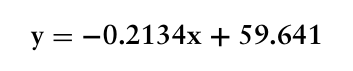
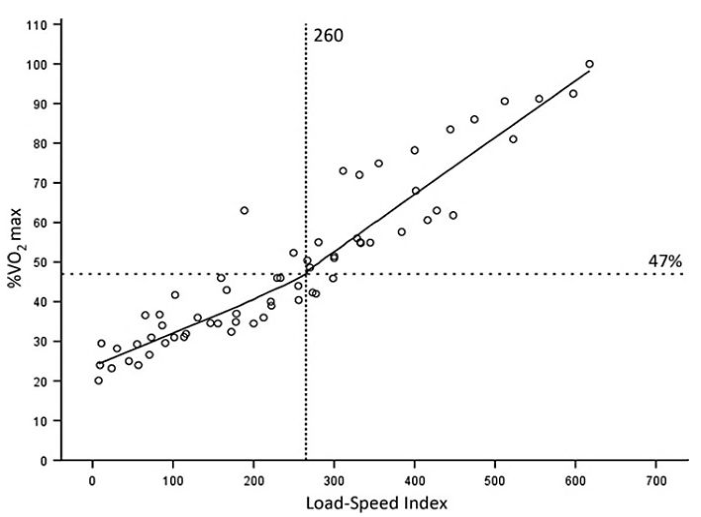
Load-Speed-Index (LSI) The load-speed-index (LSI) is to be used as a parameter in order to also be able to consider the external load (additional load and walking speed) in the model. The advantage of this parameter is that it can be customized to each soldier and scenario based on walking speed and additional load as a percentage of body weight (%BW). While marching the external load and speed are primarily responsible for changes in energy expenditure, and there is much evidence that load and speed should be controlled to maintain a load intensity of ∼45% VO2max to delay the time to fatigue during extended marches. In one study, during self-directed marches of 1 to 3.5 h duration, participants in various tests limited their speed, and thus energy expenditure, to maintain an aerobic power of less than 45% VO2max, regardless of the load carried. When soldiers marched 204 km over 6 days, they maintained an intensity equivalent to 30-40% of their VO2max (Boffey et al., 2019). Figure 3 illustrates the relationship between LSI and %VO2max. Military reports advise caution and recommend that VO2 should not exceed 30- 45% of maximal oxygen consumption to reduce the effects of fatigue during prolonged exercise (Scott et al., 2000).
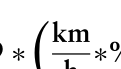
For the calculation of the LSI an input mask of the external load is neces- sary. Based on the stored body weight of the soldiers, the relative load is calculated in relation to the body weight (%BW) and the following formula is applied:
Equation reproduced from the original PDF.Figure 3: The relationship between load-speed-index (LSI) and % VO2max (Boffey et al., 2019).
Real-Time Remote Stress Monitoring Based on Specific Stress Modelling 89
Figure 4: Zone setting and possible weighting for the different parameters.
Based on the previously mentioned literature, an upper threshold of 45% VO2max is recommended as an orientation for longer marches up to 3.5 hours regardless of load or speed. For the middle zone (zones 3 and 4), a classification of 30% to 45% of VO2max is thus recommended (see Table 1).
Final Score Once the zones are known/calculated for each of the included parameters, they can be combined with each other. Figure 4 shows which values can be assigned to the zones and how they are combined with each other to calculate an overall value. The following points must be considered when determining the score:
Depending on the exercise/scenario, the weighting (0-1) of each parameter can be determined individually.
Sum of the weighting of all parameters must always result in “1”.
A value is assigned to each zone.
The value is multiplied with the weighting.
The results of all zones are added.
Depending on the level of the detected value, a corresponding color is displayed in the live dashboard.
For better readability, the calculated value is then converted to a percen- tage (0-100%) and displayed on a color scale in the live dashboard.
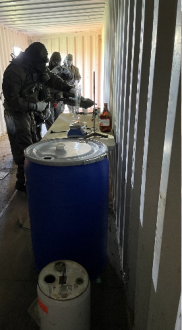
EVALUATION Invited by the Austrian Armed Forces (AAF), the VitalMonitor system was subjected to an intensive test as part of a large international CBRN live exercise in Suffield, Canada (see Figure 5). The NATO exercise “Precise Response” is held yearly since 2004 in Suffield and is a Live-Agent-Training where CBRN reconnaissance and decontamination capabilities are conso- lidated, expanded and new developments are tested in a multinational
Figure 5: VitalMonitor at the international CBRN exercise precise response 2022.
environment. In 2022, the AAF for the first time lead one of three multi- national task forces, deploying and coordinating about 100 CBRN defence specialists from five different nations. A particular challenge in this exercise is the physical exertion of working in protective equipment, under high tempe- ratures and the associated rise in core body temperature. In order to analyze the stresses and avoid heat-related emergencies, “VitalMonitor” was tested as part of the exercise implementing new methods and procedures for asses- sing the physical condition of soldiers in real-time, thereby providing a basis for decision-making by military commanders.
CONCLUSION AND OUTLOOK Soldiers are at the center of deployed sociotechnical military systems, while requirements in the physiological and cognitive field have increased signi- ficantly. Therefore, optimized capability and performance development for soldiers is a key focus for military organizations. Innovative biosensor tech- nology, which is currently available on the commercial market, enables the monitoring of physiological parameters during physical strain and thus basi- cally also during different military deployment scenarios. A targeted use for military tasks, which provides soldiers, executives and medical personnel with meaningful, real-time situation-relevant information, requires an intel- ligent display and analysis of the sensor data. These analysis methods take into account, on the one hand, the load characteristics of the operational sce- narios and, on the other hand, the individual fitness and stress situation of the persons.
Commercial system developments in the fitness and health sector do not fulfil the requirements for military tasks (Friedl, 2018). It is therefore neces- sary to continue pursuing in-depth research in the field of stress analysis of special military task forces based on innovative bio-sensor solutions. A real-time monitoring system as described in this paper makes it possible on the one hand to promote the health, performance and skill development
Real-Time Remote Stress Monitoring Based on Specific Stress Modelling 91
of soldiers in a targeted manner and on the other hand to provide impor- tant decision-making support for commanders both in training and in real operations.
Further essential steps in the development of such systems would be the implementation of so-called quality parameters for each individual value, as well as a possibility to adapt the parameters and their weighting to each other depending on the respective scenario of use. The implementation of quality parameters would positively influence the model accuracy by excluding or reducing the weight values that do not show sufficient measurement accuracy in the calculation. Therefore, it is necessary that such models can be adapted flexibly and still deliver a usable result.
ACKNOWLEDGMENT
The presented research activities were embedded into a project worked out within the Austrian Defence Research Programme FORTE, funded by the Austrian Research Promotion Agency (FFG) and the Austrian Federal Mini- stry of Finance. The project was carried out in close cooperation with the Austrian Federal Ministry of Defence.
REFERENCES
Almer, A. Weber, L. Paletta, M. Schneeberger, S. Ladstätter, J. Tschuden, D. Wallner, T.
Hölzl (2022) Real-time Strain Monitoring based on Wearable Sensors to Support Military Task Forces in Demanding Work Scenarios. Urban Operations Expert Talks; 19th July 2022 —21st July 2022. Eisenerz / Austria. Bermejo, J. L., Couto, B. R., Marco-Ahulló, A., Villarrasa-Sapiña, I., & García- Massó, X. (2019). Effects of an incremental maximal endurance exercise stress- induced cortisol on cognitive performance. Journal of Human Sport and Exercise. David Boffey, Idan Harat, Yftach Gepner, Cheyanne L Frosti, Shany Funk, Jay
R Hoffman (2019) The Physiology and Biomechanics of Load Carriage Per- formance, Military Medicine, Volume 184, Issue 1-2, January-February 2019, Pages e83–e90. Eßfeld, D. (2008) Abschlussbericht zum Verbundforschungsprojekt M/SAB1/4/A010.
Psycho-physiologische Erfassung der momentanen Leistungsfähigkeit unter ein- satznahen Bedingungen. Friedl, K. E. (2018) Military Applications of Soldier Physiological Monitoring.
Journal of Science and Medicine in Sport 2018; 21: 1147–53. Glitz K. J., Piekarski C., Leyk D. (2018) “Faktoren der Hitzebelastung: M¨oglichkeiten der Pr¨avention im Rahmen eines Hitzemanagements”; Wehrmedizinische Monatsschrift 10/2018 http://wehrmed.de/article/3500- faktoren-der-hitzebelastung-moeglichkeiten-der-praevention-im-rahmen-eines- hitzemanagements.html. Godehardt, K. (2018). Referenzwerte gesunder Probanden für ventilatorische Parameter und das Atemäquivalent in Ruhe und unter Belastung auf dem Laufban- dergometer im Alter von 4 bis 74 Jahren (Doctoral dissertation, Ruhr-Universität Bochum). https://doi.org/10.1093/milmed/usy218. Hancock, P. A., & Vasmatzidis, I. (2003). Effects of heat stress on cognitive perfor-
mance: the current state of knowledge. International Journal of Hyperthermia, 19(3), pp. 355–372. doi: 10.1080/0265673021000054630.
Hunt, A. P., Billing, D. C., Patterson, M. J. & Caldwell, J. N. (2016). Heat strain during military training activities: The dilemma of balancing force protection and operational capability. Temperature, 3(2), 307–317. https://doi.org/10.1080/23328940.2016.1156801. Scott, P. A. & Christie, Candice. (2000). Cardiac responses under diverse combinati-
ons of marching speed and backpack load. 12. Sean L. Corrigan, Jace Drain, Stuart Warmington, Sean L Bulmer and Luana Main (2020): Monitoring allostatic load across basic military training using heart rate variability. Defense Human Sience Symposium. Australian Government, Department of Defence. 7–9 December 2020. Virtual Event. Swiss (2020): Langfristiger Forschungsplan (LFP) 2021-2024; Forschungskonzept
armasuisse mit Forschungsschwerpunkten und prioritären Themen; Copyri- ght armasuisse Wissenschaft und Technologie (W+T) Forschungsmanagement und Operations Research Feuerwerkerstrasse 39; CH-3602 Thun; Thun, 11. January 2020. Tanaka, H., Monahan, K. D., & Seals, D. R. (2001). Age-predicted maximal heart rate revisited. Journal of the american college of cardiology, 37(1), 153–156. Thomas, M. L, Russo, M. B. Army (2006): Neurocognitive monitors: Toward the
prevention of cognitive performance decrements and catastrophic failures in the operational environment. Combat Readiness Center 2006: Aviat Space Environ Med 2007; 78(5, Suppl.): B144-152. Witzki, A., Sievert, A., Gorges, W.1, Glitz, K. J.,1, Kreim, G., and Leyk, D. (2011): Psycho-physiologische Leistungsparameter im Soldatenberuf: Multi-Methodales Vorgehen eröffnet neue Perspektiven. Wehrmedizin und Wehrpharmazie; https://wehrmed.de/article/1728-psycho-physiologische-leistungs-parameter-im- soldatenberuf-multi-methodales-vorgehen-eroeffnet-neue-perspektiven.html. Wonisch, M., & Ledl-Kurkowski, R. P. (2017). Kompendium der Sportmedizin
(Vol. 2). Wien: Springer.
LISTED IN THE AHFE DIGITAL BOOKSTORE CATALOGUE
Explore the complete digital volume
Cognitive Computing and Internet of Things
Read this individual research paper free through the original publisher, or explore the full digital proceedings book.
ISBN 978-1-958651-49-0
Explore this ISBN in the AHFE Bookstore ↗Listed in the July 2026 bookstore catalogue; search by ISBN to confirm current availability · Digital book purchase optional