Florian Haid, Anna Weber, Thomas Schnabel, Stefan Ladstätter, Julia Tschuden, Michael Schneeberger, Lucas Paletta, Alexander Almer, Markus Bergen, Gerald Bauer (2025). Innovative MedEvac Decision, Coordination and Support System for Military Evacuation Scenarios. In: Cognitive Computing and Internet of Things. AHFE Open Access, vol. 165, pp. 114–124. https://doi.org/10.54941/ahfe1006095
Modern battlefields are characterized by rapid redeployments, expansive operational zones, and evolving threats such as CBRN hazards, all of which render traditional medical support systems insufficient. The iMEDCAP project addresses these challenges by developing an integrated MedEvac Decision, Coordination, and Support System that revolutionizes battlefield casualty management. By leveraging autonomous technologies, the system incorporates advanced sensor networks – including wearable smart textiles and UAV-based multi-sensor reconnaissance – to continuously monitor soldiers’ physiological parameters and rapidly detect injuries. Upon casualty detection, the system activates a coordinated evacuation protocol managed by the Patient Evacuation Coordination Center (PECC), which dynamically allocates unmanned aerial and ground vehicles to transport patients using a specially designed patient transport module that ensures continuous remote monitoring and, if necessary, immediate medical intervention. Key innovations include real-time vital sign monitoring for early injury assessment, a decentralized approach to casualty detection and data integration, and autonomous transport solutions capable of short-, medium-, and long-distance evacuations. In addition, the project integrates diagnostic and intervention technologies that enable remote administration of first aid, significantly reducing the time between injury and critical treatment. This paper details the development, validation, and potential future enhancements of the iMEDCAP system, demonstrating its capacity to improve survival rates and operational efficiency in high-risk military scenarios. Through its user-centered design and robust decision support framework, iMEDCAP lays the groundwork for a next-generation European medical evacuation system, setting new standards in combat medical care.
Innovative MedEvac Decision, Coordination and Support System 115
medical facilities or even basic treatment by medically trained personnel close to the Forward Line of Own Troops (FLOT). On the battlefield of the future, forces will be deployed in ever larger areas with ever fewer soldiers, resulting in isolated positions. Highly dynamic situations and even more dangerous battlefields, including chemical, biological, radiological and nuclear (CBRN) threats, pose major challenges for medical care, especially since the time between the incident and the provision of assistance must be as short as possible and assistance must be provided in an appropriate medical environment to ensure the highest possible survival rate. This poses a challenge upon others to the transport chain, which must be fast, flexible, scalable, coordinated, autonomous and ideally unmanned.
OBJECTIVE This paper presents the work conducted within the iMEDCAP project (Development of intelligent military capabilities for monitoring, medical care and evacuation for contagious, injured and contaminated personnel), a collaborative initiative involving research institutions, universities, industry partners, and governmental organizations and funded by the European Defense Fund (EDF) under Grant Aggreement number 101121421. iMEDCAP aims to develop an integrated concept for the detection, extraction, transportation, and remote support of critically injured and potentially contaminated individuals (Jänig et al., 2024). The approach leverages an unmanned system that enhances transport scalability while significantly reducing the burden on medical personnel. A fundamental aspect of this initiative is the user-centered scenario definition, which considers potential CBRN threats and operational requirements. Furthermore, an autonomous casualty detection system is designed to identify and assess injuries in real-time, enabling the automated derivation of evacuation and rescue strategies and priorities. The project also focuses on developing unmanned ground (UGVs) and aerial vehicles (UAVs) that can safely transport injured personnel using an interoperable patient transport module. In addition, the integration of diagnostic and intervention technologies ensures that medical countermeasures can be administered remotely, thereby improving survival chances. The final outcome of the project will be a Proof-of-Concept technology demonstrator for the validation of the developed components and the establishment of a roadmap for future development, ultimately paving the way for an innovative European medical evacuation system. By leveraging semi-autonomous air- and ground-based transport platforms, real-time vital sign monitoring, and advanced decision-support frameworks, iMEDCAP seeks to optimize casualty care and evacuation processes in complex battlefield scenarios.
RELATED WORK
Medical evacuation (MedEvac) in military contexts has been widely studied, with recent research focusing on the integration of emerging technologies to enhance efficiency, speed, and decision-making. For instance,
Biswas et al. (2023) provide a comprehensive literature analysis that highlights the potential of emerging technologies and advanced decision- analysis techniques to transform medevac operations, while Borowska- Stefa´nska et al. (2023) review wartime mass evacuation strategies, emphasizing the critical need for coordinated resource allocation in large- scale scenarios.
Foundational work by Cunningham et al. (2019) sets the stage by detailing conventional medevac processes, against which the benefits of automation and unmanned system integration are increasingly measured. In this context, Graves et al. (2021) demonstrate that even minor triage classification errors can have significant repercussions on dispatching policies, thus motivating the development of robust decision support systems – a need further addressed by proposals from Lubkowski et al. (2023) and smart system designs advanced by Krygier et al. (2024).
Complementing these efforts, the studies by Jenkins et al. (2018, 2020) introduce multi-objective optimization models and Markov decision process frameworks that enhance evacuation dispatching and location-allocation strategies under uncertainty. Meanwhile, research on unmanned systems is steadily maturing: Handford et al. (2018), Gubáš (2024) and Schmidbauer et al. (2024) explore the feasibility and prospective use of UAVs and UGVs for casualty transport, a direction bolstered by the early visionary perspectives of Martinic (2014) and the practical feasibility studies of Pickell et al. (2019) on electric unmanned aerial systems, as well as the development insights from Qian et al. (2021) regarding military UGVs.
Moreover, broader system-level evaluations by McDonough et al. (2024) and Van Dongen et al. (2017) highlight ongoing challenges in ensuring an expeditious and integrated evacuation chain, while Walderhaug et al. (2008) contribute early work on enhancing documentation and information flow during field operations. Together, these diverse studies provide a robust foundation for the iMEDCAP initiative’s integrated approach to autonomous medical evacuation and support, effectively synthesizing advanced sensor networks, decision analytics, and unmanned vehicle capabilities to meet the evolving demands of modern battlefield medicine.
Figure 1: iMEDCAP - project logo.
Figure available in the original PDF paper.
iMEDCAP – System Overview In iMEDCAP, the primary objective is the creation of the MedEvac Decision, Coordination & Support (MedEvac DCS) System, aimed at facilitating the diagnostics, treatment, transport, and monitoring of injured, highly contagious, and/or contaminated personnel. The system encompasses
Innovative MedEvac Decision, Coordination and Support System 117
various key components. Firstly, it focuses on detection, surveillance, and reconnaissance within the combat zone, also gathering crucial information on soldiers’ health status, including exposure, contamination, injuries, and position. This is done via the incorporation of wearable sensors like smart textiles and UAV based multi-sensor reconnaissance which enable the aggregation of diverse data, fostering a comprehensive situational understanding from a medical point of view. This rapid data collection facilitates tasks such as resource management, identifying suitable landing sites, conducting initial medical assessments and automating life-saving and evacuation measures in the combat zone.
An important aspect is the development and integration of a decision support system for the Patient Evacuation Coordination Center (PECC) advancing processes for decision support in medical assistance and the evacuation of injured and contaminated personnel. Additionally, the initiative involves the development of tools to support first aid activities, offering targeted decision support for time-critical first triage decisions in the combat area.
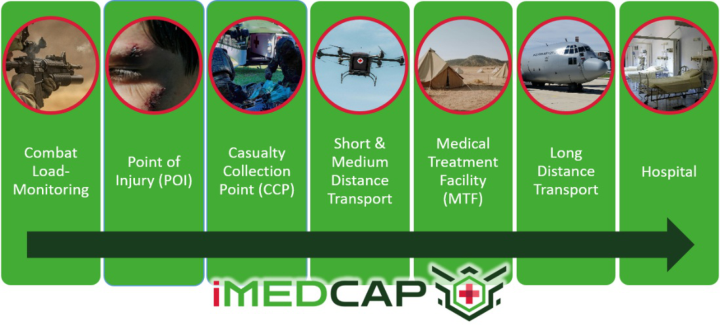
Evacuation itself is performed via a multimodal patient transport system (patient box) that allows continuous monitoring of the patient without the need for an accompanying medical professional. It will enable faster evacuation of more casualties, saving and protecting medical staff. The aim is to implement an unattended patient evacuation transport (UAV and UGV based) for short and medium distances, allowing not only continuous monitoring of vital signs, but also semi-autonomous life-saving interventions in case of critical developments. Furthermore, a dedicated system for long- distance transport will be introduced, ensuring continuous health monitoring throughout the transport. A complete overview of the evacuation chain of iMEDCAP is visualized in Figure 2.
Figure 2: iMEDCAP – evacuation chain.
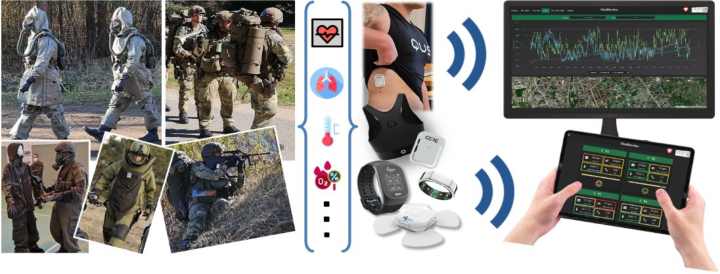
Combat Load-/Stress-Monitoring To provide real-time decision support for field commanders, soldiers are equipped with advanced wearable physiological sensors, which monitor various vital parameters. These include smart textiles measuring heart rate, respiratory rate, position, and acceleration data, as well as a temperature sensor to track both skin and core body temperature. By continuously analyzing these data, commanders gain insights into the current physical condition and operational readiness of their units (Almer et al., 2024, Weber et al., 2024). This information allows them to make informed decisions, such as adjusting marching speed, implementing rest intervals, or modifying tactical plans to maintain combat effectiveness. By leveraging these monitoring capabilities, commanders can optimize resource allocation and ensure that soldiers remain capable of fulfilling their mission objectives (Figure 3).
Figure 3: Combat load- & stress-monitoring.
Casualty Detection (Point of Injury) Early and accurate detection of injuries is crucial for timely medical intervention. iMEDCAP employs multiple detection mechanisms to ensure that wounded personnel receive prompt assistance. If a soldier is equipped with a sensor suite, the decline of body functions and/or injuries are automatically detected, triggering an evacuation protocol via the command network. In cases where automated detection is not available, fellow soldiers can manually report an injury, prompting UAV deployment for reconnaissance and vital sign detection (Elmakhzangy et al., 2023). Autonomous UAV surveillance further enhances the detection process by periodically scanning operational areas, capturing imagery, and identifying potentially injured personnel. Once a casualty is detected, UAVs are redirected to assess vital signs and relay real-time information to the command center. Regardless of the detection method, the evacuation chain is triggered to transport the injured individual promptly to a designated Casualty Collection Point (CCP) for initial medical assessment and stabilization.
Innovative MedEvac Decision, Coordination and Support System 119
Casualty Collection Point (CCP) At the Casualty Collection Point (CCP), injured personnel receive initial medical treatment and are equipped with additional sensor technology to enable continuous physiological monitoring in the field and support informed triage decisions. A dedicated in-ear sensor is employed for this purpose, which is medically certified and capable of measuring critical vital parameters, including heart rate, blood oxygen saturation, and core body temperature.
In cases where the injured individual is already equipped with wearable sensor systems, these are integrated into the local monitoring infrastructure remotely operated by medical personnel. This ensures that all available physiological data can be utilized for a more comprehensive assessment of the patient’s condition. Beyond the real-time visualization of health data for all connected casualties, the system also facilitates the structured documentation of the initial status and medical interventions in accordance with NATO standards. Furthermore, it incorporates decision-support mechanisms to enhance the accuracy and efficiency of the triage process.
By leveraging this integrated approach to medical monitoring and decision support, subsequent interventions/actions can be systematically planned, and evacuation requests can be transmitted to the operational command center based on objective physiological data and standardized triage criteria.
Patient Evacuation & Coordination Center (PECC) The PECC serves as the central command hub for medical evacuation and resource allocation. The system is designed to support various roles within the medical evacuation framework, providing specialized user interfaces tailored to mission commanders, resource managers, and medical personnel. Mission commanders oversee the entire operational scenario, ensuring coordination between different response elements. Resource managers focus on deploying UAVs and UGVs, managing reconnaissance assets, and monitoring Medical Treatment Facility (MTF) capacity. Medical personnel are responsible for patient monitoring and triage decisions, particularly during short- and medium-distance transport. To optimize decision-making, the PECC incorporates a dedicated decision support system that facilitates the efficient allocation of transport assets based on patient condition, UAV/UGV availability, and MTF capacity. During the process, triage levels and all other system-relevant parameters are reassessed continuously and/or at certain locations and points in time.
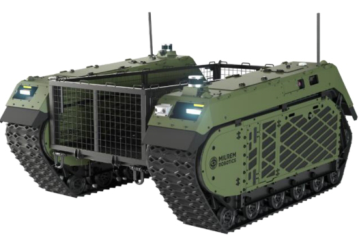
Evacuation (Short & Medium Distance Transport) The evacuation of wounded soldiers from the battlefield to initial medical treatment centers is one of the most critical steps in ensuring survival. The iMEDCAP system facilitates short- and medium-distance evacuations by employing a combination of UAVs and UGVs that autonomously transport casualties from the casualty collection point to the nearest medical facility (Figure 4). To safely navigate complex and dynamically evolving terrains, the system incorporates advanced navigation functions that account for terrain traversability. These capabilities are developed and validated using a
high-fidelity digital twin created through advanced 3D surveying techniques. The decision regarding which transport modality to use is made by the PECC, taking into account factors such as the patient’s condition, terrain accessibility, resource availability, and the operational environment.
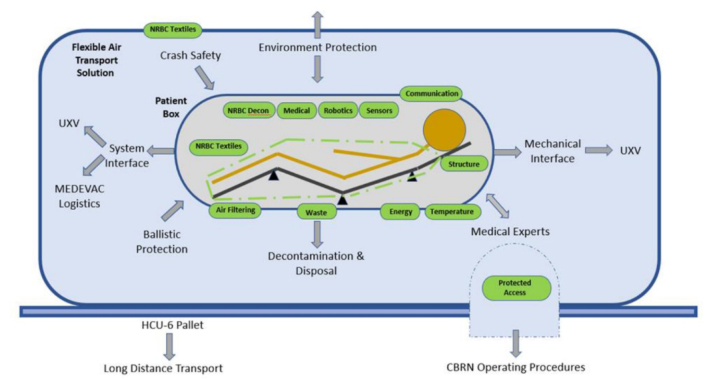
To ensure patient safety and stability during transit, a specially developed patient transport module, the patient box, is used (Figure 5). This enclosed, self-contained unit is designed to protect the patient from external environmental hazards while allowing continuous remote monitoring of vital signs. The patient box is equipped with dedicated Tempus Pro medical unit, which provides high-precision electrocardiogram (ECG) readings, real-time patient diagnostics, and continuous monitoring of heart rate, respiratory rate, in addition to the already equipped sensors.
Furthermore, the system incorporates a communication module that allows real-time transmission of patient data to the medical personnel at the command center. This ensures that doctors and paramedics are fully informed about the patient’s condition before arrival, allowing for a seamless transition of care. The integration of audiovisual communication also enables medical personnel to reassure and provide psychological support to the patient during transport, mitigating stress and anxiety.
Unlike traditional medical evacuation methods, no medical personnel accompany the patient during transit, as the patient box is designed for fully autonomous transport. The system incorporates remote intervention capabilities, including a robotic arm that can administer life-saving treatments such as the activation of a tourniquet, or the administration of emergency medications. These interventions are only carried out upon confirmation by medical personnel at the PECC, ensuring that critical decisions are always carried out by a human-in-the-loop. When signs of critical deterioration are detected, the system alerts the responsible medic/doctor at the PECC, who then decides on and authorizes the necessary intervention measures for patient stabilization. A key feature of the short- and medium-distance evacuation system is its adaptability to different combat environments. UAVs are particularly effective in rapidly reaching casualties located in areas with rough terrain or where road access is limited. In contrast, UGVs offer advantages in scenarios where aerial transport is infeasible due
Innovative MedEvac Decision, Coordination and Support System 121
to enemy threats or adverse weather conditions. The autonomous navigation capabilities of both transport modalities ensure that casualties are evacuated as quickly as possible, minimizing the time between injury and medical intervention.
Long Distance Transport At the medical treatment facility, the evacuation process is not yet considered fully complete. While wounded personnel receive professional medical care in a controlled and secure environment away from the battlefield, further medical evacuation may be required depending on the severity of the injuries and the anticipated duration of recovery. In cases where long-term or specialized treatment is necessary, patients must be transferred to a higher- level medical facility, such as a fully equipped military or civilian hospital e.g. in the home country. This subsequent phase of the evacuation chain is also encompassed within the scope of the project.
To facilitate the safe and efficient transport of injured personnel over extended distances, a dedicated medical support system has been developed for integration into a military transport aircraft. This system enables continuous in-transit medical monitoring, ensuring that real-time physiological data is available to the onboard medical personnel as well as personnel in a central coordination center throughout the entire duration of the flight (Haid et al., 2024). This capability allows the onboard medical team to maintain real-time oversight of patients’ physiological status and to intervene as necessary, ensuring optimal in-transit medical care.
CONCLUSION
In summary, iMEDCAP addresses the evolving challenges of modern warfare by introducing an innovative, technology-driven approach to battlefield medical support. The increasing complexity of military operations,
characterized by high mobility, expansive battle zones, and persistent threats such as CBRN hazards, necessitates a fundamental transformation in medical evacuation strategies. Traditional methods are no longer sufficient to ensure optimal survivability rates. By implementing an autonomous, scalable, and efficient evacuation system, iMEDCAP significantly enhances the speed, accuracy, and effectiveness of medical interventions in combat scenarios.
The integration of advanced sensor networks, real-time vital sign monitoring, and intelligent decision support systems ensures that medical personnel have access to timely and accurate information, allowing them to make informed decisions in extreme situations. The development of UAV and UGV transport solutions, along with modular patient transport units, enables the safe and efficient evacuation of injured soldiers without exposing medical staff to unnecessary risks at the FLOT. Furthermore, the system’s ability to provide remote medical interventions, such as drug administration and stabilization procedures, represents a major advancement in battlefield medicine.
Looking ahead, the continued refinement of iMEDCAP technologies will play a crucial role in shaping the future of combat medical support. Future research and development efforts should focus on enhancing interoperability with allied forces, improving AI-driven decision-making capabilities, and further optimizing transport logistics to accommodate a wider range of medical scenarios. Ultimately, iMEDCAP lays the foundation for a next- generation European medical evacuation system that not only improves survival rates but also redefines the standards for medical response in high-risk operational environments.
DISCLAIMER The project iMEDCAP is funded by the European Union. Views and opinions expressed are however those of the author(s) only and do not necessarily reflect those of the European Union or the European Commission. Neither the European Union nor the granting authority can be held responsible for them.
REFERENCES
Almer, A., Weber, A., Haid, F., Paletta, L., Schneeberger, M., Ladstätter, S., Wallner, D., Glanz, P., Klöckl, P., Eder, D., & Hölzl, T. (2023). Real-time remote stress monitoring based on specific stress modelling considering load characteristics of different military forces. 14th International Conference on Applied Human Factors and Ergonomics (AHFE 2023). https://doi.org/10.54941/ ahfe1003977 Biswas, S., Turan, H., Elsawah, S., Richmond, M., & Cao, T. (2023). The future of
military medical evacuation: Literature analysis focused on the potential adoption of emerging technologies and advanced decision-analysis techniques. The Journal of Defense Modeling and Simulation: Applications, Methodology, Technology, 15485129231207660. https://doi.org/10.1177/15485129231207660
Innovative MedEvac Decision, Coordination and Support System 123
Borowska-Stefa´nska, M., Goniewicz, K., Grama, V., Hornak, M., Masierek, E., Morar, C., Penzes, J., Rochovska, A., & Wi´sniewski, S. (2023). Evaluating approaches to wartime mass evacuation management in eastern nato territories: A literature review. Safety & Defense, 1. https://doi.org/10.37105/sd.197 Cunningham, C. W., Keen, D. E., Schauer, S. G., Kharod, C. U., & De Lorenzo, R. A.
(2019). Military casualty evacuation: Medevac. In W. W. Hurd & W. Beninati (Hrsg.), Aeromedical Evacuation: Management of Acute and Stabilized Patients (S. 21–40). Springer International Publishing. https://doi.org/10.1007/978-3-030- 15903-0_3 Elmakhzangy, B., Aziz, F., ElZawahry, Y., Maufroy, C., Schneider, U., & Huber, M. F. (2023). Improved multi-person vital signs estimation algorithm in sitting and standing positions using mimo fmcw radar. 2023 IEEE International Radar Conference (RADAR), 1–6. https://doi.org/10.1109/ RADAR54928.2023.10371038 Graves, E. S., Jenkins, P. R., & Robbins, M. J. (2021). Analyzing the impact of triage classification errors on military medical evacuation dispatching policies. 2021 Winter Simulation Conference (WSC), 1–12. https://doi.org/10.1109/ WSC52266.2021.9715319 Gubáš, F. (2024). Feasibility of casualty evacuation by unmanned systems. Challenges
to National Defence in Contemporary Geopolitical Situation, 1(1). https://doi.org/ 10.3849/cndcgs.2024.29 Haid, F., Almer, A., Weber, A., Bergen, M., & Bauer, G. (2024). Innovative biosensor based aeromedical monitoring solution for specific military medical evacuation scenarios. 15th International Conference on Applied Human Factors and Ergonomics (AHFE 2024). https://doi.org/10.54941/ahfe1004699 Handford, C., Reeves, F., & Parker, P. (2018). Prospective use of unmanned aerial
vehicles for military medical evacuation in future conflicts. BMJ Military Health, 164(4), 293–296. https://doi.org/10.1136/jramc-2017-000890 Jänig, C. W., Sauer, S., Kehe, K., Steinritz, D., Holzapfel, F., Biberthaler, P., Kulla, M., Bardon, A. G., Vits, E., & Schmidbauer, W. (2024). Intelligent military medical capabilities for monitoring, medical care and evacuation of contagious, injured and contaminated personnel. https://doi.org/10.13140/RG.2.2.28051.28965 Jenkins, P. R., Lunday, B. J., & Robbins, M. J. (2020). Robust, multi-objective
optimization for the military medical evacuation location-allocation problem. Omega, 97, 102088. https://doi.org/10.1016/j.omega.2019.07.004 Jenkins, P. R., Robbins, M. J., & Lunday, B. J. (2018). Examining military medical evacuation dispatching policies utilizing a Markov decision process model of a controlled queueing system. Annals of Operations Research, 271(2), 641–678. https://doi.org/10.1007/s10479-018-2760-z Krygier, J., Lubkowski, P., Maslanka, K., Dobrowolski, A. P., Mrozek, T.,
Znaniecki, W., & Oskwarek, P. (2024). Smart medical evacuation support system for the military. Sensors, 24(14), 4581. https://doi.org/10.3390/s24144581 Lubkowski, P., Krygier, J., Sondej, T., Dobrowolski, A. P., Apiecionek, L., Znaniecki, W., & Oskwarek, P. (2023). Decision support system proposal for medical evacuations in military operations. Sensors, 23(11), 5144. https://doi.org/ 10.3390/s23115144 Martinic, G. (2014). Glimpses of future battlefield medicine - the proliferation of
robotic surgeons and unmanned vehicles and technologies. Journal of Military and Veterans Health, 22(3), 4–12. https://search.informit.org/doi/10.3316/ informit.935366340330586
McDonough, M. M., Gray, I. R., Pickering, R. G., & Remick, K. N. (2024).
What does the military health system need to support future combat operations? Lessons from aeromedical evacuations from 2008 to 2020. Military Medicine, 189(11–12), e2616–e2623. https://doi.org/10.1093/milmed/usae128 Pickell, W., Kopeikin, A., Bristow, E., & Bluman, J. (2019). Feasibility study for a medevac electric uas capability. 2019 International Conference on Unmanned Aircraft Systems (ICUAS), 630–635. https://doi.org/10.1109/ ICUAS.2019.8797946 Qian, Y., Wang, F., Lin, C., Huang, S., & Guo, X. (2021). Development of military unmanned ground vehicles. AOPC 2021: Optical Sensing and Imaging Technology, 12065, 62–68. https://doi.org/10.1117/12.2601876 Schmidbauer, W., Jänig, C., Vits, E., Gruebl, T., Sauer, S., Weller, N., Kehe, K.,
Holzapfel, F., Lüth, T., Kanz, K. G., Rittinghaus, E., & Biberthaler, P. (2024). Ein neues Rettungskonzept für Schwerstverletzte in militärischen und zivilen Großschadenslagen: DRONEVAC. Notfall + Rettungsmedizin, 27(7), 560–567. https://doi.org/10.1007/s10049-023-01190-5 Van Dongen, T. T. C. F., De Graaf, J., Plat, M.-C. J., Huizinga, E. P., Janse, J., Van Der Krans, A. C., Leenen, L. P. H., & Hoencamp, R. (2017). Evaluating the military medical evacuation chain: Need for expeditious evacuation out of theater? Military Medicine, 182(9), e1864–e1870. https://doi.org/10.7205/ MILMED-D-17-00007 Walderhaug, S., Meland, P. H., Mikalsen, M., Sagen, T., & Brevik, J. I. (2008).
Evacuation support system for improved medical documentation and information flow in the field. International Journal of Medical Informatics, 77(2), 137–151. https://doi.org/10.1016/j.ijmedinf.2007.01.006 Weber, A., Almer, A., Paletta, L., Schneeberger, M., Klöckl, P., Eder, D., Wallner, D., Glanz, P., Kühr, O., Bauer, G., & Hölzl, T. (2024). Stress modelling based on specific stress characteristics of various military and civil forces for a real-time stress monitoring. https://doi.org/10.5281/ZENODO.10673024
LISTED IN THE AHFE DIGITAL BOOKSTORE CATALOGUE
Explore the complete digital volume
Cognitive Computing and Internet of Things
Read this individual research paper free through the original publisher, or explore the full digital proceedings book.
ISBN 978-1-964867-41-0
Explore this ISBN in the AHFE Bookstore ↗Listed in the July 2026 bookstore catalogue; search by ISBN to confirm current availability · Digital book purchase optional