With increasing age of society, the number of seniors living alone is steadily rising. This often leads to a feeling of loneliness or a decline in mental health and physical fitness. Seniors often feel overwhelmed by today's technology and speed of life and do not feel needed anymore partly due to lack of contact to the younger generation. On the other side, young adults – especially from lower social class – often lack positive role models and have problems establishing trustful relationships with adults. Buddy4All addresses these challenges by connecting the younger and older generation via an innovative technology-driven buddy platform. The solution combines classical smartphone-based interactions via the Buddy4All social app and Mixed Reality (MR) experiences via the novel and lightweight Nreal MR glasses. The social app provides multimodal cross-generational communication, experience exchange, and support content. The mixed reality solution connects the younger and older generation via fun cross-generational activities such as location-based games and cognitive exercises. These activities keep both generations mentally stimulated and physically active. The Buddy4All solution fosters the wellbeing and active lifestyle of both generations as well as the cross-generational interaction between these generations and thus, the understanding for each other.
Older adults are at risk of mental deterioration, as well as depression due to reduced social contacts after retirement (Singh and Misra, 2009). Both cognitive exercises and socialization activities have potentials to slow down mental decline (Cohen et al., 2006; Seeman et al., 2001; Hikichi et al., 2017). Gamification of socialization activities and cognitive exercises can support in motivation and engagement as this technique has previously been used for cognitive assessment and training (González-González et al., 2013; Van de Weijer et al., 2019; Khaleghi et al., 2021). For example, in (Van de Weijer et al., 2019), self-designed cognitive exercises by early-stage
Parkinson’s disease patients were shown to increase motivation to continue cognitive training. Virtual Reality (VR) has also been used for the cognitive training and social inclusion of older adults (Rendever, 2022; Syed-Abdul et al., 2019; Tuena et al., 2020), and had good acceptance rates among the users (Syed-Abdul et al., 2019). VR also carries the benefits of full immer- sion, which can improve cognitive ability (Wan et al., 2021), as well as spurn interest in the cognitive exercise (Ferguson et al., 2020). These immersive environments are also used to encourage social interaction through apps such as Alcove, a family-oriented social VR app (Alcove, 2022), and Rendever, a VR app that targets to improve the social connections and familial ties in the geriatric setting (Rendever, 2022). Mixed reality (MR) technology is also used in this field. TACTILE, for example, provides a framework for mixed reality cognitive games that include remote game partners via MR glasses (Broneder et al., 2022).
A common concern regarding VR/AR (augmented reality) gamification for older adults is the high technological boundary. Despite the general trend of increased technological acumen among seniors (Anderson and Perrin, 2017), they still lag significantly behind younger adults in terms of technological capability (Lee et al., 2019).
Buddy4All focuses on the benefits of intergenerational interaction between seniors and young (teenage) adults. In general, intergenerational intera- ction has been shown to benefit both the older and the younger generation (Zeldin et al., 2005). More broadly, social inclusion online platforms can increase the well-being of people of any age (Notley, 2009; Nichols and Ralston, 2011; Nreal, 2022). The goal of Buddy4All is to provide a tech- nological platform for intergenerational interaction between young adults (teenagers) and seniors (e.g., via location-based MR games), while simul- taneously providing cognitive MR trainings. The project seeks to use the tech-savviness of young people, who are generally more technologically incli- ned (Anderson and Perrin, 2017), to counteract any lower technical ability of seniors.
THE BUDDY4ALL SYSTEM Buddy4All utilizes the buddy concept and differentiates between three diffe- rent buddy profiles. So-called “real buddies” represent a relation between younger and older adults. These target groups are considered as primary users of the system. The “professional buddies” are represented by the rela- tion between e.g., younger adults and their social workers and older adults and their caregivers. These professionals are considered as secondary users of the system. The third buddy profile is the “virtual buddy”, which is the digital entity of the system, able to provide digital support content and rou- tines. From the technical point of view, the Buddy4All system consists of the following components: (a) the “buddy platform”which provides virtual, pro- fessional, and cross-generational support, (b) location-based MR games, and (c) MR cognitive exercises.
Buddy Platform The Buddy Platform is a smartphone app that connects seniors with the younger generation. They can help each other, e.g., seniors can help young
Buddy4All – A Mixed Reality-Based Solution for Enabling Intergenerational Interaction 299
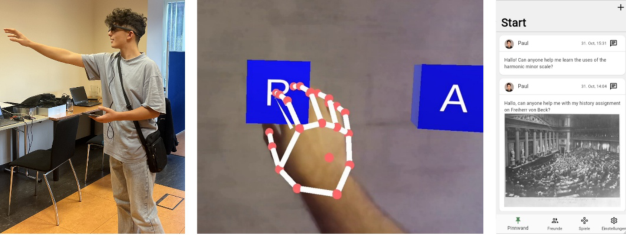
adults with their homework or younger adults can support with technical problems. Apart from that they can interact and profit from each other’s knowledge and life experience. Additionally, they can schedule location- based MR games. Users can connect with each other via friend requests and communicate via chats or video calls. Apart from the intergeneratio- nal component, the platform offers virtual support via articles and tips on specific topics relevant to the younger and/or older generation. Moreover, the platform offers a direct connection to professional buddies like social workers or care personnel to provide easily accessible support for the two target groups. To avoid abuse of the system, users are registered (usually by professionals) and thus are not anonymous. If users feel not treated well or have the feeling of being harassed or exploited, they can get in contact with the professionals who will take further actions. Figure 1 shows how the app looks like.
Figure 1: Left: younger adult finding anagrams; middle: view of the user through the glasses during the anagram game, right: buddy platform.
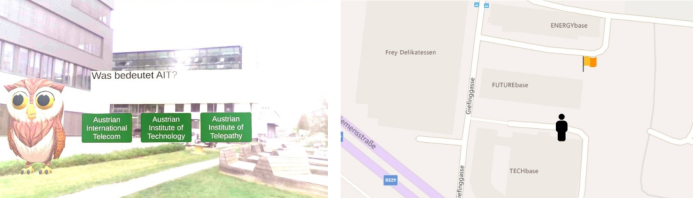
Location-Based MR Games Buddy4All offers location-based games in mixed reality to provide interge- nerational activities and thus foster the intergenerational exchange. Younger and older adults can schedule games via the buddy platform. In game, the younger adults wearing MR glasses are moving from location to location. At each location they need to solve a puzzle together with their senior buddies. The younger user’s view in the MR glasses along with the virtual content is viewed on the senior user’s smartphone. The seniors have the task to guide the younger users from one to the next location. For this, they can view a map showing the younger user’s location and the next target location. Further, the seniors are connected to the young adults via Voice over IP (VoIP), discus- sing about the right solution for the puzzle. When the young adults arrive at the correct location, an avatar presents the puzzle. This can be either a question that must be answered correctly, or a story where the users have to listen carefully and then sort items that were mentioned in the story by order. Upon a correct answer, the new location appears on the map of the senior. Location-based games are configured via a backend portal by the professionals. Locations and tasks can be defined on a map, so that they can configure a variety of games close to the younger users’ homes. Figure 2 shows the view of the younger user that is transmitted to the seniors as well as the map.
Figure 2: Location-based game. Left: view of what the young adult is seeing trough the glasses, right: next location and position of the user in the map.
MR Cognitive Exercises Buddy4All provides cognitive exercises for both the senior and younger gene- ration that are done in mixed reality. The benefit of MR is to combine cognitive exercises with physical movement by distributing elements of the exercise (e.g., cards of a memory game) within the living room. Users must then move towards the cards and touch them with their hands. The use of hand-tracking allows for intuitive user interaction. In the current prototype a word game was implemented, where new words must be created with the letters of a given word by touching the letters. This game was tested in the first user workshop that took place in November 2022. A screenshot of the game and a person performing the exercise can be seen in Figure 1.
DESIGN AND DEVELOPMENT METHODOLOGY As part of the user centered co-design process, a requirement analysis was performed (persona workshop, interviews, survey) in the beginning of the project. During the project, end-users are testing the system in a pre-test and three user-workshops. The feedback is incorporated into the system. Towards the project end, field trials are planned where the end-users use the system in their homes. Currently, the pre-test and the first two workshops were per- formed, whereas the second workshop is still evaluated. Up to this point a total of 213 primary users (young and older adults) and 145 secondary users (family members and experts in care giving or youth work) have been involved in the process.
The requirements analysis has been used to identify the needs of the two primary user groups and the secondary users. It was conducted in three steps: 1.) a persona workshop where members of the consortium used a value pro- position canvas to identify user pains and gains and made first assumptions for the analysis. 2.) The findings were used to develop interview questi- ons for primary and secondary users to further explore the findings of the workshop. In total, 7 older, 4 younger adults and 3 secondary end-users were interviewed. Based on the answers of the semi-structured interviews, 3.) an online survey was created to complete the final step of collecting users’ needs and requirements in an early stage. The goal was to collect quantifiable feedback from both primary and secondary end-users to identify trends and preferences. The survey received 264 responses consisting of answers from
Buddy4All – A Mixed Reality-Based Solution for Enabling Intergenerational Interaction 301
The assumptions drawn from the early requirement analysis were the basis for the content and main principles of the prototypes that were tested during a design pretest in August 2022 and the end user workshops in November 2022 and March 2023. In the pre-test, meant to test the design in advance, 10 per- sons participated. In the user workshops 54 primary users and 20 secondary users were engaged. The first workshop consisted of three workshop stati- ons where the primary and secondary end-users tested different aspects of the app. The test persons answered some initial questions and tested three sub-prototypes (design wireframes for future functionalities of the buddy platform, the buddy platform, and the MR cognitive game) and performed a final interview. Secondary users had to set up a location-based game in a web browser. The second workshop took place in March 2023 and the third workshop will follow in October 2023. All results were logged and analyzed to receive a list of change requests in the end that will be considered for the following workshop rounds.
The field trials that last four weeks for each attending primary user will start in the beginning of 2024. This is the final step in the user cente- red co-design process. In four consecutive months, each month a group of 20 primary users (80 in total) und in total 20 secondary users will participate.
RESULTS
In this paper the results of the first user workshop are described. The first workshop was attended by 30 elderly, 26 younger, and 20 secondary users in Austria and Switzerland. The senior users were aged between 60 and 89 years (25 between 60 and 79 years, 5 persons above 80). 20 of the 23 younger participants, that filled out the questionnaire, were aged between 14 and 16 years and 3 were aged between 17 and 19 years. The secondary users consisted of 15 professionals from care and youthwork and 5 relatives of elderly primary users.
At the first test station, design wireframes which illustrate the navigation within the app and the health tips section were tested. The most impor- tant findings for the navigation were that both primary and secondary users appreciated the overview of all options at the start screen. The terms “trai- ning”, “games” and “wall” were not clear for the users and thus will be renamed and summarized. The game scheduling was also tested at this sta- tion and showed that the primary users of both age groups had no problem following the logic of planning a location-based game. Both user groups sta- ted that they would favor to play rather spontaneously than to schedule an appointment for playing a game in advance. Additionally, users wished for more information about the planned game such as the length, the number of locations, or the overall topic of the specific game.
In addition to game planning, the involved secondary professional users were requested to create a user account for a primary user and to create a location-based game in the backend system. The professionals could perform these steps but in the final interview 9 out of 15 persons stated that the process
was too complicated (3) or time consuming (6). 4 people feared that it would be hard to find the “right” questions or tasks (4). They wished for predefined game rounds and a list of possible questions that they could choose from.
At the second station users tested the buddy platform on the smartphone. The biggest problem lay in the icons used (e.g., a pen or an hourglass) not being recognized by nearly half of the elderly participants. Younger persons, on the contrary, had no problems understanding the meaning of the icons. For the wall-function, where young and elderly persons have the possibility to ask for help, the end-users wished for a setting to make a post visible either only to friends or globally within the platform.
At the third station users tested a cognitive exercise – a word puzzle where users have to find anagrams. First, they had to start the app within the MR glasses. 12 of the elderly persons needed some initial help. 4 persons acci- dentally closed the app, 3 persons had trouble identifying the controller’s laser beam (which is essential for the navigation and item selection within the MR environment), and 5 persons had problems hitting buttons due to a light tremor or mobile restrictions like holding the smartphone while using a walking stick. In the younger group no such difficulties were observed. How- ever, the first impression was very positive. 25 out of 30 elderly and 24 out of 26 young persons described it as “cool” or “fascinating”. Only three of the younger persons stated that the design was “too simple” in their opinion.
52 out of 66 participants had no problems playing the cognitive anagram game. Only one person aborted the session due to difficulties in depth perce- ption and not being able to choose the letter boxes. The other 13 persons needed some guidance. 12 seniors expressed their wish of a possibility to adjust the distance to the letters so that they could do the task also while sitting. 6 elderly persons stated that the letters appeared too high above and not in front of them. 7 persons would appreciate the possibility to delete one letter if chosen by accident. The biggest problem for primary users in the workshop was to exit the anagrams game. 5 persons (1 elderly, 1 younger and 4 secondary users) were not able to quit the game. 12 persons (7 elderly, 3 younger and 2 secondary users) needed help to quit the game. In the final interview, 23 persons stated that the quitting process must be easier.
SUMMARY AND OUTLOOK Next to some minor design, functionality, and implementation issues within the smartphone app, the preliminary results highlighted, that the biggest challenge was in starting the anagram game via the main menu of the MR glasses. However, it needs to be mentioned that almost no participant had previous experiences using the MR glasses and that such a novel techno- logy, which uses a different interaction style, requires a familiarization phase. On the other hand, we could see that operating the anagram cognitive game itself within the MR glasses was not a problem for most users. We are curi- ous to see if above mentioned difficulties could be alleviated in the second workshop when returning users already have experience with the glasses. Furthermore, within the second workshop round we are testing new smart- phone app functionalities such as the extended user profile and the procedure
Buddy4All – A Mixed Reality-Based Solution for Enabling Intergenerational Interaction 303
of offering and accepting support and friendship requests. Regarding the MR solution, the second prototype offers next to the cognitive anagram game also an early version of a location-based game. Results of this second workshop round will be presented in a subsequent publication. The overall goal is to gather valuable user feedback in the final workshop round in October 2023 and to use this feedback to improve both the smartphone app as well as the MR app before the start of the field trial in January 2024.
ACKNOWLEDGMENT
The project Buddy4All is co-funded by the AAL Joint Programme (AAL- 2021-8-77-CP) and the following National Authorities and R&D programs in Austria, Switzerland, and Portugal: FFG, Schweizer Eidgenossenschaft, Fundação para a Ciência e a Tecnologia.
REFERENCES
Alcove, Homepage - ALCOVE, 2022. M. Anderson und A. Perrin, “Tech Adoption Climbs Among Older Adults,” Pew Research Center, 2017. E. Broneder, C. Weiß, J. Thöndel, E. Sandner, S. Puck, M. Puck, G. F. Domínguez und
M. Sili, “TACTILE – A Mixed Reality-Based System for Cognitive and Physical Training,” Lecture Notes in Networks and Systems, Bd. 319, pp. 752–759, 2022. G. D. Cohen, S. Perlstein, J. Chapline, J. Kelly, K. M. Firth und S. Simmens, “The impact of professionally conducted cultural programs on the physical health, men- tal health, and social functioning of older adults,”The Gerontologist, Bd. 46, Nr. 6, pp. 726–734, 2006. C. Ferguson, E. L. van den Broek und H. van Oostendorp, “On the role of intera-
ction mode and story structure in virtual reality serious games,” Computers & Education, Bd. 143, p. 103671, January 2020. C. S. González-González, P. Toledo-Delgado, M. Padrón, E. Santos und M. Cairos, “Including gamification techniques in the design of Tango: H Platform,” Jurnal Teknologi (Sciences and Engineering), Bd. 63, Nr. 3, pp. 77–84, 8 2013. H. Hikichi, K. Kondo, T. Takeda und I. Kawachi, “Social interaction and cognitive
decline: Results of a 7-year community intervention,” Alzheimer’s & Dementia : Translational Research & Clinical Interventions, Bd. 3, Nr. 1, p. 23, January 2017. A. Khaleghi, Z. Aghaei und M. A. Mahdavi, “A Gamification Framework for Cognitive Assessment and Cognitive Training: Qualitative Study,” JMIR Serious Games 2021;9(2): e21900 https://games.jmir.org/2021/2/e21900, Bd. 9, Nr. 2, p. e21900, May 2021. L. N. Lee, M. J. Kim und W. J. Hwang, “Potential of Augmented Reality and Virtual
Reality Technologies to Promote Wellbeing in Older Adults,” Applied Sciences 2019, Vol. 9, Page 3556, Bd. 9, Nr. 17, p. 3556, August 2019. G. Nichols und R. Ralston, “Social Inclusion through Volun- teering: The Legacy Potential of the 2012 Olympic Games,” https://doi.org/10.1177/0038038511413413, Bd. 45, Nr. 5, pp. 900–914, October 2011. T. Notley, “Young People, Online Networks, and Social Inclusion,” Journal of Computer-Mediated Communication, Bd. 14, Nr. 4, pp. 1208–1227, July 2009. Nreal, “Nreal Light,” 2021. [Online]. Available: https://www.nreal.ai/light/. [Acces-
sed at 13th of March 2022].
Rendever, “Rendever | Virtual Reality for Seniors | VR for Resident Engagement,”
2022. [Online]. Available: https://www.rendever.com/. [Zugriff am 11 12 2022]. T. E. Seeman, T. M. Lusignolo, M. Albert und L. Berkman, “Social relationships, social support, and patterns of cognitive aging in healthy, high-functioning older adults: MacArthur studies of successful aging,” Health psychology : official jour- nal of the Division of Health Psychology, American Psychological Association, Bd. 20, Nr. 4, pp. 243–255, 2001. G. Shepherd und M. Parsonage, “Measuring the costs and benefits of promoting
social inclusion,” Mental Health and Social Inclusion, Bd. 15, Nr. 4, pp. 165–174, January 2011. A. Singh und N. Misra, “Loneliness, depression and sociability in old age,” Industrial Psychiatry Journal, Bd. 18, Nr. 1, p. 51, 2009. S. Syed-Abdul, S. Malwade, A. A. Nursetyo, M. Sood, M. Bhatia, D. Barsasella,
M. F. Liu, C. C. Chang, K. Srinivasan, M. Raja und Y. C. J. Li, “Virtual rea- lity among the elderly: A usefulness and acceptance study from Taiwan,” BMC Geriatrics, Bd. 19, Nr. 1, pp. 1–10, August 2019. C. Tuena, E. Pedroli, P. D. Trimarchi, A. Gallucci, M. Chiappini, K. Goulene, A. Gaggioli, G. Riva, F. Lattanzio, F. Giunco und M. Stramba-Badiale, “Usabi- lity issues of clinical and research applications of virtual reality in older people: A systematic review,” Frontiers in Human Neuroscience, Bd. 14, p. 93, April 2020. S. C. Van de Weijer, M. L. Kuijf, N. M. de Vries, B. R. Bloem und A. A. Duits,
“Do-It-Yourself Gamified Cognitive Training: Viewpoint,” JMIR Serious Games, Bd. 7, Nr. 2, p. e12130, 7 5 2019. B. Wan, Q. Wang, K. Su, C. Dong, W. Song und M. Pang, “Measuring the Impacts of Virtual Reality Games on Cognitive Ability Using EEG Signals and Game Performance Data,” IEEE Access, Bd. 9, pp. 18326–18344, 2021. S. Zeldin, R. Larson, L. Comino und C. O’Connor, “Intergenerational relationships
and partnerships in community programs: Purpose, practice, and directions for research,” Journal of Community Psychology, Bd. 33, Nr. 1, pp. 1–10, January 2005.
Read this individual research paper free through the original publisher, or explore the full digital proceedings book.
ISBN 978-1-958651-87-2
Explore this ISBN in the AHFE Bookstore ↗Listed in the July 2026 bookstore catalogue; search by ISBN to confirm current availability · Digital book purchase optional