Florian Reichelt, Daniel Holder, Paulina Bosch, Thomas Maier (2022). How to support the appropriate method selection in design-technology-convergence?. In: Human Factors in Management and Leadership. AHFE Open Access, vol. 55, pp. 68–78. https://doi.org/10.54941/ahfe1002234
Institute for Engineering Design and Industrial Design, Department of Industrial Design, Engineering, University of Stuttgart, 70569 Stuttgart, Germany ↗
Technical products have an increasing variety of functions. This leads, on the one hand, to a continuously increasing product complexity. On the other hand, the actual development work also becomes more complex. Due to this fact, interdisciplinary and flexible development is becoming essential to maintain competitiveness. Project managers are increasingly confronted with major decisions. They range from fundamental product decisions to the selection of suitable method support. In order to be able to make adequate decisions in this volatile and complex development environment, valid basis and support for decision-making are required. The aim of this contribution is, in the special context of the so-called design-technology convergence, i.e., the early stages of product development (PD), to provide both a possibility for determining and evaluating the project-status and a support for the selection of adequate development methods.METHODSOur investigation is divided into two core areas: On the one hand, Key-Performance-Indicators (KPIs) for the general tracking of the development project, especially in the convergence between design and technology development are investigated. On the other hand, we focused on other indicators for the selection of development methods.In a first step, a systematic literature review was conducted. Subsequently, known development methods and KPIs were analyzed regarding their suitability for application as indicators for method choice. Based on this fundamental consideration, interviews with experts in the field of design-technique-convergence (D-T-C) were conducted to extract process-typical indicators. Based on the research, the analysis as well as the results of the interviews, a first approach is derived how a decision support for the use of methods in a development project can be realized.RESULTSIt is apparent that product complexity is currently the main topic in the literature. This consists of various objectively describable factors and is directly correlated with development complexity. First research tries to make this development complexity manageable by organizational ways, like capacity-planning-tools. The possibility over purposeful and situational method selection to handle the complexity with the development is considered however only insufficiently. Also, for the evaluation of the project progress no specific approaches exist and are mostly only generically regarded. This is mainly due to a large variance in project-dependent conditions, which ultimately do not allow a transferable/comparable application of KPIs. Furthermore, especially in the early phases of the PD, there are still unspecific and evolving requirements that are difficult to objectify. Ultimately, the results show that a new approach is needed that not only takes into account a distinction between project-status indicators but also method indicators. CONCLUSION AND OUTLOOKIn the context of this contribution, we took a detailed look at the generic term "development complexity". Thereby, we primarily focused on the examination of the two components of this complexity form: project-status indicators and development step indicators. Lastly, we were able to derive a first approach for necessary indicators from the literature and from direct needs in the D-T-C. We will further develop these subsequently to create a decision support tool and evaluate the level of support.
OBJECTIVE AND SIGNIFICANCE In technical product development (PD), a steady increase in product comple- xity has been observed for decades (Schönmann, 2012; Schuh et al., 2017; Gärtner, 2019) New technologies lead to a steady increase in complexity of development activities in addition (Reichelt et al., 2021) and ultimately also lead to an increase in uncertainties and risks in the development of new technologies and products (Werner, 2017; Bennet & Lemoine, 2014) Due to this fact, interdisciplinary and flexible development is becoming essential to maintain competitiveness. Project managers are increasingly confronted with major decisions in different levels of PD.
In PD, countless decisions are made that affect the design of the product and thus its success (Ebel et al., 2021). In order to be capable of making decisions, knowledge of the current development status is essential. Espe- cially in the early phases of development, so-called design decisions are of central importance (Gärtner, 2019). These significantly determine the pro- duct gestalt, the appearance. Therefore, the final design decisions are usually determined by top management (Reichelt et al., 2021).
How to Support the Appropriate Method Selection in Design-Technology-Convergence? 69
As central connection serves technical design, which combines the sub- aspects of styling and engineering in the early phases of the development process. This stage of the process is also known as design-technology- convergence (D-T-C) and creates a field of tension and solutions that brings together aesthetic and technical developments. The D-T-C process is chara- cterized by highly interdisciplinary collaboration (Schmid & Maier, 2017; Reichelt et al., 2021). Due to the special importance and positioning in PD, as well as the prevailing interdisciplinarity, a variety of decisions exist. In addition to the decision for a product design, the selection of adequate meth- ods is also of central importance for a successful product design (Reichelt et al., 2021).
Key performance indicators (KPIs) are generally used throughout the com- pany to provide the necessary information as a basis for decision-making (Bender & Marion, 2016). In research there is a lot of knowledge about busi- ness KPIs but little about PD-relevant KPIs (Bender & Marion, 2016; Taylor & Ahmed-Kristensen, 2016). This is mainly due to the fact that project pro- gress in product development is difficult to measure (Bender & Marion, 2016; Taylor & Ahmed-Kristensen, 2016; Böhm, 2019).
In this contribution, we therefore investigate which KPIs can be applied in the specific domain of D-T-C. The goal is to define a first approach, which on the one hand enables a support for design decisions. On the other hand, the approach should also support the project manager in situation-adequate method decisions in interdisciplinary design development.
STATE OF THE ART The current state of research and practice on the use of KPIs in PD is bri- efly presented below. Based on this literary illustration, previous research results on KPIs for design decisions and method selection are presented in more detail. Ultimately, further needs for research can be derived from these considerations.
KPIs can basically be divided into leading and lagging KPIs (Kaplan and Norton, 1996): leading KPIs reflect the actual process performance (impact on processes), whereas lagging KPIs measure the success of a process or pro- ject. In their case studies, Taylor & Ahmed-Kristensen (2016) found that lagging KPIs in particular are used in PD. These are mainly retrospectively measured and do not describe the actual PD progression, and therefore do not allow real-time measurement (Bender & Marion, 2016; Ebel et al, 2021).
In general, performance measurement is difficult in the development pro- cess (Bender & Marion, 2016; Taylor & Ahmed-Kristensen, 2016; Werner, 2017). Bender & Marion (2016) mention as reasons the heterogeneity of activities that engineering design entails: In practice, there is no reference process by which each project can be evaluated. The prevailing dynamics within PD lead to different evaluation criteria, which change from module to module. This volatility of evaluation criteria is further increased by the interdisciplinary nature of the process (Bender & Marion, 2016, Ebel et al. 2021).
Furthermore, it is difficult to quantify results or activities in the PD (Werner, 2017). Moreover, the success of a developed product cannot be attributed purely to the performance of Research & Development, as other departments of the company are also involved (Bender & Marion, 2016; Werner, 2017).
From the company’s point of view, the long-term outcome (product) of a PD is ultimately more relevant than the short-term output of a single deve- lopment activity (Bender & Marion, 2016). As essential success factors for the product and thus for its PD can generally be considered the fulfillment of requirements for the product (Albers et al., 2019). The degree of fulfill- ment is used in practice at certain milestones in PD to make decisions about the current development state (Ebel et al, 2021). The Technology Readiness Level (TRL) (Straub, 2015) is a common example for measuring this degree of fulfillment. The main problem here is the time lag between development, evaluation, and decision-making (Ebel et al., 2021).
With regard to the design decisions, which are primarily made in the early phase of PD, there are further specific challenges in the application of classic KPIs in addition to those mentioned above. The difficulty in evaluating early concept states is that only an estimate of later success can be made, since both the requirements and the target definitions of the product are antici- pated derivations which depend on countless external factors that cannot be captured (Bender & Marion, 2016). A key characteristic of the initial phase and thus also of D-T-C is the prevailing presence of a high degree of uncertainty and dynamism, since the requirements for the product are only analysed and defined in the course of these initial development pha- ses (Albers et al., 2019). According to Werner (2017), a valid estimation of success factors is not possible and the use of corresponding KPIs is not sui- table as a basis for decision-making. There are already a few approaches for general PD activities: Bender and Marion (2016), for example, present neces- sary characteristics that KPIs for PD activities should have, but they do not mention any specific indicators. As another approach, Werner (2017) sugge- sts classical considerations of cause-and-effect principles. However, the use of these is not considered applicable for the early and thus uncertain phases (Bender & Marion, 2016). Ebel et al. (2021) focus on measuring the pro- ject status using digital twins, or examining the maturity of the engineering artifacts created. However, design decisions are in their nature consistently opposed to rational and quantifiable decisions (technological, strategic), since the basic parameters for a decision are not descriptive, but much more intui- tive and creative. This specific nature of formal design decisions has not yet been studied scientifically (Gärtner 2019).
In addition to design decisions, the targeted use of methods for general PD (Birkhofer, 2008; Albers et al., 2019, Baschin et al., 2021), as well as for design development (Reichelt et al., 2021), is essential in project mana- gement. A variety of methods are available for the method decision, which are intended to improve the engineering work itself and thus the core cri- teria of quality, costs and time (Schneider & Lindemann, 2005; Birkhofer, 2008). Especially due to new methods, such as agile methods, PMs are incre- asingly faced with the challenge of selecting the adequate method for the
How to Support the Appropriate Method Selection in Design-Technology-Convergence? 71
development process (Böhm, 2019; Baschin et al., 2020 & 2021). According to Baschin et al. (2020) and Albers et al. (2019), there are currently no sele- ction tools or methods in use, which enable adequate method decisions based on KPIs, especially in the dynamic environment of PD.
Individual approaches have been presented in the literature that can sup- port method selection for specific use cases: For example, Albers et al. (2015) presented the InnoFox method selection tool. With the help of this tool, suitable methods, especially from the field of knowledge management, are suggested based on the available resources and according to the corre- sponding development tasks. The focus here is on the consideration of the available resources. However, the development tasks can only be selected from a pre-defined reference process. Thus, only limited account can be taken of situational requirements, especially in the case of design-specific activities.
Another approach to method selection in general PD was presented by Albers et al. (2019): Depending on the current development task, a suita- ble methodological approach is suggested. Thereby, the decision is based on product attributes and related development paths. However, specific activi- ties of the PD are only taken into account to a limited extent. Therefore, this approach provides guidance mainly at the planning stage.
As a further approach, Baschin et al. (2020) present a general method to support to plan the use of methods in the project planning. In the meantime, an advanced development of this approach has been presented (Baschin et al., 2021). However, the approach focuses primarily on the analysis of boundary conditions. A consideration of activity conditions, or the situational analysis are not undertaken.
In particular, the field of D-T-C considered in this paper is not limited to processes with regard to method selection, but rather also with regard to design activities (Reichelt et al., 2021). As described earlier, these show signi- ficant differences from other PD activities. In particular, the high variation of issues considered in D-T-C makes it very difficult to investigate factors influ- encing design activities (Maier & Fadel 2003). This is another constraint to method decisions in D-T-C. Overall, the state-of-the-art shows that there is still a need for investigation with regard to design decisions and method decisions in D-T-C.
METHODS
For a basic understanding of the application of KPIs in technical PD and in particular D-T-C, a systematic literature research (L) was conducted (see state of the art). In Addition, this research served as basis for the identification of performance metrics used in practice.
Based on the literature research, further KPIs existing in the practice were investigated in workshops (W) with experts from the automotive industry. The workshops were conducted from July to November 2021. Employees from the areas of design, ergonomics and technology development were sele- cted as experts. A total of 19 workshops could be evaluated. Using open questions, further relevant performance indicators were identified directly from practical application.
However, no evaluation of the applicability and transferability of these KPIs to design decisions was done in these workshops. Therefore, additional interviews (I) were conducted with experts from D-T-C. A total of 10 experts participated in the early 2022 interviews. To evaluate the applicability of the researched KPIs to the characteristics of the D-T-C, a collection from KPIs was evaluated. This collection represents a summary of KPIs from the litera- ture as well as the expert workshops. A preselection was made because, as described above, not all known KPIs are applicable per se for design decisi- ons. The synthesized KPIs were evaluated using a 5-point Likert scale with regard to their applicability to design decisions. Since the literature in the area of design-relevant KPIs is limited, the experts were additionally asked with open questions about KPIs known to them for design decisions.
With regard to KPIs for method decision-making in D-T-C, no adequate KPIs could be identified in the literature. Therefore, a collection of potential KPIs was created by means of open questions within the expert interviews (I).
Based on the results of the different investigations, a first approach for appropriate decision-making in the D-T-C was derived.
RESULTS
As a result of the systematic literature research, 30 KPIs for performance measurement in technical PD could be identified. However, the majority of the most frequently named and most frequently used KPIs represent so-called success factors (lagging KPIs). Since the success factors are determined after the project is completed (e.g., exact return of investment), they have no active influence on the dynamic decisions in the course of development. In parti- cular, these KPIs cannot be applied to design decisions and were therefore excluded from further investigation. In addition to the success factors, there are other KPIs that are also not suitable for design decisions: This applies in particular to financial indicators, such as cost of delay or profit, which are only indirectly related to product development activities (Bender & Marion, 2016; Taylor & Ahmed-Kristensen, 2016). Based on these restrictions, a reduction was made to essential KPIs that could have an impact on design decisions. The following KPIs were selected for further investigation according to the literature research: Customer Satisfaction (8) (Bach et al., 2017; Bender & Marion, 2016; Burger, 2016; Ebel et al., 2021; Hanschk, 2021; Hinsch, 2019; Niemann & Pisla, 2021; Taylor & Ahmed-Kristensen, 2016); Delta planned vs. actual Quality (6) (Dombrowski & Wullbrandt, 2019; Atzberger et al., 2019; Atzberger et al., 2020; Ebel et al., 2021; Künzel, 2016; , Schmidt et al., 2018); Time-to-Market (4) (Dombrowski & Wullbrandt, 2019; Atzberger et al., 2019; Schmidt et al., 2018; Werner, 2017); Design Development Time (2) (Atzberger et al., 2020, Gärtner, 2019); Quantity of Change Requests (Ebel et al., 2021); Delta planned vs. actual Time (Ebel et al., 2021); Overall Aesthetics Appearance (Gärtner, 2019); Degree of Intuition (Gärtner, 2019); Fulfillment Corporate Identity/Design (Gärtner, 2019); Designcosts (Gärtner, 2019).
How to Support the Appropriate Method Selection in Design-Technology-Convergence? 73
In the first expert workshop (W), the experts were asked about known and applied KPIs in the design process. The results of this question were mainly characteristic parameters that characterize the development status. No explicit factors were named as indicators for the design decision. The KPIs named partly correspond to the KPIs named in the literature or specify them (see Table 1).
It was observed that central design decisions take place at specific points in the development process and are mostly data-based. Unlike technical, strategic judgments, the judgment of aesthetics is difficult to objectify and quantify. Based on the assessment of the fulfillment of requirements or the fulfillment of specifications, the so-called maturity level can be estimated - similar to the TRL (Straub, 2015) and used as a basis for decision-making. However, these requirements evolve analogously to the design concepts. The- refore, a dynamic estimation in the course of the project is advisable, or unavoidable. Furthermore, as a rule, only estimates can be made for certain parameters, which ultimately contribute a tendency in the rating of design variants.
The KPIs identified from the literature (L) and the workshops (W) were evaluated by experts during the interviews (I) in terms of applicability to design decisions.
Table 1 presents all key results related to the design decisions. The KPIs investigated are mentioned. In addition, the source of each KPI from the literature (L), and the expert workshops (W) is indicated, including the num- ber of mentions. The results of the applicability evaluation using the 5-point Likert scale are also enlisted.
Based on the results, the various KPIs can be divided into the following categories based on their focus: superior, aesthetics, strategical, technical, economical and user requirements.
Based on the assessments for applicability of the proposed KPIs, the following results were determined:
The experts were clearly certain that a total of 3 of the 18 KPIs were also suitable for design decisions. These are: Requirement Fulfillment, Fulfillment of Technical Specifications, and Usability / User Experience
Overall Aesthetics Appearance, Fulfillment Corporate Identity/Design, Producibility, Dimensional Deviations, Designcosts, and Degree of Intui- tion were positively assessed by the majority.
Fulfillment of Strategic Requirements, Time-to-Market, Design Develo- pment Time, Delta planned vs. actual Time, Estimate Production Costs, and Customer Satisfaction were assessed as tending to be applicable
The following KPIs were rated as rather unsuitable: Quantity of Change Requests, Weight Estimation, and Delta planned vs. actual Quality In the context of method decisions, no relevant KPIs for the use in D-T-C could be identified in the previous literature review. Therefore, during the expert interviews (I), the experts were asked about possible factors for the selection of suitable methods in the design process. The following collection of conceivable criteria emerged:
Table 1. Overview of the applicability of identified KPIs for design decisions.
Table available in the original PDF paper.
method-specific: implementation effort; transferability of methods., pur- pose, data basis
user-specific: knowledge of the method; personal preference; user/target group; type of collaboration (teamwork vs. individual)
activity-specific: available resources; project stage; development type, activity objectives It is generally apparent that there is no consistent procedure for selecting suitable methods in practice. The vast majority of experts consider support in deciding on a method to be useful and necessary.
APPROACH ON METHOD SELECTION Ultimately, the results show that a new approach is needed to support project managers in decision making, especially in the field of D-T-C. In particular for design activities, performance measurements are very difficult to implement. Due to the characteristics of the early phases, which are characterized by very volatile and uncertain, but also free design spaces (Reichelt et al., 2021), a
How to Support the Appropriate Method Selection in Design-Technology-Convergence? 75
large number of KPIs are not directly transferable (Bender & Marion, 2016). Especially for KPIs that can be assigned to the classic development goals of costs, quality, and time, only estimates or forecasts can be made in the early phase. These can only be measured retrospectively as project success factors.
Ideally, KPIs should be situationally sensitive according to the prevailing PD activities (Bender & Marion, 2016; Neely et al. 2000). Therefore, it is rea- sonable to define the so-called leading KPIs on a project-specific basis and to continuously develop them (Taylor & Ahmed-Kristensen, 2016; Bender & Marion, 2016; Albers et al., 2019). These statements are also reflected in the results from the workshops. The definition of project-specific KPIs applies to design decisions as well as to the decision of situationally appropriate meth- ods. The literature shows that there is no real separation between KPIs for design decisions and method decisions.
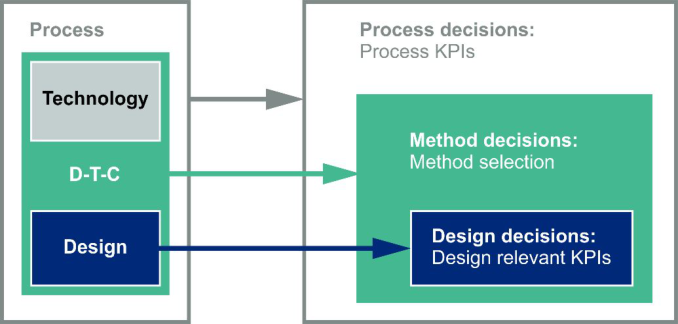
Figure 1 shows the variety of decisions in the domain of D-T-C. Pro- ject managers are confronted with general decisions on processual level, for example major decisions on the product specification. On the other side there are design decisions with concentrate on the specific product gestalt and can- not be supported directly with common KPIs. In between of those different levels of decision-making the domain of D-T-C is situated. Due to the inter- disciplinary combination between technology and design activities a variety of different methodical approaches are possible to both enable product rela- ted decisions (on process and design level) and support the developer team in their different activities.
Figure 1: Differentiation between processual, design oriented and methodical decisi- ons in the context of D-T-C.
Therefore, our approach includes the deliberate separation of processual, design-oriented, and methodical decisions: Process decisions are based on the numerous known and established KPIs, which enable control of the entire process. All relevant departments must be taken into consideration for the decision-making process.
Design decisions are based on KPIs from the identified categories: supe- rior, aesthetics, strategic, technical, economical and user requirements. This
ensures that all decision-making criteria relevant to design development are identified and taken into account. Analog to the process decisions, all relevant departments and their requirements should also be included here. However, the decisions primarily concern the product and not the PD process.
Method decisions are primarily based on the assessment of the prevailing development complexity. For this purpose, the method-specific, user-specific and activity-specific complexity level can be determined and used as a basis for method selection. In contrast to the other two levels, the method decisions primarily address the activities of the D-T-C and apply to this specific domain. Effects on the rest of the PD process are conceivable, but the decisions significantly affect the domains of the D-T-C.
Possible factors on which the decisions can be based on have a certain inter- section and influence each other. However, as our research shows, different foci are required, so different performance indicators must be used according to the specific level of decision-making.
CONCLUSION AND OUTLOOK Starting with the general description of the need for a detailed investigation of appropriate KPIs in the context of D-T-C, the current state of research and practice regarding PD-relevant KPIs was first presented. In addition to the general use of KPIs in PD, the focus was on relevant decisions in the early phases, in particular D-T-C: design decisions and method decisions in the design development process.
Based on the current status, the preceding systematic literature research made it possible to identify specific KPIs that are used in PD. These KPIs were supplemented with further mentions from expert workshops.
Since the transferability of PD KPIs to the early phase faces some hurd- les, interviews with experts from D-T-C were conducted. They evaluated the previously researched, supplemented, and pre-sorted KPIs in terms of applicability in the context of the design process.
The findings clearly show that an approach is needed to support project managers in the particularly volatile and uncertain early phases, or D-T-C, with suitable indicators for decision-making. Therefore, based on the fin- dings of the investigations, a first approach was formulated, how a support in decision-making (in processual, design oriented and methodical manner) can look like. Essentially, a subdivision and specific consideration of KPIs is necessary with regard to design decisions and method decisions. For each decision type, initial properties were presented on which the KPIs should be based.
As further work, we will elaborate and develop the approach. In par- ticular, we need to extend our current collection and define suitable KPIs for the different decision types. These must be reviewed for quantifiability. When defining KPIs, the dynamic adjustment in the course of the D-T-C must be taken into account. Further research and follow-up workshops with the experts will therefore be conducted as the next steps. In addition to the per- formance measurement, a collection of methods for the D-T-C activities will be created, in order to provide relevant and adequate methods, especially for
How to Support the Appropriate Method Selection in Design-Technology-Convergence? 77
the method decision. Finally, the further developed approach will be applied and evaluated.
REFERENCES
Albers, A., Hirschter, T., Fahl, J., Reinemann, J., Spadinger, M., Hünemeyer, S.
and Heimicke, J. (2019), Identification of Indicators for the Selection of Agile, Sequential and Hybrid Approaches in Product Development. Procedia CIRP, 84, pp. 838–847. Albers, A., Reiß, N., Bursac, N., Walter, B., & Gladysz, B. (2015). InnoFox– Situationsspezifische Methodenempfehlung im Produktentstehungsprozess. In Stuttgarter Symposium für Produktentwicklung. Stuttgart: Fraunhofer Verl. Atzberger, A., Gerling, C., Schrof, J., Schmidt, T. S., Weiss, S., & Paetzold, K. (2019).
Evolution of the Hype around Agile Hardware Development. In 2019 IEEE Inter- national Conference on Engineering, Technology and Innovation (ICE/ITMC) (pp. 1–8). IEEE. https://doi.org/10.1109/ICE.2019.8792637. Atzberger, A., Nicklas, S. J., Schrof, J., Weiss, S., & Paetzold, K. (2020). Agile Entwicklung physischer Produkte. University of Armed Forces Munich. https: //doi.org/10.18726/2020_5. Bach, N., Brehm, C., Buchholz, W., & Petry, T. (2017). Organisation: Gestal-
tung wertschöpfungsorientierter Architekturen, Prozesse und Strukturen (2. edit). Lehrbuch. Springer Gabler. https://doi.org/10.1007/978-3-658-17169-8. Baschin, J., Huth, T., & Vietor, T. (2020). An approach for systematic planning of project management methods and project processes in product development. In 2020 IEEE International Conference on Industrial Engineering and Engineering Management (IEEM) (pp. 1037–1041). IEEE. Baschin, J., Schneider, D., Huth, T., & Vietor, T. (2021). Project-oriented Selection
of Agile Methods for the Design of Physical Products. In 2021 IEEE Internatio- nal Conference on Industrial Engineering and Engineering Management (IEEM) (pp. 999–1003). IEEE. Bender, B., & Marion, S. (2016). Dimensions of product development success.
In: Proceedings of the DESIGN 2016 14th International Design Conference. Dubrovnik, Croatia (pp. 1455–1464). Bennett, N. and Lemoine, G. J. (2014), What a difference a word makes: Understanding threats to performance in a VUCA world. Business Horizons, 57(3), pp. 311–317. Birkhofer, H. (2008). Tidying up design methods–an approach using elementary
design methods. In: Proceedings DESIGN 2008, the 10th International Design Conference, Dubrovnik, Croatia (pp. 1–8). Burger, A. (2016). Design for Customer-Methodik für nachhaltige Kundenlösungen unter Zuhilfenahme eines bedürfnisorientierten Leistungskonfigurators. KIT Scientific Publishing. Böhm, J. (2019). Erfolgsfaktor Agilität. Springer Fachmedien Wiesbaden. https://do
i.org/10.1007/978-3-658-25085-0. Dombrowski, U., & Wullbrandt, J. (2019). Lean Leadership in Production Ramp- Up. In IFIP International Conference on Advances in Production Management Systems (pp. 54–61). Springer, Cham. Ebel, H., Riedelsheimer, T., & Stark, R. (2021). Enabling automated engineering’s
project progress measurement by using data flow models and digital twins. Inter- national Journal of Engineering Business Management, 13, 1–10. https://doi.org/ 10.1177/18479790211033697.
Gärtner, F. (2019). Formelle Designentscheidungen. In R. H. Stelzer & J. Krzywinski (Eds.), Reihe Technisches Design: TD 11. Entwerfen, entwickeln, erleben in Produktentwicklung und Design 2019 (pp. 52–77). TUDpress. Hanschke, I. (2021). Digitaler Wandel – lean & systematisch: Disruptive und evolu-
tionäre Innovationen ganzheitlich vorantreiben in Business & IT. Springer eBook Collection. Springer Vieweg. https://doi.org/10.1007/978-3-658-32144-4. Hinsch, M. (2019). Die ISO 9001:2015 – das Wichtigste in Kürze: Die Norm für den betrieblichen Alltag kurz, knapp und verständlich erklärt. Essentials. Springer Vieweg. https://doi.org/10.1007/978-3-658-24830-7. Kaplan, R. S., & Norton, D. P. (1996). Linking the balanced scorecard to strategy.
California management review, 39(1), 53–79. Künzel, H. (2016). Erfolgsfaktor Lean Management 2.0: Wettbewerbsfähige Verschlankung auf nachhaltige und kundenorientierte Weise (1. Aufl. 2016). Erfolgsfa- ktor Serie. Springer Gabler. https://doi.org/10.1007/978-3-662-49752-4. Maier, J. R., & Fadel, G. M. (2003). On the complexity of the designer-artifact-
user system. In: Proceedings of ICED 03, the 14th International Conference on Engineering Design, Stockholm. Neely, A., Mills, J., Platts, K., Richards, H., Gregory, M., Bourne, M., & Kennerley, M. (2000). Performance measurement system design: developing and testing a process-based approach. International journal of operations & production management. Niemann, J., & Pisla, A. (2021). Life-Cycle Management of Machines and Mech-
anisms. Mechanisms and machine science: Volume 90. Springer International Publishing AG. https://doi.org/10.1007/978-3-030-56449-0. Reichelt, F., Holder, D., & Maier, T. (2021). Development of a situational development methodology - a hybrid approach for agile transformation in technical design. In Stuttgarter Symposium für Produktentwicklung SSP 2021: Stuttgart, 20. Mai 2021, (1–12). Schmid, M., & Maier, T. (2017). Technisches Interface Design. Springer Berlin
Heidelberg. https://doi.org/10.1007/978-3-662-54948-3. Schmidt, T. S., Weiss, S., & Paetzold, K. (2018). Agile Development of Physical Products: An Empirical Study about Motivations, Potentials and Applicability. University of Armed Forces Munich. Schneider, S., & Lindemann, U. (2005). Anforderungen an ein Bewertungssystem für
Methoden. In DFX 2005: Proceedings of the 16th Symposium on Design for X, Neukirchen/Erlangen, Germany, 13.-14.10. 2005. Schömann, S. O. (2012). Produktentwicklung in der Automobilindustrie: Management-konzepte vor dem Hintergrund gewandelter Herausforderungen. Zugl.: Eichstätt-Ingolstadt, Univ., Diss., 2011 (1. Aufl.). Gabler Research. Gabler Verlag / Springer Fachmedien Wiesbaden GmbH. https://doi.org/10.1007/978-3- 8349-6673-5. Schuh, G., Gartzen, T., Soucy-Bouchard, S., & Basse, F. (2017). Enabling Agility in Product Development through an Adaptive Engineering Change Management. Procedia CIRP, 63, 342–347. https://doi.org/10.1016/j.procir.2017.03.106. Straub, J. (2015). In search of technology readiness level (TRL) 10. Aerospace Science
and Technology, 46, 312–320. Taylor, T,. & Ahmed-Kristensen, S. (2016). Global product development: KPI selection support. In Proceedings of International Design Conference, Dubrovnik, Croatia (pp. 1615–1624). Werner, H. (2017). Performance-Messung in Forschung und Entwicklung. Control-
ling & Management Review, 61(3), 16–27.
LISTED IN THE AHFE DIGITAL BOOKSTORE CATALOGUE
Explore the complete digital volume
Human Factors in Management and Leadership
Read this individual research paper free through the original publisher, or explore the full digital proceedings book.
ISBN 978-1-958651-31-5
Explore this ISBN in the AHFE Bookstore ↗Listed in the July 2026 bookstore catalogue; search by ISBN to confirm current availability · Digital book purchase optional