Young Mi Choi, Wendell Wilson (2023). Leveraging Biologically Inspired Design As An Effective Instructional Strategy. In: Interdisciplinary Practice in Industrial Design. AHFE Open Access, vol. 100, pp. 87–92. https://doi.org/10.54941/ahfe1002974
This project(s) adressed by this paper have been undertaken by graduate students in the MID program within the School of Industrial Design at the Georgia Institute of Technology. Georgia Tech offers both two and three year graduate programs, the longer program being intended for students without undergraduate training in design. As such, they lack basic design skills or familiarity with the design process. This prerequisite “certificate year” of studies is comprised of two semesters, intended to help students develop the skills and understanding needed for the subsequent two years of study. Most of the initial semester is focused on basic design skill building – specifically form, proportions, spatial relationships, structure, problem definition, user research, basic anthropometry, 2D visualization and model fabrication to name a few. The first opportunity for students to apply these skills to a complete project has traditionally been a lighting-related design project in which biologically-inspired design (BID) is used as a model for developing design solutions. Since 2013, this BID approach has been applied in 8 of the 11 years, collaborating with professors from Georgia Tech’s Center for Biologically Inspired Design who introduce the concept of biologically inspired design, discuss case studies where the BID process has been particularly effective, and to provide input & feedback throughout the design process to help guide the students as subject matter experts (SME) on BID. Students are given a project brief that details how students must identify a lighting-related problem and a biological inspiration that can be leveraged in solving the problem through design, along with specific project requirements. In an effort to facilitate identification of a biological inspiration, the class typically visits the local zoo or aquarium as a group with a focus on the unique characteristics of different organisms that might be utilized or emulated to innovate effective design solutions. This break from the routine has typically been both motivating and fun for the students who become very engaged in this project.While there are numerous approaches to the design process (i.e. Double Diamond, Circular Design Process, Design Thinking, Engineering Design Process etc.) using BID as a model for introducing the design process to new students has proven to be particularly effective. The final deliverables resulting from this effort frequently are outstanding – despite the fast pace of this project. This paper details how Biologically Inspired Design (BID) has been used successfully as a means of introducing the design process to graduate students.
INTRODUCTION AND BACKGROUND Biologically Inspired Design (BID) is an approach to design that involves using examples found in nature as an archetype for solving various design problems. The essence of this approach is to understand how & why biologi- cal organisms address their needs in a particular way. This approach is to be distinguished from biomimicry in which the form or appearance of a biologi- cal organism might be simply “imitated” without consideration of how/why the organism behaves or it’s physical appearance is configured in a particular manner.
This paper details how a BID assignment has been utilized to introduce students to the design process and how it has proven to be a particularly effective and well-received exercise.
Biologically inspired design is an approach which uses analogies from bio- logical systems to generate solutions in engineering and other design fields. It has become important tool for innovation and sustainable development from design practice, manufacturing, engineering and many others (Bosner 2006, Bosner and Vincent 2006, Kubota et al. 2006). Many examples can be found that use BID in teaching engineering and innovation. In this context BID has been shown to increase the novelty and variety of solutions generated by experienced students (Nelson, et al. 2009, Helms, et al 2009, Yen, et al 2011).
The contribution explored here is the use of BID as a first entry point for students with no prior design training to learning iterative, evidence- based design methodologies. BID by nature is multidisciplinary by nature that requires some understanding of systems and processes in biology and the ability to apply that within a different domain. The ability to synthesize information across different fields and identify opportunities for use betw- een them is the kind of skill designers seek to develop and is a component in many innovations.
METHOD
Human At the outset of the project, professors from Georgia Tech’s Cen- ter for Biologically Inspired Design introduced the principles of biologically inspired design to the students, showing examples and case studies of how various examples in nature had been effectively leveraged to create soluti- ons to common problems. The project was then introduced to the students through a written brief that outlined the design goals & requirements of the assignment. In short, students were charged with identifying a lighting-related problem to address with their designs and a biological inspiration that could be used as a model for how to address the chosen problem.
The entire class then visited the Atlanta Zoo as a group in order to obse- rve how animals have unique characteristics that help them address different aspects of their existence (i.e. avoiding predation, facilitating movement or feeding, attracting mates, etc.). While some students identify specific animals to leverage in engaging their chosen design problems during this visit, the intent of the zoo visit is to help students better understand how to select their bioinspirations.
Leveraging Biologically Inspired Design as an Effective Instructional Strategy 89
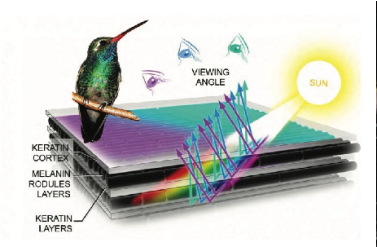
Students initially performed background research in order to identify both a lighting problem to be addressed through design and a biological inspira- tion that could serve as a model for how the lighting problem might be solved (Figure 1). The intent of this research is an accurate definition of the pro- blem, the understanding of relevant design requirements and objectives, and an appreciation of how the biological inspiration solves a similar problem. As a part of this background research, students identified key stakeholders, relevant materials and technologies, competitive products as well as com- pensatory solutions that might exist, user needs, “pain points” inherent in the lighting problem, etc.. Students presented the results of this initial rese- arch to an audience including representatives from Georgia Tech’s Center for Biologically Inspired Design to confirm that the choice of lighting pro- blem is a suitable design problem and that their choice of a bio-inspiration is appropriate for their chosen problem. Typically this is a “Go/No Go” point in the process where students are advised to modify the scope of their cho- sen problem or alternative organisms are suggested for use as their biological inspiration.
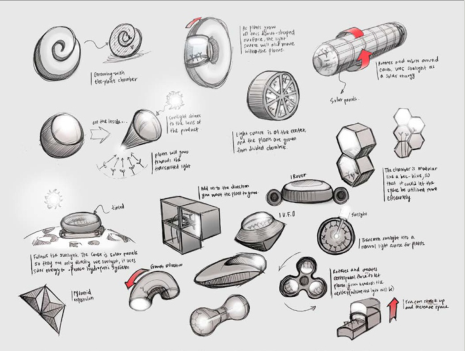
At this point, students start their design ideation, working in both 2D “thumbnail” sketch and 3D study model formats. Morphological matrices were utilized for “mapping concepts” from the initial ideation (Figure 2). Each student developed 3 alternative concepts for addressing their chosen problem, presenting them to an audience including representatives from Georgia Tech’s Center for Biologically Inspired Design to identify the most promising direction.
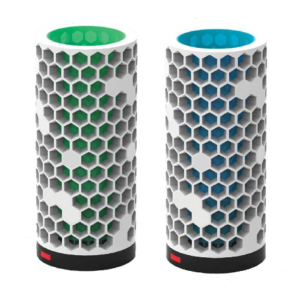
The agreed-upon design concepts are subsequently refined in terms of included features, appearance, manufacturability and usability. Students are required to detail how their designs might be ultimately be configured for production and to fabricate “proof of concept” prototypes that permit demonstration and testing of key operational aspects (partial or complete) of their proposed solutions (Figure 3). CAD models are typically used to illustrate design intent for the appearance and assembly of the final produ- ction version of their design solutions. “Proof-of-concept” prototypes can vary from simple lighting devices powered by alternative power sources to more complex systems that incorporate sensors & Arduino type processing to provide “smart product”functionality. Storyboards are usually prepared to communicate the sequence of use, showing how the proposed designs might be used.
Figure 1: Supporting research infographics.
90 Choi and Wilson
Figure 2: Example of thumbnail ideation sketches & morphological matrix used for “Concept Mapping” of results from initial ideation.Figure 3: CAD model of proposed design & proof-of-concept prototypes.
RESULTS
Student design solutions developed and submitted as a part of this BID Assignment over past years were assessed following a common three-point rubric.
Each proposed design solution was evaluated in terms of (1) whether the design solution successfully addresses the chosen problem; (2) whether the design solution makes appropriate use of the chosen bio-inspiration; and (3) whether the design solution was convincingly demonstrated by the proof-of- concept prototype? Each question was answered on a scale of 1–5 with “1” indicating “not at all” and “5” indicating “yes/effective/complete”, which was used to derive an assessed value for the overall level of completeness for the design (Table 1).
Leveraging Biologically Inspired Design as an Effective Instructional Strategy 91
Table 1. Comparison of results from Project over 8 semesters it has been assigned.
Table available in the original PDF paper.
Academic Semester: Number of Student Projects: Average Assessment (% Complete): Fall 2013 11 4.18 84% Fall 2014 7 3.95 79% Fall 2015 14 4.04 80.9% Fall 2019 7 3.67 73.3% Spr 2019 10 4.3 86% Fall 2020 7 3.8 76.2% Fall 2021 13 4.0 80.5% Fall 2022 9 4.22 84.4%
DISCUSSION
Using BID as a model of an effective problem solving process has been observed to be an interesting and enjoyable break from the heavy wor- kload and routine skill building exercises that comprise the rest of the semester and traditional design projects that are typically assigned over the following year of studies. By having supporting details regarding how an organism solves a problem (and the “tangible” example itself), it seems to be easier for students who lack prior experience with the design process, to address their chosen design problems than if no such example could be followed.
Students tend to be highly motivated over the course of this project, often incorporating “smart features” into their designs and creating more sophisti- cated and complex solutions to their chosen problem than actually assigned in the project. The familiarity with the design process and application of basic design skills learned over the course of this project seem to benefit students as demonstrated in their approach to subsequent projects in the following semester of study. While subsequent projects follow a more traditional design process (i.e. Double Diamond), there does not seem to be any confusion or hesitation on the part of students that have participated in this project in making this transition.
As demonstrated in Table 1, designs developed by students over the course of this project are typically fairly complete solutions to their chosen pro- blems. Considering this is their first attempt at developing a design from concept to prototype, it is the opinion of these authors that following the example of BID helps students remain more engaged in their projects. (It has been observed that student at this level can easily become discoura- ged during the process or can tend to “over focus” on specific details and lose sight of the end-goals of the overall development process. Clearly it would be helpful to perform a similar assessment of the solutions deve- loped using more traditional development processes. Comparison of the resulting scores could be more a more objective validation of the edu- cational value of integrating BID during the introduction of the design process.
92 Choi and Wilson
CONCLUSION AND RECOMMENDATIONS This assignment has been a particularly effective method to introduce stu- dents to the design process. The focus on a bio-inspiration as a part of this introductory process removes the stress to students of developing totally new solutions and has motivated and encouraged students in developing their solutions, utilizing skills & techniques only recently introduced.
It is recommended that future iterations of this project be more tightly defi- ned so as to narrow the range of problems pursued by students, making it easier to compare the resulting designs in a meaningful manner. Perhaps a spe- cific design problem could be posed to the class so that students must identify a suitable bio-inspiration and focus more directly on their design solutions that leverage their particular choice of inspiration. It is also recommended that a pre/post project survey be developed in order to more accurately assess student’s familiarity with Biologically Inspired Design (BID) before and after engaging in this project. Finally, it is suggested that a similar analysis & asses- sment of student designs developed as the result of a more traditional design processes be undertaken in order to permit a more objective evaluation of the effectiveness of using BID as an introduction to the design process.
ACKNOWLEDGMENT
The authors would like to acknowledge the ongoing assistance and guida- nce of Georgia Tech’s Center for Biologically Inspired Design, contributing heavily to the relevance and effectiveness of this project since 2013.
REFERENCES
Bosner, R (2006) Patented biologically-inspired technological innovations: a twenty year view, Journal of Bionic Engineering Vol 3 pp. 39–41. Bosner, R and Vincent, J (2006) Technology trajectories, innovation, and the
growth of biomimetics, Journal of Mechanical Engineering Science Vol 221 pp. 1177–1180. Helms, M., Vattam, S. S., & Goel, A. K. (2009). Biologically inspired design: process and products. Design studies, 30(5), 606–622. Kubota T, Nagaoka K, Tanaka S, Nakamura T (2007) Earth-Worm Typed Drilling
Robot for Subsurface Planetary Exploration. Proc. IEEE Int. Conf. on Robotics and Biomimetics, Sanya, China, December 15–18, 2007, 1394–1399. Nelson, B., Wilson, J., & Yen, J. (2009, October). A study of biologically-inspired design as a context for enhancing student innovation. In 2009 39th IEEE Frontiers in Education Conference (pp.1–5). IEEE. Yen, J., Weissburg, M., Helms, M., & Goel, A. (2011). Biologically inspired design:
a tool for interdisciplinary education. Biomimetics: nature-based innovation, 7.
LISTED IN THE AHFE DIGITAL BOOKSTORE CATALOGUE
Explore the complete digital volume
Interdisciplinary Practice in Industrial Design
Read this individual research paper free through the original publisher, or explore the full digital proceedings book.
ISBN 978-1-958651-76-6
Explore this ISBN in the AHFE Bookstore ↗Listed in the July 2026 bookstore catalogue; search by ISBN to confirm current availability · Digital book purchase optional