Yong-Gyun Ghim (2022). Designing Mobile Robots: A Systems Thinking Approach for Industrial Designers. In: Interdisciplinary Practice in Industrial Design. AHFE Open Access, vol. 48, pp. 124–131. https://doi.org/10.54941/ahfe1002024
With robots’ presence gradually expanding to homes and public spaces, there are increasing needs for new robot development and design. Mobile robots’ autonomous and dynamic behaviors ask for new design approaches and methods that are different from the ones for designing non-robotic products. This study proposes a methodology for designing mobile robots from a systems thinking perspective to supplement the limitation of traditional industrial design approaches. A conceptual framework consisting of user, robot, and environment is proposed and task flow models are built to help designers analyze and specify complex interactions between multiple system elements. A robot system blueprint, a storyboard, and a system map are subsequently introduced to design and represent a product-service system of a robot holistically. This approach was applied to student projects for mobile robot design in a fourth-year studio course at a university’s industrial design program.
Living with robots is becoming a reality thanks to the recent technological developments in artificial intelligence (AI), sensors, and connected netw- ork. As tech companies and the service industry introduce more robots in our homes and public spaces, it will become common to see various robots moving around and helping us in multiple areas. In the past, cleaning robots were one of few robots we could encounter in our life outside factories or museums but now we are observing an increasing number of home assistant robots, delivery bots, airport robots, and other types of service robots ente- ring our daily lives and interacting with us. Accordingly, there have been growing needs for new robot development and design, and the demand will continue to grow. However, designing robots pose challenges to industrial designers because of robots’ unique characteristics and industrial designers’ overall lack of previous experience in designing robots. For example, robots’ autonomous and dynamic behaviors with respect to time make interacti- ons with surrounding environments crucial (Lee et al. 2007) and require a holistic approach for robot development (Lee et al. 2009), whereas interacti- ons happen mostly between users and products with non-robotic products. Conventional design approaches have limitations to address such differences,
Designing Mobile Robots: A Systems Thinking Approach for Industrial Designers 125
so it is necessary to provide industrial designers with a more suitable design approach that can effectively capture the autonomous and dynamic nature of robots and design them holistically considering the context of use. This study examines the unique characteristics of robots first, with the focus specifically on mobile robots because most of the robots we encounter in homes and public spaces are mobile. Then it builds a conceptual framework of robots’ interactions and operations in context and proposes methods for designing robots based on a systems thinking approach, incorporating tools from inte- raction design and service design into the design process to help designers think from a system perspective. This methodology is further examined by applying it to a studio project in an industrial design program at a university.
MOBILE ROBOTS AND SYSTEMS THINKING Mobile Robots and Conceptual Framework
A mobile robot is a “robot able to travel under its own control”(International Organization for Standardization [ISO], 2017). Mobile robots are capable of moving around autonomously, with a capacity to sense their surroundings, plan and follow the path, and adapt to the changes of the environment while performing their tasks. For example, a cleaning robot, the most widely used type of mobile robot in our daily life, leaves its charging base when its clea- ning task is initiated by the user and moves around the home by itself to clean the floors without interventions from the user unless undesired moments happen that the robot cannot figure out. Particularly with a robot equipped with the simultaneous localization and mapping (SLAM) capability (Leonard and Durrant-Whyte, 1991), it can map the environment, locate its position, and plan its path. While moving forward, if it recognizes obstacles, whe- ther walls, furniture, sudden changes of the floor elevation, or people, it stops, changes its moving direction, and adjusts the movement path accor- dingly. As each environment and situation in which the robot operates is unique, full of unpredictable occurrences throughout its operation, the robot needs to be able to actively sense its dynamically changing surroundings and react as it performs its cleaning task. This autonomous behavior continues until the cleaning robot decides that its task is finished or runs low on bat- tery, then returns to the charging base. Accordingly, it can be deduced that a mobile robot has dynamic behavior responding to “a substantial change of environments with respect to time” (Lee et al. 2007).
These autonomous and dynamic behaviors give mobile robots such uni- que characteristics in comparison to conventional non-robotic products that it requires a different approach for designing mobile robots. Non-robotic products are passive and static: they are fully or mostly controlled by human users and remain still unless directly operated by humans. Because users are in control of a product’s operation, users become the center point of design and the interaction is dealt solely between the user and the product. Accordingly, traditional industrial design practice has been centered around discovering user needs from a user’s perspective and translating them to a desirable, feasible, and viable product. On the other hand, mobile robots’ active, auto- nomous, and dynamic behavior shifts the focus. Users are not the sole focus
126 Ghim
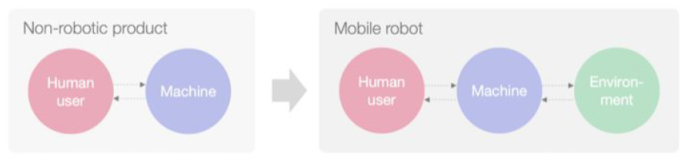
anymore, but the operation of and interactions with robots need to be also understood from the robot’s viewpoint, with the robot taking the central role and actively interacting with both users and surrounding environments. This calls for a “robot-oriented design” (Lee et al. 2007) approach. Accordingly, Figure 1 shows a comparison of interaction models for non-robotic produ- cts and mobile robots. Here, the environment does not just mean a physical space but includes artifacts, pets, and the other autonomous robots in the space along with people who are not the users of the robot but may come across the robots.
Figure 1: Comparison of interaction models for non-robotic products and robots.
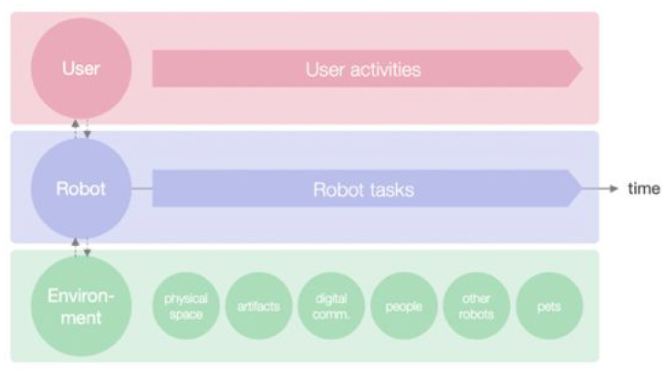
At the same time, for a robot to work properly in real-world situations, a context where the robot will operate should be considered. The context includes the environment the robot will operate in and the people it will inte- ract with. The context is determined by the tasks the robot is called to do. For instance, a cleaning robot’s tasks include vacuuming or mopping floors and moving inside the home. These tasks set the cleaning robot’s context in a home environment and for people at home. Conversely, the context also defi- nes a boundary for the tasks. The home environment as a physical context of the environment for the cleaning robot limits its main tasks to cleaning the home instead of cleaning streets. The interaction model of a mobile robot described above (Figure 1) consists of user, robot, and environment, and a framework can be developed from this model to capture the context and the robot’s specific relationship with the context in a sequence of time: what tasks a robot goes through, how the robot interacts with the user for what user activities and robot tasks, and how the robot interacts with the environ- ment to perform the tasks. By arranging those elements in a time sequence under the categories of user, robot, and environment, designers can get a clea- rer understanding of the context and the system around the robot (Figure 2).
Systems Thinking and Design Methodology As manifested in the research of Lee et al. (2009), developing a robot requires a holistic approach to its design with consideration of the context, develo- pment as a product and service system, and interaction design to support social behavior. Bartneck et al. (2020) also argue for the importance of con- sidering multiple design aspects holistically, which include not only form and function, but also level of autonomy, interaction modalities, user acceptance, and context of use.
Designing Mobile Robots: A Systems Thinking Approach for Industrial Designers 127
Figure 2: A conceptual framework for designing a mobile robot.
Systems thinking is a useful approach to deal with these complex and mul- tiple aspects of designing robots. Firstly, in a broader definition, systems thinking means both a philosophical and practical perspective of looking at things in the context of relationships rather than in isolation through which a phenomenon is investigated holistically. Systems thinking enables people to see the whole with the interconnecting and interacting parts together. Having this perspective is particularly important when dealing with technologies, which possess “the interconnectivity of one realm to another” (Mononen, 2017). The development of robots is also highly relevant to this because robotics involves multidisciplinary effort between engineers, psychologists, designers, and researchers in other domains (Bartneck et al. 2020). Secondly, at a product level, Norman (2009) explains systems thinking as looking at a product as a set of cohesive and integrated experiences that involves process and service aspects. The entire experience is to be considered with all the parts working coherently and consistently, and it requires thoughtful analysis (Nor- man, 2009). Robots have service aspects at the core because they replace or supplement manual tasks traditionally done by humans. The recent integra- tion of robots with mobile applications further emphasizes the service aspects of robots. Compared to the past when robots worked independently without being necessarily connected to the network, current robots operate in a larger system that connects physical robotic products with digital services.
In the previous section, it was argued for looking at a robot as a product and service system. As a system deals with a set of interacting or interrela- ted elements, it is important to capture and define the system elements and their relationships with one another for systems thinking. Visual or narra- tive tools like system diagrams, models, and stories are useful methods to see the system (Mononen, 2017). Morelli (2002) discusses scenarios as a meth- odology for the design of services, for which diagrams are used to describe use cases, then proposes blueprints and storyboards for the representation of product-service systems. Task flow models have been used for analyzing
128 Ghim
interactive systems in various forms. Mobile robots’ dynamic behavior with respect to time and space necessitates the task flow to be analyzed by looking at the interactions between users, robots, and the environment in both time sequence and physical space. Accordingly, two separate task flow models are proposed in this paper for both an analysis of the current system and ideation. A service blueprint is to envision future service offerings by detailing visible actions, invisible interactions, touchpoints, and the support processes (For- lizzi and Zimmerman, 2013). This paper introduces a robot service blueprint, in which a robot’s internal components and processes through technological infrastructure replace backstage actions and support processes. A storyboard and a system map are also introduced in this study for the design and repre- sentation of a system around a robot and they are further discussed in the next section with examples.
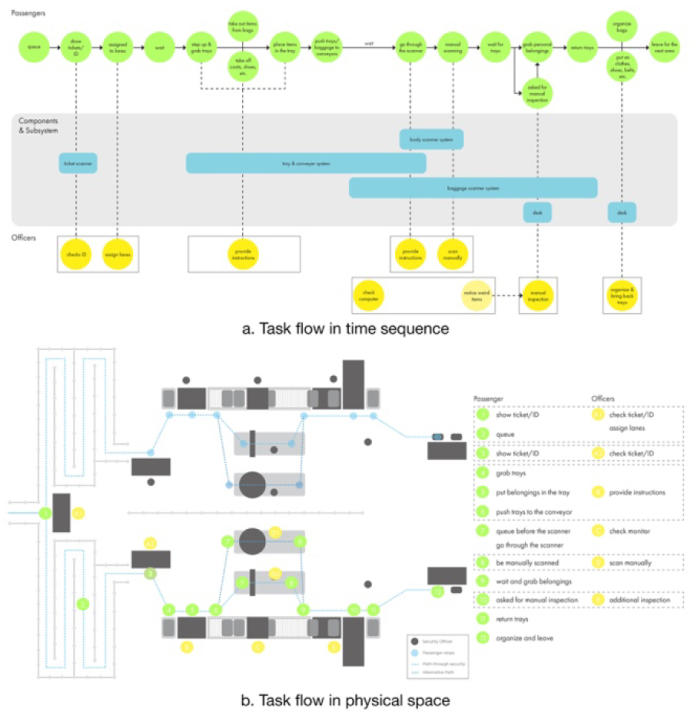
MOBILE ROBOTICS STUDIO The systems thinking approach and the methodology mentioned in the pre- vious sections have been applied to a mobile robot design project in a fourth-year studio course at the University of Cincinnati’s Industrial Design program, with the project running for 15 weeks each in Fall 2020 and Fall 2021. Students worked as teams to design a system of mobile robots for public spaces, such as supermarkets, airports, hospitals, fitness centers, etc. Each team consisted of three students, either two industrial design students and one communication design student or three industrial design students. Students were asked to follow the design process set by the instructor: 1) context understanding; 2) system design; 3) validation and refinement; 4) implementation; and 5) storytelling and documentation. In particular, systems thinking was applied during the context understanding and the system design phase. For context understanding, after students conducted initial research to understand users, stakeholders, technology, and the space in interest, they created two types of task flow models of the current system, one in a time sequence and another on a physical space layout, to analyze the detailed interactions and relationships between users, service elements, and the environment. This task flow analysis helped the students to discover pain points of the current system and to gain insights for new opportunities. For example, Figure 3 shows task flow models of a security check at an air- port, with which students were able to analyze the whole screening process for both passengers and security officers in time and space, pointing out pain points and searching areas where the user experience can be improved by robotic applications.
During the system design phase, students were guided to explore ideas from a bigger system perspective. Each team was asked to first define three to four subtopic areas based on the pain points and insights discovered in the previous phase. Focusing on those subtopic areas, students ideated how robots can provide better solutions for people and work well in the existing environments. Ideas were visualized with sketches and clustered under the predefined subtopic areas. Though grouped under each theme, ideas were yet fragmented and lacked a cohesive story as a whole. While more ideas were
Designing Mobile Robots: A Systems Thinking Approach for Industrial Designers 129
Figure 3: An example of the task flow analysis: a security check in airports.
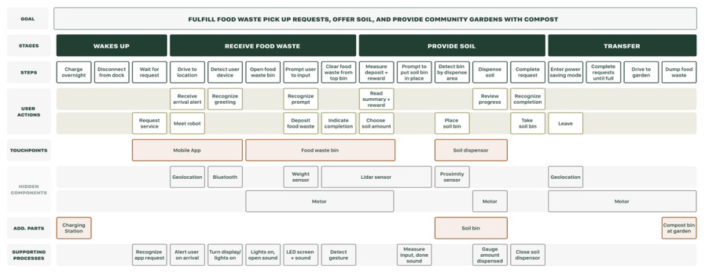
generated, students were asked to combine, reorganize, and revise ideas and then build several system scenarios that have more coherent stories and show an integration of product and service. New task flow models were created by introducing robots to the current system, compared with the previous task flow models, and then robot service blueprints were developed. The robot service blueprint was useful to see the whole procedure of a robot’s operation and interactions while allowing the students to specify touchpoints and functional components as well as supporting processes happening both inside the robot and in the cloud. Figure 4 shows an example of the robot service blueprint for a composting robot to be used on sidewalks in big cities. Along the sequence of user actions and robot tasks, it specifies the robot’s product components, service elements, and processes for running the whole system.
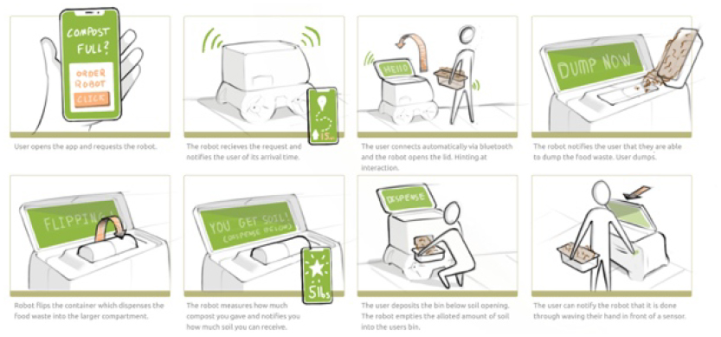
Based on the robot service blueprints, students developed and visualized their ideas through storyboarding (Figure 5). The aspect of a robot’s product and service integration made a storyboard a useful tool to communicate the
130 Ghim
Figure 4: An example of the robot service blueprint.Figure 5: A storyboard example for a composting robot.
usage context and scenarios as well as to help the students approach from a system perspective.
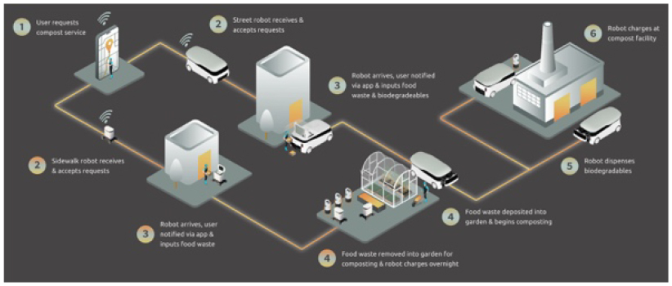
For the remainder of the design process, the ideas were further refined and materialized with detailed sketches, interface design, CAD models, and pro- totypes. A system map was also created to show how robots operate and interact with people and other system elements in a particular environment. Using isometric composition, robots’ final designs and their movement paths were overlaid on a drawing of the environment where the robots will be deployed, so that the whole system of robotic product and service, inclu- ding the context and the flow of the system elements, can be captured in a single page. Figure 6 shows the system map for the composting robots and the service related to the usage of the robots. Subsequently, students completed both product and interface design of the robot and other rela- ted interface designs like mobile applications. They communicated the design concepts using storytelling techniques to fully convey the system surrounding the mobile robots.
Designing Mobile Robots: A Systems Thinking Approach for Industrial Designers 131
Figure 6: A system map of the composting robot.
CONCLUSION
Designing mobile robots requires a holistic approach with consideration of the context of use because of mobile robots’ dynamic and autonomous behaviors, their interactions with multiple system elements, and the service aspects. A systems thinking approach and its design methods, such as task flow models in time and space, a robot service blueprint, a storyboard, and a system map, are useful to help industrial designers to analyze and ideate holistically. This approach enabled the students to propose larger product and service systems of robots that include physical products, interfaces, infra- structure, and other user experience elements, with particular consideration of the environments where the robots are to be deployed, rather than simply focusing on physical design attributes of robots.
REFERENCES
Bartneck, C., Belpaeme, T., Eyssel, F., Kanda, T., Keijsers, M., Šabanovi´c, S.
(2020). Human-Robot Interaction: An introduction. Cambridge University Press. Forlizzi, J. and Zimmerman, J. (2013, August). Promoting Service Design as a Core Practice in Interaction Design. In: IASDR 2013. International Organization for Standardization. (2017). Mobile Robots - Vocabu-
lary (ISO standard no. 19649:2017). Lee, H., Kim, H. J., Kim, C. (2007, March). Autonomous behavior design for robotic appliance. In: HRI ‘07. pp. 201–208. Lee, M. K., Forlizzi, J., Rybski, P. E., Crabbe, F., Chung, W., Finkle, J., Glaser, E.,
Kiesler, S. (2009, March). The Snackbot: Documenting the Design of a Robot for Long-Term Human-Robot Interaction. In: HRI ‘09. pp. 7–14. Leonard, J. J. and Durrant-Whyte, H. F. (1991). Simultaneous Map Building and Localization for an Autonomous Mobile Robot. In: IEEE/RSJ International Workshop on Intelligent Robots and Systems Volume 3. pp. 1442-1447. Mononen, L. (2017). Systems Thinking and Its Contribution to Understanding
Future Designer Thinking. The Design Journal, 20(sup1). S4529-S4538. Morelli, N. (2002). Designing Product/Service Systems: A Methodological Exploration. Design Issues, 18(3). pp. 3–17. Norman, D. A. (2009). Systems Thinking: A Product Is More Than the Product. Inte-
ractions, 16(5). pp. 52–54.
LISTED IN THE AHFE DIGITAL BOOKSTORE CATALOGUE
Explore the complete digital volume
Interdisciplinary Practice in Industrial Design
Read this individual research paper free through the original publisher, or explore the full digital proceedings book.
ISBN 978-1-958651-24-7
Explore this ISBN in the AHFE Bookstore ↗Listed in the July 2026 bookstore catalogue; search by ISBN to confirm current availability · Digital book purchase optional