Marcelo Vicente Junior, Luiz Valdo Alves Maciel Filho, Amilton Arruda, Thamyres Oliveira Clementino (2023). Inspirations for more sustainable practices in Design: potential of biomimicry, material selection and 3D technology. In: Ergonomics In Design. AHFE Open Access, vol. 77, pp. 40–49. https://doi.org/10.54941/ahfe1003361
Several reflections arise in the field of design when it comes to the materialization of projects, covering artifacts, systems and others. The debate becomes pertinent due to the Designer's connection to the production chain, since their professional practice generates diverse repercussions for the well-being of living beings and ecosystems on the planet. For this, it is up to the Designer to redefine their practices, and more deeply, their way of thinking; with this, the article aims to contribute to the ongoing paradigm shift. In this context, the article presents analytical and critical perspectives on projects by Ross Lovegroove, Arturo Tedeschi and Neri Oxman; professionals who have in their work the exploration of high-performance materials, alongside with technologies and creative strategies that are at the threshold of human capacity (Arruda, 2022). For the study, projects of designers who seek to carry out the insertion of new materials, technologies and design approaches, such as parametric modeling, will be analyzed. As an example, the Aguahoja project by Neri Oxman developed in 2014, in which it was necessary to develop its own manufacturing platform, generating bio-inspired construction strategies, materialized by software capable of building rigid and flexible structures, can be mentioned. Ross Lovegroove also explores unconventional strategies in the Project Ergo, using highly sustainable material selection approaches, and inspirations from nature's shapes for the human anatomy. Arturo Tedeschi’s “Horizon” Project, for example, features both high and low tech, relying on 3D printing and Murano glass crafts, algorithmic design, and LED technology. Based on the exposed projects, we reinforce: 1) the importance and potential of nature's creative and strategic principles for solving humanity's problems, by uniting functionality, aesthetics and sustainability; 2) the relevance of questioning the role of technology, and applying it to visualize and materialize bioinspirations, as well as to build tools and mechanisms to generate autonomy in creative processes, generating advances in the area; and finally 3) urge the designer to solidify his repertoire about the possibilities related to the selection of materials, as well as the perception of their strengths and weaknesses, also contemplating the immaterial contexts embedded in these raw materials; thus being able to contribute even more to multidisciplinary processes.
Inspirations for More Sustainable Practices in Design 41
INTRODUCTION
Solutions in the area of design have experienced the development of their processes due to several factors, some of which are related to social, economic and environmental demands, as well as the advances in those areas. Other factors are also related to scientific and technological developments that are capable of making artifact materialization processes viable. In this dynamic, there is a diversity of methods to reach solutions; and in the current context, it means establishing a relationship between the technique available and what is economically necessary, generating proposals that are socially and culturally appreciable (Manzini and Vezzoli, 2016).
Bearing in mind the problem-solving development process, combining eco- logical needs with technology, the article highlights the potential of applying natural inspirations to digital advances and the plurality of tools and means of materialization that are still accessed in the 21st century. Biomimicry for example, is pointed out in this article as an important support for the designer, precisely because it addresses the study of models and natural pro- cesses to solve human problems (Benyus, 1997); in this way, the designer also starts to contemplate the systemic perspective that involves the processes and models identified in nature, and take this same perspective to the design scope, through the analysis of the impacts and implications of the projects in the environment.
Together with the biomimetic base and attention to environmental needs, the importance of technological resources that will assist the materializa- tion process is highlighted. It is possible to highlight the advances in 3D manufacturing processes and the consolidation of some alternatives as means of final production (Kellens, et al., 2017). This progress also implies new areas of research, and even the composition of new materials (Marilena Christodoulou, 2020). It is also noted that technological approaches, while showing pioneering spirit, also reinforce the possibility of new pacts with less technological processes.
With this design dynamic, it is indisputable that the selection of materials is a fundamental step, as it turns what would end up in a concept into a tangible entity (EVNUOMWAN, 1991). In this way, deciding the role that the material plays in a product becomes one of the biggest challenges faced by designers, in view of the relative meaning of the expressive qualities and performance of a candidate material (Hassenzahl 2010).
The Designer is assigned the task of re-signifying values and practices tow- ards the environment (McDonough and Braungart, 2001; Allwood et al., 2011), acting under the visible need to change social and design paradigms, with the aim of contributing for a new generation of intrinsically sustainable products and services (Manzini, Vezzoli P 24. 2016).
In the current context of technological advances, the ever-increasing diver- sity of materials, as well as different social contexts, it is noticeable that there are endless implications for design; reinforced by the multidisciplinary chara- cter, along with the challenge of re-signifying its practices and values towards the environment. Bearing this in mind, three case studies will be addressed, aiming to contribute to reflections on the designer’s performance in the midst of technological advances and the materialization of artifacts.
GROUNDS The authors of this article believe that some methods of creation and mate- rialization of artifacts facilitate the development of sustainable products, not only fulfilling environmental requirements, but also social and economic ones. This section will be dedicated to confirming that bioinspiration toge- ther with 3D digital tools, among them parameterization, are themes that support the process of achieving sustainable goals capable of covering the Tripple Bottom Line.
BIOINSPIRATION Nature has been an incessant source of inspiration for individuals engaged in any creative pursuit. By observing the operation of nature, in its plant, ani- mal or mineral contexts, human beings are inspired and transpose natural strategies for the development of products, systems, constructions, servi- ces, materials, among other purposes; this, because the observation of the most adapted living beings can serve as a basis for the development of more efficient solutions (Benyus, 1997).
The wide spectrum of possibilities through inspiration in nature is acces- sed by several areas of knowledge, engineers, architects, designers, artists and artisans, for example (Volstad and Boks, 2012). Biomimicry has become an area of innovation inspired by nature (benyus, 1997), and consequently stimulates a range of possibilities for product innovations. Whether by impro- ving mechanical properties and performance (Fischer et al., 2010), also by exploring practical and aesthetic functions in the field of furniture (Tavsan and Sonmez, 2015), architecture and design (Oxman, 2010), or clothing (Babaee et al., 2020).
The study of natural elements, on micro and macro scales, is made possible by the development of techniques for morphological and structural studies of animals and plants, also encouraging reverse engineering processes (du Plessis and Broeckhoven, 2019). The importance of technological development for these studies is indisputable, as well as for the production process, visible in the progress of additive manufacturing (AM); which allowed achieving a wide variety of organic forms, and exploring different biological inspirations (Yang et al., 2018; Wang et al., 2020).
Digital Tools – 3D Three-dimensional modeling technologies with the aid of computer graphics have changed the ways of conceiving products. Together with digital fabri- cation tools, it became possible to materialize ideas developed in a virtual environment in a more efficient way.
Romcy (2017) highlights in her thesis that at the end of the 1990s, the design industry witnessed the growth and consolidation of 3D scanning for the productive environment, this consolidation was mainly due to the percei- ved advantages in relation to 2D systems, such as: increased precision and better manipulation of the object; direct visualization of the object in diffe- rent angles; detection of unwanted conflicts; rapid creation of alternatives; and the ease of creating more realistic and detailed models. They were also
Inspirations for More Sustainable Practices in Design 43
added to rapid prototyping techniques and digital capture through 3D scan- ners, which brought speed, versatility and precision to the manufacture of physical models (Kowaltowki et al., 2006).
However, this technology has not stopped the development of its pro- cessing and operation method, being constantly updated and modified by an active community in digital media, with the parameterization of three- dimensional objects being one of the most revolutionary techniques today.
Parametric Design is one of those tools that help the design process today. This modeling is considered one of the technological bases of BIM (Buil- ding Information Modeling) (Eastman et al., 2011). This non-linear design method is based on predefined parameters, allowing the designer to mani- pulate the relationship between parameters to define a geometry and create countless variations and solutions. At the end of the 20th century, parametric design emerged in response to post-Fordist society and capitalism’s demands for mass production and consumption.
Parametric design opened the door to more research and innovation, while the need to manufacture complex geometries led to the development of digi- tal fabrication tools, among them 3D printing. The new possibilities offered by computer-aided design have also affected fashion and product design. Parametric design allowed designers to experiment with new shapes, geo- metries and materials, while creating a new level of product customization by tying human data directly into the design, engineering and manufacturing process.
Sustainability and Material Selection Deciding what role the material will play in a product is one of the biggest challenges faced by designers, in view of decisions concerning the expressive qualities and performance of a candidate material (Hassenzahl, 2010). For the Design area, the multi-dimensional aspect of materials is ratified, in addi- tion to the engineering dimension (technical aspects), there is the usability dimension, related to ergonomics and interfaces, an environmental dimension (sustainability), an aesthetic value, which is represented by evoking emotions, and which builds the personality of a given material. These theories and sele- ction processes are in constant transition, emphasizing people’s relationship to these (Zhou and Rognoli, 2019).
Designers face difficulties when it comes to designing products that achieve sustainable goals. Even with methods capable of measuring the environmen- tal impact of products, this mishap is often related to the materials used that can provide a “green product face”having too much paper and wood in their structure or packaging, which can often characterize in greenwashing.
From this premise, Zafarmand, Sugiyama and Watanabe (2003) bring in their research an approach on what should contain sustainable aesthetics, or that at least promote sustainability. More than 60 mentions of sustainability in various publications were investigated, they were able to reduce to 7 main ideas that can be used to represent the aesthetic qualities that an eco-oriented product must have, they are the following:
Aesthetic Durability - can be seen when the object has a neutral, elegant and timeless design, which encourages use, care and maintenance by the consumer.
Modular and upgradable aesthetics - which allow users to extend the useful life of an object, replacing damaged parts or even reframing the way to use the objects.
Simplicity and minimalism - which gives objects the ability to have few parts, often detachable and replaceable, avoiding the adoption of unnecessary parts and facilitating repair and modularity.
Logic and functionality - when the object has its form in harmony with its function, giving objects intuitive use and facilitating the application of simplicity and minimalism.
Natural forms and materials - prioritizes the use of renewable materials, as well as the search for a form inspired by nature in order to achieve objectives, as nature has most likely already achieved them in a much more efficient and effective way.
Local aesthetics and cultural identity - it is capable of attributing recogni- tion to objects by its users, making them associate such products with the communities, culture and causes defended by the represented peoples, thus being a strong promoter of the social pillar.
Individuality and diversity - It has the concepts of universal design stron- gly inserted, making the product likely and preferable to be used by anyone, despite the different possibilities of users, both in physical and cultural characteristics. Respecting and exalting the individualities of its users.
METHODOLOGY
Given the reasoning addressed, this article proposes to carry out an analysis of projects developed by designers who use bioinspiration in their creation together with digital creation tools. This analysis will be carried out from the perspective of the study carried out by zafarmand, sugiyama and watanabe in 2003, to verify which of the 7 aspects defined by the authors are found in the creations of these designers, where not only the form will be analyzed, but also the materialization and selection of materials.
CASE STUDIES PROJECT: ERGO; ROSS LOVEGROOVE TO NATUZZI (2019)
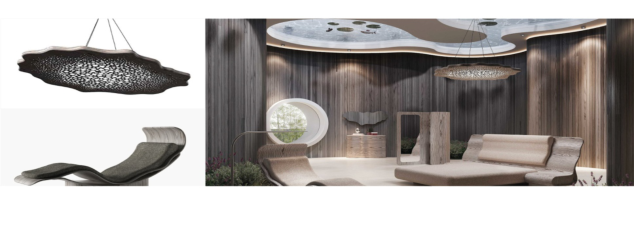
This Project, developed in collaboration with the Italian company Natuzzi, was exhibited at Milan design week in 2019, and ‘Ergo’ also won the Red Dot Award in the same year. This collaboration sought to focus on sustainability in the area of furniture.
They used wood from Forest Stewardship Council certified plantations, and fitting methods were used to avoid metallic fastenings. The adhesives used were based on water and insect formaldehyde, due to the highly toxic characteristic of traditional adhesives; in addition, the surfaces were fini- shed with natural wax. Note also the use of organic fabrics (wool, linen and
Inspirations for More Sustainable Practices in Design 45
Figure 1: Project Ergo – images set (autors).
cotton) for the production of upholstery; 100% natural latex is also used to produce the mattress for the bed, and hemp fiber as a lining. The flowing shapes of the Ergo collection are intended to evoke shapes found in nature which, in the case of the chaise longue in particular, have been adapted to fit the contours of the human body. This character evidenced the presence of ergonomics, not only in the title of the Project, but also in a practical way.
Identified attributes: Aesthetic durability, considering the neutral and time- less aspect of the pieces in the collection. Simplicity and minimalism were also identified, since they are pieces that contain few parts, however, some pieces can be considered difficult to replace, such as the back of the bed, for exam- ple, since it appears to be a continuous wooden sheet. We identified logic and functionality, bearing in mind the coherence between forms and functi- ons, mainly due to the ergonomic appeal, which favors intuitive use. The use of natural shapes and materials are perhaps the most evident aspects, bearing in mind the careful process of selection and application of materials; and the visual aspect that is evident through the use of the sinuous forms of nature to translate the human anatomy, in the outline of the black chandelier, also being evident through the work on the surfaces of the collection, which present a natural wooden aesthetic. The aspect of Individuality and diversity are nota- ble, bearing in mind the universal characteristic of the pieces, the chaise and the bed, for example, can reach a wide range of people, of different physical and cultural types.
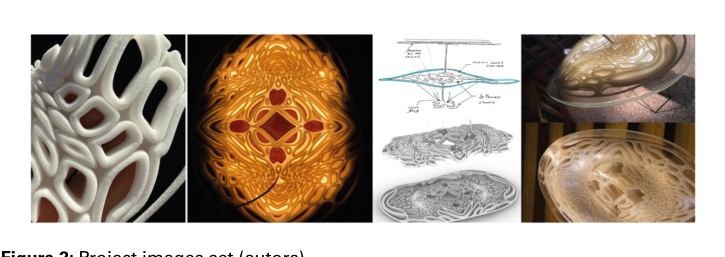
PROJECT: HORIZON - ARTURO TEDESCHI (2013) HorizON is a suspended lamp for architectural interior decoration, mixes high and low technology, featuring 3D printing and Murano glass craftsman- ship, algorithmic design and LED technology. This Project is based on the belief that the industry in the coming years will not only evolve through a constant technological update of products, but also by reconsidering and reintegrating values such as uniqueness, manual manufacturing and even “imperfection”.
The main Idea is to encapsulate a free-form 3D-printed form within a shel- ter of handcrafted glass manufactured in Murano, the legendary Center of Italian glassmaking for over 700 years. To create the two sinuous surfaces, Glass Master hand-shapes the glass based on CNC-milled molds. After the
Figure 2: Project images set (autors).
glass has reached the required shape, it sits in a tempering oven for a day where it cools slowly to prevent any cracking. Once the glass is cold, it is polished to remove any excess material and finally pierced with diamond points.
Identified attributes: Aesthetic durability was identified in the project, perhaps not because of the neutral aspect, but mainly because it represents luxury, beauty and uniqueness, which encourages care and longevity on the part of the consumer. Modular and upgradable aesthetics were neglected as the project seeks to value classic molding techniques and seeks to achieve exclusivity. The logic and functionality were identified in the function of the luminaire that not only illuminates, but causes the user to be immersed in the environment, who appreciates its form as a work of art. In the aspect of natural forms and materials, it is considered that there was the use of orga- nic forms, but no natural references were pointed out, while the use of glass, one can represent the use of renewable materials, but apparently the pieces in Murano glass depart from of virgin processes. The aspect of local aesthetics and cultural identity can also be highlighted; mainly due to the tradition that Murano glass represents, and the promotion of social development, through tourism, for example, that Murano production attracts to Venice.
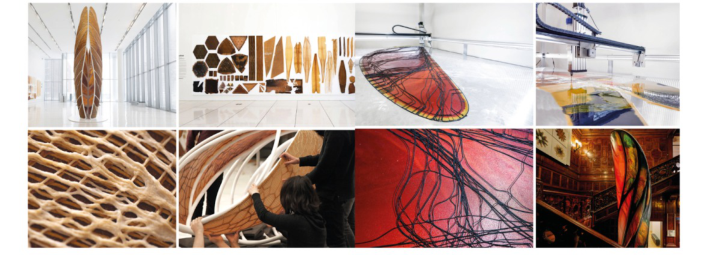
PROJECT: AGUAHOJA - NERI OXMAN In this project, a water-based fabrication platform was developed to build chitosan structures. This iniciative is positioned as an alternative to address the high rate of plastic disposal, with more than 300 million tons produced globally each year, according to the United Nations Environmental Program (UNEP). Less than 10% of this material is recycled, while the rest becomes waste, being disposed of in landfills and oceans.
To make this Project possible, a robotic platform for 3D printing of biomaterials was developed. In ‘Aguahoja’ they show that the shape and composition of the material can be directly informed by physical properties (stiffness and opacity), environmental conditions (load, temperature and rela- tive humidity) and manufacturing constraints (degrees of freedom, arm speed and nozzle pressure).
In this way, the architectural pavilion Aguahoja I was developed, composed of the most abundant biopolymers on the planet. 5,740 fallen leaves, 6,500
Inspirations for More Sustainable Practices in Design 47
Figure 3: Project images set (autors).
apple peels and 3,135 shrimp peels were used. The layered structure, known as a biocomposite, is designed as a hierarchical network of patterns optimi- zed for structural stability, flexibility and visual connectivity. Each structure in the collection contains a unique combination of organic materials whose allocation, texture and distribution within the final object are computati- onally driven and additively fabricated in high resolution. This allows for control over specific physical properties and environmental adaptation to changing weather conditions.
This Project points to a future where the industrial cycle of overproduction and obsolescence is subverted through the use of abundant natural materi- als. This Project envisages the ability to temporarily divert materials from healthy ecosystems, integrate them into human projects and allow them to decompose in nature. In this proposition between design and digital fabri- cation with biopolymers, the protection and strengthening of ecosystems is encouraged, highlighting a new frontier between design and production.
Identified attributes: In this project, we can find the aesthetic durability evidenced by the elegance and use of neutral colors that are part of the mate- rial used. The modular and updatable aesthetic is also present, in this project each part of the can be reprinted separately, even its parts can be reproces- sed to become something new. Simplicity and minimalism are also present, in the repetition of the structure’s forms and in the fact that a single piece is capable of performing several functions according to the density of the mate- rial applied in its construction, this quality also encompasses another aspect that is the Logic and Functionality. Natural forms are present throughout the project, which is strongly inspired by the foliage of plants and their vari- ous functions, as well as the material used is a composer of various natural elements that would otherwise be discarded were re-signified from the role of polluters to raw material. The local and cultural identity can be a little more complicated to identify, but the molded structures can refer to foliage found in few parts of the globe, bringing recognition to those who live in their surroundings.
CONCLUSION
It can be concluded from the aspects found in the designers’ projects, that the bioinspired creation process together with digital manufacturing are closely
aligned with sustainability, where other forms of manufacturing or design would not allow the goals to be achieved.
The aesthetic durability found in the 3 artifacts, for example, was made possible by the digital creation of bioinspired neutral forms. The natural forms, which refer to organicity, is also an aspect found in the three cases, clearly inspired by biology and which contribute to the elegant and neutral aesthetic durability, this quality can also be achieved due to the coloring of their materials.
Another element also found in the three cases is logic and functionality, because as design products, they are designed to meet a demand that they need to meet and thus solve problems, in this case, once again, bioinspiration plays a very important role in the conceptions of these parts.
Another aspect common to the three cases was the local aesthetics and cultural identity, as the three seek to solve local problems or exalt the existing culture, bioinspiration is seen as a facilitator of obtaining this aspect.
The objective of the three cases is achieved due to the capacity of digital fabrication technologies, where without these tools it would be very difficult or even impossible to obtain the results achieved.
REFERENCES
Allwood, J. M., Ashby, M. F., Gutowski, T. and Worrell, E. 2011. “Material Efficiency: A White Paper.” Resources, Conservation and Recycling (55:3), pp. 362–381. Babaee, S., Pajovic, S., and Rafsanjani, A. et al. Bioinspired kirigami metasurfaces as
assistive shoe grips. Nat Biomed Eng 4, 778–786 (2020). https://doi.org/10.1038/ s41551-020-0564-3 Benyus, Janine M. (1997). Biomimética: Inovação inspirada pela natureza. 6a ed. São Paulo: Ed. Pensamento- Cultrix. Christodoulou, Marilena. (2020). The History of Parametric Design and Its Appli-
cations in Footwear Design. Conference: ICDHDS. Du Plessis, Anton. (2019). Beautiful and Functional: A Review of Biomimetic Design in Additive Manufacturing. Additive Manufacturing. https://doi.org/10.1016/j.ad dma.2019.03.033 Eastman, C., Eastman, C. M., Teicholz, P. et al. (2011). BIM Handbook: A Guide
to Building Information Modeling for Owner, Manager, Designer, Engineers and Contractors (p. 243). Hoboken, NJ: John Wiley & Sons. Hassenzahl, Marc. (2010). Experience Design: Technology for All the Right Reasons.
10.2200/S00261ED1V01Y201003HCI008. Kellens, Karel et al. (2017). Environmental Impact of Additive Manufacturing Processes: Does AM Contribute to a More Sustainable Way of Part Manufacturing? Procedia CIRP 61 ( 2017) 582–587. Manzini, Ezio., Vezzoli, Carlo. (2016). O desenvolvimento de produtos sustentáveis:
os requisitos ambientais dos produtos industriais. 4 ed. São Paulo: Edusp, 2016. McDonough, W., Braungart, M. 2001. “The next industrial revolution.” Sustainable solutions: Developing products and services for the future, edited by Charter, M. and Tischner, U. Sheffield, England: Greenleaf Publishing, pp. 139–150. Oxman, Neri. (2010). Material-based design computation. Romcy, Neliza. (2017). Abordagem paramétrica e ensino de projeto: proposição
de diretrizes metodológicas, considerando estratégias curriculares e o ateliê de projeto. Tese de doutorado.
Inspirations for More Sustainable Practices in Design 49
Tav¸san, Filiz., Sonmez, Elif. (2015). Biomimicry in Furniture Design. Procedia - Social and Behavioral Sciences. 197. 2285–2292. 10.1016/j.sbspro.2015.07.255. Volstad, N. L., Boks, C.. (2008). Biomimicry - A useful tool for the industrial desi-
gner? Shedding light on nature as a source of inspiration in industrial design. Proceedings of NordDesign 2008 Conference. 275–284. Zhou, Ziyu., Rognoli, Valentina. (2019). Material Education in Design: From Literature Review to Rethinking. doi: 10.21606/learnxdesign.2019.17078.
LISTED IN THE AHFE DIGITAL BOOKSTORE CATALOGUE
Explore the complete digital volume
Ergonomics In Design
Read this individual research paper free through the original publisher, or explore the full digital proceedings book.
ISBN 978-1-958651-53-7
Explore this ISBN in the AHFE Bookstore ↗Listed in the July 2026 bookstore catalogue; search by ISBN to confirm current availability · Digital book purchase optional