Xinyang Hu, Xingyu Zha, Haoyang Liu, Mengyao Wang, Anni Zha (2025). Parametric generation based graphic design and spatial expression research. In: Human Factors in Design, Engineering, and Computing. AHFE Open Access, vol. 199, pp. 40–51. https://doi.org/10.54941/ahfe1006816
Parametric design is nowadays a development hotspot in the field of design and graphic computing design. However, due to its existence need to have a little mathematical theory foundation and computer graphics software design foundation threshold exists, affecting designers and other enthusiasts on the threshold as well as the cost of learning, in the Internet platform media can be called and learn relatively few reference materials; (2) Methods: In this paper, we construct a complete set of development tool prototypes that can be adjusted and modified in any part of the complete traceable process from graphic design to spatial structural expression; (3) Results: This study explores the role of parametric design tool prototypes in the workflow and refines the strengths and weaknesses of parametric design in the past, and summarizes the framework of the study on the production of graphic to spatial production workflow using parametric design de-velopment prototypes; (4) Conclusions: It also summarizes a research framework for de-veloping prototypes for graphic to spatial production using parametric design, providing design case studies and design methodology support for design tool innovation in the context of emerging technologies.
Under the wave of Industry 4.0, traditional production models struggle to adapt to evolving demands (Dandan et al., 2024). Parametric design and interaction, grounded in mathematical principles, have emerged as frontiers for exploring the intersection of visual arts and structural design. Originating from geometric design, parametric design transforms design elements into controllable parameters and establishes logical relationships between them, enabling the real-time optimization of solutions (Fang, 2016). As a computer- aided technology based on topological concepts, it represents an evolution of CAD. During the mid-to-late 20th century, parametric technology was mainly applied in complex systems engineering within aerospace and shipbuilding industries (Chiliang, 2014). As indicated in Table 1, the volume of published research papers on parametric design has shown an upward trend over the past five years, reflecting its establishment as a key focus for practice within the design discipline and a stable domain of academic output.
Parametric Generation Based Graphic Design and Spatial Expression Research 41
Table 1: Research on the growth rate of parametric designbased publications over the past five year.
Table available in the original PDF paper.
Year Growth Rate of Parametric Design Publications (%) 2019 Baseline(100%) 2020 0.15 2021 0.28 2022 0.42 2023 0.61 2024 0.85
Research on the Growth Rate of Parametric Design-Based Publications over the Past Five Years. The data in Table 1 shows a year-on-year increase from the 2019 baseline, with growth rates of 0.15, 0.13, 0.14, 0.19, and 0.24, respectively. Analysis of the data reveals an overall upward trend in the volume of parametric design-related publications, reflecting the technology’s emergence as a focal point in design discipline practice and its role in sustaining relatively stable academic output. From the perspective of design products, the category of design includes two types. One is the material product, the other is the immaterial design (Yanzu and Fuya, 2011). This study examines three distinct design approaches—traditional craftsmanship, artificial intelligence-driven techniques, and parametric design technology— and summarizes their characteristics across six dimensions, as presented in Table 2.
Table 2: Comparison of current design workflows.
Table available in the original PDF paper.
Traditional Craftsmanship
AI Technology Parametric Design Technology
Design Approach Relies on artisan experience and manual operation
Generates numerous solutions via machine learning
Parametric design software
Produces concrete forms through algorithmic parameter adjustment Design Tools Hand tools Deep learning frameworks with AIGC tools Production Efficiency
Weeks to years per piece
Minute-level solution generation
Hours-level form iteration Current Applications
AI-generated content
Art customization, intangible cultural heritage preservation
Customizability, traceability, efficiency, flexibility Continued
Table 2: Continued Traditional Craftsmanship
Table available in the original PDF paper.
AI Technology Parametric Design Technology
Existing Challenges Lengthy
High complexity in rule-setting, steep technical barriers
production cycles, standardization difficulties, inability to meet mass demand
High data dependency, lack of emotional expression, absence of cultural concepts in generative AI
The product design innovation method based on parametric design thinking makes up for the deficiencies of designers in traditional design methods, thereby enabling the design of more divergent and feasible optimization schemes (XiKun et al., 2023). This study aims to explore the geometric composition of patterns through parametric design, offering innovative perspectives for motif development while revealing cultural core drivers. To validate the sustainability of this design philosophy, the research employs a three-dimensional analytical framework—comprising data analysis, parametric path reconstruction, questionnaire surveys and analysis, and output diversity—for comparative testing to verify the accuracy of design outcomes.
RELATED WORK
In the early 1990s, pioneering architectural institutions and design teams began exploring parametric design, exemplified by practices such as Foreign Office Architects (FOA) in the Netherlands, the Architectural Association (AA) in the UK, and architects including Greg Lynn, Frank Gehry, and Zaha Hadid. China’s adoption of parametric technology commenced later, though academic institutions—notably Tsinghua University, Tongji University, and South China University of Technology—spearheaded its domestic development. In professional practice, Beijing-based MAD Architects, led by Ma Yansong, produced signature works including the Absolute Towers (Mississauga, Canada), Ordos Museum, Harbin Opera House, and Haikou Cloudscape Library.
The involvement of parametric techniques in the design process and the development of “parametric design” took place in the field of architectural design (Liuzhuang, 2016). Over time, parametric design has transitioned beyond being a subject of debate and controversy, permeating diverse realms of artistic design. Although the technology holds potential for elevating recognition of cultural products, it has yet to foster public engagement with design and cultural narratives. Developing experience-centric solutions with enhanced visual language and enriched cultural depth has thus emerged as a critical industry focus.
Parametric Generation Based Graphic Design and Spatial Expression Research 43
METHODOLOGY
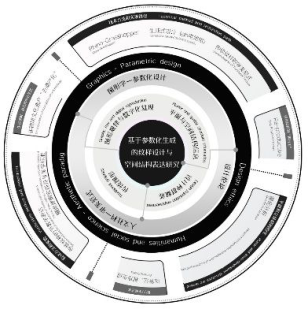
Research Methodology This study highlights parametric tools (e.g., Touch Designer, Grasshopper, Blender) using node-based modules for efficient data flow. Open- source ecosystems enhance accessibility, supporting data-intensive research and iterative workflows. While parametric design streamlines pattern transformation, current applications focus primarily on product design, with limited 2D-to-3D conversion. Consequently, this research integrates social sciences with parametric methodologies to develop a cross-disciplinary theoretical framework (Figure 1) addressing:
Figure 1: Theoretical framework and blueprint for parametric design.
1. Technical: Grasshopper-based 2D/3D conversion; 2. Cognitive: Semiotic and aesthetic dimensions; 3. Generative: Kinetic-algorithmic synthesis. 4. Assess prototype system usability through interdisciplinary synthesis to advance media integration and design expression.
Table 3: Schematic diagram of the study route.
Table available in the original PDF paper.
Stage Focus Methodology Software Difficulty Test Questionnaire Research on Pain Points Difficulties in expanding the use of tools and parametric tools to enhance design expression in pattern design and spatial design
Prototype control
Prototyping based on parametric design cases
Comparison of visual tension and richness of detail with content produced by conventional design tool techniques
Continued
Table 3: Continued Stage Focus Methodology
Table available in the original PDF paper.
Comparative assessment
Prototype evaluation Mapping in terms of resolution, fineness, degree of model conformity to expectations, aesthetics and semiotics User research Summarizing and concluding Feasibility and summarizing the direction of future modifications through consultation
Data and Methodology This parametric design study engages four domains using Grasshopper- generated Penrose tessellation components. The system employs two primary shapes—kites (1: ϕ) and darts (ϕ: 1)—adhering to the golden ratio (ϕ≈1.618) with strict rotation rules (e.g., 36
/72
).
Algorithmic Workflow:
1. Decomposition: Recursive subdivision of base shapes (e.g., rhombi) into kites/darts. 2. Scaling: ϕ-based iterative refinement of sub-patterns. 3. Alignment: Edge-matching constraints enforcing aperiodicity.
Grasshopper Implementation:
1. Formula input via Expression components for parametric scaling. 2. Recursive subdivision using Anemone plugin: golden ratio (ϕ) scaling/rotation per iteration. 3. Vector/Transform components for tile orientation (e.g., 36
rotation via Transform Rotation).
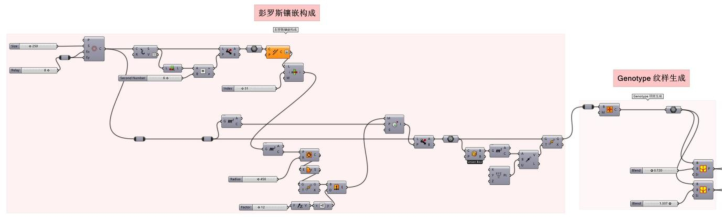
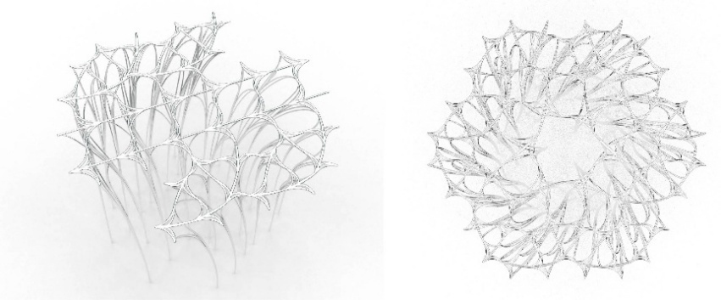
A hexagonal centroid-diffusion framework generated 12 parametric texture styles (Figure 2), enabling spatial-image comparisons through parametric spatial composition.
Figure 2: Parametric toolset prototype and math toolset demonstration.
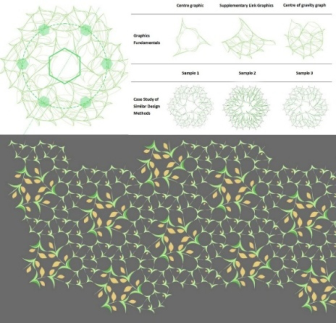
Building on this, researchers established tiling relationships between supplementary images and a central centroid image to generate patterns,
Parametric Generation Based Graphic Design and Spatial Expression Research 45
Figure 3: Schematic based on multiparty continuous and combinatorial graphical relationships and Schematic of a case with irregular tiling.
Adjusting connector thickness, height parameters, and node count enables rapid development of:
1. Spatial visualization products; 2. 3D deconstructive rendering of planar patterns; 3. Parametric stylization for digital media/games.
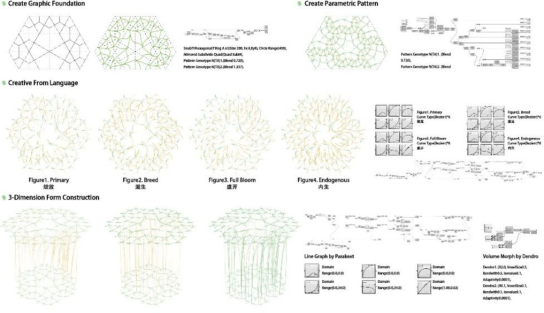
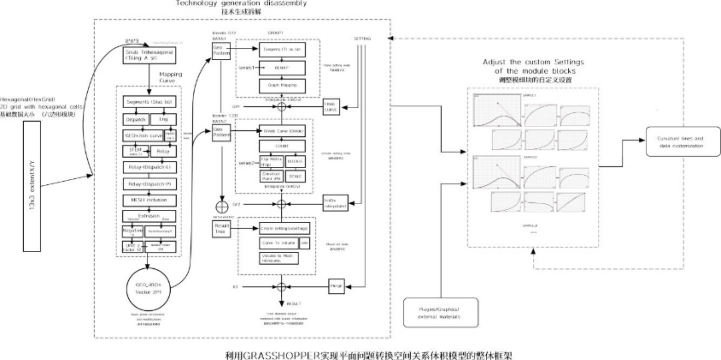
The study establishes a fully traceable workflow where data adjustments instantly modify models. Genotype principles automate complex designs through dataflow-driven logic, establishing a workflow: planar framework →continuous assembly →parametric linking →spatial modelling (Figure 4). Precisely controlling curve radii through function-parameter relationships materializes 2D graphics into 3D spatial forms with volumetric attributes (Figure 5).
Figure 4: Decomposition diagram based on parametric prototyping tools.Figure 5: Results map of design outputs based on parametric prototyping tools.
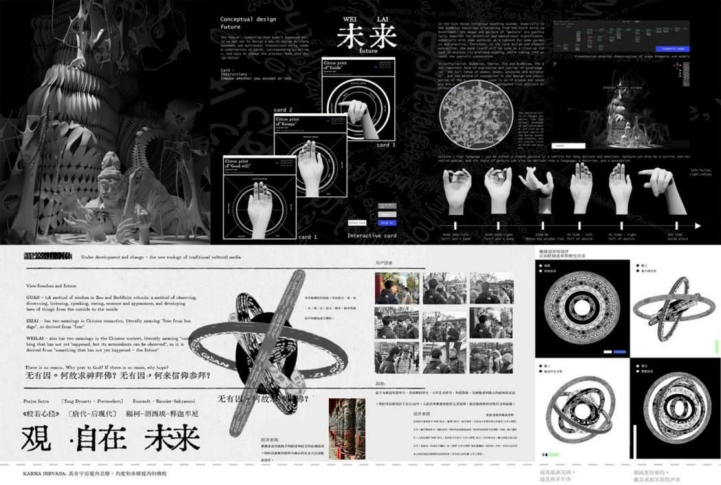
Data Conclusions To assess prototype usability and visual perception, this study conducted an in-person survey and one-day exhibition with undergraduate design students. Fifty participants from Product/Industrial Design backgrounds were divided into five groups (three to four members each). Each group developed distinct thematic patterns/models for presentation (Figure 6).
Figure 6: Schematic diagram of user testing of the prototype system.
Prior to the project, we trained the control group participants in the use of parametric prototyping to generate patterns and models, including:
1. How to configure and deploy the operating environment for parametric design tools and software.
Parametric Generation Based Graphic Design and Spatial Expression Research 47
2. How to use the above parameterized module prototype to test the generation effect. 3. How to collect new data and adjust the data to optimize the model. 4. Summarize the limitations of prototyping tools.
Summarizing the limitations of the prototyping tool, after the above training, the students collected the datasets from their groups, retrained the AI prototypes, and finally selected the outputs that were suitable for processing to be presented as the results for comparison with the hand-drawn graph-transformation modeling group. During this process, the authors of this paper will be involved in answering questions that arise when using the prototyping tool but will not be involved or interfere in the production of the final work. To explore the advantages and disadvantages of utilizing efficiency and production in relation to traditional design and drawing, visitors were invited to fill out a questionnaire (24 valid questionnaires were received).
Table 4: Statistical data on the time spent by each control group in different sessions.
Table available in the original PDF paper.
Model Building
Model Optimization
Model Rendering
Convert CAD to Vector Drawing
Average Time Spent on Pre-Pattern sketches(Unit: Minutes) 45mins 10mis 92mins 12mins 44mins Traditional workflow
16mins 2mins 118mins 24mins external renderer
Parametric Design Prototyping Group
Prototype Limitations Thirty design experts meeting two criteria—professional training and modelling tool experience—assessed workflow plausibility using 5-point Likert scales across four dimensions: colour, form, detail, and production rationality (higher scores indicating better quality). As summarized in Table 5, the method generates relatively efficient design sequences.
Table 5: When examining the workflow steps, what factors made the evaluator feel that there were problems?
Table available in the original PDF paper.
Options Distribution Documentation and toolkit need to be improved 9/37.5% Toolkit titles and content visualization need to be improved 11/45.8% Content richness needs to be improved 18/75% A little difficult to get started 14/58.3% The type is prone to bugs and errors 6/25%
RESULTS AND ANALYSIS Prototype Development and Design Outputs
Graphic design represents an established, self-contained visual system (Wei, 2022). To advance knowledge in this field, qualitative methods were employed to examine designers’ cognitive processes through two phases (Table 6): mathematical deconstruction of drawing principles, and interdisciplinary development of parametric tools.
Table 6: When examining the workflow steps, what factors made the evaluator feel that there were problems?
Table available in the original PDF paper.
Design Dimension Genotype Design Penrose Mosaic Core value Data flow control and parameterized logic reuse
Nonperiodic aesthetics and mathematical algorithm generation Applicable scenarios Structural optimization, modular design, dynamically tuned data flow control and parametric logic reuse Tool support Anemone, Lunchbox, Path Mapper
Unification of performance optimization and aesthetic expression for acyclic structures
Customized scripts, golden ratio calculations, rotation matrices Strengths combined case Dynamic parameterization and mass production adaptation of Penrose patterns
Developing beginner-oriented parametric tools requires understanding both technical characteristics and learning challenges. Through literature review and expert interviews, we identified two core aspects. The technical foundation includes, Hierarchical dataflow control via tree structures; Real-time parametric adjustments (e.g., Number Slider); Modular logic encapsulation (Clusters); Plugin integration (Anemone/Lunchbox); Automated solution filtering (Cull Pattern/Dispatch); Computational optimization (Flatten/Proximity 3D); Shape: Sequential scaling of similar forms; Colour: Contextual relationship adjustments; Composition: Centre- to-periphery sequencing; Hierarchy: Primary elements before details; Aperiodic patterns: Mathematical textures for decorative applications; Proportional systems: ϕ-based recursive division.
The principles outlined above may present potential conflicts, with no single principle holding absolute priority. To identify the primary challenges faced by beginners learning parametric design component creation, we conducted semi-structured interviews with ten novice users. Analysis of the interview findings revealed the main difficulties encountered when learning this tool for designing graphics and transforming spatial expressions. It includes Inaccurate shape data adjustment (45%); Inconsistent colour palette (32%); Difficulty in grasping specific functions of functional groups (52%);
Parametric Generation Based Graphic Design and Spatial Expression Research 49
Graph transformation spatial expression is prone to bugs but complex to adjust and debug (19.6%).
Figure 7: An overall framework for transforming spatially relative volume models for planar problems using grasshopper.
Comparative Questionnaire Results Analysis To evaluate the usefulness and potential issues of parameter generation for beginners, we invited 10 novice designers to use our prototype system for design support. Semi-structured interviews were then conducted. When asked about the usefulness of parametric design steps for learning, 80% of beginners found them helpful. When asked about missing information in parametric drawing steps, beginners highlighted three main issues:
1. Unclear modification beyond templates, requiring more mathematical knowledge and software proficiency; 2. Insufficient guidance on modeling principles and fine-tuning model transformations; 3. Excessively high drawing detail requirements, though potentially directly related to traditional graphic conceptualization and planar design.
Analysis and Evaluation Building on prior research and leveraging a comprehensive battery toolset, the combined advantages of Genotype and Penrose tessellation yield the following insights:
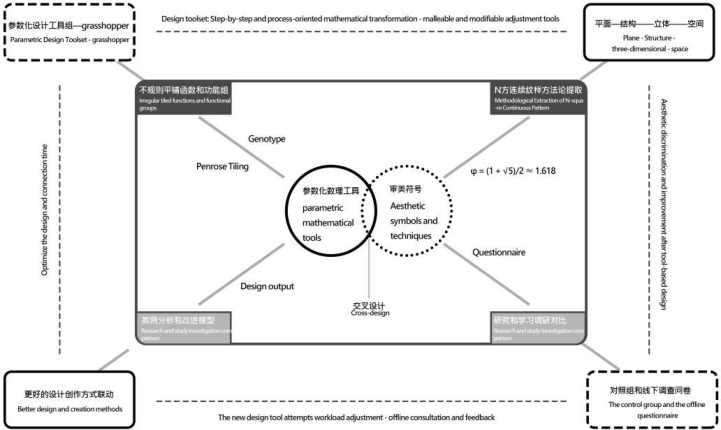
The application of digital technology in the field of cultural heritage protection is becoming increasingly in-depth. It provides channels for sharing, dialogue, cooperation and collective action to achieve social transformation (Fei, 2025). Responses to digital skill development should prioritize human- centred approaches (Xiaojuan & Yuanyuan, 2024). Consequently, we developed an applied research framework to facilitate the transition from 2D patterns to 3D spatial conversion through parametric generation (Figure 8).
Section 3 details a Grasshopper-based arithmetic tool employing mathematical foundations to drive aesthetically inspired designs, enhancing detail and visual tension. Questionnaire and field studies revealed that while users found the parametric process novel and exciting, they preferred more interactive formats and richer feature sets. Section 4 evaluates prototypes via case studies and functional component simplification. User experiments confirmed the tool’s usability with clear classification and traceability methods, yet interviews indicated demands for enhanced guidance post- beginner stage.
Figure 8: Parametric design and aesthetic symbolism research framework diagram.
CONCLUSION
In the ever-changing world of globalization, culture is constantly evolving (Drache and Froese, 2006). Enriching design expression through emerging technologies and methodologies is a universal cultural challenge. Parametrically generated patterns and spatial design are evolving from technical tools into cross-disciplinary innovation paradigms (Jincheng, 2014). Their core strength lies in transcending static boundaries of traditional design, achieving dynamic equilibrium among form, function, and culture
Parametric Generation Based Graphic Design and Spatial Expression Research 51
through algorithmic logic (Yan and Zhuo, 2019). As intelligent technologies and sustainability principles advance, parametric design will deepen dialogues between art/engineering and tradition/innovation, redefining design’s essence—from “creating forms” to “organizing systems.”
This study explores parametric technology’s potential in expanding technical boundaries and visual expression through pattern design. We analyzed challenges in prototyping and learning processes, validating advantages through participatory experiences. Interviews and analysis identified optimizable areas for intelligent tools in enhancing design efficiency and expressiveness, leading to actionable recommendations. Finally, we proposed a parametric design experience framework leveraging mathematical toolkits. This research provides tools, methodologies, and theoretical references for future design and cultural studies.
REFERENCES
Drache D, Froese M D. (2006). Globalization, world trade and the cultural commons: Identity, citizenship and pluralism, 11(3): 361–382. Fang Xiaojuan, Chen Yuanyuan. (2024). Research on the Policy and Regulatory
System of Data Governance in the European Union [J]. Digital Library Forum, 20(06): 1–11. Jing Wei. (2022). Research on Digital Visual Design Reconstruction and Application of Dunhuang Murals [D]. Xi ’an Academy of Fine Arts. Li Jincheng. (2014). Interdisciplinary Parametric Graphic Design Analysis [J].
Packaging Engineering, 35(02): 126–130. Li Xikun, Yu Shishi, Jing Jianxiong, et al. (2023). Review of the Domestic Application of Grasshopper Parametric Design Method Based on Bibliometric Method [J] Packaging Engineering, 44(S1): 34–41. Li Yanzu, Zhang Fuya. (2011). A Brief History of Design in China and Abroad.
(1st ed., pp.12). China Youth Publishing House. Ma, Chi-Liang. (2014). A Convergent Study on the Development and Application of Parametric Design in Architecture, Zhejiang University, China. Sun Fei. (2025). Deepening Reform to Promote Cultural Prosperity, Innovation and
Openness to Stimulate Cultural Vitality [N] Xinhua Daily Telegraph, May 29. Tian Fang. (2016). Research on the Development and Application of Parametric Design in Architecture [J]. Sichuan Building Materials, 42(02): 93–95. Wang Liuzhuang. (2016). Exploring the impact of parametric technology on product
design. Packaging Engineering, 37(16): 10–13. Wang Yan, Li Zhuo. (2019). Research on Data Logic Thinking Based on Parametric Design [J]. Design, 32(15): 65–67. Zhang Dandan, Sun Baoqiang, Zhang Xinyu, et al. (2024). Application of parametric
design in industrial economic development in the context of Industry 4.0. Modern industrial economy and informatization, 14(01):159–160+164.
LISTED IN THE AHFE DIGITAL BOOKSTORE CATALOGUE
Explore the complete digital volume
Human Factors in Design, Engineering, and Computing
Read this individual research paper free through the original publisher, or explore the full digital proceedings book.
ISBN 978-1-964867-75-5
Explore this ISBN in the AHFE Bookstore ↗Listed in the July 2026 bookstore catalogue; search by ISBN to confirm current availability · Digital book purchase optional