The rapid development of artificial intelligence generated content (AIGC) technologies (such as ChatGPT, Midjourney, and Sora) has profoundly changed design practice by facilitating creativity and efficiency. As a structured design framework, the Double Diamond still plays an important role in the design process. As AI technologies continue to develop, the Double Diamond can integrate the AI technology to better meet the needs of the current design process. This paper proposes an innovative AIGC-enhanced Double Diamond that integrates AI tools (such as ChatGPT for idea generation, Midjourney/Sora for visualization, Wix ADI/Photoshop/Illustrator for prototyping, and Figma for delivery) with traditional and emerging design tools. We used a mental health application as a hypothetical scenario to assess the feasibility, flexibility, and inclusiveness of the framework in the four stages of Discover, Define, Develop, and Delivery. This paper aims to contribute to design theory and practice by extending the research of the Double Diamond framework and providing practical insights for human-IA collaboration design in UI design.
In recent years, the rise of artificial intelligence generated content (AIGC) technology has been profoundly reshaping the global design field. Tools such as ChatGPT can generate design inspiration through natural language processing, while Midjourney and Sora provide creative support by generating images and videos. AIGC has shown great potential in a wide range of fields, such as product design, user experience (UX), and sustainable design (Hsiao and Tang, 2024). For example, the intelligent fashion design framework based on generative adversarial networks (GAN) proposed by (Yan et al., 2022) achieved the coordinated optimization of controllability and randomness in the design process through staged sketch generation and texture rendering modules, significantly improving design efficiency and diversity. Saidani et al. (2021) have also used algorithms to obtain and analyze online product reviews, and then mined needs from user feedback to optimize product functions. This technological breakthrough is due to the advancement of deep learning algorithms such as GAN, which enables designers to quickly analyze data, extract inspiration from massive data,
and generate diverse design solutions. In addition, the Double Diamond, as a classic framework, has been playing a role as a design guidance framework in different design processes, including user interface design, through its four stages: Discover, Define, Develop, and Deliver, and its characteristics of balancing divergent and convergent thinking. The model originally provided a structured path for solving complex design problems, especially in product and service design, such as interaction design, product design, and service design. Global design trends show that the integration of technological innovation and structured methodology is driving the transformation of design practice (Buchanan, 2019, Norman and Verganti, 2014), and also provides new possibilities for responding to design needs in different scenarios, such as mental health design scenarios. However, with the popularization of AI technology, the static framework of the traditional Double Diamond has gradually shown its limitations and urgently needs to be combined with new design tools. For example, it needs to be combined with new technologies with dynamic characteristics, such as AIGC, to adapt to modern design challenges. In addition, mental health applications are a key application scenario in the design field, but due to their relatively complex design process and the need to consider the psychological changes of users more (Peters et al., 2018), their design process is somewhat different from traditional design, highlighting the limitations of traditional methodology (Bennett and Rosner, 2019). Although the Double Diamond performs well in structured design, its adaptability is challenged in the face of rapidly changing technological environments and complex user needs (Khan et al., 2025). This raises research questions for the application of AIGC technology in the Double Diamond. How can AIGC enhance the four stages of the model to address the challenges of emotional resonance and user engagement in the user interface (UI) design of mental health applications? This issue is not only about improving design efficiency, but also about the social impact of technology, especially how interaction design in mental health can better interact with users and provide a more user-friendly experience.
The primary goal of this study is to explore how AIGC specifically enhances the four stages of the Double Diamond through the design process of a mental health application UI case, focusing on improving emotional resonance and user engagement. To achieve this goal, the study adopted a scenario-based conceptual simulation approach, which constructs a hypothetical but realistic design scenario that replicates the real-world design process, allowing theoretical exploration of the feasibility of the approach without directly intervening in the real user environment (Gaba, 2004). The study will evaluate ChatGPT’s creative generation capabilities in the Discover stage (such as proposing mood tracking, guided meditation, and diary functions to meet different mental health needs). It also assesses Midjourney and Sora’s visual synthesis effects in the Define stage (such as generating soothing tones based on natural themes and adjusting design elements in combination with user feedback), Wix ADI combined with Photoshop/Illustrator’s rapid prototyping efficiency in the Develop stage (optimizing user interface consistency through automated layout and custom icons), and Figma’s usability and accessibility testing effects in the Deliver
Human–AI Co–Creation in Design Through AIGC Integration 155
stage (ensuring user-friendly access experience through iterative testing). In addition, this study will also propose future research directions, including the deep integration of AIGC and design theory to promote the development of human-machine collaborative design. This study not only aims to verify the feasibility, flexibility, and inclusiveness of the AIGC-enhanced Double Diamond. It is also hoped that it can provide theoretical support and tool guidance for the practice of UI design.
LITERATURE REVIEW
This section reviewed the application of AIGC in the field of design, the traditional application of the Double Diamond and its limitations, and explored how AIGC can enhance the model to optimize the design process. Studies have shown that AIGC has great potential in design inspiration acquisition, creation assistance, intelligent optimization, and feedback evaluation, which not only improves design efficiency but also promotes the development of human-machine collaboration. At the same time, as a design framework, the Double Diamond has been widely used in product, game, service, and interaction design. However, its linear structure has certain limitations when dealing with complex design problems. With the advent of the AI era, the intervention of AIGC has brought new changes to the Double Diamond, such as using generative AI to deeply explore user needs, accelerate solution generation and iteration, and optimize user experience design.
Application of AIGC in Design The design field has gradually paid more attention to the application of AIGC, especially in different stages of the design process, such as inspiration acquisition, design creation, intelligent suggestions, and feedback optimization (Wu et al., 2024).
In the early inspiration or acquisition stage of design, for the traditional methods, designers need to find inspiration from different relevant channels, such as books, design cases, websites, and brainstorming forms. However, due to the birth of AIGC in recent years, such as ChatGPT, Midjourney and sora, designers can get a lot of design inspiration through conversations and prompts with AI. These platforms help designers break the traditional design process, design thinking and stimulating innovation. In addition, AIGC can also mine user needs from text data such as online reviews, articles and patents through natural language processing technology. Saidani et al. (2021) constructed a mapping model between product attributes and consumer emotions through sentiment analysis, helping designers to extract user needs from a large amount of data and optimize product design. In summary, these results show that AIGC is changing the traditional design process and design production methods.
In the design creation stage, AIGC is particularly widely used, especially in the automatic generation of large numbers of design images and mass production. AIGC can be used not only as a generation tool, but also as an assistant to designers for human-machine collaboration. For example, Yang et al. (2021) have used generative adversarial networks (GANs) to
generate icon designs that conform to a specific style, significantly improving design efficiency. In addition, Wu et al. (2023) have developed a clothing design system called StyleMe, which generates preliminary sketches based on the style selected by the designer, and the designer then fine-tunes and finally generates real clothing images.
In the design creation optimization stage, AIGC can also be seen as an “intelligent assistant”, providing designers with style suggestions and optimization ideas. For example, Feng et al. (2021) have developed an automatic color-matching system based on deep learning that can generate suitable color schemes based on different input themes. In addition, large language models (LLMs) such as Stable Difusion could also provide designers with inspiration and communication, and optimization suggestion throughout the collaborative design (Verheijden and Funk, 2023), generate phased task lists or method suggestions (Nah et al., 2023), and even optimize the workflow of user experience design. Immersive technologies such as virtual reality (VR) have also shown strong potential in enhancing simulation-based learning in healthcare, particularly when integrated with user-centered approaches like design thinking (Zhang et al., 2024). Zhou et al. (2024) through empirical research, have found that LLM could provide optimization ideas (such as user portrait generation and prototype feedback) in UX design. However, its output still needs to be verified and adjusted by designers, reflecting the balance of “human-led and AI-assisted” in human-machine collaboration.
In the design evaluation and feedback stage, the application of AIGC also has shown great potential. AIGC can detect similar content in the design through deep learning models to prevent plagiarism. For example, Liu et al. (2023) have proposed a GAN-based visual saliency feature extraction network that could capture the global semantic information of graphic design and detect and evaluate similar content through image segmentation and multi-weight similarity measurement. In addition, through neural networks, AIGC can also evaluate the novelty of the design by building a mapping model between design features and aesthetic evaluation. Nobari et al. (2021) have suggested the CreativeGAN, which evaluates the overall novelty of the design by extracting features using a K-nearest neighbor and using “rewriting GANs”technology to generate designs with novel components. This not only shows the powerful feedback ability of AI tools but also allows the design to incorporate some data and scientific judgments, forming a combination of sensibility and rationality.
The above literature shows that the application of AIGC in design has gradually evolved from a simple generation tool to a system that can support the entire design process. By combining design theory and computational thinking, AIGC can not only improve design efficiency but also help designers achieve better design results in stages such as inspiration, design creation, intelligent suggestions, and feedback optimization. Future research can further explore the deep integration of AIGC and design theory and develop more intelligent application frameworks that adapt to the design process.
Human–AI Co–Creation in Design Through AIGC Integration 157
Traditional Application of Double Diamond Double Diamond was proposed by the British Design Council in 2005. As a structured design process framework, it has been widely applying in the design field due to its clear structure and flexibility. The framework divides the design process into four stages: Discover, Define, Develop, and Deliver, emphasizing the alternating use of divergent and convergent thinking to ensure that the design process is both creative and systematic. As a guiding framework for a general design process, it uses two “diamond”-shaped graphics to vividly demonstrate the divergent and convergent thinking in the design process. The first diamond (Discover and Define stage) is used to explore problems and define requirements. The second diamond (Develop and Deliver stage) is used to develop solutions and deliver the final design.
The Double Diamond has a wide range of application scenarios in the design field, covering product design, game design, service design, interaction design, and other fields. However, in the entire Double Diamond design process, it is always required to emphasize the user-centered design concept (Design Council, 2005). In the field of product design, the Double Diamond has facilitated the formation of business strategies and helped companies reshape product development and gain a competitive advantage through innovation (Brown, 2008; Canhoto et al., 2025). Wang et al. (2023) have further analyzed the application of the Double Diamond in aging design product design, demonstrating its flexibility and applicability in different fields. In game design, Liang et al. (2024) have improved the Double Diamond by incorporating system thinking, user-centered design, agile method, and heuristic evaluation into the four phases, making the new design framework more flexible, practical, and comprehensive. In service design, the Double Diamond has been also widely used in the design of complex service systems. Yu et al. (2018) have pointed out that the Double Diamond provided a structured framework for social innovation projects, helping teams find innovative solutions to complex social problems. In the field of interaction design, Dove et al. (2017) have analyzed the development process of mobile applications and smart devices and confirmed that it could systematically integrate user research and interactive prototype testing, significantly improving the usability and user experience of the design.
Although the Double Diamond has been widely used across design fields, it also exhibits structural limitations when applied to complex or dynamic research contexts. Kimbell (2011) critiqued the oversimplified and linear assumptions often embedded in design thinking frameworks, which can restrict the flexibility needed in complex, real-world contexts. Furthermore, (Pandey et al., 2024) have highlighted that traditional frameworks based on the Double Diamond may lack flexibility and transparency, particularly in identifying knowledge gaps and reducing bias in systematic processes. To address these challenges, they propose a revised “Double-Stage SLR” approach (DDA in SLR), which enhances the structure and adaptability of the original model. To some extent, this leaves conceptual room for further integration of emerging tools like AIGC to complement and modernize the traditional design framework.
Moreover, with the advent of the AI era, the design environment and user needs have undergone profound changes, and the Double Diamond is also facing new challenges and opportunities. In the AI era, new design methods and means require Double Diamond to pay more attention to the integration of new technologies, such as generative AI tools, rather than just traditional research methods. The popularity of AI tools may change the way of working in the entire design process. Design teams need to collaborate more with AI tools to accelerate design iterations and testing, shorten design cycles, and improve flexibility.
In summary, as a design process framework, the Double Diamond design has provided important methodological support for the design field in the past few decades, helping teams maintain a user-centered design perspective and balance creativity and feasibility in the innovation process. Future research can explore how to deeply integrate AI technology with the Double Diamond to adapt to the design needs of the AI era, allowing design teams to adjust the design direction based on real-time feedback and pay more attention to interdisciplinary collaboration to promote further development in the design field.
AIGC Enhances Double Diamond AIGC can provide designers with new tools and methods by generating text, images, videos, and other content, greatly improving design efficiency and innovation capabilities. At the same time, the Double Diamond, as a design process framework, has also been widely used in design practice. Combining AIGC with the Double Diamond can not only optimize the design process but also provide designers with more efficient and innovative solutions.
AIGC technology shows great potential in each stage of the Double Diamond (Discover, Define, Develop, Deliver). On the one hand, Zhang and Yin (2024) have proposed an industrial design process using AIGC, combined with the framework, to optimize the design process. Studies have shown that AIGC could help designers better understand user needs and generate innovative solutions throughout the design stages. Similarly, Wang et al. (2024) have explored the application of AIGC technology in Chinese Ming-style furniture design, demonstrating the application of AIGC, helping designers improve design efficiency and sustainability. On the other hand, AIGC tools can also help designers quickly generate and iterate design solutions (Edwards et al., 2024). Also, (Lai et al., 2023) have conducted a comprehensive study using the Double Diamond as a lens to analyze GAI’s practical integration, showing how tools like ChatGPT and Midjourney assist designers across all four stages—particularly by expanding divergent thinking in the discover phase and improving efficiency in the develop and deliver phases. Finally, Yin et al. (2023) have studied how to integrate AIGC tools into design systems, combined with the framework, to guide designers to conduct further user-centered design, broaden the imagination of design concepts, and help designers generate design solutions through rapid iteration.
Human–AI Co–Creation in Design Through AIGC Integration 159
In addition, the application of AIGC technology in design thinking has gradually attracted attention. On the one hand, in the field of UX, the combination of AIGC tools and the Double Diamond has also shown great potential. Wang et al. (2024) have explored the application of AIGC tools in UI/UX and combined the Double Diamond to analyze the impact of AIGC on UX collaboration. Research results have shown that AIGC tools could help designers better understand user needs and improve the usability and user experience of design solutions. On the other hand, AIGC technology has also shown certain advantages in the generation and understanding of traditional cultural patterns. Bao et al. (2025) have explored the application of AIGC technology in traditional Chinese blue and white porcelain design and other types of traditional Chinese pattern design and found that AIGC tools could help designers quickly generate and iterate design solutions and provide a large number of pattern designs for designers to refer to. In addition, the application of AIGC technology in conceptual design has gradually become one of the research focuses (Edwards et al., 2024), because it can generate many conceptual designs for designers and broaden the imagination space of designers. Taken together, these studies suggest that AIGC holds great potential in a wide range of design fields, including product design, user experience design, traditional design (such as cultural pattern generation), and conceptual design.
In summary, the combination of AIGC technology and the Double Diamond brings new possibilities to the design field. By applying AIGC tools to various stages of the Double Diamond, designers can better understand user needs, generate innovative solutions, and optimize the design process.
METHODOLOGY
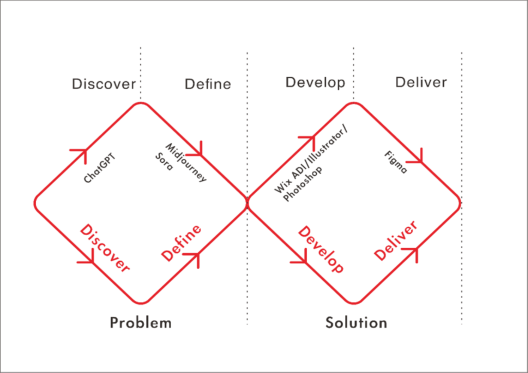
Through the scenario-based conceptual simulation approach, we explored the AIGC-enhanced Double Diamond, a novel framework that optimized the four phases of the Double Diamond—Discover, Define, Develop, and Deliver—by integrating AI tools (e.g., ChatGPT, Midjourney, Sora and Wix ADI), traditional tools (e.g., Photoshop, Adobe Illustrator), and emerging tools (e.g., Figma), see Figure 1. Here, mental health applications have been identified as a key application scenario in the design field, particularly in UI/UX design, due to their complex requirements for emotional resonance, user engagement, and privacy protection (Fitzpatrick et al., 2017; Inkster et al., 2018). According to the critical case reasoning strategy (Flyvbjerg, 2006), if a framework performed well under challenging and complex conditions, it is likely to be effective in more general or less demanding settings. From this, it can be seen that psychology-related apps are more challenging and difficult. It is our assumption that if such complex design requirements can be well met by this new framework, the results could be transferable and effective in other design applications. Therefore, we have chosen the theme as an experimental test to demonstrate the framework’s universality, feasibility, and flexibility. Based on this, the ‘Mental Health Application UI Design’ theme is a great example to be tested.
Figure 1: AIGC-enhanced double diamond.
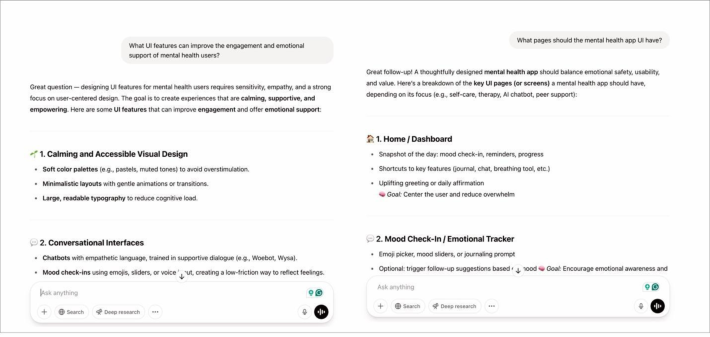
Discover Phase (ChatGPT) The Discover phase is defined by the Design Council as starting with questioning challenges and conducting research quickly to identify user needs (Design Council, 2005). In this case, ChatGPT was used as a divergent thinking tool to generate prompting questions (such as “What UI features can improve the engagement and emotional support of mental health users?” and “What pages should the mental health app UI have?”) to initially propose diverse, feasible, and inclusive UI concepts, including features such as emotion tracking, guided meditation, diary recording, and personalized recommendations, see Figure 2. The goal is to explore possibilities and reveal the emotional and functional needs of mental health app users, laying the foundation for subsequent stages.
Figure 2: Example input prompts and ChatGPT responses in the discover phase. Note: The generated responses may vary across sessions, even with identical prompts. The outputs shown here are for illustrative reference only.
Human–AI Co–Creation in Design Through AIGC Integration 161
Define Phase (Midjourney, Sora) The Define phase focuses on integrating the results of the Discover phase, understanding the alignment of user needs with problems, and creating clear design requirements. Based on the text output of ChatGPT (such as “Design soothing visual elements to relieve anxiety”), Midjourney and Sora generate visual concepts, including mood boards (using soft blue and green tones, based on natural themes such as forests and oceans), minimalist icons, dynamic background videos, and other visual elements related to the theme of mental health app UI. At the same time, communicate with stakeholders (including psychologists, nurses, and doctors) to obtain feedback to optimize design elements, ensure that the visual design meets the emotional tone required for mental health applications, and support the “user participation” co-creation process.
Develop Phase (Wix ADI, Photoshop, Illustrator) The Develop phase focuses on developing, testing, and refining multiple potential solutions. Wix ADI automatically generates preliminary UI prototypes based on design briefs and user needs, and produces iterative functional layouts. For more detailed interactive elements (such as mood tracking modules, guided meditation pages, and diary functions), Midjourney provides design references, while Photoshop and Illustrator are used to add nature-themed illustrations (such as leaves, flowers), custom icons (to ensure style consistency), and optimize the color, size, and proportion of graphic elements to enhance the unity and visual consistency of the prototype.
Deliver Phase (Figma) The Deliver phase involves selecting a single solution and preparing for release. Figma integrates prototypes from the Develop phase to further plan and refine the UI design, focusing on ensuring usability and accessibility through iterative testing. By integrating stakeholder feedback, the application is ensured to meet the needs of mental health users, and finally confirms a complete and systematic UI design solution.
In summary, this case study demonstrates the flexibility, effectiveness, and comprehensiveness of the AIGC-enhanced Double Diamond model in the UI design of the mental health application. The model integrates AI tools (ChatGPT, Midjourney, Sora, Wix ADI), traditional tools (Photoshop, Illustrator), and emerging tools (Figma) to achieve efficient demand mining in the Discover phase, improve the co-creativity of visual design in the Define phase, accelerate prototype iterations in the Develop phase, and ensure usability and ease of use in the Deliver phase. This structured approach highlights the potential of AI-human collaboration while providing direction for the future design framework.
DISCUSSION
This section explored the innovative approach of the AIGC-enhanced Double Diamond in the UI design of the mental health application and verified
its advantages in different design stages (Discover, Define, Develop, and Deliver). The results have shown that the framework can significantly improve design efficiency, stimulate creativity, and promote human-machine collaboration. AI tools (such as ChatGPT, Midjourney, Sora, and Wix ADI) show obvious advantages in concept exploration, visual generation, and prototyping, providing new possibilities for UI design. However, the framework still faces certain challenges, such as technical stability, cultural adaptability, and ethical issues. Based on these findings, the following sections will further explore the specific advantages and limitations of the AIGC-enhanced Double Diamond and its implications for design process.
Advantages of the Framework The AIGC-enhanced Double Diamond has shown significant advantages in the design process of “Mental Health Application UI”. By integrating AIGC tools (such as ChatGPT, Midjourney, Sora, and Wix ADI) with traditional tools (Photoshop and Illustrator) and emerging tools (Figma), the framework could improve design efficiency and creativity in four stages (Discover, Define, Develop, and Deliver). The following previous studies can further verify this advantage. In the Discover stage, ChatGPT promoted divergent thinking by generating diverse UI concepts, helping designers quickly explore user needs and align with user-centered design principles. This is consistent with the results of studies (Li et al., 2024; Wu et al., 2023), further verifying the reliability of the AIGC-enhanced Double Diamond. In the Define stage, Midjourney generated elements that were visually consistent with the theme, supporting emotional resonance and achieving co-creation with the “user participation loop” to ensure that the design met the user’s emotional needs. This is also consistent with the research of Verheijden and Funk (2023), who have demonstrated how Midjourney could generate visual elements to support co-creation, ensuring designs align with users’ emotional needs. In fact, this is a co-design link. In the Develop stage, the rapid prototyping capabilities of Wix ADI combined with the detailed optimization of Photoshop and Illustrator significantly improved the iteration efficiency of the design, ensured the consistency of function and vision, and also reflected the close integration of AI and traditional design methods. This experimental result is supported by Edwards et al. (2024), who have demonstrated how generative AI can accelerate prototyping and iteration through tools like Sketch2Prototype. In the Deliver stage, the final design was optimized through iterative feedback, supported by Figma’s collaborative features. Zhou et al. (2024) have highlighted the role of large language models (LLMs) in facilitating iterative design processes in the Deliver stage, such as providing adaptive presentations based on multi-modal user feedback. Additionally, Figma’s accessibility tools, such as the native color contrast checker, help ensure designs meet accessibility standards (Figma, 2025). From these four different stages, we can see that AIGC has played a key role. It not only improves design efficiency and creativity but also further proves the feasibility and superiority of the framework. This provides a novel design framework for accelerating idea generation, prototyping, and human-machine collaboration.
Human–AI Co–Creation in Design Through AIGC Integration 163
Limitations and Challenges Although the AIGC-enhanced Double Diamond has significant advantages, it still faces some limitations and challenges. Since this study is based on scenario-based conceptual simulation and lacks real user data, the generalizability of the results is limited. At the same time, simulated feedback cannot fully capture the diverse emotional responses of users and may also ignore cultural or accessibility differences. For example, users from different cultural backgrounds may have significant differences in their interpretation of colors and symbols, and AIGC tools may not fully take into account these subtle cultural sensitivities.
Second, AIGC tools may have certain technical limitations in practical applications. For example, the text generation of ChatGPT or the visual output of Midjourney sometimes have problems with inconsistency between input and output results. Even if precise prompt words are provided, the output results may still not match the designer’s expectations, causing them to feel frustrated and affecting their enthusiasm for use. This often happens. In addition, the AI functions of tools such as Figma are not yet mature, and Figma does not currently belong to AIGC. It only has some AI features and still performs insufficiently in usability tests in many environments. In addition, over-reliance on multiple AIGC tools may increase the complexity of the design process and require designers to have higher human-machine collaboration skills. Designers not only need to master traditional design tools, but also need to be familiar with the operation and optimization methods of AI tools. Therefore, designers need higher technical and interdisciplinary collaboration capabilities to be competent for this new design framework, and may face many obstacles in popularization.
Finally, ethical issues of AIGC tools, such as intellectual property risks and data security, also require careful manual supervision. For example, the content generated by AIGC may involve copyright issues, especially when using copyrighted images or texts for training. In addition, AIGC tools may have potential algorithmic bias, especially in the sensitive field of mental health. The generated content may inadvertently reinforce certain stereotypes or biases, which may have a negative impact on user experience and design effects. It is also not conducive to the norms of ethics and may even face certain ethical dilemmas. Therefore, how to ensure data security and user privacy in design is an important challenge.
Implications for Design Practice The research results are of great significance to design practice, especially in the field of user experience UX and UI. The AIGC-enhanced Double Diamond provides designers with a flexible and practical framework that can enhance creativity while maintaining a user-centered approach. In addition, through the scenario-based conceptual simulation approach using a hypothetical design case, the application of this framework in the UI design of the mental health application highlights the potential of AIGC in the field of emotional health and provides certain design process advantages compared with traditional frameworks by balancing innovation and empathy.
Specifically, the framework encourages designers to regard AI as a creative partner, especially in the early creative and visualization stages. AIGC tools can help designers quickly generate diverse creative solutions and accelerate design iterations through visual synthesis and prototyping. However, designers still need to play a leading role in key decisions to reduce the bias and errors that may be caused by AIGC tools. In addition, the framework emphasizes the importance of interdisciplinary collaboration. Especially in the design of mental health applications, designers need to work closely with psychologists, user experience researchers, doctors, nurses, patients, and technical developers to ensure that the design is not only beautiful and functional but also can meet the user’s psychological expectations, and can effectively support the user’s emotional health. This interdisciplinary collaboration model provides new ideas for future design practice.
However, the success of this framework in real-world environments still needs further empirical verification, especially in terms of cultural sensitivity and ethical compliance in the field of mental health. In addition, new AI tools are constantly emerging and iterating, and soon this framework may no longer be applicable to UI design scenarios, or it may not keep up with technological advances and be abandoned. Therefore, future research can further verify the effectiveness and applicability of the framework through real user testing and long-term tracking evaluation.
CONCLUSION
Human This study proposed the AIGC-enhanced Double Diamond could be a promising framework and using AI tools to improve creativity, efficiency, and user engagement at each stage of the Double Diamond can enhance user experience. The hypothetical case study (for designing a mental health application UI) demonstrated the feasibility, flexibility, and inclusiveness of the model, which was based on the framework developed by the Design Council (2005) and iterated on AI tools, and made up for the shortcomings of previous AIGC-design integration research. By integrating ChatGPT for idea generation, Midjourney/Sora for visualization, Wix ADI/Photoshop/Illustrator for prototyping, and Figma for delivery, the framework demonstrated human-machine collaboration to support emotional responsive design. Although the scenario-based conceptual simulation approach provides a foundation, this study emphasizes the need for empirical testing to confirm its real-world effectiveness, providing some insights into the intersection of AI and user-centered design. Future research should focus on deepening the integration of AIGC and design theory, expanding the Double Diamond model, such as introducing cognitive psychology models to better meet the emotional needs of mental health users. In addition, the ethical challenges brought by AIGC - especially privacy (such as handling sensitive user data) and copyright issues still need to be further explored, which can be addressed by formulating responsible AI use guidelines. Building a full-process closed-loop design system that is seamlessly embedded in AIGC, combined with real-time feedback loops
Human–AI Co–Creation in Design Through AIGC Integration 165
and interdisciplinary collaboration, can improve the adaptability of the framework. At the same time, it is also recommended to verify the impact of the model on user experience through empirical research on diverse mental health user groups, use advanced AIGC tools to optimize usability and accessibility, and further enhance the AIGC-enhanced Double Diamond model’s inclusive design framework.
REFERENCES
Bao, Q., Zhao, J., Liu, Z. & Liang, N. 2025. AI-Assisted Inheritance of Qinghua Porcelain Cultural Genes and Sustainable Design Using Low-Rank Adaptation and Stable Diffusion. Electronics, 14, 725. Bennett, C. L. & Rosner, D. K. The promise of empathy: Design, disability, and
knowing the “other”. Proceedings of the 2019 CHI conference on human factors in computing systems, 2019. 1–13. Brown, T. 2008. Design thinking. Harvard business review, 86, 84. Buchanan, R. 2019. Systems thinking and design thinking: The search for principles in the world we are making. She Ji: The Journal of Design, Economics, and Innovation, 5, 85–104. Council, D. 2005. History of the Double Diamond [Online]. Available: https://www.designcouncil.org.uk/ our-resources/the-double-diamond/history-of- the-double-diamond/ [Accessed 2025]. Canhoto, G., Almeida, R., & da Silva, M. M. (2025). Phases, metrics, and techniques
of product discovery. Journal of Innovation and Entrepreneurship, 14(1), 11. Dorst, K. 2011. The core of ‘design thinking’and its application. Design studies, 32, 521–532. Dove, G., Halskov, K., Forlizzi, J. & Zimmerman, J. UX design innovation:
Challenges for working with machine learning as a design material. Proceedings of the 2017 chi conference on human factors in computing systems, 2017. 278–288. Edwards, K. M., Man, B. & Ahmed, F. 2024. Sketch2Prototype: Rapid conceptual design exploration and prototyping with generative AI. Proceedings of the Design Society, 4, 1989–1998. Figma. (2025). Color Contrast Checker. https://www.figma.com/color-contrast-
checker/ Fitzpatrick, K. K., Darcy, A., & Vierhile, M. (2017). Delivering cognitive behavior therapy to young adults with symptoms of depression and anxiety using a fully automated conversational agent (Woebot): A randomized controlled trial. JMIR mental health, 4(2), e7785. Feng, Z., Hou, M., Liu, H., Liu, M., Kaur, A., Febrinanto, F. G. & Zhao, W.
SmartColor: Automatic Web Color Scheme Generation Based on Deep Learning. 2021 12th International Conference on Information and Communication Systems (ICICS), 2021. IEEE, 285–290. Flyvbjerg, B. (2006). Five misunderstandings about case-study research. Qualitative inquiry, 12(2), 219–245. Fui-Hoon Nah, F., Zheng, R., Cai, J., Siau, K. & Chen, L. 2023. Generative AI
and ChatGPT: Applications, challenges, and AI-human collaboration. Taylor & Francis. Gaba, D. M. (2004). The future vision of simulation in health care. BMJ quality & safety, 13(suppl 1), i2–i10.
Hsiao, H.-L. & TANG, H.-H. A Study on the Application of Generative AI Tools in Assisting the User Experience Design Process. International Conference on Human-Computer Interaction, 2024. Springer, 175–189. Inkster, B., Sarda, S., & Subramanian, V. (2018). An empathy-driven, conversational
artificial intelligence agent (Wysa) for digital mental well-being: Real-world data evaluation mixed-methods study. JMIR mHealth and uHealth, 6(11), e12106. Khan, A., Shokrizadeh, A. & Cheng, J. 2025. Beyond Automation: How UI/UX Designers Perceive AI as a Creative Partner in the Divergent Thinking Stages. arXiv preprint arXiv:2501.18778. Kimbell, L. 2011. Rethinking design thinking: Part I. Design and culture, 3, 285–306. Li, M., Li, Y., He, C., Wang, H., Zhong, J., Jiang, S., He, M., Qiao, Z.,
Chen, J. & Yin, Y. Generative AI for sustainable design: A case study in design education practices. International Conference on Human-Computer Interaction, 2024. Springer, 59–78. Lai, Y.-R., Chen, H.-J., & Yang, C.-H. (2023). Exploring the impact of generative artificial intelligence on the design process: Opportunities, challenges, and insights. Artificial Intelligence, Social Computing and Wearable Technologies, 113, 49–59. Liang, R., Chu, S., Lawton, D. & Pan, G. 2024. Human-centered design based on
the Double Diamond model for optimizing hybrid game design. Liu, Z., Yang, B., An, J. & Huang, C. 2023. Similarity evaluation of graphic design based on deep visual saliency features. The Journal of Supercomputing, 79, 21346–21367. Nobari, A. H., Rashad, M. F. & Ahmed, F. 2021. Creativegan: Editing generative adversarial networks for creative design synthesis. arXiv preprint arXiv:2103.06242. Norman, D. A. & Verganti, R. 2014. Incremental and radical innovation: Design
research vs. technology and meaning change. Design issues, 30, 78–96. Pandey, H. P., Maraseni, T. N., & Apan, A. A. (2024). Enhancing systematic literature review adapting ‘double diamond approach’. Heliyon. Peters, D., Calvo, R. A. & Ryan, R. M. 2018. Designing for motivation, engagement
and wellbeing in digital experience. Frontiers in psychology, 9, 300159. Saidani, M., Kim, H. & Yannou, B. Can machine learning tools support the identification of sustainable design leads from product reviews? Opportunities and challenges. International design engineering technical conferences and computers and information in engineering conference, 2021. American Society of Mechanical Engineers, V03AT03A005. Verheijden, M. P. & Funk, M. Collaborative diffusion: Boosting designerly co-creation with generative AI. Extended abstracts of the 2023 CHI conference on human factors in computing systems, 2023. 1–8. Wang, X., Huang, Z., Xu, T., Li, Y. & Qin, X. 2023. Exploring the future design
approach to ageing based on the Double Diamond model. Systems, 11, 404. Wang, Y., Xi, Y., Liu, X. & Gan, Y. 2024a. Exploring the dual potential of artificial intelligence-generated content in the esthetic reproduction and sustainable innovative design of ming-style furniture. Sustainability, 16, 5173. Wang, Z., Shen, L., Kuang, E., Zhang, S. & Fan, M. Exploring the Impact of
Artificial Intelligence-Generated Content (AIGC) Tools on Social Dynamics in UX Collaboration. Proceedings of the 2024 ACM Designing Interactive Systems Conference, 2024b. 1594–1606.
Human–AI Co–Creation in Design Through AIGC Integration 167
Wu, D., Yu, Z., Ma, N., Jiang, J., Wang, Y., Zhou, G., Deng, H. & Li, Y. Styleme: Towards intelligent fashion generation with designer style. Proceedings of the 2023 CHI conference on human factors in computing systems, 2023. 1–16. Wu, J., Cai, Y., Sun, T., Ma, K. & Lu, C. 2024. Integrating AIGC with design:
Dependence, application, and evolution-a systematic literature review. Journal of Engineering Design, 1–39. Yan, H., Zhang, H., Liu, L., Zhou, D., Xu, X., Zhang, Z. & Yan, S. 2022. Toward intelligent design: An AI-based fashion designer using generative adversarial networks aided by sketch and rendering generators. IEEE Transactions on Multimedia, 25, 2323–2338. Yang, H., Xue, C., Yang, X. & Yang, H. 2021. Icon generation based on generative
adversarial networks. Applied Sciences, 11, 7890. Yin, H., Zhang, Z. & Liu, Y. 2023. The exploration of integrating the midjourney artificial intelligence generated content tool into design systems to direct designers towards future-oriented innovation. Systems, 11, 566. Yu, E. & Sangiorgi, D. 2018. Service design as an approach to implement the value
cocreation perspective in new service development. Journal of Service Research, 21, 40–58. Zhang, Z. & Yin, H. 2024. Research on design forms based on artificial intelligence collaboration model. Cogent Engineering, 11, 2364051. Zhou, Z., Li, Y. & Yu, J. 2024. Exploring the application of LLM-based AI in UX
design: An empirical case study of ChatGPT. Human–Computer Interaction, 1–33. Zhang, L., & Wang, C. X. (2024). User Experience of Virtual Reality in Healthcare Clinical Training. AHFE International, 159. https://doi.org/10.54941/ ahfe1005682
Read this individual research paper free through the original publisher, or explore the full digital proceedings book.
ISBN 978-1-964867-71-7
Explore this ISBN in the AHFE Bookstore ↗Listed in the July 2026 bookstore catalogue; search by ISBN to confirm current availability · Digital book purchase optional