Sauman Chu, Allyson Hart, Marilyn Bruin (2023). A patient-centered approach in designing a kidney transplant decision aid. In: Human-Centered Design and User Experience. AHFE Open Access, vol. 114, pp. 177–183. https://doi.org/10.54941/ahfe1004234
The kidney transplant decision aid tool (https://www.srtr.org/tools/kidney-transplant-decision-aid/) was designed, created, and included as part of the Scientific Registry of Transplant Recipients (SRTR) resource website. The decision aid tool was created with input from patients with kidney disease and the doctors who care for them. An extensive information gathering and testing process with user-centered approach was implemented. Ten interviews and 4 focus group discussion sessions were held with an average of 4.5 patients in each group to gather preliminary design and content directions. Two additional focus groups with a total of 12 kidney transplant providers and 4 additional national focus group discussions with a total of 19 patients were held afterward to discuss the created content and design approach. Finally, 15 individual patient testing sessions were conducted to refine the content, design, and navigation of the tool. The tool is intended to be used during patient’s visit with their doctor as the patient learns about kidney transplant. Our goal is to provide informative materials to empower patients by helping them understand treatment options and outcomes. The doctor will guide patient through the tool and explain the information to help them to make informed decisions.The decision aid tool contains concise information to compare the pros and cons of dialysis vs. transplant treatments, living donor vs. deceased donor transplant, accepting higher quality vs. lower quality deceased donor kidney offers, and increased infectious risk kidneys vs. standard infectious risk kidneys. We also created a calculator to estimate a patient’s likely outcomes on the kidney transplant wait list based on the transplant regions or center and the individual’s medical condition. Preliminary testing suggests that patients find the tool and the likely outcomes helpful in leading to informative decision making.
The kidney transplant decision aid tool (https://www.srtr.org/tools/kidney- transplant-decision-aid/) was designed, created, and included as part of the Scientific Registry of Transplant Recipients (SRTR) resource website. SRTR is operated by the Hennepin Healthcare Research Institute under a contract from the Health Resources and Services Administration, an agency of the US Department of Health and Human Services (HHS). SRTR provides epi- demiological data and statistical analyses regarding the status of solid organ transplantation and the transplantation system in the United States.
We applied a human centered design approach for data gathering and incorporated different stakeholder feedback into the design process. The tool was created with input from patients with kidney disease and the doctors who care for them. Human centered design is a creative approach to problem solv- ing that starts and ends with users, with the goal of building a deep empathy about the users one intends on designing for. The process involves generating ideas as well as building and sharing prototypes and solutions with the users (Norman, 2013).
Through this process, we created an online decision aid tool that commu- nicates a patient’s options and likely outcomes on the wait list for a kidney transplant based on their region and clinical characteristics.
PROBLEM Many patients waiting for a deceased donor kidney transplant die or become too sick to transplant (Lentine et al., 2022). Patients who do not understand their likely outcomes may not complete the evaluation process, consider liv- ing donation or accept lower quality kidneys (Gordon, 2001). Therefore, our study focused on these three areas of uncertainty:
What do patients know about waitlist outcomes?
What do patients want to know about waitlist outcomes?
What do patients need to know about waitlist outcomes?
METHOD
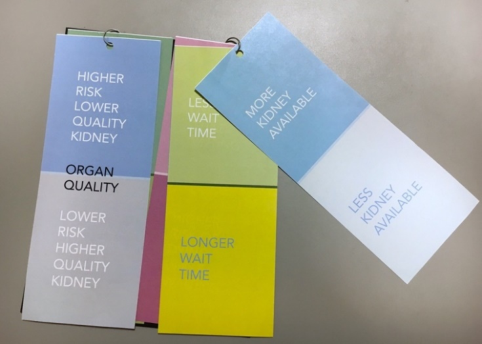
Stage One: Interviews We conducted 10 interviews with transplant candidates recruited from Hen- nepin Healthcare and University of Minnesota Transplant Centers. We approached the interview with general questions about understanding treat- ment options of kidney disease. Based on the collected information, we iden- tified topics that patients did not have clear understanding and grouped them into themes. Couple low fidelity paper prototypes (Figure 1) of presenting the information were then created for the next stage data gathering.
Stage Two: Focus Group Discussions Four focus group discussions were then conducted between October 2016 and April 2017 with a total of 18 adults from the same centers. We started with discussions and patients shared their wait list, dialysis, or transplant experiences. We then presented a paper prototype (Figure 1) of the treat- ment options during the focus group discussions and had patients to provide thoughts on if the information presented in the prototype addressed their questions and uncertainties. We also asked for feedback on the topics and if more topics need to be added. The purpose of the focus group discussions was to provide a concrete direction if a decision aid was needed, and that information included on the website will be accurately reflect and match the need of patients.
A Patient-Centered Approach in Designing a Kidney Transplant Decision Aid 179
Figure 1: A paper prototype example designed and used during focus group informa- tion gathering session.
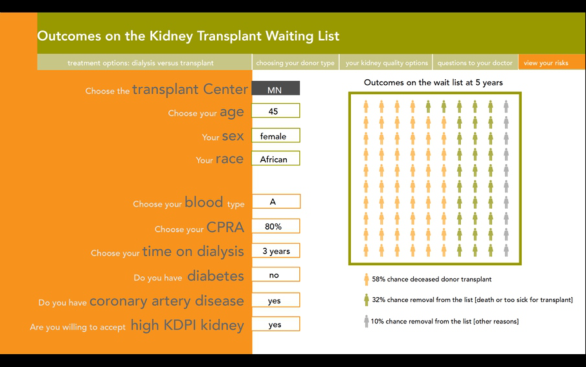
When data saturation was obtained with no new information emerging from subsequent discussions, a website with the decision aid was created. Figure 2 shows a preliminary early design of the interactive tool with fields that are needed to be entered by patient in order to calculate and view their individual risk and better understand their outcomes on the kidney transplant wait list. Content identified through focus group discussions and included on the website were dialysis vs. transplant, living vs. deceased donation, kidney quality including description of high Kidney Donor Profile Index kidneys, and increased infectious risk kidneys.
Figure 2: An early design of the interactive tool provided fields for patient to enter individual health characteristics.
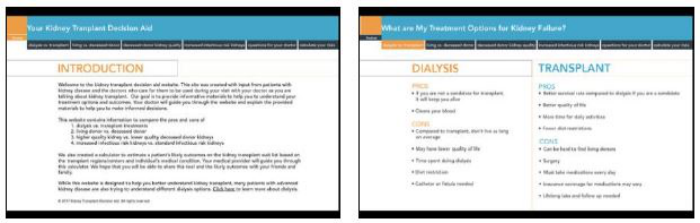
Stage Three: Second Focus Groups The preliminary website was then presented to four focus groups with 19 kidney transplant recipients and 2 focus groups with 12 kidney trans- plant providers recruited from different states in the US. The purpose of these national focus group discussions was to ensure the reliability of the study and better representation of the population so that information included in the website tailor broadly to diverse population. Figure 3 shows further changes made to both the design and the content of the website after the national focus group discussions. Changes made mainly focused on the language used about the pros and cons of each topic or treatment option.
Figure 3: The decision aid website design after the national focus group discussions.
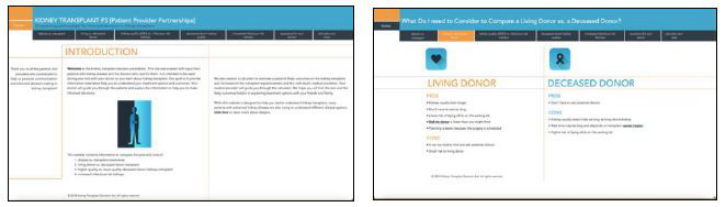
Stage Four: Usability Testing With Individual Patients Fifteen individual usability tests of the website were conducted with patients at on the kidney transplant waitlist. The purpose of this user testing was to examine how users directly interact with the interface of the website and the decision aid tool. A set of scenarios were developed to test if patients would be able to locate information, navigate different pages, and use the decision aid calculator accurately. Each testing ranged between 45–90 minutes. Feedback from the testing was then incorporated into the final design before it was made accessible to the public and health providers in 2018.
Figure 4: Two pages of the final design of the decision aid website with added illustrations.
A Patient-Centered Approach in Designing a Kidney Transplant Decision Aid 181
RESULTS
Many patients expressed that existing information provided by transplant centers or available online was complicated, overwhelming, and difficult to understand. One participant who already received kidney transplant treat- ment shared that they did not know that different quality of deceased donor kidneys existed and how that decision could impact the time on waitlist. Many patients rely heavily on the case manager and their doctors to guide their waitlist and treatment options.
There were several key findings through this study. First, patients preferred concise and easy to understand language. This approach aligns to the recom- mendation that information targets for general populations should be written with a 5th grade or 6th reading level (Hoffmann and Worrall, 2004).
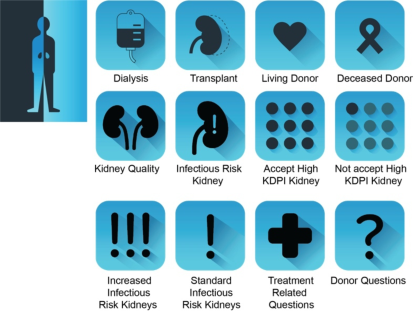
Second, design consideration in the usage of color, typeface selection, and placement of information are also important factors in helping patients read and follow the content of the website and the interactive tool. Due to the different health conditions, some patients have impaired vision and read- ing speed. Therefore, clean and simple typeface, high contrast of color, and information placed closer in middle section of the screen were preferred. In addition, patients expressed that the inclusion of illustration or images would be helpful. We decided adding abstract illustrations to highlight each section of the content (Figure 5).
Third, regarding to the interactive decision aid tool that calculates the probability that a patient would be transplanted, still be waiting, or die or be removed from the waiting list due to becoming too sick to transplant based on the individual patient’s health characteristics and geographical location in the US, patients found the calculator helpful in understanding and real- izing their own likely outcomes on the waitlist and the differences between each state or center’s wait time. Based on the calculation of the wait time and likely outcome of survival rate, some patients expressed they will consider and discuss the option of receiving a lower quality kidney to increase their chance of surviving (instead of only accepting higher quality kidney offers). In addition, some patients also expressed that they will share the information with their families/friends and perhaps seek living donors if possible.
In response to the three key questions:
What do patients know about waitlist outcomes?
What do patients want to know about waitlist outcomes?
What do patients need to know about waitlist outcomes?
The majority of the patients expressed that their expectation in receiving a kidney transplant on the wait list was 3–5 years. The calculator helped them to realize and have a better understanding of the estimate wait time based on location and individual health characteristics. In reality most patients waited longer, and with certain health conditions, some patients will become too sick for transplant and will not survive while waiting for 3–5 years.
Patients indicated they want to know what they could do during wait time to increase their chance of survival. A key component provided in the decision
aid was the educational information about kidney quality (how it was evalu- ated and given a score). Patients are asked by transplant centers whether they would accept a lower quality kidney. This is a critical educational component because in the current state, nearly 25% (Scientific Registry of Transplant Recipients, Hennepin Healthcare Research Institute, Minneapolis, MN et al., 2021) of recovered deceased donor kidneys were not used due an inability to find a center or patient willing to accept it (for example, a kidney came from a patient with a history of substance use who died of overdose given the extremely small chance the kidney might be infected with HIV or Hepatitis B despite negative serologic tests) but they would likely benefit many patients on the transplant waitlist. In other words, instead of waiting for a high qual- ity kidney that results with a longer wait time, a patient needs to decide if one is willing to accept a lower quality kidney with a shorter wait time and therefore, increase their chance of survival.
Figure 5: Illustrations for each topic of the decision aid.
CONCLUSION
Throughout the data gathering process, a majority of patients demonstrated limited understanding of options and likely outcomes, including mortality on the waitlist and likelihood of transplant. In addition, patients had limited understanding of differences between deceased and living donor organs, and deceased donor organ quality. Additional research is needed on whether the decision aid tool influences decisions in accepting of lower quality kidneys and rates of living kidney donation.
REFERENCES
Gordon, E. J. (2001). Patients’ decisions for treatment of end-stage renal disease and their implications for access to transplantation. Social Science & Medicine, 53(8), pp. 971–987. doi: https://doi.org/10.1016/s0277-9536(00)00397-x. Hoffmann, T. and Worrall, L. (2004). Designing effective written health education
materials: Considerations for health professionals. Disability and Rehabilitation, 26(19), pp. 1166–1173. doi: https://doi.org/10.1080/09638280410001724816.
A Patient-Centered Approach in Designing a Kidney Transplant Decision Aid 183
Lentine, K. L., Smith, J. M., Hart, A., Miller, J., Skeans, M. A., Larkin, L., Robinson, A., Gauntt, K., Israni, A. K., Hirose, R. and Snyder, J. J. (2022). OPT- N/SRTR 2020 Annual Data Report: Kidney. American Journal of Transplantation, 22(S2), pp. 21–136. doi: https://doi.org/10.1111/ajt.16982. Norman, D. A. (2013). The design of everyday things. Revised and expanded edition.
Philadelphia: Basic Books. Scientific Registry of Transplant Recipients, Hennepin Healthcare Research Institute, Minneapolis, MN, and Department of Medicine, Hennepin Healthcare, University of Minnesota, Minneapolis, MN (2021). Deceased Organ Donation (DOD). [online] Hrsa.gov. Available at: https://srtr.transplant.hrsa.gov/annual_ reports/2021/Deceased%20Organ%20Donation.aspx [Accessed 11 Jul. 2023].
LISTED IN THE AHFE DIGITAL BOOKSTORE CATALOGUE
Explore the complete digital volume
Human-Centered Design and User Experience
Read this individual research paper free through the original publisher, or explore the full digital proceedings book.
ISBN 978-1-958651-90-2
Explore this ISBN in the AHFE Bookstore ↗Listed in the July 2026 bookstore catalogue; search by ISBN to confirm current availability · Digital book purchase optional