Megan Strickfaden, Joyce Thomas (2022). Designing in the Wild Problem Solving Specialized Apparel Design. In: Interdisciplinary Practice in Industrial Design. AHFE Open Access, vol. 48, pp. 25–33. https://doi.org/10.54941/ahfe1002012
The aim of this paper is to propose and elaborate on the concept of designing in the wild theoretically and practically through a case study on an apparel system created for people working in the oil and gas industry. Through our explorations we elaborate on motivating factors for designing in the wild, offer some of the fundamental theories on problem-solving in design, and provide an overview of human-centred practices to compare and contrast these with designing in the wild. Naturally there are a myriad of different ways that designers can approach designing. They can take a designer-centric approach, an artifact-centric approach, use- or user-centric approach, or a combination of these. Typically, designers will select one of these approaches especially when creating ready-to-wear apparel, soft products, and accessories. For example, apparel and soft product designers are often expected to peruse the market, speculate on new styles, and forecast trends (both are generally artifact-centric approaches) with a vision to realizing designs that will be easily produced and sell well. Alternatively, designers who are involved in creating products for specialized markets such as design for disability or safety wear take more use- and user-centric approaches where there is a greater focus on the use environment (use-centric approach). Furthermore, user-centric approaches in apparel design have been popularized around sizing, scaling and fit to the human body, usually as the study of anthropometrics, which is interestingly also quite artifact-centric because designers are consulting databases and documents with numbers that indicate how apparel and soft products need to interface with bodies. These approaches to creating apparel and soft products have provided the domain with tools towards developing apparel that fit the shapes and needs of consumers, but not necessarily the expectations and desires within specialized product realms. With the growing needs for more specialized apparel and soft product design due to specific work situations and environments, aging demographics and people with special needs, and niche markets it is essential that a more holistic problem-solving approach and acknowledgement of the complexity of design scenarios be taken. Designing in the wild plays on the work of Callon and Rabeharisoa’s Research ‘in the wild’ and the reshaping of new social identities (2003). Like “research in the wild” designing in the wild offers various methods to get at and understand the complexity of human experiences including the nuanced relationships among person-apparel-environment. Designing in the wild takes a two-pronged approach: (1) where the designer is required to understand themselves to design better for others; and (2) where a more in-depth methodology for understanding others is employed. Consequently, designing in the wild focuses on a more complex understanding of authentic human behavior to design for the portable environments of apparel and soft product. Our results are a rich description of our case study, what designing in the wild is, and pointers on how to employ this approach when problem solving for specialized apparel and soft product design.
There is a myriad of different ways that a designer can approach creating apparel. They can take a designer-centric approach, an artifact-centric appro- ach, use- or user-centric approaches or a combination of these. Typically, designers will select one of these approaches especially when creating fashion wear, ready-to-wear clothing and accessories. For example, apparel designers are often expected to peruse the market (artifact-centric approach), specu- late on new styles and forecast trends with a vision to realizing designs that will sell. More creative fashion designers often seem to get their ideas from ‘within’ themselves (designer-centric) by reflecting on what has been previ- ously created whether this be through fashion shows or magazine clippings (artifact-centric) towards what might be considered desirable in the future. Designers who are involved in creating products for specialized markets such as safety wear may take a more use-centric approach with a greater focus on the environment where the garment will be worn. User-centric approa- ches (study of anthropometrics) have been popularized around sizing, scaling, and fit of garments. These approaches to creating apparel have provided the domain with tools towards developing apparel that fits the desires and needs of consumers.
With the growing needs for more specialized apparel due to specific work situations and environments, aging demographics, people with special needs, and niche markets it is essential that a more holistic problem solving pro- cess be employed. Designing in the wild is proposed as a methodology of creation that also considers the complexity of the design scenario. It plays on Research ‘in the wild’ and the reshaping of new social identities by Cal- lon and Rabeharisoa (2003). We offer various methods to discover and understand the complexity of human experience including the nuanced rela- tionships among person-apparel-environment. Designing in the wild takes a two-pronged approach: 1) the designer is required to understand themselves in order to design better for others, and 2) a more in-depth methodology for understanding others is employed.
This paper describes a case study where a garment system was created for an ‘extreme’ setting. It highlights the problem solving process toward a protective garment system that was created for men and women working in the oil and gas industry. We identify two motivating factors for designing in the wild and offer some fundamental theories around problem solving in design.
MOTIVATION FOR DESIGNING IN THE WILD Alternative problem solving methodologies for the creation of specialized apparel are needed as the designer encounters and confronts other people’s needs, wants, desires, and expectations. Various studies on designing for others (e.g., Strickfaden & Heylighen, 2009) indicate that although human- centred designing has come a long way, it is not always accomplished in a particularly nuanced way that aids in creating detailed designs. For some time the design community has made a call for more people to be present during the design process (e.g., Ostroff, 1993), yet there is still a propensity for (especially novice) designers to generalize other’s needs and feelings and link these to their own values, beliefs and actions (Strickfaden & Heylighen, 2009). As such, it is simply not enough to have people present to design for; it is imperative for designers to also understand themselves, so they are not inadvertently and unconsciously designing for themselves. In sum, designing requires a genuine interest in other people, and to design for others well it requires a design process that balances the understanding of the self (designer) and the other (users).
Another motivation for proposing designing in the wild is that current design process models such as those by the Stanford d.school (Balcaitis, 2019) created to aid in problem solving towards design solutions are relatively gene- ral with no specifics on how these phases work in practice, and no details on how to develop and use tools that address the complexity of specialized apparel design problems. The aim of these kinds of design models is purely descriptive, perhaps to teach novice designers and/or to aid other domains towards understanding the design process.
In the realm of apparel design, Orlando’s (Orlando, 1979) functional apparel design process, elaborates on three contributing factors that aid in establishing design criteria: the constructed environment, the natural
Designing in the Wild Problem Solving Specialized Apparel Design 27
environment, and the behavioral environment. The constructed and natu- ral environments can be interpreted as referring to work and leisure contexts of people that could include weather conditions and temperature. The beha- vioral environment can be interpreted as focusing on human variables such as wear patterns, working styles, and other preferences. Like generic design process models, Orlando’s functional apparel design process provides an ove- rview that is a lens to understanding the context of a design being created; however, it does not provide tangible methods that can be developed and used by designers. In essence, Orlando’s model acts as another kind of map for learning and teaching. Lamb and Kallal’s (1992) functional apparel design process proposes three conjoined concepts—functional, expressive, aesthetic (FEA)—to meet wearers’ needs by prioritizing comfort, mobility, and servi- ceability. The FEA model focuses on many of the things that are valued in specialized apparel design. These are: 1) functional aspects (F) concerned with protection from the environment, thermal comfort, fit and mobility with attention to the shape and form of the clothing and fasteners; 2) expres- sive elements (E) relate to the meaning of clothing relative to self-esteem and dignity; and 3) aesthetic details including aspects such as beauty including visual and tactile elements (e.g., line, color, harmony). Lamb and Kallal’s FEA model provides a way of establishing specific criteria that guides designing. However, much like Orlando’s model, it brings the design process down to a set of themes that are general concepts that do not provide actual metho- dologies that can be applied readily during a project. Interestingly, the idea of having a design process (theory) that is easily applied during designing (practice) and is not so prescriptive that it generalizes design needs is not a new concept to researchers in apparel design. Two works that stands out are Watkins (1988) research where she describes using a functional apparel design process and Tullio-Pow and Strickfaden (2020) development of a ‘clo- thing taskscape’ to guide building design criteria. Both these works give ideas around how to move from theory to practice in designing apparel; however, they do not elaborate on the problem solving process.
CASE STUDY: SAFETY APPAREL FOR WORKER’S PROTECTION FROM STEAM AND HOT WATER Our case study involves a specialized apparel design project that took place over the course of approximately four years. This project is the design of a garment system that protects workers from injury while working in the oil and gas industry. The work sites include oil fields, extraction plants and refineries where they transition from the outdoor to indoor environments multiple times per day including various mobility requirements such as wal- king, climbing, crawling, driving in domestic and industrial trucks, and more. The workers perform a series of tasks including thawing wellheads during the winter season (outdoors), filling or emptying water tankers (outdoors), testing or repairing valves (indoors) and testing the state of oil being refined or extracted (indoors). Workers are subjected to extreme outdoor conditions during the winter and summer seasons where temperatures range from −40 to 104°F/−40 to +40°C and weather conditions include rain, snow, cold and
28 Strickfaden and Thomas
heat. Some workers spend a great deal of time indoors (where temperatures can be at extremes depending on the season), while other workers transi- tion many times during a day from indoors to outdoors and other workers spend most of their time in trucks where they perform specific tasks at oil field sites. During work, people are exposed to hot water at 175–195°F/80– 90°C and steam temperatures of up to 710°F /375°C with a pressure of up to 13,500 kPa steam temperatures (Ackerman et al., 2011). Environmental hazards include impact from machinery and falling objects, exposure to toxic gases and chemicals, exposure to conductive and radiant heat, and exposure to thermal stress (hot and cold) (Yu et al., 2012). The hazard of hot steam is high since pipes can rupture and there are many routine tasks that expose workers to stream and hot condensate. The consequences of high-pressure steam, even as a splash, are skin burns or death. The range of the duties, vari- ous work sites and the array of tasks required of each worker often requires them to don and doff apparel throughout their 12-hour shift. The garment system needs to protect from exposure to flash fire, steam, and hot water. The worker-clothing-environment fit involves different needs, wants, expe- ctations and desires for workers depending on multiple issues that connect like a spider’s web. These issues include thermal warmth and cooling; pro- tection from work hazards and exposure to steam, hot water, and fire; and intense physical mobility.
The complexity or wild factor is relative to the number of issues within the design problem. These are not necessarily easy to discover or apparent with- out enquiry that ideally triangulates methods to get at the true nature of the problem. This investigation is accomplished on two levels: 1) where the desi- gner/s is required to understand themselves to design better for others; and 2) where the workers, work environment, use-scenario, worker-environment fit, worker-apparel fit, and hazards are identified. This research makes up the in-depth methodology that propose as designing in the wild towards better understanding others and creating more sophisticated design outcomes. It is important to note that these two levels occur simultaneously and iteratively, they are not easily separated in practice but are discussed separately.
On the surface it seems relatively straightforward for designers to under- stand themselves to design for others. This first level is most challenging because it is natural for every person to take their values, beliefs, and actions for granted because these are usually invisible to them. Although most people empathize and sympathize with others, this is done through their own perspe- ctives and worldviews (McDonagh, Thomas, & Strickfaden, 2011) meaning that if they are not self-aware, they can still be focusing on their own best inte- rests. This very notion of understanding oneself better to design for others is a challenging endeavor.
Designers can hold a mirror to themselves and work towards unpacking personal assumptions. During initial ideation (sometimes documented as ske- tches, models, lists, diagrams and more) designers tend to come up with instant responses or preliminary ideas. These often are riddled with perso- nal assumptions that through discussion with others and self-analysis are revealed. For example, preconceptions for our protective garment project included creating a highly tailored suit that fit snuggly to the body with
Designing in the Wild Problem Solving Specialized Apparel Design 29
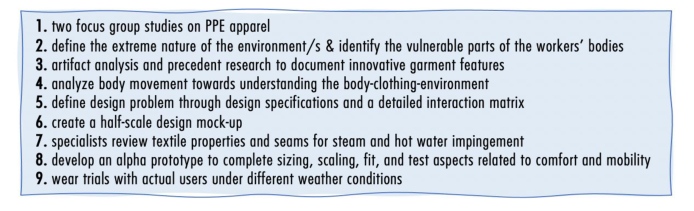
Figure 1: Overview of nine research moments during the design of apparel to protect against steam & hot water.
separate trousers and top, which represented the designer’s value for tailored clothing and separates. At this early stage, it would have been impossible for any design to consider the needs, wants, expectations and desires of our user group because the complexity of the situation had not emerged yet. However, as a team we were able to deconstruct the values we unconsciously included which made it more possible to discern ideas for the user from ideas for the designer.
The designers kept track of their own feelings by journaling. The goal was not to create viable design ideas, rather it was about designers using reflection to understand their values. Journaling has been used by anthropologists to aid in reflecting on research scenarios, situations, participants, and oneself (Bernard, 1995) and reflexivity in research on apparel is on the rise (Rice, 2009). A third way that we got at the assumptions of our design team was ‘walking in the shoes’ of the workers we were designing for. This understan- ding the workers points of view was through a form of empathic modeling (Eilouti, 2009). Our team visited the various worksites where we wore a full kit of safety gear including street clothes under coveralls, steel-toed boots, hardhat, gloves, safety eyewear, earplugs and/or earmuffs, and a waterproof jacket-pant combination when doing tasks that exposed us to steam and hot water. By wearing this kit of gear for extended periods of time, it became clear what assumptions and biases each of us had about the nature of clothing in general.
The second level of designing is about finding out as much about the design problem as possible through a variety of methods over time. There were nine distinct research moments that involved gaining access to the lived experiences of the workers; taking an artifact-based approach by looking at precedent; using sketches, mock-ups and prototypes with users and manufa- cturers to gain insights into the specifics of safety apparel design; analyzing photos that were taken on-site and of workers in their apparel; and textile analysis including seam analysis. Figure 1 provides an overview of the nine research moments and the various techniques employed.
The first moment of our process began with two focus group studies on worker perceptions of their PPE with a particular emphasis on apparel. The aim was to have an early impression including any biases this specialized group of users might have. One of the outcomes was a clearer understanding of what kinds of things they would and would not wish to adopt (styles,
30 Strickfaden and Thomas
fabrics, fasteners, etc.). Design outcomes ultimately needed to be flexible to consider different ways of wearing, using, and engaging with apparel.
The second moment was a more extensive research endeavor geared tow- ards beginning to define the extreme nature of the workers environment/s. Field observation was done at multiple plant and field site work environ- ments. Workers with different jobs were observed to get at the various tasks and hazards that they are exposed to. Field observations took several mon- ths with extensive fieldnotes and thousands of photographs taken by multiple members of the team. These observations revealed information that had been unknown to even the safety supervisors who thought they had an intimate understanding of the workplace and workers. Another major outcome of the observation was identifying the vulnerable parts of the body of the worker and the relationship between worker-clothing.
The third moment was doing artifact analysis (i.e., what people currently use) and precedent research (Eilouti, 2009; Oxman, 1994). We developed a systematic method (Yu et al., 2011) perusing the market for workwear, outdoor wear, and sportswear to document innovative garment features such as combinations of different fabrics in one garment, venting at the underarm, elastic/drawstring at the waist, divided pockets and more towards designing a better jacket. This focus is like looking at trends but involves a more in- depth analysis of the minute details of designs that are near and far from the task at hand. Artifact analysis was done independently and with some of the project stakeholders (e.g., safety supervisors, manufacturers).
The fourth moment involved analyzing body movement through photo- graphs taken of workers in positions that related to their work tasks. This need emerged from observations in the second moment and so we spent time towards understanding the body-clothing-environment relationship in this phase. We gained a great deal of information here about ease, bulk of layers, restrictions due to additional PPE and more.
The fifth moment was about defining our design problem by creating recommendations. Here, we created design specifications and a detailed inte- raction matrix mapping out the web of information we had acquired. We took our results to our stakeholders for discussion to ensure the design direction was clear.
Moment six was our first attempt at creating a design (beyond documen- ting our preconceptions in early sketches). A half-scale mock-up was created for the sake of dialogue and to emphasize the design as a work in progress rather than a finished product.
The seventh moment of research involved other specialists who looked at textile properties and seams for steam and hot water impingement. This research by textile analysts and engineers was crucial to being able to design or select appropriate fabrics.
The eighth moment in our research involved developing an alpha pro- totype to complete sizing, scaling, fit, and test aspects related to comfort and mobility. A local company specializing in safety apparel manufactured the prototype, applying industry standards to the design.
Finally, our ninth research moment involved taking the prototype to wear trials with our user group and getting feedback. Actual users engaged in
Designing in the Wild Problem Solving Specialized Apparel Design 31
the wear trials for an extensive period under different weather conditions with different participants before creating a final beta prototype that went to manufacture.
DESIGNING IN THE WILD AS AN APPROACH FOR PROBLEM SOLVING Designing in the wild is a two-level process with multiple other phases within. It is iterative, dynamic, and fluid and will never be quite the same with each project. First, we must acknowledge that we all have intimate experiences with a variety of artifacts throughout our lives, which makes it easy to begin to believe that our opinion is the same as others. Consequently, knowing oneself to design for others is crucial. Second, this process takes time: over the project and as the designer matures. The more we teach young designers about how to recognize and acknowledge their own needs, wants, expectati- ons and desires about artifacts they are more able to explore those of other people’s. This sets up a kind of compare and contrast that happens on a heightened level of awareness that deepens the understanding of others by sensitizing designers away from their own needs and towards the heteroge- neity of human experience. Third, designing in the wild takes an in-depth more holistic approach that acknowledges complexity and brings together designer, user, use and artifact. The design problem is explored from a vari- ety of different angles through artifacts (similar and different from the target), the various stakeholders (users, bosses, manufacturers), and use-scenario and contextual environments (dynamic, varied, multiple, relative to the human body). The complex web or network of the person-artifact-environment is examined and triangulated to determine the most meaningful ways to deve- lop the new design. This approach considers the whole person: how they feel in their bodies including all the human senses, how they feel in their clothes in motion, and how these clothes create that portable environment that creates an interface with the context.
CONCLUSION
Designing is a juggling act that requires a combination of thinking, doing, problem solving, researching, and acting on requirements. It requires foresi- ght and judgment, the ability to enquire and ask questions, the need to be critical about oneself and the worlds of others. Further, it is useful that the designer feels empathy, understands different ways of being, and can think on their feet. Although this is not an exhaustive description of designing, it provides an impression that being a designer or part of a design team requires an integration of intellectual, physical, and emotional skills.
Designing in the wild does not involve a straightforward way. It is not a systematic, prescriptive approach where research is placed somewhere near the beginning of the process and testing a prototype is at the end. Designing in the wild assumes that the person-artifact-environment interface is so complex that it requires extensive attention to detail through reflection and primary research from different perspectives on the specialized topic at hand. It also
32 Strickfaden and Thomas
suggests extensive involvement of people at multiple phases during designing. It is an iterative, multi-staged and multi-method approach. While this process is more time consuming than a more static and less layered design processes, the rewards are significant - more viable, innovative, and sustainable designs. In this way, the end-users’ needs, wants, desires and expectations are empha- sized, incorporated and demonstrated into designs that are more meaningful. The end result of designing in the wild is apparel that is created for people by people, which means the problem solving process acknowledges the web of variables related to people and their clothing.
ACKNOWLEDGMENT
The authors wish to thank Sihong Yu, Sara Olsen, and Indu Sunder for their contributions to the design of the apparel to protect from steam and hot water.
REFERENCES
Ackerman, M.Y., Crown E.M., Dale, J.D., Paskaluk, S. & Song, G. (2011). Project update: Protection from steam and hot water hazards: Research in progress. 3rd Annual Davey Textile Solutions Inc. Seminar on Protective Clothing System for Safety. Edmonton, Canada, November 16. Balcaitis, R. (2019). Design Thinking models. Stanford d.school. https://empathizei
t.com/design-thinking-models-stanford-d-school/ Bernard, R.H. (1995). Research methods in anthropology–Qualitative and quantitative approaches, 2nd Edition. USA and London: Altamira Press. Callon, M. & Rabeharisoa, V. (2003). Research “in the wild”and the shaping of new
social identities. Technology in Society, 25, 193–20. Eilouti, B. H. (2009). Design knowledge recycling using precedent-based analysis and synthesis models. Design Studies, 30(4), 340–368. Lamb, J. M., & Kallal, M. J. (1992). A conceptual framework for apparel design.
Clothing and Textiles Research Journal, 10(2), 42–47. McDonagh, D., Thomas, J., & Strickfaden, M. (2011). Empathic design research: Moving towards a new mode of industrial design education. Design Principles and Practices: An International Design Journal. 5(4), 301-314. Orlando, J.Y. (1979). Objectifying apparel design. Combined proceedings, Associ-
ation of College Professors of Textiles and Clothing, Inc., Eastern, Central and Western Regional Meetings, USA, 127–132. Ostroff, E. (1997). Mining our natural resources: The user as expert. Innovation, 16(1). Oxman, R. E. (1994). Precedents in design: A computational model for the organi-
zation of precedent knowledge. Design Studies, 15(2), 141–157. Rice, C. (2009). Imagining the Other? Ethical Challenges of Researching and Writing Women’s Embodied Lives, Feminism & Psychology, 19(2), 245-266. Strickfaden, M. & Heylighen, A. (2009). Who are they? Student voices about the
‘other’. Include 2009, Helen Hamlyn Centre RCA London UK. ISBN 978-1- 905000-80-7. Tullio-Pow, S. & Strickfaden, M. (2020). Clothing Taskscape as an Approach Towards Assessment of User Needs. Clothing and Textiles Research Journal, 40(3).
Designing in the Wild Problem Solving Specialized Apparel Design 33
Watkins, S.M. (1988). Using the design process to teach functional apparel design.
Clothing and Textiles Research Journal, 7, 10–14. Yu, S., Glasper, M., Strickfaden, M., Crown, B. & McQueen, R. (2011). Methodology for using Precedent-based Clothing Design. International Textile and Apparel Association (ITAA) Annual Conference, Celebrating Inclusivity & Innovation, Philadelphia, PA. November 2-6, 2011. Yu, S., Strickfaden, M., Crown, B. & Olsen, S. (2012). Garment specifications and
mock-ups for protection from steam and hot water. Shepherd, A. (ed.) Perfor- mance of Protective Clothing and Equipment: Emerging Issues and Technologies, 9th Volume, Selected Technical Papers STP 1544. West Conshohocken, PA: ASTM International. 290–307.
LISTED IN THE AHFE DIGITAL BOOKSTORE CATALOGUE
Explore the complete digital volume
Interdisciplinary Practice in Industrial Design
Read this individual research paper free through the original publisher, or explore the full digital proceedings book.
ISBN 978-1-958651-24-7
Explore this ISBN in the AHFE Bookstore ↗Listed in the July 2026 bookstore catalogue; search by ISBN to confirm current availability · Digital book purchase optional