Agnieszka Ptak-Wojciechowska, Magda Matuszewska, Agata Gawlak (2023). Senior-friendly apartments in the context of professional activation of the elderly. In: Design for Inclusion. AHFE Open Access, vol. 75, pp. 166–173. https://doi.org/10.54941/ahfe1003337
Both in Poland and globally we can observe significant demographic changes triggered by the phenomenon called ‘ageing societies’. According to the data of the Central Statistical Office (GUS), in 2020 there were 9.8 million people aged 60+ in Poland and this number is forecast to increase to 13.7 million in 2050. With the longer life span, we can observe that the period of potential professional activity gets extended. We might assume that people will be working longer and retiring later than in the past. In view of economy, the seniors could partially meet the labour force demand which arises due to disproportionate structure of population in different age groups. With the demand for employees in the working age exceeding the supply, seniors are becoming an attractive alternative. Alongside those trends, the image of a senior in social awareness has changed. Professional potential of the seniors due to their abilities and experience has become widely acknowledged. Professional activation with no age barriers poses a chance for the seniors to longer maintain social bonds, which in turn translates into healthier ageing process. This is further reflected in the increase of the quality of life (in the broad meaning of the term) of ageing societies. With the currently changing working methods, we can find more and more ‘distant work’ job offers that are increasing relying on new technologies. This allows the interested parties to render professional services in their places of residence. At the same time, this trend effectively counteracts the adverse phenomenon of cyber exclusion of people in 65+ age group and extends their options of professional activation. The ageing process is inextricably linked with a decline in the efficiency of senses. It is important for the architecture, and the residential space in particular, to adapt to the changed abilities of its inhabitants in order to mitigate the impact of their physical and cognitive deficiencies. It is vital in the process of supporting good health condition and well-being. Because most of the elderly prefer remaining in their previous places of residence (ageing in place), the residential space should be designed in view of a universal and flexible layout that might be rearranged to adequately respond to any potential deficiencies. As per principle, interior design should be adaptable to reduced motor skills of the residents. The interior of an apartment should be envisaged as a place that can be adapted - if needed - to suit those requiring long term healthcare or rehabilitation. A workplace zone or a gym zone facilitating physical exercises might be perceived as a suitable extension of space and functions of an apartment. Moreover, technology can be viewed as a solution effectively supporting safe and unassisted living in one’s own apartment. Technology stands a good chance to support the physical and psychosocial well-being of residents. The article aims to present recommendations for designing senior-friendly apartments to facilitate their fitness and professional activation, thus, maintaining their good health condition, the feeling of comfort, safety and independence. Carefully designed space, sensitive to physical limitations and abilities as well as personal aspirations, will predetermine the quality of life of an individual and will exert impact on the society as a whole. An apartment should be responsive to needs of inhabitants that change as they age; it shall, furthermore, be age friendly and free of any spatial barriers, as well as activating, supporting and at the same time preventing any stigmatisation and social exclusion.
Senior-Friendly Apartments in the Context of Professional Activation of the Elderly 167
AGEING OF SOCIETIES OR OF APARTMENTS “Designing environment accessible for all groups of users, regardless of their sensory and motor skills seems today the only proper solution (in moral terms)”. (Kłopotowska, 2013)
Average life span has been rising in Poland since 1992. According to the data of the Central Statistical Office, in the years from 1991 to 2016, average life span increased by about 8 years for men (up to 73.9 years) and by about 7 years for women (81.9 years). According to the data of the Central Statistical Office, in 2020 the 60+ population in Poland reached 9.8 million inhabitants and, in accordance with forecasts made by the same statistical office “Popu- lation forecasts for 2014-2050”, this number will increase up to 13.7 million and will represent 40% of the entire population. The 80+ population will reach 3.5 million and thus, as compared to the 2013 data, will double.
As per the last census made in Poland in 2011, almost 4.7 million persons suffered from sensory disorders preventing them from living without any assistance. Half of them were aged 60+ (Central Statistical Office, 2021). According to the WHO report, there are over 1 billion people suffering from dysfunctions (15% of the overall population) and about 110–190 mil- lion young persons aged 15+ that have significant difficulties with copying with their daily routines. The increasing number of people with dysfuncti- ons results among others from the rising numbers of seniors (World Health Organisation & World Bank, 2011). On the basis of forecasts concerning the ageing societies, it can be concluded that numbers of people affected with sensory disorders will be steadily rising. There is no way to reverse or stop this phenomenon.
According to the demographic data, in 2050 the 60+ population will reach 2 billion and 68% of people will be living in cities (United Nations, 2018). As a result of changing global demographics, we need to modify our approach to the design of the living and housing environment of the seniors. The changing needs of today’s and future seniors motivate us to search for such solutions that might facilitate good health and well-being of seniors. In other words, we need solutions that will enable the seniors to live independently and without assistance on daily basis.
Therefore, principles governing the design of inclusive space should be determined by the entire spectrum of characteristics of elderly persons with their lowered perceptive abilities. Such space may actually be conducive to healthy ageing by helping compensate for weaker physical and mental condition of the elderly. Thus, designing senior-friendly space based on under- standing the changing needs can actually promote better life quality and longevity.
NEEDS OF ELDERLY PEOPLE RELATED TO LIVING SPACE “Appreciation of old age and lifting its social status is also necessary in order to be able to provide a creative answer to challenges that the ageing society faces and to look for new roles for seniors in the ever-changing world.” (Chabiera & Tokarz-Kami´nska, 2012)
The processes of physiological ageing are accompanied by progressing chan- ges in sensory performance. In addition to diminished motor skills, impair- ment of the sense of sight or hearing is noticeable to an individual degree. Architectural design should aim to mitigate the physical and cognitive deficits associated with ageing.
Is residential space preventively adapted to this type of gradually pro- gressing impairment? How to design dwellings that are ready for the chan- ging condition of their inhabitants over the years and support them in psychophysical and social aspects?
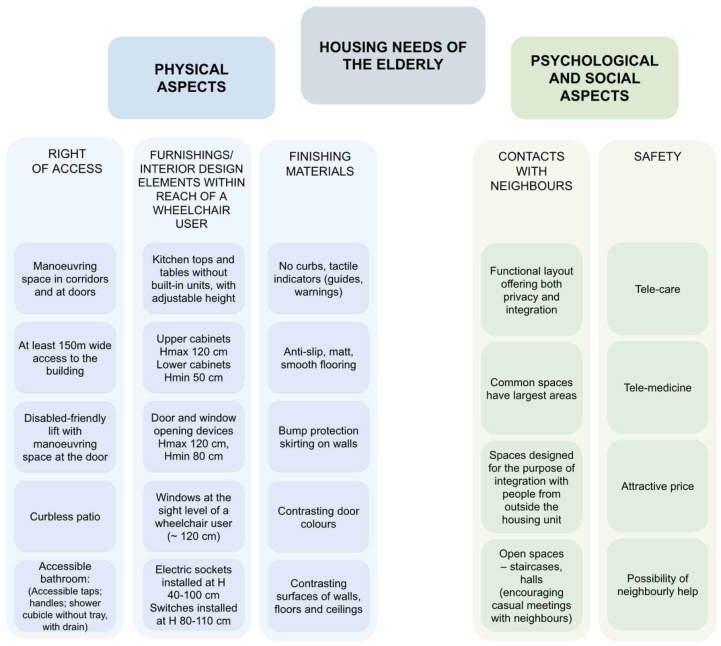
An apartment is a spatial unit that is particularly important in terms of sup- porting health and well-being in older people. Satisfying such needs as sense of safety and comfort has a huge impact on quality of seniors’ life and can make an elderly person feel happier despite health deficits. The programming of residential space for the elderly should take into account a range of defi- ned needs including both physical and psychosocial aspects, the satisfaction of which can be ensured through specific functional and spatial measures (see Figure 1).
Research directly indicates that improved quality of housing, apart from improving the overall quality of life, reduces the number of hospitalisations,
Figure 1: Housing needs of elderly people. (Based on: Kowalski, 2016; Mielcarski and Benek, 2018).
Senior-Friendly Apartments in the Context of Professional Activation of the Elderly 169
and this has an economic impact on the society as a whole (Jackson et al., 2011).
Physical and Mental Aspects The causes of disability, apart from environmental and social factors, are sensory impairments manifested by organ malfunctions or mental disorders. However, it should be emphasised that impairments are not the same as disa- bility (Sen, 1999). Disability, when it relates to specific functioning, occurs when a sensory dysfunction imposes functional limitations on person’s abi- lity to carry out his or her intentions that are not a problem for a reference group (Paszkowicz, 2014). A properly designed space can minimise the dysfu- nction and thus “neutralise” the disability. An important aspect for defining the degree of disability is the disabled person’s individual and subjective assessment of his or her own condition. A living space that fully meets the needs of a disabled person and counteracts limitations will promote a positive perception of one’s own condition.
Aesthetic values are often considered inessential in designing architecture that is accessible and open to all. Yet the need to experience beauty and aesthetics is the need of every human being regardless of their perceptual abilities. Agnieszka Kłopotowska in her text “Invisible architecture - the sta- tus of beauty in non-visual perception of architectural space”emphasises that the sphere of aesthetics, conveying emotions and the language of meanings in architecture should be on the same priority level in universal design as functi- onality that determines the elementary sense of dignity, comfort and safety of the user (Kłopotowska, 2013). For example, functionality and legibility of space is a fundamental requirement for a spatial layout that honours the needs of the blind/visually impaired users. On the other hand, a much more complicated feature of architecture is its beauty experienced also through non-visual perception, going beyond the purely visual sphere.
The Social Aspect As life expectancy figures are on the rise, the number of people with disabi- lities is growing. Among the elderly population there are aged people with congenital sensory dysfunctions and people who acquire disabilities later in life as a result of changes in the body caused by the ageing process. As people age, sensory functioning and psychomotor coordination are adversely affe- cted, fitness and strength decline. As a result of the ageing process, people become increasingly dependent on others. Compared to ageing people whose dysfunctions are congenital or acquired early in life, those who have not pre- viously experienced similar problems may find them even more painful to experience (Gutowska, 2015). Adaptation processes in old age are slower and less effective. In the context of the ‘majority’ criterion, disability is often identified as difference, something outside the ‘normality’ range and thus perceived as negative. Society imposes restrictions on the ‘disabled’ by defi- ning the framework within which they may function (Muca, 2018). Disability can therefore be viewed as deprivation of a potential or function resulting from spatial barriers and impediments related to a specific dysfunction, or
from social constraints when there is discrimination and stigmatisation in interpersonal relations (Mitra, 2006). The elderly must cope not only with retirement from work and loss of loved ones, but also with deteriorating psychophysical condition and diminished social standing. Sensory dysfuncti- ons are significant disability markers in the social context if, combined with a limiting physical environment, they make it impossible for a person to rea- lise a higher goal of being active in society and achieving self-realisation. A person with a dysfunction is thus excluded, despite his or her potential dispo- sitions. It is important to have a social policy in place that emphasises equal treatment of citizens regardless of their degree of disability, promotes socio- professional activation and prohibits discrimination (Terzi, 2005). Equally important, however, is the space itself that should be designed to provide ever- yone with the same opportunities for development and enable independence in performing the widest possible range of activities.
Apartment of the Future as the Senior’s Place of Work According to a number of studies, most elderly people prefer to remain in their homes despite their advanced age. This is because living in a familiar space promotes feelings of comfort, independence and overall well-being. Fol- lowing the idea of “Ageing in place”, housing for current and future seniors should not only facilitate daily motor activities or medical support but should allow for professional self-realisation. To quote Stephen Hawking: “Work gives meaning and purpose, and life is empty without it.” Working late in life is also an opportunity for remaining present in a wider community, i.e., a network of friends and co-workers and staying physically and intellectually fit while benefiting society.
The research carried out in 2015 (Leeson, Nanitashvili and Založnik, 2016) showed a sharp decline in professional activity of people aged over 60 in Poland, which reflects the current retirement model. Less than 60% of Poles aged 55–59 were still professionally active, while in Sweden employ- ment in this age group exceeded 80%. Working Poles aged 60–64 accounted for only 30%, less than half the corresponding figure for Sweden or Norway. In the 65–69 age bracket, the percentage of those still working in Poland was only 13%.
However, it can be expected that the number of working seniors will ste- adily rise, especially since there is still a relatively small number of young workers entering the labour market.
Nowadays, in the era of technological advancement, apartments are incre- asingly often becoming workplaces. The flexible nature of remote work is an opportunity to prolong professional activity and, at the same time, social acti- vity. The functional program of the apartment is extended to include space dedicated to professional fulfilment. Sometimes it is a separate room, a study, sometimes a space more or less separated from the daytime activities area. If the apartment ages with its users, it can be assumed that the senior of the future will need a space in it for stationary and remote work. A well-designed living space has the potential to activate the elderly professionally, reintegra- ting them into society. However, attention should be paid to the skills and
Senior-Friendly Apartments in the Context of Professional Activation of the Elderly 171
competencies of the elderly – those aged over 65, but especially those who will only grow old in another 10 or 20 years.
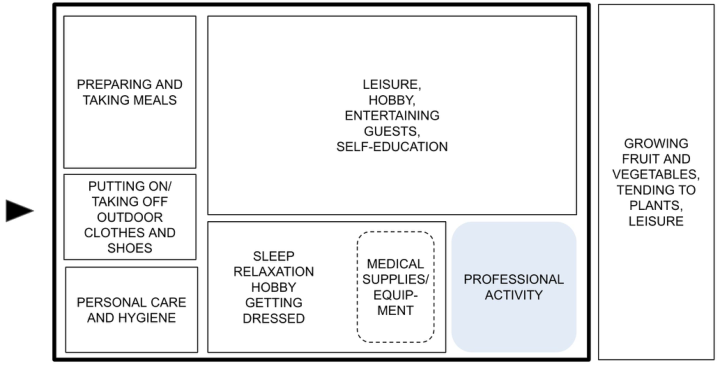
Statistics show a very rapid increase in ICT skills in the general population. The number of people using smartphones, the Internet, and tablets is grow- ing rapidly. Research conducted among the ageing Americans confirms these trends. While in 2013 only about 18% of people aged 65+ owned smart- phones, by 2016 that number had more than doubled, rising to 42%. The number of internet users increased by 55 percentage points over the past two decades. In 2016, already 67% of seniors were using the Internet, and half of older Americans had broadband connections at home (Pew Research Center, 2017). In the near future we are going to live in the information society, in which the ability to use mobile devices, access the Internet or handle information will be very common, also among the 65+ generation. It is likely that the cyber-exclusion aspect will be statistically insignificant. The spread of new skills justifies projected changes in the approach to housing design for ageing populations (see Figure 2).
Figure 2: Simulation of activity in residential space – professional activity (source: own work of A. Ptak-Wojciechowska).
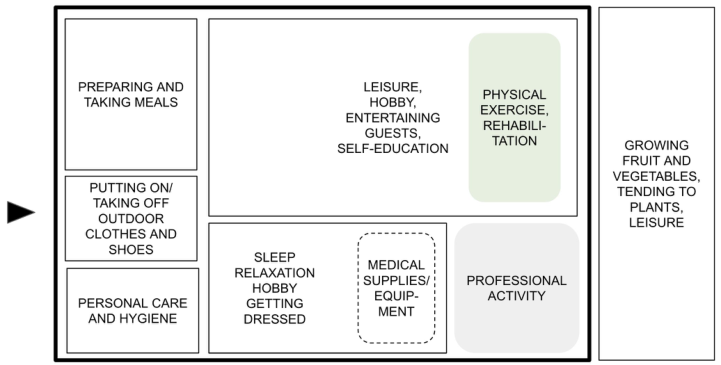
According to the Active Ageing Index (AAI) one of the significant areas other than employment or social participation, is “independent living in health and safety”, which translates into physical exercise, among other things (Chancellery of the Senate, 2019). According to a 2016 CSO survey, 46% of people living in Poland participated in sports or physical recreation (Central Statistical Office, 2017), but only 25.1% of people aged 60+ were physically active, of which 14.5% undertook physical activity sporadically. This alarmingly low result indicates the need to increase physical activity among seniors. In cases where low attendance is due to unwillingness or ina- bility to go outside and attend organised or other out-of-home activities, the possibility of activity at home should be offered by preparing a suitable space
for it. As computer illiteracy drops and the elderly become active users of the Internet, they can benefit from training videos designed for this age group. In addition, the possibility of rehabilitation at home should be included in the design of the residential space, which will be a significant convenience for the elderly (see Figure 3).
Figure 3: Simulation of activity in residential space – physical activity (source: own work of A. Ptak-Wojciechowska).
A highly individualised apartment space can minimise disabilities, inclu- ding those resulting from changes in the ageing body, by fully adapting that space to the needs created by a particular dysfunction. Every meter can be designed with maximum effectiveness by including elements that facilitate the use of the space, activating the resident or at least not creating limitati- ons. It is important that the aesthetics of the supporting elements be discreet, even invisible to outsiders, which will minimise the risk of exclusion on the basis of noticeable ‘otherness’.
CONCLUSION
The changing needs of societies pose new challenges for architects and designers. A living space must fully meet the changing requirements of its occupants and be adequate to the limitations that come with old age. It must support not only the basic activities of daily life but create new opportuni- ties. Such challenges are the new functions of housing and they must be taken into consideration at the design stage in order to create spaces that are not only intended for rest but also for physical activity, rehabilitation or other forms of therapy, health-promoting spaces that take into account the tele- medicine solutions. Finally, spaces that support elderly people’s professional activities at their place of residence. After all, comprehensive and universal design determines the quality of life, which at no stage should be diminished by the functional-spatial shortcomings of the living area. A great opportunity for improving the quality of housing is ICT and telemedicine solutions. Their
Senior-Friendly Apartments in the Context of Professional Activation of the Elderly 173
large-scale application is becoming increasingly possible and feasible because the digital illiteracy among older generations is decreasing. More and more people aged 65+ are users of the Internet, computers and cell phones. Care- ful observation of the ongoing social changes, sensitivity of architects to the variability of needs while implementing new technologies will determine the quality of future housing and satisfactory ageing.
REFERENCES
Central Statistical Office (2017) Uczestnictwo w sporcie i rekreacji ruchowej w 2016 r. Warsaw, Poland. Central Statistical Office (2021) Sytuacja osób starszych w Polsce w 2020 r. Białystok. Chabiera, A. and Tokarz-Kami´nska, B. (2012) ‘Wizerunek staro´sci i człowieka
starego. Postawy wobec starzenia sie˛ społecze´nstw’, in Strategie działania w starzeja˛cym sie˛ społecze´nstwie. Tezy i rekomendacje. Rzecznik Praw Obywatel- skich, p. 124. Chancellery of the Senate, Analyses, Documentation and Correspondence Office (2019) Aktywno´s´c osób starszych. Opracowania tematyczne. OT–672. Warsaw, Poland. Gutowska, A. (2015) ‘(Nie) pełnosprawna staro´s´c – przyczyny, uwarunkowania,
wsparcie’, Interdyscyplinarne Konteksty Pedagogiki Specjalnej, (8), pp. 9–33. Jackson, G. et al. (2011) ‘Reduced acute hospitalisation with the healthy housing programme’, Journal of epidemiology and community health, 65, pp. 588–93. Kłopotowska, A. (2013) ‘Niewidzialna architektura - status pie˛kna w pozawzro-
kowej percepcji przestrzeni architektonicznej’, in Miasto-Zdrój. Architektura i programowanie zmysłów. Warsaw, Poland: Fundacja Be˛c Zmiana, p. 78. Kowalski, K. (2016) Projektowanie bez barier - wytyczne. Warsaw, Poland: Stowarzyszenie Przyjaciół Integracji. Leeson, G., Nanitashvili, N. and Založnik, M. (2016) ‘Foresight Trends: Future of
an Ageing Population’ Research Report. Mielcarski, M. and Benek, I. (2018) ‘Mieszkanie Seniora – Bytomski Model Doste˛pnego Mieszkalnictwa’, Lab60plus, 10 September. Mitra, S. (2006) ‘The Capability Approach and Disability’, Journal of Disability
Policy Studies, 16(4), pp. 236–247. Muca, K. (2018) Niepełnosprawno´s´c jako inno´s´c : popularny dyskurs o braku sprawno´sci w ´swietle kulturowych bada´n nad niepełnosprawno´scia˛. Kraków: O´srodek Badawczy Facta Ficta. Paszkowicz, M. (2014) ‘Niepełnosprawno´s´c w ´swietle koncepcji zorientowanej na
ludzkie mo˙zliwo´sci’, Prakseologia, pp. 205–224. Pew Research Center (2017) ‘Internet & Technology’, Pew Research Center. Available at: https://www.pewresearch.org/topic/internet-technology/ (Accessed: 30 January 2023). Sen, A. (1999) Development as freedom. 1st ed. New York: Knopf. Terzi, L. (2005) ‘A Capability Perspective on Impairment, Disability And Special
Needs’, Theory and Research in Education, 3, pp. 197–223. United Nations. Department of Economic and Social Affairs. (2018) World Urbanization Prospects: The 2018 Revision. New York, NY, USA: United Nations. World Health Organization and World Bank (2011) World report on disability. Avai-
lable at: https://www.who.int/teams/noncommunicable-diseases/sensory-functio ns-disability-and-rehabilitation/world-report-on-disability (Accessed: 30 January 2023).
LISTED IN THE AHFE DIGITAL BOOKSTORE CATALOGUE
Explore the complete digital volume
Design for Inclusion
Read this individual research paper free through the original publisher, or explore the full digital proceedings book.
ISBN 978-1-958651-51-3
Explore this ISBN in the AHFE Bookstore ↗Listed in the July 2026 bookstore catalogue; search by ISBN to confirm current availability · Digital book purchase optional