Moyen Mohammad Mustaquim (2022). Accessibility Passport Model for Designing Inclusive Games– A Requirement Engineering Viewpoint. In: Advances in Ergonomics In Design, Usability & Special Populations: Part II. AHFE Open Access, vol. 19. https://doi.org/10.54941/ahfe1001243
While disability and other types of user exclusion issues are evident in society at present and thereby universal design is a key concern in design society, less effort towards inclusive games design is obvious. Designing inclusive games are authoritative and it would therefore be important to recognize any framework or model that could be followed to come up with any well-adjusted inclusive games design solution. In this paper an accessibility passport model for inclusive games design was proposed. The model was based on and originated from a requirement engineering model for inclusive games design which was also presented. The accessibility passport model was combined with the requirement engineering model together with different accessibility passport features which could be suitable for inclusive games design as projected in this the paper. The accessibility passport features and model were then discussed within the context of sustainable system design and a new concept of universal design, where usability augmentation was prioritized through the practice of universal design by considering further than the scope of accessibility issues only intended for triggering the innovation process for future games design.
Design for all awareness has been popular for a notable period of time with a moderately small market potential. This is because most designs aiming for universal design standard would often base on the standard user and specific business group (Bühler, 2008). Research on design is more and more focusing on generating additional values to the end designed product or service allowing the organizations to participate in competitive innovation process. Accumulation of new values through design from general consumer products to software is clearly evident in today’s market. Computer games have taken a major shift in last decades and it surely is not considered anymore to be an entertainment element for children only. Game design has been a major research interest and many different aspect were looked into game design research while overlooking some. Computer games has different potentiality namely using games as learning tool in today’s society. Online gaming community became a massive industry now which also is a focus of several research groups. Computer games were often used as a good training tool for the use of assistive technology- for children as well as for adults after accidents and chronic diseases (Archambault et al., 2008), and thus in addition considerable contribution through game playing was noticed in the field of HCI for understanding different skills. However use of universal design concept or the design for all strategy for designing ‘‘accessible games for all’’ was seldom noticed. Not because of physical disabilities but also for social, political and even personal exclusion could affect different groups of people towards using an important service like games. A call for designing games with enhanced properties like rewarding experience, combining low-threshold interaction styles with content was therefore addressed in the work of Ijsselsteijn et al. (2007), for engaging elderly adults in playing games. Therefore it would be important to focus on the inclusive design issues of games. Although deriving some standardization for inclusive games design could eventually be the goal of inclusive games research, it is a very difficult process and would not be scope of this paper. User participatory development could lead better design for a specific user group and through the power of internet accessibility passport concept could become more and more widely used to act together between users and developers. In this paper an approach of designing inclusive games for a true practice of universal design for gaming was addressed. A standard model for accessibility passport for finding the proper user requirements was the topic of research addressed here. The accessibility passport model was proposed and discussed which was based on a requirements analysis framework that was also discussed in the paper, combined together with different accessibility features.
BACKGROUND
The Accessibility Passport The accessibility passport could be described as a way where developers and users could create a focused dialogue through communication with each other through the use of internet. Divers users from multiple resources that are available online often offer the developers a way of understanding, through which developers could get a clear different pictures of accessibility requirements during designing different systems (Ball and Sewell, 2008), for instance computer games. Also it could be seen as a way of giving feedback from users after they have used the end design. Like online document (ex. a wiki) it could be editable at different stages by people involved in the process. Anyone involved in the whole process could design, specify or create a program. Accessibility passport could contain different information about a specific material (ex. computer games) as a reference point. In this respect it could be thought as a type of metadata. But unlike most of the metadata accessibility passport could be delivered using everyday language and would be available for many different stakeholders (ibid.). Usually people in charge for content production would hold certain obligation and their responsibilities could be concerned over how they inscribe, segment or distribute the materials that they would produce. Although at present there is no standard method that could be followed for designing accessibility passport, it is important to realize the right method since many different people involved in the process would be using the materials and which way others would handle them should be accurately informed through a proper method.
Inclusive Design Inclusive design could be defined as the design of any mainstream product which could be accessible and used by reasonably possible number of peoples (British Standard, 2005). While these people would use the product, there should not be any special need for special design or adaption. Inclusive design aiming for better design is very popular in the design world for improving the experience of product towards a broader range of users. Usually this concept should be embedded within the design and development process. This would result improved designed product for higher usability, usefulness and ultimately user satisfaction. The desirability of using the product should also be increased by including inclusiveness in a design. Sometimes design for all and inclusive design holds similar meaning to universal design, especially in Europe.
Inclusive Games-Why?
Games became an important part in present culture which is not really limited for children only. However at present most of the children in developed countries have good knowledge of playing different types of games (Archambault et al., 2008). Although games usually were used by a massive amount of population including especially young adults, the proportion of players is also growing in different age groups. One in five between 51 to 65 years old in UK were found to be participating on playing games in a study by Pratchett et al. (2005) while a study from Entertainment Software Association (ESA) in USA found, 19% Americans over 50 years old to be participating in playing games which was an increase by 9% from 1999, whereas this number increased 25% in the year 2005 (ESA, 2005, 2006), (Ijsselsteijn et al., 2007). Although senior or older people usually play games less than the young people and any proper statistics of how many people over 65 are involved in game play is not well known, the reasoning behind this could not be stated as just a lack of interest on gaming but that the technology could also sometimes be difficult to use for old people (Ijsselsteijn et al., 2007). As we grow older there are different changes in our visual, cognition, motor and hearing system and therefore these could remarkably effect the different requirements of interface design for a computer system like games. Standard universal design principles like simplicity and intuitive design are typically followed by designers to design improved interfaces for the older adults to reduce their cognitive load which seem to work at a certain extent. But games could be used not only as an entertainment tool for the older adults but issues like social inclusion (online or real life), social support etc. could be some of many hidden potentials in playing games for them. Many people with different types of physical disabilities are often left out from participating in playing games because of the issues related with games accessibility and also not finding games that were properly designed for them (Archambault et al., 2008). As soon as the scope of games extend its traditional purpose of use for the older adults (ex. research showed different importance of playing games for older adults), the interface design requirements would also change according to that. In their literature review for example, Ijsselsteijn et al. (2007) stated that, it was found from the study of Drew and Waters (1986) that, hand-eye coordination could be improved for older adults while playing video games. Also a trial was reported on 95 elderly adults with average age of 80, where the memory and attention of the subjects were considerably improved while they regularly played a game designed for improving brain functions (Miller, 2005). Therefore reasoning behind playing games for older adults were not only limited within the scope of socialization, entertainment or learning something but it has different health benefits for them too. So together the lack of any interest due to technological disinterest and other functional limitations would make many older adults to be excluded from playing games. These reasoning could work for determining the usability of the games design for older adults, for which they often struggle than any other user groups like young people. There could be two alternative solutions for this. One is to design games exclusively for older adults where many different functions could be sacrificed and games could be customized just for them. This way games could be limited and customized for the specific need and interest of the focused user group. However another alternative is to design games inclusively where the older adults with certain limitations would be under consideration during design process and that way the focused user could experience game playing like any typical regular user. Although this kind of games accessibility issue has initially been considered as a field with minor importance since there were other more serious issues to focus on (Archambault et al., 2008), a change of attitude towards this was noticeable since the middle of 1990s. Since then a lot of work has focused on improved design for older people like making office computer applications accessible and computer games should therefore not be an exceptional design issue either. Traditionally game designers typically follow a set of accessibility guidelines and often designers are unaware of the proper user requirement. User involvement in understanding their requirement and need could therefore help the designers understand the proper design principles for designing games for elderly adults. The importance of designing inclusive games is therefore imperative considering the fact of demographic trend, age gap, and tomorrow’s technologically inclined people’s longevity in life.
Importance of User Participation in Inclusive Games Design Since the 1960s it has been generally acknowledged that, user participation in the Information Systems (IS) development process would increase the likelihood of a project success (Terry and Standing, 2004), (Barki and Hartwick, 1994), (Foster and Franz, 1999). User involvement is likely to result in increased user satisfaction (Terry and Standing, 2004), (Garceau, Jancura and Kneiss, 1993) and the perceived usefulness of the application (Terry and Standing, 2004), while Foster and Franz (1999) emphasized user involvement need by focusing on the need for user involvement in the early stages of development stating that, “Managers should actively seek user involvement in systems development activities.” This argument could be related in game design. If user participation could become more active into computer games design by allowing and including more users to participate into the requirement analysis phase of games design, the design of a game to be more inclusive would be highly possible. However it is therefore vital to understand the specific user group. Also to understand what could be different factors that would influence user group for not involving themselves in to the game development process, could be another issue to watch out. To conclude, if user involvement in computer games design could be increased by the design for all metaphor the designed games would become authoritative for leading towards inclusiveness.
FRAMEWROK Requirement Engineering Model
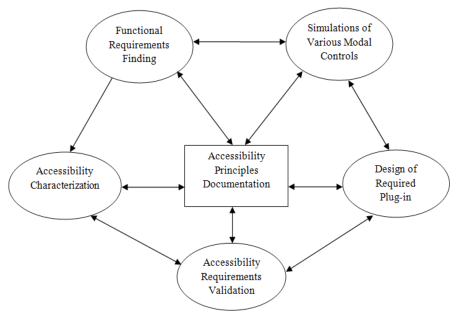
Typical requirement engineering in system development is a cynical process which involves four activities: elicitation, specification, validation and negotiation. As the requirement analysis here aimed to find needs from a focused group for creating a program (inclusive games) aimed for focused user group, the requirement analysis framework could be viewed from the games accessibility specifications perspective. The functional requirement characterized the accessibility along with the typology of game interaction situations and these were the primary requirements to find. Based on the research by Summerville (2005), the requirement engineering model for inclusive games design could be viewed as the following four individual processes:
Plug-ins for various game development environments and platforms
Documentation of the accessibility principle fetched from users
Validation of the required accessibility requirements and
Simulation apparatus for different modal control simulation (voice, gaze, gesture, color test)
Figure 1: A Framework for Requirement Engineering Process of Inclusive Games Design (Adapted from
Summerville (2005)).
The accessibility passport features described in the next section could enable users to participate in a crowd sharing platform and the functional requirements could thus be found from the user. The accessibility issues then could be characterized and the documentation for accessibility principle could be updated with these information. If necessary, the functional requirements could be found for future development with the help of this documentation. The next step would be to validate the requirements of the accessibility that was characterized previously. The validation process would lead towards creating required plug-ins and could do simulation using different human modal controls such as voice, gaze, and gesture. At any point the failure of validation of the requirement would reverse the process of plug-in design and simulation. Also the documentation could be updated with each steps of validation, plug-in design and simulation. Off course at any time of the future design work, the documentation would be helpful for finding or analyzing any information from users.
Accessibility Passport Features- Inclusive Games Design Viewpoint Often it is important to reduce the number of different factors that are to be studied (Tait and Vessey, 1988). Therefore rather than attempting to investigate all factors effecting user involvement and its impact on systems success, the proposed accessibility passport model provided a structure within which to examine the concepts that were central to influence the user involvement towards the system success.
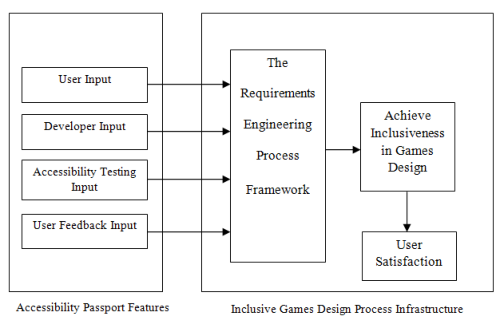
Four different inputs were considered to classify the features for the proposed accessibility passport model.
User Input
Developer Input
Accessibility Testing Input
User Feedback Input User Input
The inclusive games player would specify their requirement in gaming that would reflect their accessibility requirements. This could include addition of a specific technology or pre-defined accessibility requirements. Ergonomics In Design, Usability & Special Populations II
Possible different questions from the user end could be:
For whom the game would be indented?
How difficult it would be to learn using the program?
What would be the price of such games?
Would the game reflect any focused accessibility objective or any standard accessibility objective?
How much physical effort would be needed for using the game program?
Would the game application require use of special technology or device?
Developer Input The developers would provide detail information on what kind of design and end game system they would be able to give to their users and what kind of pre-learned knowledge, method or tool they would be using that for development. It is also possible for the developers to provide information about their past experience of designing games with similar or diverse accessibility properties. This would give user a clear idea what to expect from the developer beforehand. Possible different questions from the developer end could be:
What way the game would be delivered? Online, storage media etc.
What might be the difficulties of learning the game?
Would the game program suitable for a particular disable user group or would it generalize several groups?
Would the game designer consider other types of inclusions rather than physical disabilities or not?
What kind of special input device might be needed to control the newly designed games and would it be mandatory to use such new input device? What kind of exclusion users could face if they disagree or fail to use that special input device?
Accessibility Testing Input After the user testing of the game is done the accessibility issues would be queried from both users and developer’s side since this would be very important before getting proper user feedback of the game which the developers designed for a specific user group only. Possible different questions from both user and developer end could be:
How was the test for accessibility designed and conducted?
What was the result of the accessibility test? How was the result evaluated by the developers?
What would be the outcome of the result? Would there be any resources that are going to be changed because of the result? Were any guidelines for using games used for conducting the test or not?
Was the result matched with the projected result?
Was the accessibility test successful for a particular or general accessibility issues?
User Feedback Input Finally it is also important to realize that an accessibility passport feature should reflect the ability of users to give feedback about the inclusively designed games that they would be playing for further enhancement of the features and thereby future design. This would help in turn for finding the different new functional requirements. Possible different questions for the end users could be:
Was the games designed for them flexible enough to play?
Did the user feel psychologically included into the game community?
Is the game worth for recommendation to others by its players?
What kind of physical or any other types of accessibility issues were solved through the design of the game that the users were playing?
How difficult the learning process of the game was? In which respect the difficulty was related to the new or special input control device and the specially designed game interface?
PROPOSED MODEL The accessibility passport features could be combined with the proposed requirement engineering model and would result an accessibility passport model for inclusive games design which was showed in Figure 2. By choosing contextual and appropriate accessibility passport features through the four inputs, different phases of the requirement engineering model could be altered for improved performance. With proper information required information in hand the requirement engineering process would be in action to result successful design of inclusive games which in return could achieve user satisfaction.
Figure 2: Accessibility Passport Model for Inclusive Games Design.
It is important to understand that the requirement engineering process framework could be customized for keeping in mind that the process should find requirements feasibly for designing inclusive games. Also the accessibility passport features proposed here were not necessarily static in nature. Depending on the type of design, accessibility passport could be modified and if necessary improved. Hence the success of this model to design optimal inclusive games would depend on how the accessibility passport features would be used to initiate the requirements engineering process and vice versa. While user satisfaction could surely help enhancing the accessibility passport features after the iteration of the whole process, it is important to pick right features from the accessibility passport for right design and for a smooth requirement engineering for resulting a properly designed inclusive games.
Sustainable Games, Innovation and Universal Design The proposed requirement engineering model and the accessibility passport features were the basis of accessibility passport model which could contribute in understanding sustainable system design and a broader concept of universal design in an expanded way. While traditionally universal design was practiced within the scope of accessibility domain, a new way to observe the practice of the notion of universal design could be to focus on different factors during system design for adding enhanced functionalities and thereby providing enhanced usability to the users and this could also reflect the necessity of adding values in design. Disability could be one of the properties to differentiate a user group but universal design should not only be limited within this scope of interest. Figure 2 showed how user satisfaction level could be enhanced after achieving inclusiveness in the design. User satisfaction could be thought as one of the different parameters that could define universal design in an extended way. Together with this and other parameters that could be contextually worthwhile for a design (games in this case) could then enhance the overall usability of the end system. This concept of universal design is highly promising in present HCI research since focusing universal design beyond the scope of disability issues only could contribute improved end design and thereby could trigger interest for the organizations to practice universal design, which unfortunately at present is not so much noticeable. Designing inclusive games system could also be perceived in a different way through this universal design concept and that could be how to design sustainably. While the traditional understanding of sustainability is more or less limited within the ecological scope of interest, HCI looked sustainability issues mainly on how to design user interfaces to promote sustainable actions where the sustainable actions were primarily identified as ecological features. However a different way of looking into the sustainability issues could be through the context of universal design’s new concept. A truly universally designed system should promote sustainability or in another words it could be stated that, no design could be sustainable if it is not
universally designed or vice versa. The proposed accessibility passport model as presented in this paper is in a very abstract level and it was the intention of the author to show how this model could be used for successful design of inclusive games. However, a short discussion for the understanding of the impact this accessibility model or features could play on innovation would be necessary to understand the practical implication of the model. Universal design while considered to look into the out of box scope of interest like disability or design for elderly, an important feature could be summarized as result which would be adding certain values to a product or service through this design. Why would future consumers purchase a product or choose a product to use should be an underlying question organizations could ask for creating successful product or service. One way to enhance the value of a product could be building universal design or universality into it. That is, by adding certain different parameters a design could be expressing certain features as an added value. This could trigger innovation in a positive way. While technology driven innovation is highly evident today, design driven innovation could be a key for adding values on future products or services. By pulling ideas from research, organizations could innovate through research driven innovation which often usually is a slow process. Focusing on design and thereby innovate new products could be a key for organizations. Therefore as the population of the earth grows older, over time there will be more elderly people living than more young adults and many of those elderly adults would be technologically inclined and would not want to be excluded from playing games just because of the design issues. Successful innovation on games for the future population majority could be triggered through design driven innovation practice to fill the gap between research and industry. The underlying concept of the accessibility passport features and the model presented in this paper therefore reflects this message. The accessibility passport features presented in this paper could be viewed as adding factors that would make a design process smoother to make the end product more usable. The concept of sustainable HCI as addressed could be reflected through this. The design process could sustain over time in a way that the end product could be enhanced and improved over and over again based on the features of accessibility passport which could be improved continuously. Different inputs illustrated in figure 2 could create and change the feature database which would define the sustainability of a system (games in this case). The concept of universal design that could be explored out of the scope of disability could be reflected here since achieving inclusiveness in a game design is a complex thing and different factors out of the scope of disabilities could be considered to define the contextual inclusiveness properties of a game. The requirement engineering process is an iterative process which could include different factors in the process that could be learned over the iteration of the process.
DISCUSSIONS The requirements engineering for a special target domain (inclusive games design in this case) is a very complex thing to come up with. The four stages described in the requirements engineering would surely would involve time and resources to run them successfully. Since accessibility feature selection could define the success of the requirement engineering picking up the wrong features would result poorly designed games which would not serve the actual purpose of using accessibility passport features in the design process. The model shown in Figure 2 is a continuous process. The satisfied users would have impacts on requirement engineering process and they in turn could be responsible for update or modify accessibility features for improved future games design. Although from designer’s standpoint inclusive games could be designed successfully without ultimate user satisfaction, it still could remark good feedback for changing accessibility passport features. This would loop back the whole process for achieving improved user satisfaction. User input thus could have higher impact for a successful design of inclusive games and as mentioned earlier since this is an iterative process to see the developer’s impact the whole process would therefore need to run multiple time.
FUTURE WORK
Empirical analysis of the proposed accessibility passport model is the next first step that should be taken from this stage of this research. This would be able to understand and return new parameters for accessibility passport features and find any flaws on requirement engineering model. Also the proposed model could be analyzed in different ways. How the requirement engineering model behaves with a set of accessibility passport features would be interesting to observer and this could contribute in building a database for the accessibility passport features for inclusive games design. User satisfaction level could be compared by running empirical studies between two different genres of games design inclusively. Collecting data from disabled users group by letting them play specific games that were designed exclusively for them following this framework would also be interesting to observe. Analyzing the proposed model’s quantitative data with multiple results could find other new parameters that could be important to be included for improving the requirement engineering model. Such research are already on the way initiated by the author.
CONCLUSIONS
The strength of this paper was the presentation of a combinatorial model which was important to understand for practicing and achieving inclusiveness through universal design for an important platform like games in today’s society. Few interesting research issues were highlighted here which would be worth for further investigation. Universal design is real, substantive and responsive to a fact that no design could be truly sustainable without being universally designed where the reality of human assortment in age and their different capabilities would be the primary attention and games design could not be any ignored. The true potential of games for elderly users are promising and unfortunately this has not truly explored or realized yet. Games could reflect a therapeutic value (Ijsselsteijn et al., 2007) for the elderly adults and since technology used for communication could play an important role for older adults while technology could make them perceive that learning or using it could be benefited for them (Melenhorst, 2002), inclusive games could be a motivation for attracting older adults for this purpose as the accessibility passport guidelines and model presented in this paper could result improved designed games for initiating this motivation. Simultaneously it would also be critical to examine whether a game that was designed following such requirement engineering framework and accessibility passport features could actually construct a system that would be inclusively designed and usable at the same time for the target group of users. Sustainable games design where the concept could expand beyond the scope of ecology only and adding additional values in design for triggering design driven innovation could thus contribute towards understanding the new concept of universal design for expanding the scope of usability enhancement and this therefore could be justified and reflected through the practice of accessibility passport features and model for designing inclusive games.
REFERENCES
Archambault, D., Gaudy, T., Miesenberger, K., Natkin, S. and Ossmann, R. (2008). Towards Generalized Accessibility of Computer Games, In: Proceedings of the 3rd international conference on Technologies for E-Learning and Digital Entertainment, June 25-27, 2008, Nanjing, China. Ball, S. and Sewell, J. (2008). Accessibility Standards Are Not Always Enough: The Development of the Accessibility Passport,
in Proceedings of the 11th international conference on Computers Helping People with Special Needs. Springer-Verlag: Linz, Austria. p. 264-267. Barki, H. and Hartwick, J. (1994). Rethinking the concept of user involvement, and user attitude. MIS Quarterly, 18 (1), 59-7. British Standard 7000-6:2005. Design management systems - Managing inclusive design – Guide. Bühler, C. (2008). Design for All – from Idea to Practise, in Computers Helping People with Special Needs, K. Miesenberger, et al., Editors. Springer Berlin / Heidelberg. p. 106-113. Drew, B. and Waters, J. (1986). Video games: Utilization of a novel strategy to improve perceptual motor skills and cognitive
functioning in the noninstitutionalised elderly. Cognitive Rehabilitation, 4, 26-34. ESA (2005). Essential Facts About the Computer and Video Game Industry; 2004 Sales, Demographics, and Usage data. Entertainment Software Association (ESA). ESA (2006). Essential Facts About the Computer and Video Game Industry; 2005 Sales, Demographics, and Usage data. Entertainment Software Association (ESA). Foster, S.T. (Jr.) and Franz, C.R. (1999). User involvement during information systems development: A comparison of analyst and user perceptions of system acceptance. Journal of Engineering and Technology Management, 16, 329-348. Garceau, L., Jancura, E. and Kneiss, J. (1993). Object oriented analysis and design: A new approach to systems development.
Journal of Systems Management, 44, 25-33. Ijsselsteijn, W., Nap, H. H., de Kort, Y. and Poels, K. (2007, November). Digital game design for elderly users. In Proceedings of the 2007 conference on Future Play (pp. 17-22). ACM. Melenhorst, A.-S. (2002). Adopting communication technology in later life. The decisive role of benefits. PhD Dissertation,
Eindhoven University of Technology. Miller, G. (2005). Society for neuroscience meeting: Computer game sharpens aging minds. Science, 310, No. 5752, p.1261. Terry, J. and Standing, C. (2004). The value of user participation in e-commerce systems development. Informing Science: International Journal of an Emerging Trans-discipline, 7, 31-45. Pratchett, R., Harris, D., Taylor, A. and Woolard, A. (2005) Gamers in the UK: Digital Play, Digital Lifestyles. London: BBC. Sommerville, I. (2005). Integrated Requirements Engineering: A Tutorial. IEEE Software 22(1):16-23. Tait, P. and Vessey, I. (1998). The effect of user involvement on system success. MIS Quarterly, 12(1), 90-107.
LISTED IN THE AHFE DIGITAL BOOKSTORE CATALOGUE
Explore the complete digital volume
Advances in Ergonomics In Design, Usability & Special Populations: Part II
Read this individual research paper free through the original publisher, or explore the full digital proceedings book.
ISBN 978-1-4951-2107-4
Explore this ISBN in the AHFE Bookstore ↗Listed in the July 2026 bookstore catalogue; search by ISBN to confirm current availability · Digital book purchase optional