Mikako Tsurugasaki, Namgyu Kang (2024). The Relationship Between Aesthetic Evaluation of Product Design and Purchase Intention in 100-Yen Shops—Focusing on Uniqueness, Humor, and Unexpected. In: Human Factors in Design, Engineering, and Computing. AHFE Open Access, vol. 159, pp. 528–535. https://doi.org/10.54941/ahfe1005619
In recent years, various types of retail shops have appeared in Japan. The popularity of 100-yen shops can be attributed to the low price of 100 yen per item and the high quality of their products, which have won awards for design from Japanese organizations. The gap between "Low Price and High Quality" and "High Quality" is judged to be surprising to consumers. Thus, 100-yen shops are famous for their affordable prices and high functionality. On the other hand, there have been no cases where the relationship between the sensitivity evaluation of 100-yen shop products and willingness to purchase has been analyzed. Therefore, this study aims to visualize and investigate the relationship between consumers' assessment of the uniqueness, humor, and unexpectedness of 100-yen shop products and their willingness to purchase them. Seven participants visited three different 100-yen shops in Hakodate in evaluation experiment 1. The collaborators were asked to photograph each "Unique and Humorous" and "Unexpected" product and describe their reasons for choosing. Then, 281 participants in their 20s to 70s were asked to complete a questionnaire about the 100-yen shop. Then, as part of Evaluation Experiment 2, we investigated how they would evaluate the products using the pictures taken in evaluation experiment 1. The results showed that more than half of the consumers plan what they will buy before they go to a 100-yen shop, but they tend to make impulse purchases due to low prices or buy unexpected items to stock up on consumable items. Moreover, "Unique and Humorous" was strongly related to "Unexpected." On the other hand, "Unique and Humorous" did not lead to "Want to Buy".
Currently, 100-yen shops are attracting much attention in Japan. A 100-yen shop refers to a store where the price of each item is fixed at 100 yen (although some stores may sell items for more than 100 yen). Despite economic recessions, 100-yen shops have continued growing their business
The Relationship Between Aesthetic Evaluation of Product Design 529
and expanded within Japan and globally (Daiso, 2023). In 2023, the domestic market size of 100-yen shops exceeded 1 trillion yen for the first time in history (Teikoku Databank, 2024), making it a genuinely growing industry.
There are two reasons for the popularity of 100-yen shops: First, they have a low price of 100 yen per product. 100-yen shops began to increase their sales in the early 1990s when the bubble economy burst. Therefore, it is thought that one of the reasons for the preference for low-price settings is that the awareness of saving money has increased due to the effects of recession, deflationary tendencies, and tax hikes (Mizuhara, 2020).
Second, the high-quality of the products. Several 100-yen shop products have won the Good Design Awards hosted by the Japan Institute of Design Promotion (Daiso, 2022). Despite their low prices, 100-yen shop products are highly rated for their functionality and innovative ideas. For instance, the “Cardboard Size Adjustment Cutter,” which won a Good Design Award in 2022, was praised by the judges for being offered at an affordable price (Daiso, 2022). Thus, the gap between “Low Price and High Quality”provides an element of surprise to consumers.
On the other hand, price, quality, and product design are believed to influence consumer interest in products. Previous literature has revealed that consumers classify products based on attributes such as “Modernity,” “Simplicity,” and “Playfulness” (Blijlevens et al., 2009). Interpreting “Playfulness” as “Unique and Humorous,” it becomes evident that unique and humorous product designs serve as consumers’ evaluation criteria. As mentioned earlier, numerous studies have conducted aesthetic evaluations of products by consumers. However, no existing case studies analyze the relationship between the aesthetic evaluation of 100-yen shop products and purchase intention.
Therefore, this study aims to visualize and investigate the relationship between consumers’ assessment of the uniqueness, humor, and unexpectedness of 100-yen shop products and their willingness to purchase them.
First, in Evaluation Experiment 1, a small group will visit 100-yen shops to identify which products are evaluated as “Unique and Humorous” and “Unexpected.” In Evaluation Experiment 2, a larger group of participants will re-evaluate some of the products assessed in Evaluation Experiment 1 to analyze and visualize the relationship between aesthetic evaluations and purchase intentions.
Evaluation Experiment 1: Evaluation Experiment on Products in a 100 Yen Shop Evaluation Experiment 1 aimed to investigate and analyze which products in 100-yen shops consumers evaluate as “Unique and Humorous” or “Unexpected.” We visited three well-known stores in Japan: DAISO, Seria, and Can⋆Do.
The participants were eight affiliates from Future University Hakodate. The experiments were conducted on April 19 and April 29, 2024. On April 19, the Evaluation Experiment 1 was conducted at DAISO. Due
530 Tsurugasaki and Kang
to one participant’s incomplete responses, seven participants” data were ultimately obtained. On April 29, the evaluation experiments were conducted at Seria and Can⋆Do. One participant only participated in the experiment at Seria, and data from another participant were excluded due to incomplete responses. As a result, data were obtained from four participants at Seria and three at Can⋆Do.
Participants were asked to take at least three photographs of products in the 100-yen shops they found “Unique and Humorous” or “Unexpected.” They then narrowed the photographs to three to five and described the reasons for their selection.
As a result of Evaluation Experiment 1, 64 data points were obtained for “Unique and Humorous” and 59 data points for “Unexpected.” The written descriptions were then analyzed using text mining. For the “Unique and Humorous”category, the most frequently occurring word was “できる”(can do). On the other hand, for the “Unexpected” category, the most frequently occurring word was “100 ” (100-yen).
Considerations for each category are as follows. For the “Unique and Humorous” category, the frequent appearance of the word “できる” (can do) indicates that participants felt not only visual uniqueness and humor but also functional uniqueness and humor. Additionally, sensory reaction words such as “思う” (think) and “感じる” (feel) were also present, suggesting that designs that move emotions were highly evaluated. For the “Unexpected” category, the frequent appearance of the word “100 ” (100-yen) indicates that participants were surprised by the quality and functionality of the products they chose at that price. Sensory reaction words such as “感じる” (feel) and “ く” (be surprised) were also present in this category, suggesting that designs that move emotions are factors that attract consumers” attention.
Evaluation Experiment 2: Questionnaire and Evaluation Experiment 1 on 100 Yen Shops The Evaluation Experiment 2 aimed to analyze and visualize the characteristics of the selected products with 281 participants. Additionally, we investigated the usage condition of 100-yen shops.
We surveyed the usage condition of 100-yen shops on a Likert scale (with seven scales) to examine participants’ shopping behaviors. First, we asked participants to what extent they plan their purchases when using 100-yen shops and asked how often they end up purchasing items they had no intention of buying. We also surveyed those who have used 100-yen shops to understand their usage patterns.
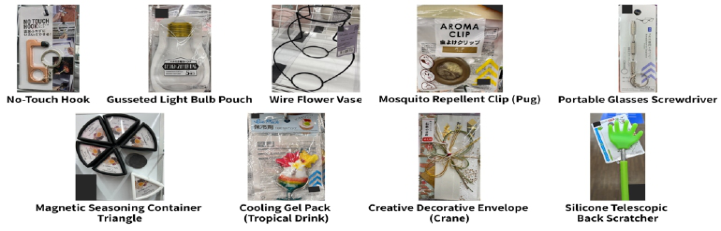
After that, 281 participants evaluated the nine product images. The nine products were selected as “Unique and Humorous” or “Unexpected” in Evaluation Experiment 1 using the following method. Seven research assistants classified the selected 59 product items using the KJ method to avoid combinations of product images with overlapping genres and to choose the appropriate nine product images for the evaluation experiment.
The Relationship Between Aesthetic Evaluation of Product Design 531
We used a grid-scale to obtain an intuitive evaluation of product images. The evaluation items were “Unique and Humorous,” “Unexpected,” “Practical,” “High Quality,” “Contextual in Design,” and “Want to Buy.” Each participant rated the nine product images on a 5-point scale: “Strongly Disagree,” “Somewhat Disagree,” “Neutral,” “Somewhat Agree,” and “Strongly Agree.”
We prepared three different orders of stimulus images to avoid the order effects. Figure 1 illustrates the selected nine product images.
Figure 1: The array of product images presented in the evaluation experiment 2.
Regarding the extent to which participants plan their purchases when using 100-yen shops, only 6.3% chose the option “Not Thinking at All about What to Buy Before Visiting,” and 87.1% chose the option “Deciding What to Buy Before Visiting.” Regarding how often participants ended up purchasing items they had no intention of buying, 26.8% chose the option “Never Happened,” 52.4% chose the option “Happens Every Time I Visit,” and “Happens Sometimes I Visit,” 31.9%. The results mean many consumers buy items without intending to buy at the 100-yen shops.
Figure 2-1 to 2–6 illustrates the results of an analysis of variance (ANOVA). For the item “Practical,” all products received positive values, while for “Want to Buy,” all received negative values.
Figure 2-1: The significance of differences between products in the “unique and humorous” category.
532 Tsurugasaki and Kang
Figure 2-2: The significance of differences between products in the “unexpected” category.
Figure 2-3: The significance of differences between products in the “practical” category.
Figure 2-4: The significance of differences between products in the “high quality” category.
The Relationship Between Aesthetic Evaluation of Product Design 533
Figure 2-5: The significance of differences between products in the “contextual in design” category.
Figure 2-6: The significance of differences between products in the “want to buy” category.
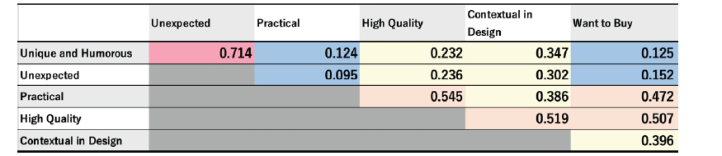
Next, we conducted a correlation analysis to examine the relationships between the evaluation items. Figure 3 shows the results. The “Unique and Humorous” category strongly correlates with “Unexpected.” On the other hand, the “Unique and Humorous”category has little correlation with “Want to Buy.”
Figure 3: The correlation coefficients between evaluation criteria.
534 Tsurugasaki and Kang
CONCLUSIONS
This study aims to visualize and investigate the relationship between consumers’ assessment of the uniqueness, humor, and unexpectedness of 100-yen shop products and their willingness to purchase them. While most participants tend to decide on their purchases before visiting the store, more people buy items they had not planned to buy. This result suggests a tendency towards impulse purchases due to low prices or stocking up on consumables, among other factors.
Next, considering the results of the analysis of variance: Firstly, regarding the category of “Practical,”all products received favorable ratings. This result indicates that the product evaluated in Evaluation Experiment 1 generally demonstrated high practicality as perceived by respondents. Conversely, in the “Want to Buy” all products received negative ratings. This could be attributed to the fact that many products are specialized items such as “Silicone Telescopic Back Scratcher” or “Portable Glasses Screwdriver,” which have limited situational utility.
Finally, the correlation analysis was discussed: The results revealed a strong correlation between “Unique and Humorous” and “Unexpected.” This result suggests that the selected products in the first experiment would be similarly valued when re-evaluated by a broader age group or larger sample. However, there was little correlation between “Unique and Humorous” and “Want to Buy.” Considering this result, along with the findings from the analysis of variance, it becomes evident that while uniqueness and humor are appreciated aspects, they do not necessarily translate into a desire to purchase.
The results of Evaluation Experiment 1 suggested that consumers perceived uniqueness and humor in appearance and functionality. Consumers were surprised at the gap between their perceptions and those of a high- quality, highly functional product that cost 100 yen and felt it was unexpected. The results of Evaluation Experiment 2 made it clear that “Unique and Humorous”was strongly related to “Unexpected.”On the other hand, it became clear that having “Unique and Humorous” does not lead to “Want to Buy.”
In the future, we will conduct factor analysis to consider product and item characteristics further. We will also proceed with the research by making comparisons based on the attributes of the subjects. Moreover, we will further develop the research by comparing products of 100-yen shops with other products.
REFERENCES
Blijlevens, J., Creusen, M., & Schoormans, J. (2009). “How consumers perceive product appearance: The identification of three product appearance Attributes.” International Journal of Design, Vol. 3, No. 3, pp. 27–35. Daiso (2022). “Three products from Daiso Industries Co., Ltd. win the 2022
Good Design Award”, available at: https://www.daiso-sangyo.co.jp/wp-conten t/uploads/2022/10/68085e251304e4f7d0c4cfd281ad8c9a.pdf (accessed 23 July 23, 2024).
The Relationship Between Aesthetic Evaluation of Product Design 535
Daiso HP (2022). “Three products from Daiso Industries Co., Ltd. win the 2022 Good Design Award”, available at: https://www.daiso-sangyo.co.jp/en/info/news/ 19452 (accessed: 28 June 2024). Daiso HP (2023). “Locations Around the World,” available at: https://www.daiso-
sangyo.co.jp/en/global (accessed: 28 June 2024). Mizuhara Tasuku (2020). “100 yen shop”, The social science, Vol. 49, No. 4, pp. 1–5. Teikoku Databank (2024). “100 Yen Shop Industry Survey (2023)”, available at:
https://www.tdb.co.jp/report/watching/press/pdf/p240506.pdf (accessed: 28 June 2024).
LISTED IN THE AHFE DIGITAL BOOKSTORE CATALOGUE
Explore the complete digital volume
Human Factors in Design, Engineering, and Computing
Read this individual research paper free through the original publisher, or explore the full digital proceedings book.
ISBN 978-1-964867-35-9
Explore this ISBN in the AHFE Bookstore ↗Listed in the July 2026 bookstore catalogue; search by ISBN to confirm current availability · Digital book purchase optional