Nowadays, there are various bottles and packages of liquid laundry detergents in Japan. Many companies have tried to create not only more powerful detergency of the products but also the new value of design in the laundry detergent bottle and package. And our lifestyle is changing like an increasing nuclear family and single life and enjoying a shopping using the internet in recent. Since selecting a detergent might be linked depending on such lifestyle, we need to survey the relationship between the design of detergents such as a bottle shape or package and the user's lifestyle. Therefore, we focused on the shape of bottles and packages of liquid laundry detergents in this study. Therefore, this study aims to clarify the difference in impressions of the bottle's shapes and packages of laundry liquid detergent based on Kansei engineering.So, we have experimented with ten bottles and packages using the ranking evaluation method to clarify the relationship between participants' decision to want to use bottles and the following items; 1) Luxury feeling level, 2) Easiness level to grip, 3) Fit feeling level to the laundry space, 4) Easiness level to store the bottle up, 5) Fleeing level of detergency power, and 6)Preference level to want to use. As a result, the item of "Preference level to want to use" had a stronger relationship with the bottle's packages of liquid laundry detergents than the bottle's shapes concerned with the usability of liquid laundry detergents. Even though the handle helps grip the bottles, participants preferred these bottles that do not have any handles with a luxury feel. Moreover, for the "Preference level to want to use," the Kansei factors of the bottle's shape, such as "Luxury feeling level" and "Fit feeling level to the laundry space," are more critical than the Usability factors, such as "Easiness level to grip" and "Easiness level to store up." Also, in the bottle packages situation, the item "Preference level to want to use" had a more substantial relationship with the item of "Luxury feeling level" than "Fleeing level of detergency power." This "Preference level to want to use" and packages differ depending on the participants' lifestyle, such as 'living style' and 'number of washes clothes per week.' For example, the participants who live alone want to use the bottle with a luxury feeling and easy to store. In contrast, the participants who live with family want to use the bottle with a luxury feeling, which fits their laundry space. These participants who live with family showed a similar tendency as the number of washes increased. Moreover, there are different characteristics in evaluating liquid laundry detergent depending on each one's lifestyle. Also, these results mean we need to survey more the condition of laundry space in Japan to propose a new bottle package design as future work.
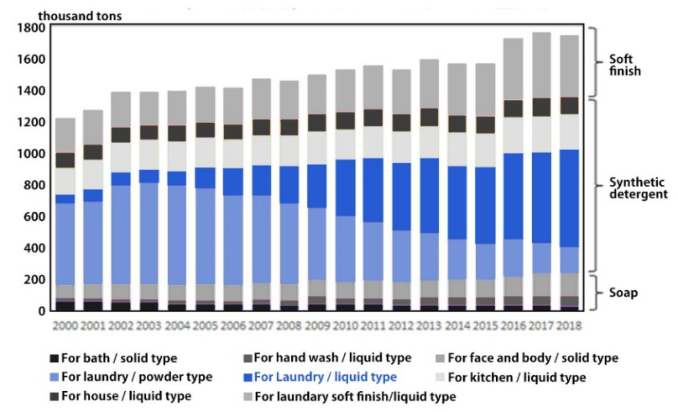
Nowadays, there are various bottles and packages of liquid laundry deter- gents in Japan. The products of soaps, detergents, and soft finishes have been rising steadily in Japan for 20 years [Ministry of Economy, Trade, 2020]. Among them, the liquid laundry detergent shows the most significant rising scale (Fig. 1). In the process, the types of care becoming more diverse. Many companies have tried to create a new product with more powerful detergency
Figure 1: The Changing rate in production of soaps, synthetic detergents, and soft finishes in Japan. Source: Ministry of Economy, Trade, and Industry (Japan).
and new Kansei value of the laundry detergent bottle design. For example, laundry detergent has a different shape, such as a push-type bottle on Japan’s market. That means a company wants to make a different point using design elements from other companies [H. Kuriyama 2019].
A nuclear family and single life are increasing faster in recent. So, each con- sumer’s decision style to buy a laundry detergent might differ depending on such lifestyle. Since the frequency of detergent use differs depending on the way of life, consumers need to choose a detergent that suits their way of life. Also, as previously mentioned, when the consumer buys a laundry detergent, he/she select a laundry detergent with not only powerful detergency but also Kansei value. For example, there is a luxury products category on the web shopping site of liquid laundry detergents. That means many consumers need the Kansei value, such as the Luxury feeling when they buy a liquid laundry detergent. Several studies have clarified the usability of a bottle of liquid laun- dry detergent based on the ergonomic design field was conducted [Muneatsu YAZAWA 2010, Y. Yohma and A. Komatsu 2009]. However, there are only a few studies on a bottle of liquid laundry detergent based on Kansei Engi- neering, even though several studies evaluate drink bottles based on Kansei Engineering [Y.Takayama and H. Sato 2013]. Therefore, this study aims to clarify the difference in impressions of the bottle’s shapes and packages of laundry liquid detergent based on Kansei engineering.
METHOD OF EXPERIMENT This section describes the characteristics in impressions of the participants’ evaluations depending on the bottle’s shapes and packages of liquid laundry detergents. We have conducted an experiment using the ranking evaluation method to clarify the relationship between participants’ impressions of liquid
Kansei Analysis of Liquid Laundry Detergent Bottle’s Shape and Packages Design 129
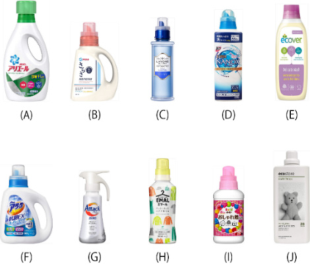
Figure 2: The ten experiment samples. Source: Amazon Japan.
laundry detergents and the decisions to use one. And we considered the visualized results by comparing with them the customer’s lifestyle.
In this experiment, we have experimented using the ranking evaluation method to clarify participants’ relative evaluation into bottles and packages of laundry liquid detergent bottles and packages. Before the experiment, we have prepared the following 7 question items for grouping the subjects later. The contents of the question are as follows: 1) Gender, 2) Age, 3) Lifestyle 1: How many family members do you live with? 4) Lifestyle 2: How many times do you your laundry? The ten experiment samples were selected based on the top 10 liquid detergent sales rankings (as of June 09, 2020) on the Japanese web shopping site. Based on these ten samples, we created bottle silhouettes in 1/3 the size of the actual product (Fig. 2 (left side)). The ten packages with bottles were also reduced to 1/3 of the actual size in the same way (Fig. 2 (Right side)). First, each participant saw only the silhouette of the ten bottles (Fig. 3 (Right side)) and ranked them using the ranking evaluation method [6] according to the following five evaluation items: 1) Luxury feeling level, 2) Easiness level to grip, 3) Fit feeling level to the laundry space, 4) Easiness level to store the bottle up, and 5) Preference level to want to use. Next, each participant saw these ten colorful packages with bottles ((Fig. 3 (Left side)) and ranked them according to the following four evaluation items: 1) Luxury feeling level, 2) Feeling level of detergency power, 3) Fit feeling level to the laundry space, and 4) Preference level to want to use. We have experimented with 46 participants on the internet using Google Forms due to COVID-19 from June 17 to 21, 2020.
RESULTS AND DISCUSSION
The Condition of Bottle’s Shape
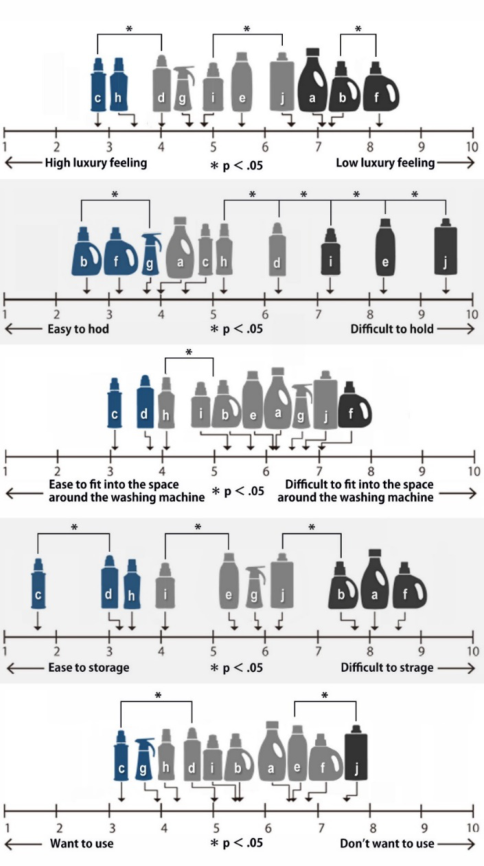
Figure 3 illustrates the result of the mentioned five evaluation items against the ten bottle’s shapes. The evaluation result of ‘Easiness level to grip’ was most different depends on the bottle’s shapes. However, the evaluation results of ‘Fit feeling level to the Laundry space’ tended to be most similar regardless of the bottle’s shapes.
130 Kang and Nishiya
Figure 3: The evaluation results of the shapes of ten bottles.
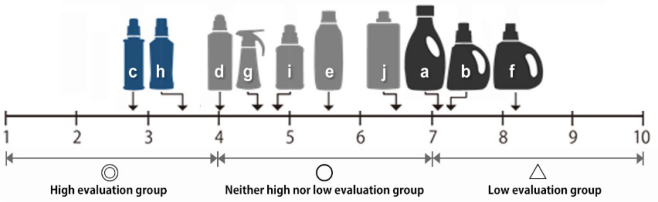
Table 1 shows the comprehensive comparing the result of the five evalu- ation items of ten bottle’s shapes. The double circle mark means the high average evaluation result ranked between 1 to 2.9, and the single circle mark means the average evaluation result ranked between 3 to 6.9. Finally, the tri- angle mark means the low average evaluation result ranked between 7 to 10 (Fig. 4).
As a result, the (c) shape was evaluated highest on all items except for the “Easiness level to grip.” However, the evaluation of “Easiness level to grip” was the highest among the bottle’s shapes without handle parts. The (c) is the most preferred shape as the bottle of liquid laundry detergents. Especially on the evaluation of “Luxury feeling,” the bottles with perforated handles
Kansei Analysis of Liquid Laundry Detergent Bottle’s Shape and Packages Design 131
Table 1. The results of comprehensive comparing the ten bottle’s shapes.
Table available in the original PDF paper.
Figure 4: The example of dividing into three evaluation groups.Table 2. Correlation coefficient score of shape evaluation.
Table available in the original PDF paper.
ranked the lowest evaluated three shapes. However, the (g) bottle, a push-type even though it had a handle, was in 4th rank. These results mean the bottle shape with a perforated handle negatively affected the “Luxury feeling.”
To compare the correlation coefficients between the item “Preference level to want to use” as the comprehensive evaluation and the other evaluated items (Table 1), the “Luxury feeling” had the most substantial relationship with “Preference level to want to use.” However, the relationship between the item “Easiness to grip” and “Preference level to want to use” was weak. From these results of table 2, ‘Kansei factor’ of the bottles of liquid laundry detergents such as “Luxury feeling level” and “Fit feeling level to the laundry space” is more critical than ‘Usability factor’ of them such as “Easiness level to grip” and “Easiness level to storage.”
The Condition of Bottle’s Packages
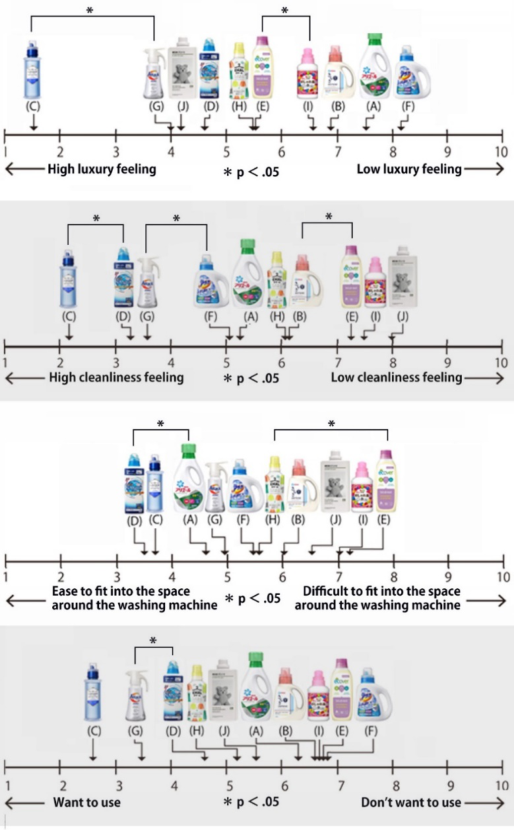
Figure 5 illustrates the result of the mentioned four evaluation items against the ten bottle’s packages.
132 Kang and Nishiya
Figure 5: The example of dividing into three evaluation groups.
Participants evaluated package (C) overwhelmingly as the package with the most luxurious feeling than the other packages. Conversely, they evalua- ted the package (F) as a bottle with the lowest luxury feeling. In addition, the range between the maximum and minimum values of “Luxurious feeling” was the largest among the average evaluations. “Feeling level of detergency power” of the package (C) was the highest among the evaluations. (This item was an evaluation item only for the package evaluation condition.) They evaluated the packages with many blue colors as a package with powerful detergency. In contrast, the package (J) with monochrome color was evalua- ted lowest among the packages. Also, they evaluated lowly the packages with warm colors such as (i), (e), and (b).
Kansei Analysis of Liquid Laundry Detergent Bottle’s Shape and Packages Design 133
Table 3. The results of comprehensive comparing the ten bottle’s packages.
Table available in the original PDF paper.
Table 4. Correlation coefficient score of package evaluation.
Table available in the original PDF paper.
Table 3 shows the comprehensive comparing result of the four evalua- tion items of ten bottle’s packages. Comparing the four evaluation items for the package, we found that the (C) package evaluated the highest among all evaluation items except for the item “Fit feeling level to the laundry space.” However, there is no significant difference between the (C) package from the (D) package, ranked first. And participants overall evaluated the (E) and (I) packages with warm colors as the lowest than others. In contrast, they prefer- red the packages with cold colors as a package of liquid laundry detergents than warm colors.
Table 4 shows the correlation coefficients between the item “Preference level to want to use” as the comprehensive evaluation and the other evalua- ted items. The “Luxury feeling level” had the most substantial relationship with “Preference level to want to use.” (This result in the age condition sho- wed the common tendency with the bottles’ shape condition.) However, the relationship between the item “Preference level to want to use” and “Fee- ling level of detergency power” or “Fit feeling level to the laundry space” was vital also. From these results, the package of liquid laundry detergents is more critical than the bottles’ shape condition.
The Relationship between the Evaluation and Lifestyle
Table 5 shows the correlation coefficient between the level of “Preference level to want to use” and evaluated other items based on the participants’ living style.
In the bottle’s shapes condition, the participant group living alone had a strong correlation between “Preference level to want to use” and “Luxury feeling level” or “Easiness level to store the bottle up.” On the other hand, the participant group living with family had a strong correlation between “Preference level to want to use” and “Fit feeling level to the laundry space” or “Luxury feeling level.” On the bottle’s packages condition, the participant
134 Kang and Nishiya
Table 5. Correlation coefficient score of package evaluation.
Table available in the original PDF paper.
Table 6. The results of correlation coefficients by number of washings.
Table available in the original PDF paper.
group living alone had a strong correlation between “Preference level to want to use” and “Luxury feeling level,” or “Feeling level of detergency power.” In contrast, the participant group living with family had a strong correlation between “Preference level to want to use”and all three items. Moreover, their correlation between “Preference level to want to use” and “Luxury feeling level” was extremely strong.
Table 6 shows the correlation coefficient between the level of “Preference level to want to use” and evaluated other items based on the participants’ number of washes clothes per week as a participant’s lifestyle.
In the bottles’ shape condition, the participant group, who washes clo- thes less often, had a strong correlation between “Preference level to want to use” and “Luxury feeling level,” and “Easiness level to store the bottle up.” (This result showed the common tendency of the results of correlation coeffi- cients by living style.) On the other hand, the participant group, who washes clothes often, had a strong correlation between “Preference level to want to use” and only “Luxury feeling level.” In the bottle’s packages condition, both participant groups had a strong correlation between the item “Preference level to want to use” and all three items. However, these correlations of the participant group, who washes clothes often, had a more extreme stronger than the one of the participant groups, who washes clothes less often. From those results, a different characteristic in evaluating liquid laundry detergent depends on each one’s lifestyle.
CONCLUSION
In this study, we experimented with clarifying the difference in impressions of laundry liquid detergent bottles and packages, laundry liquid detergent based on Kansei engineering.
Kansei Analysis of Liquid Laundry Detergent Bottle’s Shape and Packages Design 135
In analyzing the bottles’ shape condition, participants’ impressions remar- kably changed depending on the presence or absence of the perforated handles on the bottle of liquid laundry detergents. Even though the handle helps grip the bottles, participants preferred these bottles that do not have any handles with a luxury feel. Moreover, for the “Preference level to want to use,” the Kansei factors of the bottle’s shape, such as “Luxury feeling level” and “Fit feeling level to the laundry space,” are more critical than the Usabi- lity factors, such as “Easiness level to grip” and “Easiness level to store up.” Moreover, the “Preference level to want to use” had a stronger relationship with the bottle’s packages of liquid laundry detergents than the bottle’s sha- pes concerned with the usability of liquid laundry detergents. Especially, a cool-colored package is preferable to monochrome color or a warm-colored one. This “Preference level to want to use” of bottle’s shapes and packages were different depending on the participants’ lifestyle, such as ‘living style’ and ‘number of washes clothes per week.’ The participants who live alone want to use the bottle with a luxury feeling and easy to store. In contrast, the participants who live with family want to use the bottle with a luxury feeling, which fits their laundry space. (These results mean we need to survey the condition of laundry space in Japan to propose a new bottle package design.) These participants who live with family showed a similar tendency as the number of washes increased.
In the future, to more logically ratio the relationship between “the used color balance in these packages” and “Preference level to want to use,” we plan to quantify the physical characteristics of the used color and analysis. Mainly, we will focus on the color balance and the margin area of the used color on the packages of laundry liquid detergents. And we will survey the condition of the laundry space also.
REFERENCES
H. Kuriyama 2019, SENTAKUYOUSENZAINO SYOUHINKEITAITO KATIKEI- SEIHENSE: Minivation RENSANI KANSURU ICHIKOSATSU, JAIST(Japan Advanced Institute of Science and Technology) Repository 34: pp. 506–511, (2019) Muneatsu YAZAWA and Yoshihiro NARITA 2010, Evaluation of Impression to Pet
- Bottle Shapes, Journal of Japan Society of Kansei Engineering, Vol. 10, No. 1, pp. 27–34, (2010) Y. Takayama and H. Sato 2013, Research on Difference of the Impression Accompanying Form Change of the Product, Proceeding of JSSD (Japan Society for the Science of Design) 60(0), 167, 2013 Y. Yohma and A. Komatsu 2009, Usability Evaluation of Grasps of Detergent Bottles,
30. No. 2: pp. 358—359, (2009) Ministry of Economy, Trade, and Industry in Japan|Production Statistics Survey, Viewed June 30 2020. https://www.meti/go.jp/statistics/toppagereport/minikaisetsu/h itkoto_kako/20200129hitokoto.html
LISTED IN THE AHFE DIGITAL BOOKSTORE CATALOGUE
Explore the complete digital volume
Kansei Engineering
Read this individual research paper free through the original publisher, or explore the full digital proceedings book.
ISBN 978-1-958651-16-2
Explore this ISBN in the AHFE Bookstore ↗Listed in the July 2026 bookstore catalogue; search by ISBN to confirm current availability · Digital book purchase optional