Emiri Otsuka, Namgyu Kang (2022). Kansei Evaluation of Localized Film Posters. In: Kansei Engineering. AHFE Open Access, vol. 40, pp. 114–120. https://doi.org/10.54941/ahfe1001769
In recent years, Japanese animation films have been attracting attention overseas. For example, "Blade of the Demon" was released in 2020 and became a massive hit in 45 countries and regions worldwide. Film posters are one of the influential advertising media for the release of a film. film posters are essential advertising media to influence the film box office, as they comprehensively express the contents and appeal of the film story in a single image. However, depending on where the film is released, the poster is changed into a different layout from the home country version. For example, the film poster of "Big Hero6" in Japan appealed to an emotional story, but in some other countries, the poster appealed to an action hero film. In this way, film posters were localized depending on the country where the film was released. According to previous studies on film posters, the Japanese and Americans had different perspectives in grasping the film stories even though the film was the same, reflected in the film posters. In addition, in a previous study conducted by our research team on film posters of Studio Ghibli of Japan, subjects' impressions differed significantly from the original Japanese poster version and re-produced others. However, even though the Japanese and Korean versions are very similar layouts and designs, the participants' impressions about these two posters differed due to the influence of the textual information. Therefore, this study evaluated the impressions of film posters with mosaic processing on the language part to eliminate the influence of the language information on the posters. As a result of the SD method's experiment, there was a negative correlation between the "Familiarity feeling" and the "Unique feeling" of the film posters. However, there was a positive correlation between the "Dynamism feeling" and the "Familiarity feeling" of the posters. Moreover, participants' impression about the mosaiced textual information of the Japanese and Korean versions was almost the same. That means textual information in a poster influences participants' impressions significantly. These results in this study will help future film posters production.
In recent years, Japanese animation films and TV animations have attracted much attention worldwide (Animation Business Journal, 2020). As a result, many Japanese animated films are being screened abroad. ‘Spirited Away’ of studio Ghibli, one of the most popular animated Japanese films, has been released in many countries (Tsuken, 2008). The film posters used to advertise the film are designed differently in each country.
The ‘Big Hero 6’ poster, released in 2014, is different from each country. It shows that film marketing techniques vary significantly from country to country (Movies.com, 2022). In this way, film posters are an essential form of advertising because they comprehensively express the appeal of a film. According to Kim and Suk’s research, many young Koreans preferred the English film version to the Korean version (Kim and Suk, 2019). Our pre- vious study used the studio Ghibli film poster. The evaluation result of the Japanese and Korean film posters was very different, even though the layout of the Japanese and Korean film poster versions is similar (Otsuka and Kang, 2021). That means the participants’ mother language influenced the evalu- ation of the film posters. The localized and recreated film posters with each mother language may change the impression of the film. However, there are still few quantitative analyses of the characteristics of film posters depending on the country where the film is released. Therefore, it is necessary to cla- rify the localized film posters’ characteristics according to the country where
the film is released. Therefore, this study aims to quantify and describe the characteristics of film posters that people want to watch. Thus, we use the SD method to analyze with the studio Ghibli film posters with mosaic text to reduce the influence of the mother language.
METHOD
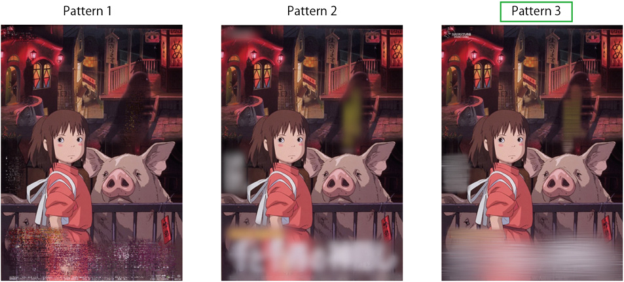
Firstly, we checked Ghibli films posters based on the top 10 Japan domestic box-office sales. Then, we selected five films as the object of our research with seven research collaborators. Each film has Japanese, English, and Korean films poster versions. In the experiment, we prepared posters with three different mosaic patterns to reduce the mother language’s influence on evalu- ating the impressions of the posters (Figure 1). Although a film poster has its meaning, including text information, we cannot erase the text information. However, mosaicking text information in the film posters can minimize the influence of the mother language. Thus, for selecting the mosaic pattern in which the mosaic’s force is minimum, we chose pattern 3 with the seven rese- arch collaborators because this pattern was the most natural as a film poster to have a minor effect on the evaluation of the poster.
The 66 Japanese participants evaluated the selected 15 posters of five Ghi- bli films (Japanese, Korean, and English versions) using the SD method. We prepared these 12 adjectives of Table 1 for the SD method to clarify the impressions of the film posters with mosaic, and each participant evaluated these film posters with a 5-point level. These 12 adjective pairs were selected based on the previous studies on visual information (Yoshioka and Hasumi, 2013) and technical books describing the SD method (Fukuda and Fukuda, n.d.). This experiment was conducted between October 21 and October 24, 2021, using Google Form to protect 66 participants from COVID-19.
RESULTS AND DISCUSSION
We analyzed the results of the SD method using the Factor analysis and sele- cted only adjectives with factor loadings scores of ±0.4 or higher. As a result,
116 Otsuka and Kang
Table 1. Selected adjective pairs.
Table available in the original PDF paper.
Table 2. Factor loading.
Table available in the original PDF paper.
we extracted the following three common factors (Table 2); “ Familiarity, “Unique,” and “Dynamism.”
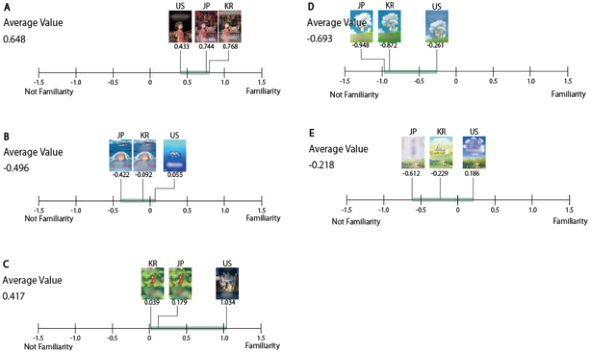
In the scores of the first factor, “Familiarity” of film, the mean values for film posters A and C were high for all three countries’ versions. As a common characteristic of the film posters A and C, they contained more information in the background to show a part of the story than the other posters. On the other hand, they evaluated that posters B, D, and E have low familiarity, so the first factor mean scores of these three posters are low in all three countries’ versions. In particular, the Japanese version of the D poster was very similar to other countries’ posters. That means only this D poster is different from other typical Japanese posters. For example, this poster has only one main character and relatively little background information, though other Japa- nese posters have more characters and rich background information. This result suggests that rich background information may affect Japanese parti- cipants’ “Familiarity” as a film poster. In addition, the mean scores of the first factor, “Familiarity,” of the English version poster was higher than other countries’ versions. This is because there are fewer characters in the English version posters than Japanese ones, and the color saturation of English ver- sion posters was darker than that of Japanese and Korean posters. These results suggest Japanese participants feel the poster with many dark colors has “Familiarity” as the typical film poster (Figure 2).
Kansei Evaluation of Localized Film Posters 117
Figure 2: The first factor scores and mean values of each poster.Figure 3: The second factor scores and mean values of each poster.
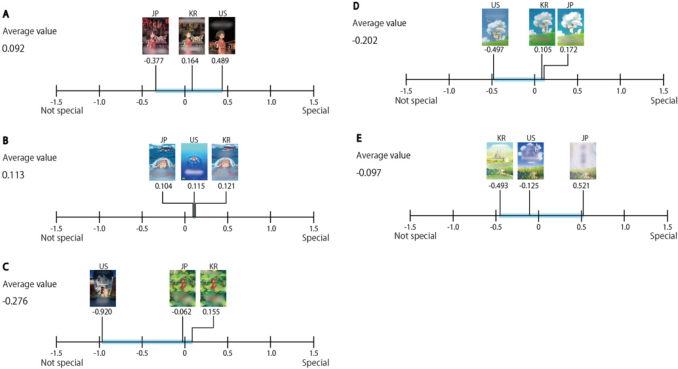
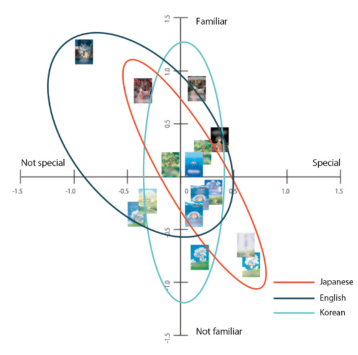
The second factor, “Unique,” scores showed a small mean range on the A, B, D, and E posters. Especially, there was almost no difference between posters A and B. Although the “Unique” is one of the most critical factors in film posters, there was not much difference. However, the mean “Unique” value of the English version of poster C was lower than the other English ver- sion posters. This C film was released by a different distributor company in the USA from Japan and Korea. That distributor re-created the English ver- sion poster, which was very different from Japan and Korea version posters. So Japanese participants might not be felt “Unique” as the Studio Ghibli artworks which are distinguished from other normal posters. This suggests the identity of Studio Ghibli artworks is closely related to the specialness (Figure 3).
118 Otsuka and Kang
Figure 4: The third factor scores and mean values of each poster.
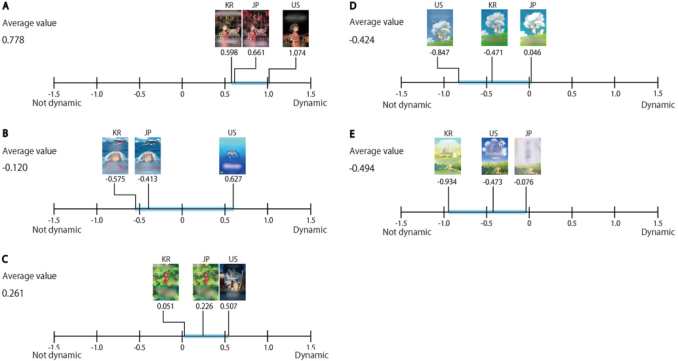
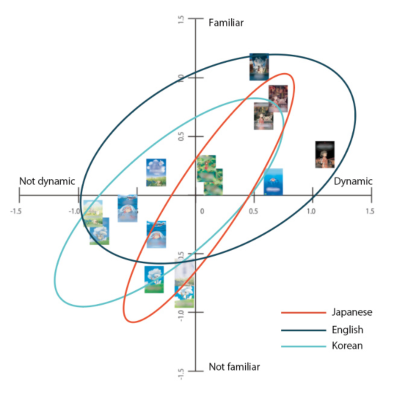
The third-factor scores, “Dynamism,” showed that the mean values of D and E posters of all three countries were low. On the other hand, the English version posters had the highest mean values in A, B, and C. Furthermore, the English version poster had a simple background, and the used color was darker than the Japan and Korea version posters. This result suggests a feeling of “Dynamism” may become strong when the poster has a lot of dark colors and a little information of background (Figure 4).
CORRELATION OF EACH FACTOR We created a distribution chart based on the factor analysis results (Figure 5). There was a negative correlation between Factor 1 “Familiarity” as a typical film poster and Factor 2, “Unique”as the Studio Ghibli. That means Japanese participants felt a poster of Studio Ghibli has a “Unique” which is distingui- shed from other film posters. However, if the “Unique” as the Studio Ghibli becomes higher, the “Familiarity” as the film poster becomes lower. Mainly, many recreated English version posters have a less Unique feeling as Studio Ghibli than the posters of Japan and Korea versions. However, the poster has high “Familiarity” as a film poster. Moreover, the three mean factor scores of English posters showed wider variability than the posters of Japan and Korea.
However, there was a positive correlation between Factor 1, “Familia- rity,” and Factor 3, “Dynamism” (Figure 6). The English version posters, surrounded by dark blue, are more widely distributed than the other posters of Japan and Korea. In addition, posters with darker colors are clustered in the upper right corner of figure 6. That means if a designer expresses more “Dynamism”, “Familiarity” as a typical film poster also becomes higher.
CONCLUSION
This study aimed to quantitatively identify the characteristics of film posters that people are interested in by evaluating the mosaicked posters using the SD
Kansei Evaluation of Localized Film Posters 119
Figure 5: Correlation between Factor 1 and Factor 2.Figure 6: Correlation between Factor 1 and Factor 3.
method. From this research, we clarified Japan and Korea version posters of Studio Ghibli are characterized by many characters and light colors, and rich background information to express the stories. On the other hand, English version posters of Studio Ghibli are characterized by one or a few chara- cters, a simple layout, and dark background as a typical film poster for local people. Especially, we could extract the “Familiarity,” “Unique,” and “Dyna- mism” from Studio Ghibli film posters using the SD method and visualize each poster’s situation based on these three-factor scores by this research. From the visualized results, we can understand each poster’s level of “Fami- liarity,” “Unique,” and “Dynamism.” When a designer re-creates a localized film poster, he/her has to express not only these “Unique” as the identity of the original film (the identity of Studio Ghibli film in this research) but also “Familiarity” and “Dynamism” as a typical film poster for the local
120 Otsuka and Kang
person. In another word, when a designer re-creates, has to keep these two balances well.
In the future, we will conduct a quantitative analysis of the characteri- stics of the re-created film posters to support more the future re-create a film poster.
REFERENCES
AcademicPost (2022) A Comparative Cultural Theory of the World’s “Spirited Away” Posters, https://academic-post.nihon-kenkyusya.com/2020/03/18/%E 4%B8%96%E7%95%8C%E3%81%AE%E3%80%8C%E5%8D%83%E3% 81%A8%E5%8D%83%E5%B0%8B%E3%81%AE%E7%A5%9E%E9%9A %A0%E3%81%97%E3%80%8D%E3%83%9D%E3%82%B9%E3%82%BF %E3%83%BC%E3%81%AE%E6%AF%94%E8%BC%83%E6%96%87% E5%8C%96/ (viewed on 19 January 2022) Animation Business Journal (2020) In 2020, the global Japanese animation mar-
ket will decline for the first time in 11 years, and foreign countries will surpass Japan for the first time, http://animationbusiness.info/archives/12232 (viewed on January 19, 2022) Fukuda T., Fukuda R. (n.d.) Ergonomics Guide to the Science of Sensitivity, Scientist, pp. 153–155. Kim J., Suk H.-J. (2019) Layout Preference for Korean Movie Posters: Contextual
Background or Character Dominance, International Association of Societies of Design Research Conference. Meilich A. (2008) INCOSE MBSE Initiative Status of HSI/MBSE Activity (Presentation) Movies.com (2022) ‘Baymax’ Posters Different Around the World: Marketing
Approaches Prom-inently Different, https://eiga.com/news/20141228/4/ (viewed on 19 Jan 2022) Otsuka E. and Kang N. (2021) Kansei Evaluation Based on Comparison of Japanese, English, and Korean Movie Posters, JSKE 23rd Japan Society of Kansei Engineering Conference, General Session [2A06-11-04] Design 2, September 3, 2021. Taubman P. (June 25, 2008) Top Engineers Shun Military; Concern Grow. The New
York Times Website: http://www.nytimes.com/2008/06/25/us/25engineer.html Tsuken N. (2008) Why “Anime”? Background and Factors of Japanese Anime Attracting Attention Overseas, Sophia: Studies in Western Culture and Cultural Exchange between East and West, Vol. 56, No. 2, pp. 61–79. Yoshioka S. and Hasumi T. (2013) Evaluation of mood in the experience of image vie-
wing and drawing work: A study of hospitable art for improving the convalescent environment, Journal of Design Studies, 60.2:2_95_2_100.
LISTED IN THE AHFE DIGITAL BOOKSTORE CATALOGUE
Explore the complete digital volume
Kansei Engineering
Read this individual research paper free through the original publisher, or explore the full digital proceedings book.
ISBN 978-1-958651-16-2
Explore this ISBN in the AHFE Bookstore ↗Listed in the July 2026 bookstore catalogue; search by ISBN to confirm current availability · Digital book purchase optional