Haruki Tanaka, Namgyu Kang, Khongthat Thongphun (2025). Anthropomorphism and the Kansei Evaluation in Product Design Between Japan and Thailand. In: Ergonomics In Design and Kansai Engineering. AHFE Open Access, vol. 170, pp. 206–214. https://doi.org/10.54941/ahfe1006182
Features in design that evoke human-like qualities—known as anthropomorphism—positively and negatively influence human perceptions. However, most previous studies have focused on subjects from a single country, and limited research explores whether similar trends exist across different nations. This study aims to investigate the differences in preferences and impressions of anthropomorphic product designs between Japan and Thailand. Despite being in the same Asian region, significant geographical distances may lead to cultural differences, resulting in varied attitudes toward anthropomorphism.We conducted an impression evaluation experiment using 16 images of anthropomorphic product designs with 60 Japanese and 70 Thai participants, employing the semantic differential (SD) method to assess this. As a result, preferences for anthropomorphism in Japan are divided, while they appear more ambiguous in Thailand. However, both Japanese and Thai participants emphasized the "overall evaluation of good design," valuing attributes such as "comfortable," "lovely," and "beautiful." Additionally, both groups preferred non-realistic anthropomorphic representations of the entire human body. Notably, products that evoke a sense of "solitude" are chosen in Thailand, whereas those that convey a sense of "simplicity" are favored in Japan. These results highlight the differences in preferences and impressions toward products with anthropomorphic elements between Japan and Thailand. This study's findings are expected to provide insights into effective anthropomorphic representations across diverse cultures.
Features that evoke a sense of human likeness—anthropomorphism—have been suggested to exert both positive and negative influences on human sensibility (Nishii, 2022). As an example of a positive influence, using human-like facial expressions that correspond to the flavor of a snack on its package design has been shown to enhance consumers’ sense of familiarity with the product and to facilitate their understanding of the flavor information (Yamamoto & Yamada, 2023). On the other hand, a negative influence has been observed when robots with human-like
Anthropomorphism and the Kansei Evaluation in Product Design 207
emotional capacities and facial expressions become highly—but not fully— human-like; at this near-human level of resemblance, observers tend to experience a sense of eeriness (Tsukimoto, 2017). Furthermore, it has also been suggested that anthropomorphism in product design affects human impressions and preferences (Tanaka & Kang, 2025). These findings suggest that incorporating anthropomorphic features into surrounding products can influence people’s impressions and preferences toward those products. However, little research has been conducted to determine whether similar tendencies hold across countries with different cultural backgrounds.
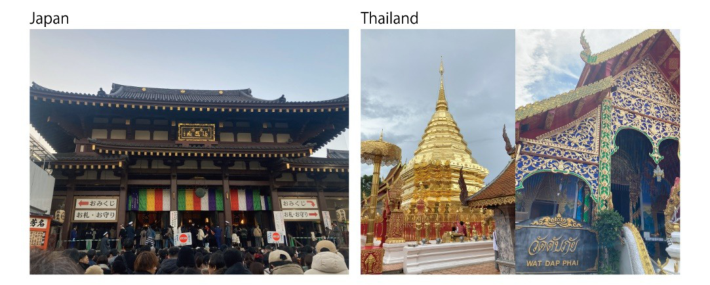
Therefore, this study aims to clarify how cultural differences between Japan and Thailand influence the effects of anthropomorphism in product design. Specifically, it examines cross-cultural differences in preferences and impressions toward anthropomorphic product designs between Japanese and Thai participants. Japan and Thailand share certain cultural elements while also exhibiting distinct cultural styles. From this perspective, both countries are well suited to serve as subjects in the present study. While Japan and Thailand share a common religious foundation in Buddhism, the architectural design of their temples differs significantly. Japanese temples typically feature calm and restrained designs, using a limited color palette such as brown, white, and red. In contrast, Thai temples are characterized by vivid, multicolored schemes and ornate, eye-catching designs (Figure 1). As illustrated above, Japan and Thailand share certain cultural foundations while maintaining distinct cultural styles, suggesting that they may hold different values in design. Accordingly, differences in preferences and impressions regarding anthropomorphism in design are also expected between the two countries.
Figure 1: Japanese and Thai temples (Japan: Kanagawa, Thailand: Chiang Mai).
EXPERIMENTAL METHOD FOR IMPRESSION EVALUATION The Semantic Differential (SD) method, which uses adjective pairs, was employed to evaluate impressions of the products. The following section provides a detailed description of the experimental procedure.
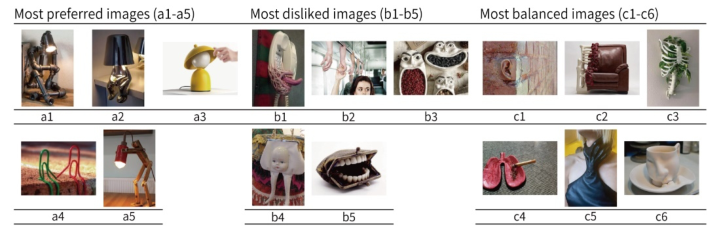
The experiments in this study were conducted independently in Japan and Thailand. In Japan, the experiment was conducted between August 1 and October 31, 2023, involving 60 Japanese participants in their teens and twenties (37 males, 23 females; M = 22, SD = 1.6). In Thailand, the experiment was conducted between September 14, 2023, and September 20, 2024, involving 70 Thai participants in their teens and twenties (34 males, 30 females, and 6 others; M = 22, SD = 4.1). Figure 2 presents the set of selected stimulus images. The stimuli were chosen based on the preference for anthropomorphic product examples identified by Tanaka and Kang. Images a1–a5 represent the products rated as most liked in Japan, b1–b5 represent the most disliked products, and c1–c6 represent products for which participant evaluations were polarized. The 16 images were divided into two groups of 8 to reduce participant burden.
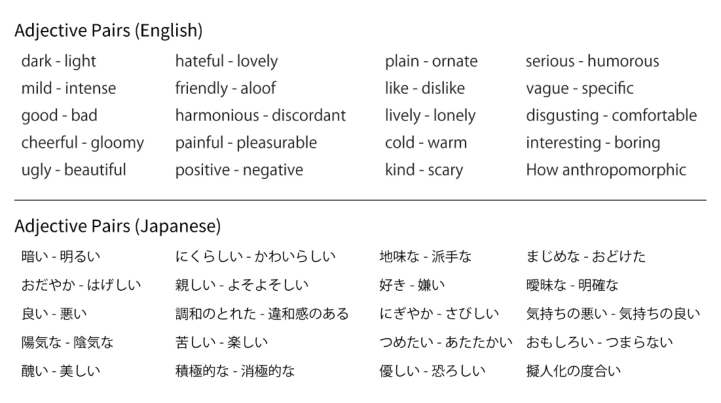
Figure 3 shows the Japanese adjective pairs used in the present experiment. The adjective pairs were selected based on literature related to the Semantic Differential (SD) method and anthropomorphism (Fukuda & Fukumoto, 2009; Inoue & Kobayashi, 1985; Hayashida, 2022; Sakuma & Kato, 2016; Sekiguchi, 2006). Subsequently, six research collaborators reviewed and discussed the items, and 20 items—17 Japanese adjective pairs and 3 independent variables—were determined to be appropriate for the study. To ensure consistency with the Japanese version, the same procedure was applied for the experiment conducted in Thailand. In collaboration with one research assistant, appropriate English translations of the adjective pairs were examined and adopted.
Participants evaluated their impressions of each stimulus image, which was presented one at a time, using a seven-point semantic differential scale based on adjective pairs. They were instructed to respond as intuitively as possible. Depending on the experimental setting, responses were collected via Google Forms (for the online condition) or printed evaluation sheets containing the adjective pairs (for the in-person condition).
Anthropomorphism and the Kansei Evaluation in Product Design 209
Figure 3: List of adjective pairs used in the Japanese and Thai experiments.
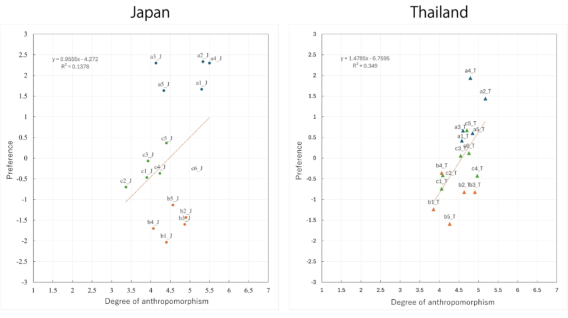
Relationship Between Degree of Anthropomorphism and Preference in Japan and Thailand For the three independent variables—”Like–Dislike,” “Good–Bad,” and “Degree of Anthropomorphism”—the final evaluation scores were calculated by averaging participants’ responses. Since the response patterns for “Like–Dislike” and “Good–Bad” were found to be highly similar, only the “Like–Dislike” variable was used in the present analysis.
Figure 4 illustrates the relationship between the “Degree of Anthropomorphism” and “Like–Dislike” ratings in Japan and Thailand. Regarding the results from Thailand, a positive correlation was found between the degree of anthropomorphism and likeability (r = .591). Among the products, a4 received the highest likeability score, while b5 received the lowest. Regarding anthropomorphism, a2 was rated as having the highest degree of anthropomorphism, whereas b1 received the lowest rating. As for Japan, a weak positive correlation was observed between the degree of anthropomorphism and likeability (r = .371). Product a2 received the highest likeability score, while b1 received the lowest. Regarding anthropomorphism, a4 was rated the highest, and c2 the lowest.
EXPLORATORY FACTOR ANALYSIS RESULTS Factor analysis using the maximum likelihood method with Promax rotation was conducted based on the evaluation scores for each adjective pair item. Table 1 presents the factor loadings and the corresponding adjective pairs for each factor. As a result of the analysis, 20 items that had eigenvalues greater than 1 and factor loadings of.300 or higher were extracted. Table 2 shows the adjective pairs associated with each factor and the interpretation of each factor. The factors were interpreted as follows: Factor 1 as “Cheerfulness and Loveliness,” Factor 2 as “Solitude,” and Factor 3 as “Simplicity.”
Figure 4: Relationship between degree of anthropomorphism and preference in Japan and Thailand.Table 1: The factor loadings and the corresponding adjective pairs for each factor.
Anthropomorphism and the Kansei Evaluation in Product Design 211
Relationship Between Factor Scores and Preference in Japan and Thailand
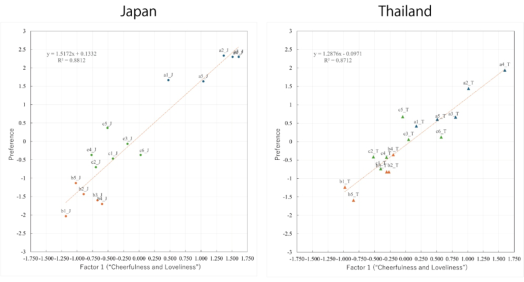
Figure 5 illustrates the relationship between Factor 1 (“Cheerfulness and Loveliness”) and the Like–Dislike ratings in Japan and Thailand. In Thailand, a very strong positive correlation was observed between “Cheerfulness and Loveliness” and Like–Dislike (r = .933). Similarly, in Japan, a very strong positive correlation was also found between these two variables (r = .939).
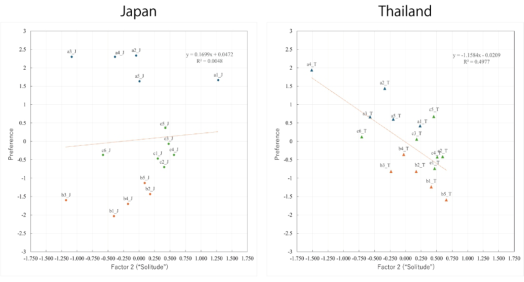
Figure 6 shows the relationship between Factor 2 (“Solitude”) and the Like–Dislike ratings in Japan and Thailand. In Thailand, a very strong negative correlation was found between “Solitude” and Like–Dislike (r = −.705). In contrast, in Japan, no meaningful correlation was observed between the two variables (r = .069).
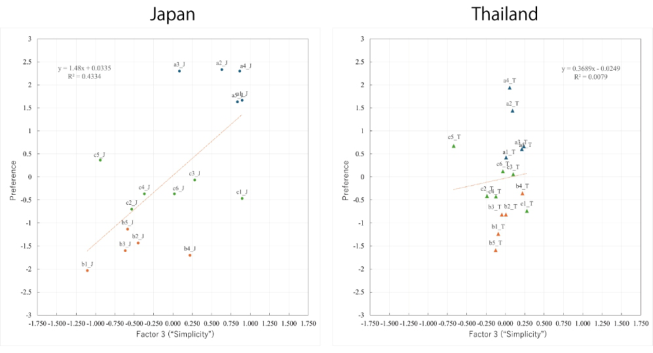
Figure 7 presents the relationship between Factor 3 (“Simplicity”) and the Like–Dislike ratings in Japan and Thailand. In Thailand, no significant correlation was observed between “Simplicity” and Like–Dislike (r = .089). In contrast, a moderate positive correlation was found in Japan (r = .658).
Figure 5: Relationship between Factor 1 (“Cheerfulness and Loveliness”) and preference in Japan and Thailand.Figure 6: Relationship between Factor 2 (“Solitude”) and preference in Japan and Thailand.Figure 7: Relationship between Factor 3 (“Simplicity”) and preference in Japan and Thailand.
CONSIDERATION First, the relationship between the degree of anthropomorphism and likeability is examined. A stronger positive correlation was observed in Thailand compared to Japan. This suggests that, in Thailand, the more anthropomorphic a product appears, the more it tends to be liked by consumers.
Next, the factor analysis results and the relationships between each factor and likeability are discussed.
Factor 1 (“Cheerfulness and Loveliness”) had a very strong positive correlation with likeability in both Japan and Thailand. This suggests that “Cheerfulness and Loveliness” is a common underlying factor influencing product preference in both countries. In other words, products perceived as cheerful and lovely tended to be more liked in Japan and Thailand.
For Factor 2 (“Solitude”), a very strong negative correlation with likeability was observed only in Thailand. This indicates that “Solitude” may function as a culturally specific factor influencing product preference in Thailand. That is, products perceived as evoking solitude tended to be less liked by Thai participants.
For Factor 3 (“Simplicity”), a positive correlation with likeability was found only in Japan. This suggests that “Simplicity” may serve as a culturally specific factor influencing product preference in Japan. In other words, products perceived as simple tended to be more liked by Japanese participants.
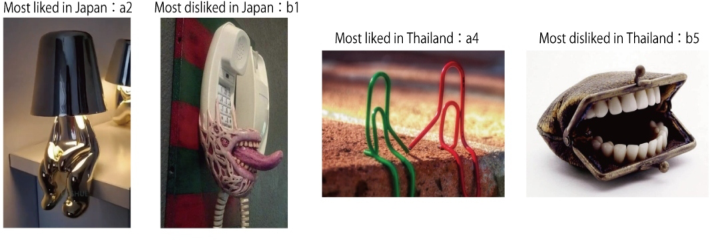
Finally, the overall findings are discussed. Figure 8 presents Japan and Thailand’s most liked and most disliked products. In Thailand, the most liked product was a4, and the most disliked was b5. These results suggest that in Thailand, anthropomorphic product designs that evoke the image of a whole human figure, particularly those that convey a sense of cheerfulness and loveliness while avoiding associations with solitude, are more likely
Anthropomorphism and the Kansei Evaluation in Product Design 213
to be preferred. In contrast, the most liked product in Japan was a2, and the most disliked was b1. This indicates that in Japan, preferred anthropomorphic designs similarly evoke the image of a whole human figure, but are characterized not only by cheerfulness and loveliness but also by simplicity. Furthermore, in both Japan and Thailand, products that incorporate anthropomorphic features resembling only parts of the human body, especially those lacking cheerfulness and loveliness, tend to be disliked.
Figure 8: The most liked and most disliked products in Japan and Thailand.
These results are likely to reflect cross-cultural differences in design preferences. As seen in the example of temple architecture, Japanese people prefer simple and subdued color schemes and designs, whereas Thai people are more drawn to vivid and ornate ones. Thailand’s most liked stimulus image featured bright, colourful tones and conveyed a cheerful atmosphere. By contrast, the most disliked image in Thailand, while visually striking in form, used dull and muted colors. In Japan, the opposite tendency was observed. These findings suggest that design preferences vary across countries depending on cultural background and familiarity with local aesthetic environments.
CONCLUSION
This study aimed to clarify cross-cultural differences in preferences and impressions toward anthropomorphic product designs between Japan and Thailand. The findings revealed that such products were generally more preferred in Thailand than Japan, particularly those resembling a full human figure, conveyed a sense of cheerfulness and loveliness, and did not evoke solitude. In Japan, products resembling a full human figure were preferred, especially when they conveyed both cheerfulness, loveliness, and simplicity. These results demonstrate that the two countries’ preferences and impressions toward anthropomorphic designs differ. Moreover, they suggest that cultural background may shape design preferences. Accordingly, the objectives of this study were successfully achieved.
While the present study focused on macro-level cross-cultural differences in preferences and impressions, future research should adopt a micro- level perspective by examining the relationship between specific product
features and evaluation scores. This will help identify which elements of anthropomorphism are more likely to be preferred.
REFERENCES
Fukuda, T. and Fukuda, R. (2009) Guide to Ergonomics: Methods for Scientifically Studying Kansei (Expanded Edition). Tokyo: Science-sha, pp. 153–155. Hayashida, K. (2022) ‘Modelling of Kansei and psychology required for coexistence
between humans and robots’, Kansei Engineering, 20(1), pp. 29–33. Inoue, M. and Kobayashi, T. (1985) ‘Overview of research fields using the SD method and adjective pair scale structures in Japan’, Japanese Journal of Educational Psychology, 33(3), pp. 253–260. Nishi, M. (2022) ‘The effect of perceived anthropomorphism on consumer behavior’,
Chiba University of Commerce Review, 59(3), pp. 233–245. Sakuma, T. and Kato, S. (2016) ‘Interactive ball play with anthropomorphic agents reflecting user reward-giving tendencies’, Journal of the Japanese Society for Artificial Intelligence, 31(6), AG-A, pp. 1–11. Sekiguchi, H. (2006) ‘Comparison using the SD method in works with different
impressions’, Bulletin of Oita Prefectural College of Arts and Culture, 44, pp. 89–96. Tanaka, H. and Kang, N. (2024) ‘Investigating the relationship between anthropomorphic expressions and preferences based on Kansei design’, in HCI International 2024 Posters, 62 (Late Breaking Work). HCII 2024, CCIS 2319, pp. 128–137. Tsukimoto, T. (2017) ‘A study on Kansei evaluation of the uncanny valley phenomenon in real robots’, Journal of the Japan Society of Kansei Engineering, 16(3), pp. 293–298. Yamamoto, R. and Yamada, H. (2023) ‘The impact of illustrated facial expressions
in package design on product evaluation’, Journal of the Japan Society of Kansei Engineering, 22(1), pp. 57–64.
LISTED IN THE AHFE DIGITAL BOOKSTORE CATALOGUE
Explore the complete digital volume
Ergonomics In Design and Kansai Engineering
Read this individual research paper free through the original publisher, or explore the full digital proceedings book.
ISBN 978-1-964867-46-5
Explore this ISBN in the AHFE Bookstore ↗Listed in the July 2026 bookstore catalogue; search by ISBN to confirm current availability · Digital book purchase optional