Sato Gai, Namgyu Kang (2024). Investigation of the contemporary value of dialects and proposals for their utilization – Possibility of maintaining cultural identity and regional promotion –. In: Human Factors in Design, Engineering, and Computing. AHFE Open Access, vol. 159, pp. 2034–2044. https://doi.org/10.54941/ahfe1005771
Publisher statistics will load when you open Metrics.
AHFE OPEN ACCESS OPEN ACCESS CONFERENCE PROCEEDINGS PAPER
Investigation of the contemporary value of dialects and proposals for their utilization – Possibility of maintaining cultural identity and regional promotion –
Japan has a wealth of dialects, each a unique reflection of its local culture and individuality. Recent advancements in information technology have accelerated the spread of these dialects, leading to their use across different regions. This study aims to analyze contemporary dialect usage and propose an event concept that promotes regional identity and serves as a beacon of hope for preserving these linguistic treasures. A questionnaire was conducted with approximately 100 people aged 20-60, and AI text mining analyzed the responses. The results showed that dialects remain vital in communication, especially in close relationships. Native region dialects were commonly used in daily conversations with family and friends, while dialects from other regions spread through media, serving as communication accessories. These findings underscore the importance of dialects in enriching communication diversity and preserving regional culture. Based on the results, an event focusing on dialects and regional promotion will be proposed and evaluated. This event, we believe, will not only enhance appreciation and understanding of these linguistic treasures but also pave the way for their preservation and continued use in our rapidly changing world.
Dialects are phonological, lexical, and grammatical differences that arise from regional differences in the use of a language (Kojien, 2018). Dialects are a part of the identity of residents and are an essential tool for deepening solidarity with people from the same region (Hidaka, 2006). In other words, there are a wide variety of dialects throughout Japan, each reflecting the culture and history of the region. However, dialects in various regions of Japan have declined in recent years. In fact, at the end of the 20th century, it was found that approximately 90% of junior high school students in Japan were speaking a common language instead of using a dialect (Inoue, 2008).
Investigation of the Contemporary Value of Dialects and Proposals 2035
In the future, it is expected that the accelerated decline in the birthrate will make it more difficult to pass on dialects through generational change.
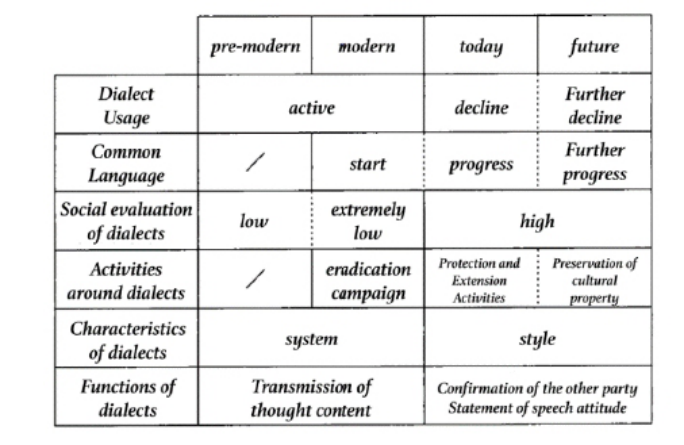
On the other hand, dialects that were once spoken only in certain regions are now being used nationwide. The characteristics of modern dialects can be seen in Figure 1. In the pre-modern stage, dialects communicated thought content and functioned as a collective language. This is called the “systemization” of dialects. Later, with the enactment of the Elementary School Ordinance in 1900, the unification of languages was promoted, and dialects were gradually recognized as an aberration, leading to a widespread movement to eradicate them. However, it became clear that dialect s uniquely impact pronunciation and speech and help identify one’s region of origin. Dialects and standardized languages gradually coexisted in a relationship that has evolved into current affairs. This is called the “stylization” of dialects (Kobayashi, 1996). Thus, dialects have changed dramatically over the past 150 years from the modern era to the present, but recently, they have undergone a different kind of change. Specifically, with the completion of standardization, regional dialects have been transformed into novelties, and partial elements have begun to be extracted and used as “fake dialects,” resulting in a situation in which dialects are being “toyed with” (Tanaka, 2007). This suggests that dialects in the modern era are often consciously used as unique elements that symbolize regional individuality and culture. There are also examples of utilizing the characteristics of modern dialects to revitalize local communities. For example, information terminals have been installed throughout the region to provide store information, such as store names and access information, using a single phrase in the dialect. Users can print out the information or transfer it to their cell phones, allowing them to check the information and pronunciation of the phrase even on their way to the store. In addition, the phrases function as coupons, and discounts are applied by telling them at the store, thus promoting communication with store clerks and allowing users to experience the dialect firsthand (Saito, 2009). Such efforts can increase residents’ pride in their dialect and provide a fresh and attractive experience for tourists and outsiders. Furthermore, communication using dialects is a factor that promotes interaction between people inside and outside the community and stimulates the circulation of the local economy.
In this study, we clarify that dialects are an essential element that reflects the culture and history of each region of Japan. In addition, we will describe the current status and impressions of dialects in the various areas of Japan and propose a method to promote the attractiveness of regions using dialects. Specifically, we will survey the current status of dialect usage, “accessorizing” and “toying” throughout Japan and ascertain the characteristics of dialects in the modern era. Then, we will attempt to maintain cultural identity by proposing a regional revitalization method that utilizes the characteristics of modern dialects.
2036 Sato and Kang
Figure 1: Social history of dialects (Kobayashi, 1996).
An Evaluation Experiment on the Usage of Japanese Dialects Experimental Method An evaluation experiment was conducted to clarify the current status of dialect usage in modern Japan. In the experiment, 112 subjects (59 males and 53 females) in their 20s to 60s were randomly selected to complete a questionnaire about their dialect usage status, and their responses were analyzed. In the questionnaire evaluation, we focused on two aspects of dialect use: the region of origin and other regions. Questions were asked about the frequency and specific use conditions for the dialect of the region of origin. For the dialects of different regions, we asked about the dialects they had come into contact with, the reasons for contact with them, and the influences they had received from the dialects.
After the questionnaire evaluation, we conducted a response analysis to investigate trends in the dialects of their hometowns and other regions in detail. The results of the multiple-choice responses were compiled into a graph after tabulation. Descriptive responses were tabulated and analyzed using AI text mining.
Results First, regarding dialects in contemporary Japan, 62% of all respondents indicated that they use some dialect daily. This suggests that more than most Japanese people use some dialect, meaning dialects are deeply related to daily life. It was also revealed that 91% of the respondents had experienced other regions’ dialects.
Investigation of the Contemporary Value of Dialects and Proposals 2037
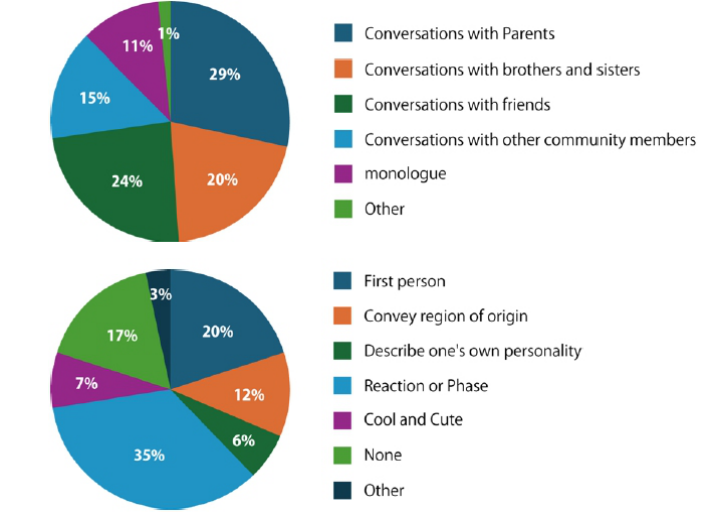
Figure 2: Dialect usage in the region of origin (above) and specific examples (below).
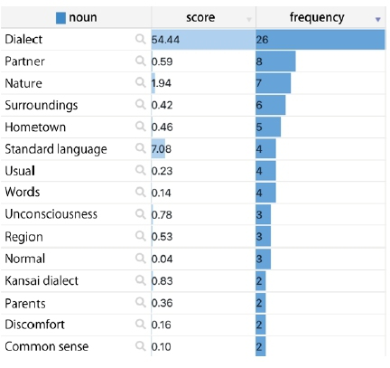
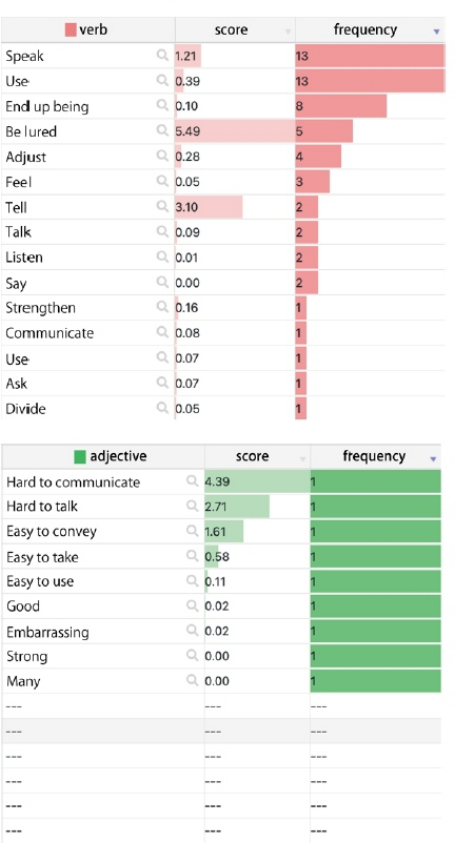
The reasons for speaking the dialect of the origin region were also analyzed using the word frequency of AI text mining. In this analysis, we used the TF-IDF method based on the score (Higuchi, 2020), which indicates the importance of a word, and focused on words with a score of 1.0 or higher. Figure 3 illustrates the results. The words “Dialect,” “Nature,” and “Standard language” for nouns, “Speak,” “Be lured,” and “Tell” for verbs, and “Hard to communicate,” “Hard to talk,” and “Easy to convey,” for adjectives appeared frequently and had high scores.
Figure 3: Continued
2038 Sato and Kang
Figure 3: Word frequency analysis of the use of native regional dialects by AI text mining (https://wordcloud.userlocal.jp/).
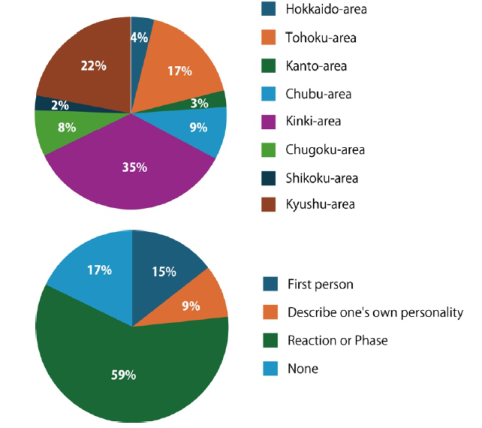
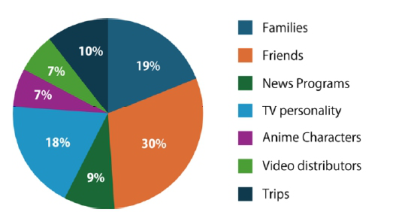
Finally, we describe the dialects of other regions. Here, we summarize the dialects they have been exposed to, their triggers, and the influences they have received from the dialects of different regions. Figure 4 shows the dialects that the respondents have been exposed to and the reasons for their exposure. The results were tabulated and analyzed separately for each region. The results show that the Kinki region had the highest percentage of dialects, followed by Kyushu and Tohoku, with more vital dialects having higher percentages. Conversations with relatives and friends accounted for about half of the respondents’ exposure to dialects. At the same time, the proportion of respondents exposed to dialects through TV programs and video distribution services was also high.
Investigation of the Contemporary Value of Dialects and Proposals 2039
Figure 4: Dialects you have been exposed to (above) and how you came into contact with them (below).
Figure 5 shows the usage of dialects from other regions. The results show that more than half of the respondents used it as a reaction and aid, indicating a tendency to use it to support communication rather than as a means of communication.
Figure 5: Usage of other regional dialects.
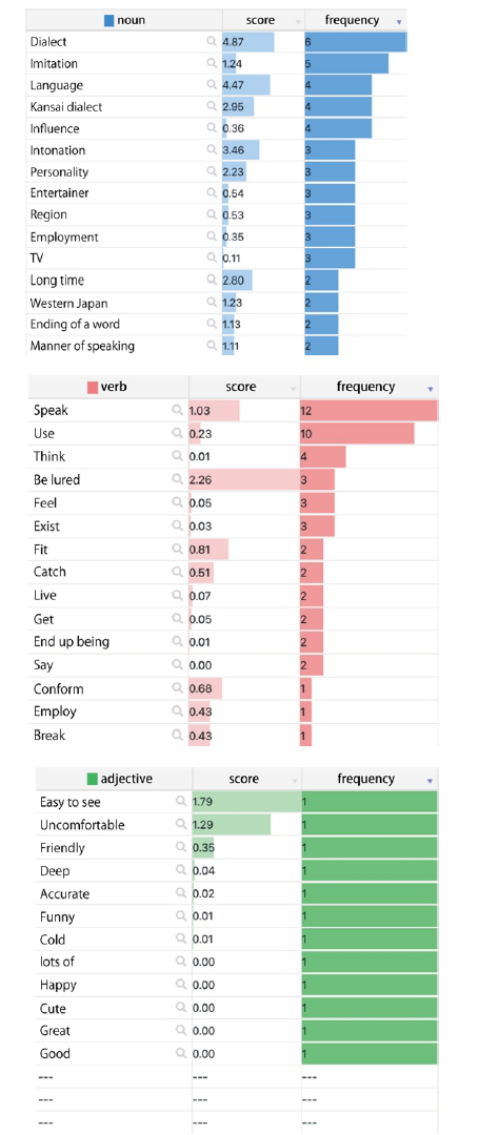
Next, Figure 6 shows the reasons for speaking dialects of other regions. As with the dialect of the origin region, focusing on words with a high score of 1.0 or higher associated with high frequency, “Dialect,” “Imitation,” “Language,” “Kansai dialect,” “Intonation,” “Personality,” “Long time,” “Western Japan,” “Endings of a word,” and “Manner of speaking,” appeared frequently and had high scores for nouns. For verbs, “Speak” and “Be lured” appeared frequently and had high scores. The adjectives “Easy to see” and “Uncomfortable” appeared frequently and had high scores.
2040 Sato and Kang
Figure 6: Word frequency analysis of the use of other regional dialects by AI text mining (https://wordcloud.userlocal.jp/).
Investigation of the Contemporary Value of Dialects and Proposals 2041
Discussion
The evaluation experiment showed that 62% of the respondents use some dialect daily, and 91% have had some experience with dialects of other regions. This suggests that dialects are still an essential means of communication, even as dialects are declining at an accelerating rate.
The ability to use dialect in daily conversation with family and close friends in their native region was high at 73%. Specifically, the results showed that dialect was frequently used in the first person, as well as in reactions and responses. This suggests that dialect indicates close relationships and is deeply rooted in daily life as part of local culture and identity. In addition, an analysis of word frequency using AI text mining revealed that verbs such as “to speak,” “to be understood,” and “to have an accent” were frequently used as reasons for dialect use. In contrast, adjectives such as “hard to communicate,” “hard to speak,” and “hard to convey” also appeared at high frequency. This suggests that dialects are more challenging to understand than standard languages due to the strong ties within the region where the dialects are used. Therefore, the reasons for using dialects reflect the fact that there are situations in which it is necessary to distinguish between dialects and the standard language while at the same time serving as a region-specific means of communication.
The results show that the dialects of the Kinki region, to which Osaka and Kyoto belong, are most frequently mentioned, followed by those of the Kyushu region, to which Fukuoka and Kumamoto belong, and those of the Tohoku region, to which Aomori and Akita belong. The above regions have strong dialects even when viewed nationwide. For example, the Kansai dialect, the most famous dialect in the Kinki region, has a firm tone, but its intonation and atmosphere are often humorous and casual. The AI text mining results showed that the w Figure 3ord scores for “intonation,” “speaking style,” and “formal” were high, indicating that dialects have charms that standard languages do not have. Thus, dialects are practical to convey nuances and emotions that differ from those of the standard language. Daring to use a dialect allows for various expressions in communication, which may result in a richer conversation. In particular, reactions and responses are essential to convey emotions in short sentences, and dialects can make these expressions more informal and friendly. In other words, dialects make conversations less formal and more relaxed. In addition, recent information technology has accelerated the development of not only television and radio but also the Internet and social media and established online communication, such as the increase in the number of celebrities and video distributors from specific regions and the development of text and voice communication on online platforms. The development of online communication, such as the increase in the number of celebrities and video distributors from specific regions and the development of text and voice communication on online platforms, is thought to have led to the spread of dialects from other regions.
In summary, the usefulness of dialects has been maintained even today. Although the number of regions where dialects are used is decreasing,
2042 Sato and Kang
dialects are still essential for communication. However, due to the wave of information technology, dialects that were once spoken only in certain regions are now widely spread, especially among young people, even in regions where the dialects are not spoken, due to their various charms. In other words, dialects are becoming more and more accessible even today. On the other hand, with the development of online communication, the spread of dialects through digital media is accelerating, and understanding of dialects is limited mainly to visual and auditory perception. In this state, it isn’t easy to fully convey the unique atmosphere of a region.
Based on the above, we believe it would be helpful to propose a system for communicating the attractiveness of dialects to the outside world. This time, focusing on service design, we propose an event concept that deepens the appeal and knowledge of dialects through an experience using the five senses.
Proposal of Ideas Based on the results of the analysis, we propose the “Dialect Market” as an event concept that contributes to the promotion of each region while enjoying the uniqueness of dialects. The purpose of the “Dialect Market”is to promote the attractiveness of the region and to revitalize the local community through the sale of products and experiences in dialect. The “Dialect Market” is a unique event that fuses dialect and promotion in a unique format for the outside world. All vendors will speak only in dialect, and visitors will experience local specialties and culture through the dialect, aiming to provide a place to rediscover the region’s charm.
Event Details The Dialect Market consists of the following three event contents.
Dialect Market Booths will be set up to sell local specialty products in regional dialects. Salespeople use local dialects to explain products and convey the appeal of dialects to visitors. For example, local specialty products, such as “This is our specialty, 00, can be described in regional dialects. It is delicious; please try it.
Dialect Workshop Conduct a workshop to learn about the usage and history of dialects. Invite local dialect experts and lecturers from local traditional stores, and have participants learn the dialect through dialect quizzes, speaking experience, etc., to understand the importance and characteristics of the local language.
Dialect Performance We provide opportunities to experience dialects’ rhythm and unique expressiveness through music and theater performances using dialects. Local artists and community members will participate to provide entertainment utilizing local dialects.
Investigation of the Contemporary Value of Dialects and Proposals 2043
Expected Effects The main objective of the Dialect Market is to provide participants with an experience of the region’s linguistic diversity and cultural background. Participants can deepen their understanding of local culture by learning about the background and history of regional specialties in the dialect market. They can also learn dialect vocabulary and usage and deepen their knowledge of the region’s unique language culture by participating in dialect quizzes and dialect workshops. Furthermore, through dialect performances, visitors can experience the expressive power and emotional connotations of the local language and have the opportunity to feel the cultural ties of the entire region. These “dialect markets” are expected to celebrate regional uniqueness and cultural heritage and contribute to the formation and promotion of regional identity.
CONCLUSION
This study aimed to understand the usage of dialects throughout Japan and propose an event concept that contributes to the promotion of each region while enjoying the charm of dialects. Dialects reflect the diverse culture and history of each region in Japan and are an essential element of regional identity and communication. However, in recent years, the use of common language has increased, especially among young people, and dialects unique to each region are disappearing from daily life. On the other hand, with the development of the Internet and social media, specific dialects are spreading online. While this has promoted understanding and empathy between regions, it has also been pointed out that it may distort dialects’ original uses and cultural background. In the future, education and the media will play an essential role in preventing the decline of dialects. In particular, it is necessary to make young people aware of the importance and attractiveness of local dialects. Therefore, we will deepen our understanding and interest in dialects through hands-on events such as dialect markets. Preserving and nurturing the appeal of dialects is believed to enrich and unite local communities.
As for prospects, we will conduct a dialect market and confirm whether it contributes to improving the appeal of dialects. Afterward, we plan to explore new forms of dialect propagation by promoting opportunities for dialect awareness and exchange, both in person and online.
REFERENCES
Hidaka, Koichiro. (2006) Comparison and Contrast Table of “Dialect” and “Common Language” (Draft): Analytical Considerations Based on Classroom Practice at a University. Bulletin of the Faculty of Education and Welfare Science, Osaka University, 35. Higuchi, K. (2020) Quantitative Text Analysis for Social Research: Toward Inheritance and Development of Content Analysis (2nd ed.). Nakanishiya Shuppan, Kyoto, p. 171. Inoue, Fumio (2008) Social Dialectology: A Study of New Dialects and their Basis.
Meiji Shoin, Tokyo.
2044 Sato and Kang
Iwanami Shoten Corporation: Kojien, 7th edition, (2018). Kobayashi, Takashi (1996) Characteristics of modern dialects. Dialect in the Present, Meiji Shoin, Tokyo, pp. 3–17. Saito, Yurie (2009) A proposal for a system using dialects: An introductory study
of sensitivity evaluation in Tsugaru dialect and standard Japanese. Graduation Thesis, Future University Hakodate, 2008, 21–23. Tanaka, Yukari (2007) The age of “dialect toying” in “dialect cosplay. Literature, 8(6): 123–133.
LISTED IN THE AHFE DIGITAL BOOKSTORE CATALOGUE
Explore the complete digital volume
Human Factors in Design, Engineering, and Computing
Read this individual research paper free through the original publisher, or explore the full digital proceedings book.
ISBN 978-1-964867-35-9
Explore this ISBN in the AHFE Bookstore ↗Listed in the July 2026 bookstore catalogue; search by ISBN to confirm current availability · Digital book purchase optional