Xingyi Wen, Yu Shu, Xi Ji, Jianmin Wang (2024). Emotion Regulation Strategies and the Innovative Design of AIGC Interactive Healing Images. In: Human Factors in Design, Engineering, and Computing. AHFE Open Access, vol. 159, pp. 507–516. https://doi.org/10.54941/ahfe1005617
The study explores a new approach to Artificial Intelligence Generated Content (AIGC) in interactive healing image design based on Gross's emotion regulation theory. By deeply analyzing the emotion regulation theory, this study proposes for the first time an innovative design framework that integrates emotion recognition, real-time adjustment and content generation. The framework focuses on the automated recognition and classification of emotions, the adjustment of real-time emotion regulation strategies, and the generation of personalized content, aiming to enhance the user's healing interactive experience.This paper provides new ideas and guidance for the application of AIGC technology in the field of interactive healing images, which has important theoretical and practical implications. Future research can further explore the practical application effects of these design principles and technical strategies.
In recent years, artificial intelligence (AI) technology has been widely used in the field of counseling and healing (Omarov et al., 2023). For people, AI interactive systems are able to provide timely accessible, low-cost, and anonymous psychological support services that compensate for some of the shortcomings of traditional face-to-face psychological healing (Hebbar & Vandana 2023). However, early AI tutoring systems mainly focused on knowledge dissemination and behavioral facilitation (Hua & Wang 2009; Yu, Shengquan et al., 2019), and in recent years many scholars have considered the influence of psychological factors such as emotion regulation (Liu, Xingyun et al., 2019; Fernández Herrero, et al., 2023).
The emotion regulation theory proposed by Gross (1998) is the dominant theoretical framework for studying emotion regulation mechanisms. Emotion regulation theory7 suggests that individuals are able to actively regulate through strategies such as selective attention and cognitive change in order to control the process of generating, maintaining and dissipating emotions (Gross, 1998). Many studies have confirmed the crucial role of emotion regulation in mental health (Aldao et al., 2010). Research on
emotion regulation has gradually increased in recent years, such as the study of metacognitive perception and emotion regulation in intelligent guided learning systems (Han, 2023) and the application of artificial intelligence in one-on-one psychological intervention systems (Erdong Wang et al., 2022), but these studies and applications are usually carried out in specific situations and have not yet resulted in a mature technology that can be widely applied to a variety of psychological healing (especially art healing) scenarios.
Based on the above background, the main objective of this study is to explore a new path for the design of a personalized interactive image healing system developed using Artificial Intelligence Generated Content (AIGC) technology under the guidance of emotion regulation theory. Specific objectives include: 1) to propose an interactive framework that combines three modules: emotion recognition, regulation strategy implementation, and content generation; 2) to explore personalized strategies for information expression and presentation; and 3) to analyze the potential application of AI technology in each module. The purpose of this research is to provide new ideas for the field of emotional counseling and art healing, and to promote the personalization and optimization of human-computer interaction experience.
EMOTION REGULATION THEORY Emotion regulation is generally regarded in psychology as a psychological process in which individuals use physiological, cognitive, and behavioral strategies to modify their emotions based on monitoring and evaluating their emotions in response to the demands of their internal and external environments (Liu, Q. 2011). Emotions are viewed as objects that need to be regulated because of their organizational capacity to drive or interfere with cognition, behavior, and emotion itself. This perspective extends previous theories by emphasizing the importance of emotional self-regulation and proposing a model of the emotion regulation process that includes strategies such as situational selection, situational modification, attentional allocation, cognitive change, and response adjustment.
Gross’s theoretical background is based on psychological emotion regulation research, combined with an understanding of the role of emotions as organizers and regulators of behavioral and psychological processes, as well as the specification and systematization of emotion regulation strategies, resulting in a comprehensive theoretical model of emotion regulation. In the field of design, the theories of Gross’s emotion regulation theory are used to address the emotional problems that arise when users use Internet products, such as anxiety, loss, tension, and excitement. Designers can utilize emotion regulation theory to identify problematic points and deficiencies in a product and design trigger conditions to regulate the user’s emotions and keep them at a moderate level of arousal, thus improving the smoothness of the user’s interaction with the product.
Gross’s Emotion Regulation Theory Gross’s theory of emotion regulation defines emotion regulation as the process by which individuals monitor, evaluate, and adopt physiological,
Emotion Regulation Strategies and the Innovative Design of AIGC 509
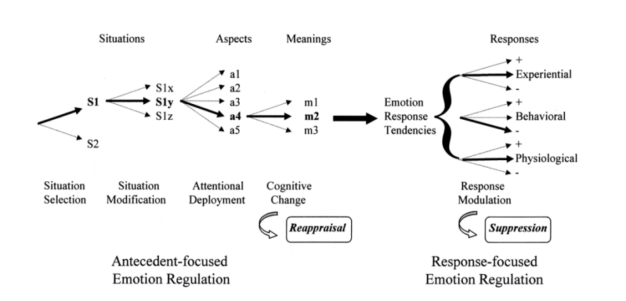
cognitive, and behavioral strategies to modify their emotions. The theory suggests that emotions are not only regulators of behavior, but also objects to be regulated because emotions have the ability to organize and drive or interfere with cognition, behavior, and emotions themselves.Gross’s model of the emotion regulation process includes the following key components: Situation Selection: the individual actively selects or avoids certain emotion-triggering situations.
Situation Modification: Individuals make changes to current situations to minimize the negative effects of emotions.
Attentional Deployment: Individuals regulate emotions by refocusing their attention.
Cognitive Change: Individuals regulate emotions by changing their perception and interpretation of emotional events.
Response Modulation : refers to the individual’s adjustment of the emotional response that has been produced, including physiological response and behavioral expression.
Figure 1: Gross’s process model of emotion regulation (Gross, 2003).
Emotion Regulation Theory Applied to Interaction Design The application of emotion regulation theory in design provides designers with a new perspective on creating products through a deep understanding of users’ emotional needs and emotional responses. This design concept not only focuses on the functionality and practicality of the product, but also emphasizes the emotional connection and interaction between the product and the user, thus enhancing the overall quality of the user experience.
By integrating emotion regulation theory into interaction design, designers are able to create more humanized and emotionally rich products, thus enhancing user satisfaction and loyalty. This emotion-centered design approach helps to create appealing products and realize the concept of “user-centered” design (Bi, Zhao, Chen, 2018).
Interaction designers first need to deeply understand users’ emotional state in specific situations through scene theory. This includes the positive or negative emotions that users may experience when using a product or
service, and how these emotions affect their behavior and decision-making. Second, based on this understanding of user emotions, designers can create or optimize user interfaces and interaction flows to trigger or modulate specific emotional responses. For example, by using soothing colors, harmonious music, or smooth animations to enhance user pleasure, or by providing clear prompts and feedback to reduce user anxiety and frustration. Further, designers should continually collect user feedback, monitor changes in user sentiment, and iterate and optimize the design based on this information. This helps to ensure that the design is always aligned with the emotional needs of the user. In addition to this, using emotion regulation theory, designers can provide users with a more personalized experience. By analyzing users’ behaviors and preferences, the design can adapt to the user’s emotional state and provide customized content and functionality. At the same time, designers can use emotion regulation theory to enhance the emotional connection between the product and the user. This can be achieved by telling stories, creating resonant visual elements, or designing interactive elements with emotional symbolism.
The application of emotion regulation theory in design provides designers with a new perspective on creating humanized, emotionally rich products by focusing on the emotional needs and emotional responses of users.
AN INNOVATIVE DESIGN FRAMEWORK FOR INTERACTIVE HEALING IMAGES UNDER EMOTION REGULATION THEORY This study proposes an innovative design framework that combines emotion recognition, real-time adjustment, and content generation to provide users with a customized emotional healing experience through highly personalized AIGC technology. By analyzing the user’s emotional state in real time, the image content is dynamically adjusted to achieve the effect of emotional soothing, relaxation or motivation. The framework consists of three core components: emotion recognition module, emotion regulation module and content generation module, which work together to optimize the effect of interactive healing images.
Emotion Recognition Module The emotion recognition module is the foundation of the whole framework, responsible for capturing and analyzing the user’s emotional state. This can be achieved through a variety of technical means, such as facial expression recognition, speech analysis, heart rate monitoring, etc. This module processes the data collected in real-time to extract the user’s emotional characteristics, such as pleasantness, nervousness, sadness, and so on. Firstly, deep learning algorithms such as Convolutional Neural Network (CNN) are utilized in the design to analyze the subtle changes in the user’s facial expression and identify different emotional states. Secondly, through the speech recognition and emotion calculation technology, the characteristics of the user’s voice, such as pitch, speech speed and volume, are analyzed to infer their emotional state. The detected emotions are then labeled based on the classification criteria (e.g., happy, sad, angry, etc.) in emotion regulation
Emotion Regulation Strategies and the Innovative Design of AIGC 511
theory. Meanwhile, it can be combined with wearable devices, such as smartwatches or heart rate monitors, to collect physiological data such as the user’s heart rate and skin conductance in real time, which can be used as auxiliary information for emotion recognition.
Emotion Regulation Module The emotion regulation module dynamically adjusts the content and presentation of the healing image according to the output results of the emotion recognition module to match the user’s emotional needs. For example, if the user is in a highly tense state, the system may choose to play images with relaxation effects; if the user is in a low mood, it may display some inspiring scenes.
After recognizing the user’s emotion, the emotion regulation module performs real-time regulation according to the five key steps of the Gross theory of emotion regulation (situation selection, situation modification, attention deployment, cognitive change, and response regulation).
Context Selection: Based on the results of emotion recognition, appropriate context or interactive content is selected for the user to avoid triggering negative emotions.
Context modification: Adjusting certain elements in the current context or environment (e.g., background music, image color tone, etc.) to alleviate the user’s negative emotions.
Attention Deployment: Direct the user’s attention to positive emotion inducers, such as engaging the user in fun or attractive interactions.
Cognitive change: guiding users to rethink their current emotional state through visual and auditory content to change their emotional response.
Reaction Modulation: After guiding the user to express their emotions, the generated content is further optimized based on the feedback.
This module focuses on dynamic adjustment: real-time monitoring of the user’s emotional changes, dynamically adjusting the color tone, rhythm, sound effects and other elements of the image to maintain synchronization with the user’s emotional state.
Content Generation Module The content generation module is the core of the framework, which is responsible for generating and presenting the corresponding healing images according to the instructions of the emotion regulation module. These images can be in the form of natural scenery, art works, music videos, etc., aiming at guiding the user into a positive, relaxed or calm emotional state through both visual and auditory stimulation.
Artificial intelligence content generation technologies, such as GANs (Generative Adversarial Networks) and VAEs (Variable Auto-Encoders), need to be utilized in this functional model to quickly generate high-quality image material. At the same time, a rich healing image content library is established, including image materials of different styles and themes, so that they can be selected and combined according to user needs. The technical
difficulty of this link lies in real-time rendering, which needs to adopt real- time rendering technology to ensure the smoothness and interactivity of the images. Users can explore different image scenes and details through interactive operations, such as sliding the screen and clicking buttons.
The content generation module uses deep learning algorithms and generative adversarial networks to generate personalized healing image content based on the conditioning strategy, and provides real-time feedback to the user. During the whole interaction process, the system continuously monitors the user’s emotional response, and ensures the maximization of the healing effect by adjusting the emotion regulation strategy and optimizing the generated content.
RELEVANT CASE STUDIES The application of AIGC (Artificial Intelligence Generated Content) technology in the field of interactive healing is gradually expanding, helping people to relieve stress, soothe their emotions, and enhance their mental health through innovative ways. Here are some AIGC interactive healing case studies:
Table 1. AIGC interactive healing images case study.
Table available in the original PDF paper.
Overview of the Case Audience and Problems Technical Realization Interaction Project Name Mind Palette App Speech to Text>GPT3 Response>Dall-E Gallery Material and Raw Image Function “Mind Palette” was developed using MIT App Inventor and combines GPT3 and Dall-E to create a conversational and open personalized experience with artificial intelligence.
Users can engage in a conversation with a GPT-powered chatbot to learn about the artwork > The platform imports images from Dall-E to assist users in drawing their personal artwork > A GPT-powered chatbot communicates with the user, encouraging them to express themselves artistically, reflecting on their emotions and being guided in the process of reconstructing the experience.
The app is designed to address the need for holistic interventions in mental health crises, particularly in the young adult population. It consists of three main areas: 1. Facilitating discussion of the user’s emotions through appreciation of the artwork and exploration of the user’s inner feelings. 2. Using generative AI to create art and engage in a conversation with an AI Art Therapist agent. 3. Utilizing AI suggestions to reframe and overcome negative thoughts while transforming paintings into a conduit for positive emotions
Dreamore AI
Primarily for Gen Z users, it helps them understand underlying emotions and stress through dream interpretation, providing psychological relief and alleviating mental health issues.
Users enter dream descriptions via the Web and App, AI generates parses and images, and users can share the results with the community for in-depth communication with psychotherapists.
Dreamore AI is an AI-based dream interpretation and psychological healing platform that provides “light psychological services” through multi-genre dream interpretation and image generation to help users understand their dreams and share them with the community.
Fine-tuned based on open-source language models, using RLHF (Reinforcement Learning Based on Human Feedback) methodology, combined with multi-genre dream parsing theories (Freud, Zhou Gong, etc.) to provide professional dream analysis and generate corresponding dream images.
Emotion Regulation Strategies and the Innovative Design of AIGC 513
“Mind Palette” Case Study “Mind Palette is a program that combines art healing and generative artificial intelligence technology (AIGC) to provide an accessible and enjoyable therapeutic platform in collaboration with a certified art therapist. The project’s practice can exemplify Gross’ theory of emotional regulation as an aid to design.
“The Mind Palette helps users make situational choices and modifications by providing artwork that matches the user’s emotional state. Users can begin the process of emotional regulation by selecting artwork that reflects their current mood, whether positive, neutral, or negative. Users are guided to focus their attention on specific elements of the artwork, such as colors or shapes, and the emotions that these elements evoke, while engaging in a conversation with the GPT-powered chatbot. This allocation of attention helps users to understand and regulate their emotions more deeply.
Through the questions posed by the AI agent, the user is encouraged to reinterpret and understand his or her emotions and experiences, a process of cognitive change. This cognitive change helps users to view their emotional state from a different perspective, which may change their emotional experience.
During the drawing process, users can vent their emotions through drawing, or control and adjust their emotions through the AI’s suggestions, which are adjustments to the physiological responses, psychological experiences, and behavioral expressions of the emotions that have been created.” Mind Palette also provides a highly personalized experience, with the AI agent adapting the conversation to the user’s emotional state and response, making the user feel understood and supported for more effective emotional regulation. Users have the opportunity to express their emotions artistically in their drawings and conversations with the AI agent, and to understand their experiences more deeply through self-reflection. This introspective process is an important part of emotional regulation. Through AI suggestions and Dall-E’s artistic creations, users can channel their negative emotions into positive ones, helping them to develop a more positive emotional state.
Finally, the entire “Mind Palette” experience is an ongoing interactive process, where the user can constantly communicate with the AI agent and adjust their artwork, which is a dynamic process of emotional regulation.
Dreamore AI Case Study In recent years, “self-labeling”has become the social symbol of Generation Z. The demand for “self-exploration” has driven the rise of broad markets such as the MBTI Type 16 personality test and astrology, as well as niche areas such as dream understanding and art healing. Research has shown that dreams can reflect hidden stress, unexpressed emotions, underlying trauma, and even correlate with illness. Since the publication of Freud’s The Interpretation of Dreams, dream analysis has become a common method of psychotherapy. According to a study by the American Psychiatric Association, about 28%
of psychotherapy involves dream interpretation, with 70.4% of patients benefiting.
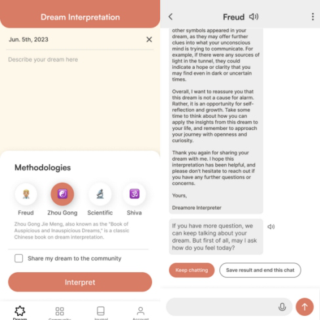
Figure 2: Dreamore AI dream analysis function, the right picture shows the Freudian school analysis effect (https://www.36kr.com/p/2315737488928001).
Founded in 2023, Dreamore AI utilizes AI technology to provide multi- genre dream interpretation and image generation services. Users can enter dream descriptions via the web side or app, and the system parses and generates relevant images based on a variety of theories, including Freud, Chou Kung, Shiva, etc. Dreamore AI was not initially commercially oriented, but rather was developed to meet the needs of the founding team, as well as those of their friends and family. As the demand for mental health services grew in the post epidemic era, dream interpretation became its entry point.
Dreamore AI is defined as a “light psychiatric service” with core features such as Dream Interpretation, Dream Community, Dream Arts and Dream Chat. The core functions include Dream Interpretation, Dream Community, Dream Arts and Dream Chat. Users can share dreams to the community and have in-depth counseling through professional psychotherapists. The team has fine-tuned the open-source language model to improve the accuracy of the dream-understanding model by utilizing high-quality interaction data from community users.
In the future, Dreamore AI plans to combine the niche of dream interpretation with the broader market of psychological healing, and is working with localized scientific and medical institutions to optimize the RLHF (Reinforcement Learning Based on Human Feedback) of dream interpretation models with the help of professional data. In terms of security, the platform filters and blocks negative dreams and guides users through positive parsing to help them gain positive life orientation from negative dreams.
CONCLUSION
The application of AIGC (Artificial Intelligence Generated Content) technology in the field of art healing has injected new vitality into the
Emotion Regulation Strategies and the Innovative Design of AIGC 515
traditional treatment. Through AI technology, users can not only generate personalized artworks, but also participate in the healing process through multi-sensory interactions (e.g. voice, image, virtual reality, etc.) AI-driven image generation and human-computer interaction not only enriches the user’s experience, but also makes the process of psychological healing more flexible and convenient. The low threshold and high adaptability of this technology make it have great potential for application.
This paper proposes a series of innovative strategies based on the theory of emotion regulation and the design of AIGC interactive images: 1) using deep learning algorithms to improve the accuracy of emotion recognition; 2) real- time emotion feedback through natural language processing technology; and 3) using Generative Adversarial Networks (GANs) to generate personalized healing content. Through theoretical analysis and design exploration, the study demonstrates the promising future of AIGC technology in emotion regulation and psychological healing. In conclusion, AIGC empowers more possibilities for art healing and greatly expands the boundaries of traditional therapy. However, when pursuing technological innovation and development, it is always necessary to keep in mind the original intention and ensure that the healing needs of users are effectively met, which is the fundamental goal of the application of technology.
ACKNOWLEDGMENT
This research was supported by Shanghai Pujiang Programme (23PJC103); China Postdoctoral Science Foundation (2024M752402); Tongji University Excellent Experimental Teaching Program(0600104108); the Digital Media Art, Key Laboratory of Sichuan Province, Sichuan Conservatory of Music (23DMAKL12).
REFERENCES
Aldao, A., Nolen-Hoeksema, S., & Schweizer, S. (2010). Emotion-regulation strategies across psychopathology: A meta-analytic review. Clinical psychology review, 30(2), 217–237. Bi, Q., Zhao, F., Chen, J. L. (2018) “Interactive design research based on emotion
regulation and scene theory”, in: Packaging Engineering, 39(8), pp. 80–83. Erdong Wang, Wen-Lung Chang, Jinwen Shen, Qian Bian, Peili Huang, Xueyan Lai, Tzu-Yuan Chang, Huang Shaoying, Zeng Ziyue, Ziyu Wang, Hanting Xue, Shelley Kues, Effect of Artificial Intelligence on One-to-One Emotional Regulation and Psychological Intervention System of Middle School Students, International Journal of Neuropsychopharmacology, Volume 25, Issue Supplement_1, July 2022, Pages A62–A63, https://doi.org/10.1093/ijnp/pyac032.086 Fernández Herrero, J., Gómez Donoso, F., & Roig Vila, R. (2023). The first steps
for adapting an artificial intelligence emotion expression recognition software for emotional management in the educational context. British Journal of Educational Technology, 54(6), 1939–1963. Gross, J. J. (1998). The emerging field of emotion regulation: An integrative review.
Review of general psychology, 2(3), 271–299. Gross, J. J. (2003) “Emotion regulation: Affective, cognitive, and social consequences”, in: Psychophysiology, 40(3), pp. 281–291.
Hebbar, S., & Vandana, B. (2023). Artificial Intelligence in Future Telepsychiatry and Psychotherapy for E-Mental Health Revolution. In Computational Intelligence in Medical Decision Making and Diagnosis (pp. 39–60). CRC Press. Hua, J. L., & Wang, W. (2009, June). The Research of Emotional Cognition Model
which Based On Bayesian Network within Intelligent Tutoring System. In 2009 International Conference on Computational Intelligence and Natural Computing (Vol. 1, pp. 324–327). IEEE. Han JH. Research on Metacognitive Perception and Emotion Regulation in Intelligent Guided Learning System[D]. Northeast Normal University, 2023. Liu, Xingyun, Liu, Xiaoqian, Xiang, Yuanyuan, & Zhu, Tingshao. (2019). Artificial
intelligence and big data in psychology. Science and Technology Herald, 37(21), 105–109. Liu, Q. (2011) “Theoretical models of emotion regulation”, in: Journal of Liaoning Normal University, (2), pp. 44–47. Omarov, B., Narynov, S., & Zhumanov, Z. (2023). Artificial Intelligence-Enabled
Chatbots in Mental Health: A Systematic Review. Computers, Materials & Continua, 74(3). Yu, Shengquan, Yan Peng, & Yu Lu. (2019). Artificial Intelligence-based Parenting Assistant System. Open Education Research, 25(1), 25. Yoo, D., Kim, D. Y., & Lopes, E. (2023, September). Digital Art Therapy with Gen
AI: Mind Palette. In 2023 11th International Conference on Affective Computing and Intelligent Interaction Workshops and Demos (ACIIW) (pp. 1–3). IEEE.
LISTED IN THE AHFE DIGITAL BOOKSTORE CATALOGUE
Explore the complete digital volume
Human Factors in Design, Engineering, and Computing
Read this individual research paper free through the original publisher, or explore the full digital proceedings book.
ISBN 978-1-964867-35-9
Explore this ISBN in the AHFE Bookstore ↗Listed in the July 2026 bookstore catalogue; search by ISBN to confirm current availability · Digital book purchase optional