Mengying Tang, Jie Jiang, Xi Chen (2024). Application of Architectural Appearance Design Process in Front Area of Fossil Fuel Power Plants Based on AIGC Collaboration. In: Human Factors in Design, Engineering, and Computing. AHFE Open Access, vol. 159, pp. 257–265. https://doi.org/10.54941/ahfe1005590
This paper examine the development, evolution, and application of AIGC (Artificial Intelligence Generated Content, AIGC), the research finds the applicable method of applying AIGC in the exterior design of the front area of fossil fuel power plants through practical cases, and verifies the feasibility of applying this technology to the above industrial projects at present. The collaborative design model of the architectural appearance of "AIGC+" fossil fuel power plants put forward. The conceptual scheme diverges through AIGC technology and then converges through the professional evaluation of human experts, which complements the advantages of human beings and AIGC. The feasibility of the design model is demonstrated by applying the model to the exterior design project of the front area of the actual fossil fuel power plants. Although there are still some shortcomings in the application of "AIGC+" in the architectural appearance design of the front area of the fossil fuel power plants, compared with the traditional architectural appearance design process, the design efficiency is greatly improved and the types and styles of schemes are more diverse. This design model can ensure the quality of the conceptual design scheme to a certain extent, effectively save design time and cost, improve design efficiency, and save money.
With the rapid development of AIGC, an increasing number of design researchers and practitioners are trying to introduce AIGC into the design process to improve design efficiency. Although AIGC can help designers spread their ideas, the AIGC design scheme has the problems of high artistry but low real-time performance for complex architectural design constrained by a large number of codes for design, and it still needs scads human work to refine the final construction drawing or local nodes.
Aiming at the limitations of AIGC technology at the present stage, this study applies the proposed ‘AIGC+’ building appearance co-design model for fossil fuel power plants to the CHN ENERGY Shenhua Jiujiang Power Plant and analyses the feasibility and advantages and disadvantages of the model in the generation of a single building scheme through case studies.
The model tries to provide ideas for the development of AIGC technology in the field of architectural design of fossil fuel power plants, in order to solve the problems of unclear demand, long cycle time, and high cost in the design process. It also takes the example of the pre-plant area building, which opens up a new technology application path for AIGC in the field of industrial construction projects.
Development and Application Status of AIGC Technology Back in 2015, Google kicked off AI with the release of DeepDream, which could generate images from text (Cox, 2019). It was in January 2021 that OpenAI introduced the DALL-E model, which brought the technology of generating images from text into the public eye in earnest (Vayadande et al., 2023). In 2022 In July, Midjourney was released, a technology that helps amateurs create complex, abstract, or realistic works by simply typing a few words into a text box (Mansour, 2023). In August 2022, Stability AI launched Stable Diffusion (SD), an open-source image generation model that requires only an ordinary computer to run (Ruiz et al., 2023). In late 2022, OpenAI released ChatGPT as a large-scale language generation model capable of fluent human-computer dialogue, making the directed generation of prompts possible (Fitria, 2023). At this point, the design work using AIGC has closed the loop.
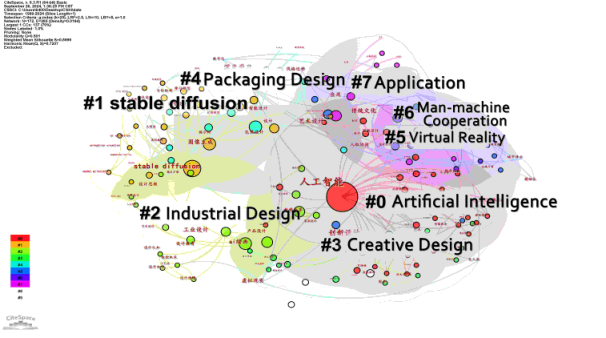
The research selected papers from China Knowledge Network, the search condition is: topic=‘AIGC, artificial intelligence, design’, the year is not limited, after sorting and filtering, we got 482 valid literature, the data was downloaded on 26th September 2024. The literature data were counted according to the keywords, and the keyword clustering network of AIGC technology in the design field was obtained in Fig. 1. It can be seen that there are mainly the following knowledge subgroups: artificial intelligence, Stable diffusion, industrial design, innovation design, packaging design, virtual reality, and human-computer collaboration, and so on.
Figure 1: Keywords clustering network.
As can be seen from the literature, AIGC has been studied more deeply in the fields of industrial design and packaging design in China, and
Application of Architectural Appearance Design Process in Front Area 259
its powerful graphic computing and design capabilities have been widely used in the fields of graphic media and e-commerce (Sun et al., 2024), while its use in the field of architectural design is not yet very mature. Some enterprises and design institutes have begun to try to apply AIGC technology to civil architecture, Ye (2024) established a workflow mode of outputting intentional diagrams through Midjourny and outputting controllable intentional diagrams through SD training, and Yuan and Zheng (2023) further proposed a design concept of generating 3D solutions based on AI technology. However, the field of application is still mainly concentrated in the field of civil construction. For the actual use of technology for industrial buildings like fossil fuel power plants, no data support has been searched and a mature theory and application system has not yet been formed.
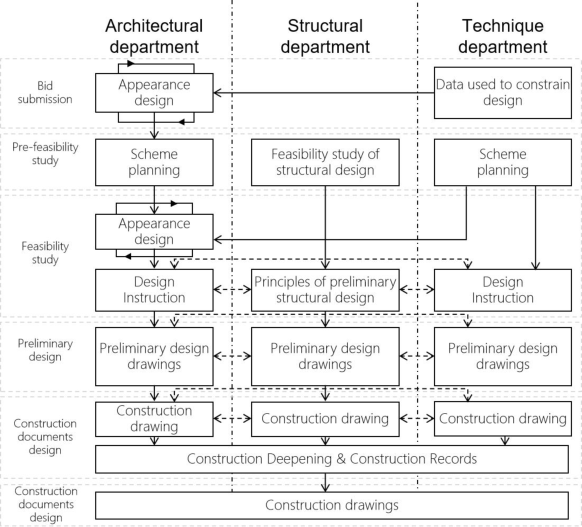
“AIGC+” Building Appearance Co-Design Model for Fossil Fuel Power Plants When fossil fuel power plants are designing the exterior of the building, except for the guiding documents of the enterprise, the owner often does not give detailed advice on the exterior design in the early stage, but asks the designer to propose 3–5 programs and then selects them, and then further deepens the design based on the selected programs. The modification process is often accompanied by the preliminary design stage until the construction drawings stage, and there is also the phenomenon of the re- construction drawings stage to carry out the preliminary program design. The main process of the exterior design of power plant buildings is shown in Figure 2, and ‘exterior design’ will appear several times throughout the project.
There are advantages and disadvantages to using AIGC over the traditional design approach. In the traditional way, designers can directly obtain the opinions of clients through contact with them, and transform these opinions and demands into building appearance attributes through understanding. Afterward, when the client proposes local modifications, the traditional design process can also make targeted modifications, and the design is more controllable.
At the same time, the designer can understand other professional information, such as structure, and equipment technology layout information, to meet the consistency of the plan information and building appearance. At the same time the implementation of various construction techniques and prices, with more comprehensive consideration, makes the design program of the actual construction of the possibility greater.
Figure 2: Building design workflow for fossil fuel power plants.
However, the disadvantage is that human thinking and cognition will be limited by their own life experience, social background, and level of education, and there will be narrowness in creative dispersion for the above reasons.
AIGC is not constrained by the traditional design mindset and is able to produce creative solutions with more perspectives and possibilities. However, it has the disadvantage of not being able to understand process-specialized inputs, such as floor plans, which can result in visually appealing solutions for the exterior of a building that do not meet the functional attributes of the power plant (as shown in Table 1).
Table 1. Advantages and disadvantages of completing the architectural design of fossil fuel power plants with human and AIGC.
Table available in the original PDF paper.
Participants/Tools Advantages Disadvantages Limited by life experience, social background and knowledge level; High cost; Slow feedback.
Human Refine and understand user needs; Process information correctly; Understand technical specifications; Can be implemented; Targeted fix.
AIGC Novel and innovative; Low cost; Low technical threshold; Fast feedback.
Unable to understand the owner’s needs independently; Unable to respond to specification; The controllability of local modification is not high.
Application of Architectural Appearance Design Process in Front Area 261
Table 1 shows that the design advantages and disadvantages of human and AIGC are almost complementary, and if the two design approaches are integrated, a relatively good design model can be formed.
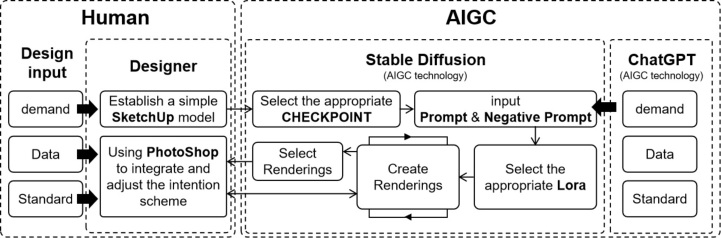
In this study, the advantages of manual and AIGC technology are mutual, and a design flow of manual + AIGC technology cooperation is proposed (shown in Fig. 3), so that the process of designing the architectural appearance of fossil fuel power plants can be more efficient, and more designers can make effective use of the AIGC tool to improve the design efficiency, and at the same time ensure that the owner’s demand is landed on the architectural scheme and targeted modifications can be carried out.
Figure 3: “AIGC+” building appearance co-design model for fossil fuel power plants.
Proposed in the model, firstly the designer obtained some design input information through communication with the owner and other professionals. The designer will collate the input data and use SKETCHUP software to transform them into the base block model. At the same time, using ChatGPT, the input data will be rewritten to make them Prompt and Negative Prompt.
Using the Stable Diffusion (SD) platform, selecting the appropriate CHECKPOINT and Lora in the platform, and entering the previously generated Prompt and Negative Prompt below, the previously completed base block model is transformed into an architectural exterior design solution with certain constraints imposed and presented as a rendering.
After the generation of the effect diagram and then confirmed by manual selection of the form of refinement of the program, and the use of Photoshop will be satisfied with the combination of effect diagrams, nodes, details, the combination of the completed picture again returned to the SD platform for the “washing rendering” The study mainly wanted to introduce two AIGC tools into the design process, “ChatGPT” to transform the owner’s needs into recognizable Prompt and Negative Prompt, and “Stable Diffusion”to transform the Stable Diffusion” transforms basic modeling into a more complete solution. This will improve the efficiency of the exterior design phase, increase the number of proposals, and expand the design ideas;
The program selection stage returns to human control, with manual assessment by relevant professional experts and owners, and control of the program deepening direction through multiple communications.
Case Study: Application of the “AIGC+” Co-Design Model in the Architectural Design of Fossil Fuel Power Plants Combining the limitations and advantages of AIGC technology at the present stage, this study will take the design process of the building in the pre-plant area of the CHN ENERGY Shenhua Jiujiang 2×1000MW Power Plant Phase II Expansion Project as an example to demonstrate the implementability of the above framework process.
The designers completed the establishment of the Sketchup basic model of the altered building in accordance with the constraints such as process speciality inputs, plan layout, and general building size limitations (top left of Table 2), and used the diagram-generated diagram function of the SD platform as the base diagram to generate a total of six architectural schemes, as shown in Table 2.
Table 2. Comparison of schemes for generating dormitory buildings based on different CHECKPOINT, Lora.
Table available in the original PDF paper.
SU Simple Model CHECKPOINT:real_ architectural_ effects_ v1.0.safetensors Lora:Complex_wenhk_v0
AIGC is capable of analysing, integrating, imitating, and learning from the various art styles that have existed throughout history, and is therefore able to make directional references (citations) to specified art styles and specified design solutions. After generating the rendering scheme, two senior architectural engineers from the project participants were selected to conduct a comprehensive evaluation of the above six schemes in terms of feasibility,
Application of Architectural Appearance Design Process in Front Area 263
aesthetics, and economy. The final decision was made to proceed with Option 1 as the design direction and refine the modelling using Shetchup (Table 2, middle left).
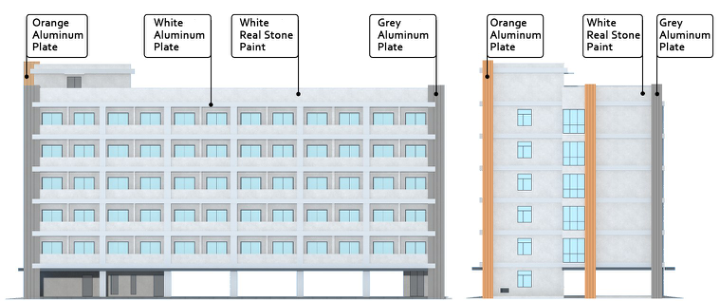
In the stage of construction drawing design, it is found that there are still many incongruities with the structure and plane layout and unreasonable structures in scheme 1, such as the concrete connection mode between the overhanging floor and decorative columns and structural columns, and the structural relationship between the side glass curtain wall and the wall. The designer of the above problems made further detailed design when the conceptual scheme was transferred to the construction drawing, and confirmed the decorative materials of each part in coordination with the effect drawing and the owner’s requirements, as shown in Figure 4.
Figure 4: Mate rial analysis diagram of G/H facade of dormitory.Figure 5: 1–7 axis elevation of staff dormitory G.
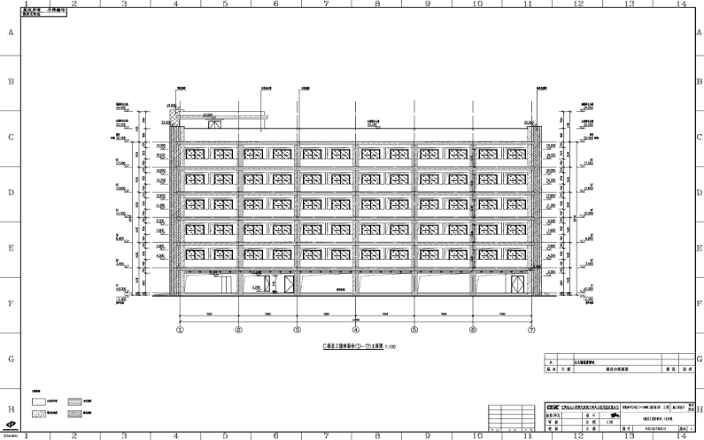
The preliminary design and construction drawing design of the building were carried out by human designers, and the construction drawing of the building has been completed. The elevation construction drawing is shown in Figure 5. However, due to the particularity of the actual project, AIGC is not used to draw the final rendering of the building.
CONCLUSION
With the continuous development and progress of AIGC technology, its application in the design field will be the general trend. This project takes the design process of dormitory in front of the factory as an example, and the traditional user interview, sketch drawing, focus group, evaluation method, 3D modeling and Photoshop image processing are coordinated with AIGC. The “AIGC+”Building Appearance Co-design Model for Fossil Fuel Power Plants makes the conceptual design of AIGC divergent, and it is converged, screened and detailed by professional technicians, making the process efficient and the scheme innovative and practical.
This model can solve the two main problems that AIGC is not accurate in identifying input data and AIGC design scheme is not feasible.
The limitations of AIGC at the present stage can be broken through manual screening and detailed design in the later stage, so that the design scheme can be controlled, adjusted, and implemented.
Although AIGC has accelerated the designer’s design efficiency to a certain extent, the adjustment of the renderings for local modification has not been well solved, and we can try to use the ControlNet plug-in for local directional optimization in the future. AIGC technology is developing at a high speed. The advantages and disadvantages of AIGC operation methods and AIGC tools presented in the current process and design practice are subject to the writing of the manuscript, which may be more convenient with the development and change of technology in the future.
ACKNOWLEDGMENT
Thanks to Central Southern China Electric Power Design Institute and site construction service personnel of the CHN ENERGY Shenhua Jiujiang Power Plant for their help in the research process.
REFERENCES
Cox, C. M. (2019). Algorithm of the Night: Google’s DeepDream and (Dis) Harmonies of an Eternal Nocturnal. In: Stahl, G., Bottà, G. (eds) Nocturnes: Popular Music and the Night. Pop Music, Culture and Identity. Palgrave Macmillan, Cham. https://doi.org/10.1007/978-3-319-99786-5_16 Fitria, T. N. (2023, March). Artificial intelligence (AI) technology in OpenAI
ChatGPT application: A review of ChatGPT in writing English essay. In ELT Forum: Journal of English Language Teaching (Vol. 12, No. 1, pp. 44–58). Mansour, S. (2023). Intelligent graphic design: The effectiveness of midjourney as a participant in a creative brainstorming session. International Design Journal, 13(5), 501–512.
Application of Architectural Appearance Design Process in Front Area 265
Okemwa, K. (2024) ‘Art is dead, dude. It’s over. AI won. Humans lost’: A controversial artist is reportedly losing millions of dollars because the US Copyright Office refused to register his AI-generated collection — it lacks “human authorship”, Windows Central. Available at: https://www.windowscentr al.com/software-apps/art-is-dead-dude-its-over-ai-won-humans-lost-a-controve rsial-artist-is-reportedly-losing-millions-of-dollars-because-the-us-copyright-o ffice-refused-to-register-his-ai-generated-collection-it-lacks-human-authorship (Accessed: 17 October 2024). Ruiz, N., Li, Y., Jampani, V., Pritch, Y., Rubinstein, M., & Aberman, K.
(2023). Dreambooth: Fine tuning text-to-image diffusion models for subject- driven generation. In Proceedings of the IEEE/CVF conference on computer vision and pattern recognition (pp. 22500–22510). Sun, S., Luo, L. and Qiao, X. (2024). AIGC Provides New Momentum and Pathways for Innovative Design. Art & Design Research, 2024(02), p. 69. Vayadande, K., Bhemde, S., Rajguru, V., Ugile, P., Lade, R., & Raut, N. (2023,
November). AI-Based Image Generator Web Application using OpenAI’s DALL- E System. In 2023 International Conference on Recent Advances in Science and Engineering Technology (ICRASET) (pp. 1–5). IEEE. Ye, C. (2024). The Exploration of Applying AIGC in Architectural. Jiangsu Construction, 2024(1). Yuan, C. and Zheng, H. (2023). A New Architectural Design Methodology in the
Age of Generative Artificial Intelligence. Architectural Journal, 2023(10).
LISTED IN THE AHFE DIGITAL BOOKSTORE CATALOGUE
Explore the complete digital volume
Human Factors in Design, Engineering, and Computing
Read this individual research paper free through the original publisher, or explore the full digital proceedings book.
ISBN 978-1-964867-35-9
Explore this ISBN in the AHFE Bookstore ↗Listed in the July 2026 bookstore catalogue; search by ISBN to confirm current availability · Digital book purchase optional