Zun-hwa Chiang, Wei-wei Su, Ming-hsien Chuang (2024). Innovative AI-Driven Product Design: Leveraging Language Models and AI Image Generators in Product Development Process—A Case Study on Insole Design for High-Heeled Shoes. In: Human Factors in Design, Engineering, and Computing. AHFE Open Access, vol. 159, pp. 266–276. https://doi.org/10.54941/ahfe1005591
Publisher statistics will load when you open Metrics.
AHFE OPEN ACCESS OPEN ACCESS CONFERENCE PROCEEDINGS PAPER
Innovative AI-Driven Product Design: Leveraging Language Models and AI Image Generators in Product Development Process—A Case Study on Insole Design for High-Heeled Shoes
Artificial Intelligence (AI) technologies, is the crucial topic all fields of professionals are researching in, it’s one of the icon of this era and its influence on our daily lives is significant, and continuously growing. Incessantly, noticing by designers and making its way into the world of product design. Language Models are to generate ideas and concepts as inspirations, while AI Image Generators are to create graphics as an alternative rapid prototyping. These functional tools are assisting designers in all sorts of ways, as well as Product Design Process (PDP). However, AI’s ability related to Ergonomics is still exiled, owing to its trained in a big data of information but not really understanding the application of Human Factor Engineering. The insole of high-heeled shoes is chosen as the product to be designed, in view of their ergonomic needs and 3D modelling logic. With AI tools assisting among stages of PDP, this paper proposed a new process of Product Design, intended to compare the efficiency of and outcomes between Traditional 4D PDP and AI-Driven PDP. This paper underscores the transformative potential of AI in product design, highlighting its ability to merge creativity with analytical precision, thus fostering more efficient and effective design workflows.
With the rapid development of Artificial Intelligence (AI) technologies, their impact on the design process is becoming increasingly significant. The ever- evolving nature of these technologies is evident through various software advancements. The incorporation of language model databases and AI image generators into the product design development process represents a significant advancement in the field. These technologies streamline ideation, enhance design refinement, and provide comprehensive evaluation, and user-centric products.
However, currently, AI mainly contributes to the conceptual development stage and cannot delve deeper into more complex design aspects, particularly
Innovative AI-Driven Product Design: Leveraging Language Models 267
in functional areas of product design. This limitation of generative software highlights its shortcomings, such as modelling human factor engineering products and 3D modelling reasoning. Thus, this paper intended to present an alternative AI-Driven Product Design Process. With traditional 4D Design Process as the base framework, and adding two types of AI application tools (language models and AI image generator) as assistants. Created a more coherent workflow for product designers in the current era, to follow and refer.
LITERATURE REVIEW
Artificial Intelligence The term “Artificial Intelligence”was coined by John McCarthy in 1955, who defined it as “the science and engineering of making intelligent machines” (McCarthy, 2007). According to the Oxford Dictionary, Artificial Intelligence is defined as the theory and development of computer systems able to perform tasks that normally require human intelligence, such as visual perception, speech recognition, decision-making, and language translation.
Generative Artificial Intelligence (Generative AI) is an AI system capable of learning from vast amounts of data to understand complex patterns and structures, subsequently generating new content that conforms to these patterns. This makes it widely applicable in fields such as natural language processing, computer vision, and artistic creation (Goodfellow, Pouget-Abadie et al., 2020).
Artificial Intelligence in Design Field Generative artificial intelligence (GenAI) and large language models (LLM) are transforming the design field, enhancing creativity and efficiency. Hong, Hakimi et al. (2023) detail how these technologies accelerate the emergence of design inspiration and concept formation, though designers must balance inspiration with operational efficiency. Language models, which understand and generate human language, enrich the ideation phase by proposing unique features, recommending materials, and suggesting ergonomic improvements. AI image generators quickly create and refine visual prototypes, allowing for rapid visualization of design modifications.
Fang (2023) conducted an in-depth study on the impact of generative AI on the field of industrial design, with a particular focus on its application in practical design processes and design knowledge acquisition. In a retrospective paper, Lu and Huang (2024) summarized the development of AI applications in creative design. Through literature review analysis and expert interviews, they gathered valuable insights from professionals across various design background.
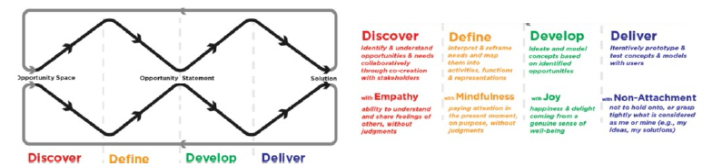
Product Design Process The traditional 4D design process is a structured approach to design that encompasses four key phases: Discover, Define, Develop, and Deliver. This methodology provides a structured framework for developing effective and
user-centered design solutions. By following the four steps, designers can ensure a comprehensive and iterative approach that addresses user needs and achieves project goals. The following flow chart is the 4D Design Innovation Process presented by the British Council.
Figure 1: 4D design innovation process (Perez, 2018).
Design Language “Design language is a set of rules and principles that guide the design of a product or a system. It ensures consistency and coherence across different touchpoints and channels” (Nielsen, 2019). A design language is an essential framework for creating visually cohesive, user-friendly, and brand-consistent designs. By adhering to a set of defined standards and guidelines, designers can ensure that their products not only look great but also provide a seamless and intuitive user experience (Chandrasegaran, Ramani et al., 2013).
The importance of design language is that, it creates communication between design team and customers. As it elucidates the functionality, design semantic and cognitive instruction straight into the product customer are holding on their hands. As well as bringing design concept into manufacturing phases, transforming the thinking and meaning without misunderstanding (Arnold and Rudolph, 2012).
RESEARCH METHOD Challenges Traditional 4D Design Process is Currently Facing
The traditional 4D design process, while systematic, faces challenges in today’s fast-paced, technology-driven environment. Rapidly evolving user needs and expectations can make lengthy, linear processes less effective (Brown, 2008). Integrating new technologies like AI and AR requires continual learning and adaptation (Gero and Sudweeks, 2012). Time and resource constraints further hinder the 4D process, making it hard to keep up with accelerated market timelines (Saffer, 2010). Its rigid structure also impedes effective collaboration among interdisciplinary teams (Cross, 2023). Additionally, managing vast amounts of data for actionable insights while ensuring user privacy is challenging (Donald, 2013). Integrating sustainability and ethical considerations is complex and resource-intensive (Papanek, 2022). These challenges underscore the need for more flexible, agile, and integrated design approaches.
Innovative AI-Driven Product Design: Leveraging Language Models 269
Complement AI Applications Can Bring to Product Design Process AI tools like language models and image generators greatly enhance the design process by boosting creativity and efficiency. Language models like GPT-3 aid in the ideation phase by generating diverse design elements, analyzing user requirements, and providing technical insights (Chakrabarty, 2024). They foster innovative solutions by offering cross-disciplinary insights (Sáez-Velasco, Alaguero-Rodríguez et al., 2024). AI image generators, using technologies like GANs, enable quick creation of visual concepts, facilitating rapid prototyping (Goodfellow, Pouget-Abadie et al., 2020). These tools allow for quick iterations and modifications, enhancing visualization and refinement based on user feedback (Kahng and Chau, 2019). By automating repetitive tasks, AI lets designers focus on complex, creative aspects, leading to improved productivity and a more efficient workflow (Verganti, Vendraminelli et al., 2020).
Generative AI and Image Generation Techniques Generative AI is widely applied in art creation and research, with text-to- image technology gaining significant attention. Using text prompts, it can synthesize new images, as seen in applications like Midjourney, Leonardo, and Stable Diffusion. Image generation techniques include various methods such as image-to-image translation, sketch-to-image generation, conditional image generation, text-to-image generation, video generation, panoramic image generation, and scene image generation. Each method is supported by numerous research papers, employing different features and technologies to achieve optimal and effective generative results (Elasri, Elharrouss et al., 2022).
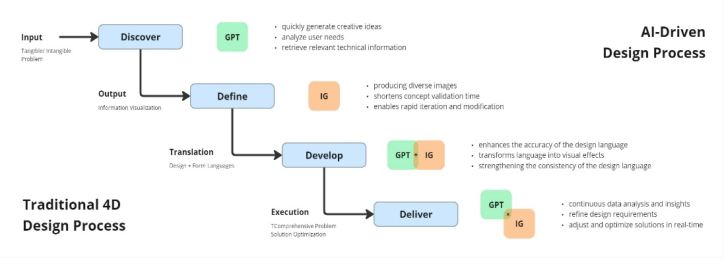
Experimental Setup The purpose of this paper is to present a new AI-Driven Design Process for Product Design. In order to do so, the 4 phases of traditional 4D Design Process are set as the framework, with variety of assisting functions of AI applications plugged in, and transformed into an alternative solution of design thinking method.
Figure 2: Experiment workflow of this study.
AI-Driven Design Process Discovery - GPT By leveraging GPT, designers can quickly generate creative ideas, analyze user needs, retrieve relevant technical information, and gain interdisciplinary insights, aiding in uncovering innovative solutions.
Define - AI Image Generator Using AI image generation, designers can swiftly create visual concepts, producing diverse images based on specific requirements or keywords. This offers varied design references, shortens concept validation time, and enables rapid iteration and modification, exploring solutions visually and defining problems more precisely.
Develop (Design) - GPT + AI Image Generator Combining GPT and AI image generation enhances the accuracy of the language design. AI transforms language into visual, refining design concepts through iterative presentation, and strengthening the consistency of the design language.
Delivery - ChatGPT x AI Image Generator Integrating GPT and AI image generation provides continuous data analysis and insights to refine design requirements. AI generates different design versions for visual validation, allowing designers to adjust and optimize solutions in real-time, achieving efficient and accurate problem-solving.
Pre-Test The purpose of this pre-test includes, 1. as this paper is a preliminary paper, a pre-test is needed for future research; 2. to try out the feasibility of the framework of AI-Driven DP, mainly on the third phase, C. Develop (Design); 3. to test out the ability of current models of AI applications related to Ergonomics.
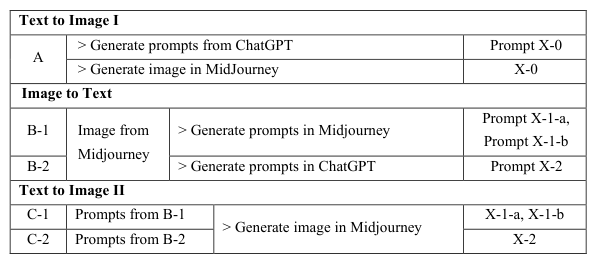
As for the setups of this pre-test, 1. The language model/ GPT performed is ChatGPT from OpenAI and AI image generator practiced is MidJourney; 2. The insole of high-heeled shoes is set as design objective. Three types of operations were practiced, as listed in the chart below. The results are shown in following chapters.
Table 1. Types of operation practiced. (Operation A to Operation C-2).
Innovative AI-Driven Product Design: Leveraging Language Models 271
RESULTS
Operation A.
Step 1. Design Language, prompting from ChatGPT Question: If I’d like to put this idea into AI image generator, as for design languages and form languages, what prompts could you suggest?
ChatGPT:
Step 2. Generate image in MidJourney from prompts of ChatGPT Comfort-Focused Insole Advanced Cushioning
From each sample group, one of the images was selected. Based on the creativity of innovation idea, reasonability of product design, feasibility of form modelling, and conformity of the design objective.
Operation B-1.
Innovative AI-Driven Product Design: Leveraging Language Models 273
Operation B-2.
Operation C-1.
Operation C-2.
DISCUSSION
From Operation A to C, it showed the back and forth of utilizing language model and AI image generator in the design process. Originated from the same prompt, yet resulted in images with various features. In Operation A, the idea of a shoe insole is relatively clearer, as the process goes on, it became more as the design of high-heeled shoes. The reason of the development might owe to how designer’s/ human’s involvement during the process. In this pre- test, the design ability of AI is also tested, hence the designer’s interference was done the minimal. As only two parts of the decision making was executed by the author: the selection of Operation A to continue for further steps; and 2 of the 4 prompts chosen in Operation B-1.
Innovative AI-Driven Product Design: Leveraging Language Models 275
CONCLUSION
AI tools like GPT and image generators enhance the design process by boosting creativity and efficiency. GPT generates ideas, refines concepts, and drafts descriptions, keeping designers updated on trends. AI image generators transform text into high-quality visuals, enabling rapid exploration and iteration. These tools improve collaboration, provide clear drafts for communication, and automate repetitive tasks, allowing designers to focus on complex, creative aspects. The result of the pre-test showed that the AI- Driven Design Process is feasible and would continue for further research. As the process was mostly conducted by AI, the outcome went astray towards
the design of high-heeled shoes, rather than the insole of it. The main features of each group of images generated resulted in the one image chosen by the designer to continue. It proved that how important the designer is taking place during the design process. With higher proportion of designer’s decision making involved inside the process, the description and details of each phase would be clearer, and a more comprehensive model would be conducted.
REFERENCES
Arnold, P. and S. Rudolph (2012). Bridging the gap between product design and product manufacturing by means of graph-based design languages. TMCE 2012 Symposium, Karlsruhe. Brown, T. (2008). “Design thinking.” Harvard business review 86(6): 84. Chakrabarty, T. (2024). Knowledge-Enhanced Large Language Models and Human-
AI Collaboration Frameworks for Creativity Support, Columbia University. Chandrasegaran, S. K., et al. (2013). “The evolution, challenges, and future of knowledge representation in product design systems.” Computer-aided design 45(2): 204–228. Cross, N. (2023). Design thinking: Understanding how designers think and work,
Bloomsbury Publishing. Elasri, M., et al. (2022). “Image generation: A review.” Neural Processing Letters 54(5): 4609–4646. Fang, Y.-M. (2023). The role of generative ai in industrial design: enhancing the
design process and learning. IEEE conference proceedings: 2023 9th International Conference on Applied System Innovation (ICASI). Chiba, Japan on. Gero, J. S. and F. Sudweeks (2012). Artificial Intelligence in Design’96, Springer Science & Business Goodfellow, I., et al. (2020). “Generative adversarial networks.” Communications
of the ACM 63(11): 139- Hong, M. K., et al. (2023). “Generative ai for product design: Getting the right design and the design right.” arXiv preprint arXiv:2306.01217. Kahng, M. and D. H. Chau (2019). How does visualization help people learn deep
learning? Evaluation of GAN Lab. IEEE VIS 2019 Workshop on EValuation of Interactive VisuAl Machine Learning Systems. Lu, T.-J. and W.-T. Huang (2024). “探索圖像生成式人工智慧在創意設計中的應用.”
SEIDF2024 生活再設計學術研討會論文集2024: c25-05-21-10. McCarthy, J. (2007). “What is artificial intelligence.” Nielsen, J. (2019). The definition of user experience (UX). Nielsen Norman Group. Norman Donald, A. (2013). The design of everyday things, MIT Press. Papanek, V. (2022). The green imperative: ecology and ethics in design and architecture, Thames & Hudson. Perez, K. B. (2018). “Design innovation with additive manufacturing (AM): an AM-
centric design innovation process.” Doctoral, Singapore University of Technology and Design. Sáez-Velasco, S., et al. (2024). Analysing the Impact of Generative AI in Arts Education: A Cross-Disciplinary Perspective of Educators and Students in Higher Education. Informatics, MDPI. Saffer, D. (2010). Designing for interaction: creating innovative applications and
devices, New Riders. Verganti, R., et al. (2020). “Innovation and design in the age of artificial intelligence.”
Journal of product innovation management 37(3): 212–227.
LISTED IN THE AHFE DIGITAL BOOKSTORE CATALOGUE
Explore the complete digital volume
Human Factors in Design, Engineering, and Computing
Read this individual research paper free through the original publisher, or explore the full digital proceedings book.
ISBN 978-1-964867-35-9
Explore this ISBN in the AHFE Bookstore ↗Listed in the July 2026 bookstore catalogue; search by ISBN to confirm current availability · Digital book purchase optional