Wei-Wei Su, Zun-Hwa Chiang, Ming-Hsien Chuang (2023). The Development of Process-Based Customized Service on Insole Design for High-Heeled Shoes. In: Ergonomics In Design. AHFE Open Access, vol. 77, pp. 430–438. https://doi.org/10.54941/ahfe1003401
In the era of customers in power, customized products have gained significance in design strategy. By discovering the uncomfortableness of wearing high-heeled shoes and researching the issues caused by inappropriate foot pressure, this study (which is currently in process) aims to establish a service process that meets customers’ needs . The service process started with scanning the contours of the subjects’ feet and constructing corresponding 3D anti-slip kits. Then, the prototype was printed with a silicone 3D printer with controlled parameters. The hardness, thickness, and density of the silicone materials differed among subjects with different experiences, and feedback was obtained. Through interviews and data collected from the subjects, the researchers will analyze the feelings they experienced—both standing and walking—while wearing the designed silicone kit. In the end, we will develop a reference chart, based on body weight and shoe size, that guides consumers in choosing silicone anti-slip kits . In this way, the manufacturer can optimize the low-cost mass production and the high-cost of full customization . Thus, we will create a service design and physical products that better meet consumer expectations.
In the past few decades, female consumers’ preference for high-heeled shoes has been increasing, and it has become a symbol of fashion. Social research on the cultural impact of high-heeled shoes also shows that about 70% of wor- king women in management positions with high-heeled shoes today, which makes them feel more confident in their ability to work professionally. How- ever, podiatrists and medical scientists recognize the concern that long-term periods of wearing these shoes may lead to health problems. Injuries such as plantar fasciitis, and osteoarthritis, occur from time to time due to abnormal foot pressure in the incorrect foot location.
Most high-heeled shoe manufacturers apply mass production processes to decrease the cost of making shoes. However, individuals have different foot sizes, shapes, and features. Therefore, using such mass production processes,
The Development of Process-Based Customized Service on Insole Design 431
it is impossible to manufacture high-heeled shoes that fit every wearer’s demands.
In the present study, through a series of measurements, designs, and experi- ments, we are developing a feasible solution for people who wear high-heeled shoes. Our solution will reduce the risk of foot injury and enhance users’ comfort.
LITERATURE REVIEW
Progress of Customized Production During Industrial Revolution, which brought the benefits of reducing manual labor and production costs, the process of “mass production” emerged. However, with changes in customers’ shopping patterns and the rise of indi- vidualism, the term “customized production,” which refers to tailor-made and unique products, was created (Huang, 2017). Subsequently, in competi- tive environments, the difficulty of management and the cost of high-quality customized manufacturing increased. In such circumstances, the era of “mass customization” emerged (Lin, 1999). According to Chen and Liou (2004), mass customization combines the benefits of both mass and customized pro- duction. It utilizes a customized model to meet customers’ needs and a mass production model to optimize production efficiency.
In the study “Computer-Aided Design and Manufacturing of Customi- zed Insoles,” Huang, Lee, and Chang (2011) created a rapid manufacturing service process for customized shoe insoles. For each subject, they used a pres- sure sensor to measure foot pressure, and then they produced a customized shoe insole with rapid prototyping technology.
Arch of the Foot, Foot Pressure, and Measuring Equipment The arch of the foot is composed of elastic and contractile tissues, such as the tarsal, metatarsal, and plantar ligaments and tendons. The arch is divided into the medial longitudinal arch, lateral longitudinal arch, and transverse arch (Li, 2015) (see Figure 1). The main function of the arch of the foot is to maintain the stability of the sole support. The arch relies on the shape of the bones and the strength of the ligaments and muscles to maintain its shape.
The term “foot pressure”refers to the pressure on the foot created by body weight and measured in load-bearing force per area unit (Liao, Hong, Yeh,
Figure 1: Image of the arch of the foot (adapted from www.footdoctormoore.net).
Figure available in the original PDF paper.
Tsai, and Chen, 2020). Shoe choice can make a huge difference in foot pres- sure. Wearing inappropriate shoes can cause parts of the foot to endure too much pressure, leading to injuries in the long term (Hsu and Ke, 2010).
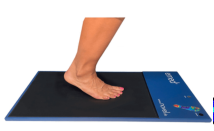
Two types of foot-measuring equipment are used in academic research and medical treatments (Liou, 2019). The first type is a plate-like system. The force plates are placed on the ground, and the subject stands on the plates with bare or shoed feet. The plates then collect data and show information on the display screen. The EMED foot pressure measuring system used by Zhan, Li, Yang, Chao, Lin, and Zhang in the study titled “Foot Pressure Analysis in Normal Young Chinese Adults” (1997) is a plate-like system (see Figure 2). In addition, Lin, Cheng, and Peng (2003) tested the evaluation on Kistler and KAT2000 force plates.
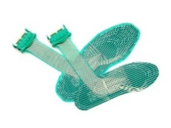
The second type of measuring equipment is an insole system in which sen- sing insoles are placed on top of the shoe insole, and the data collector is tied to the subject’s calves. This system provides dynamic pressure, timing, and force information. Liao et al. (2020) used an F-scan to evaluate the shoe insole they designed for diabetes patients. Liou (2019) used the F-scan system to measure the pressure distribution of physical trainers.
High-Heeled Shoes Wearing high-heeled shoes creates the illusion of the wearer being taller than they really are. The height difference between the shoe’s heel and toe makes the wearer naturally raise their chest and buttocks, emphasizing the body curve (Krueger, Hsu, and Chen, 2019). Whether a shoe is high-heeled depends on the height between the heel and the toe: more than 2.5 inches is high- heeled, between 2.5 inches and 1 inch is mid-heeled, and less than 1 inch is low-heeled.
The uncomfortableness of wearing high-heeled shoes is obvious. Medical scientists have been studying the danger that could be caused by wearing high-heeled shoes, and they continuously warn about this malignant phe- nomenon (Linder and Saltzman, 1998). Studies have shown that injuries such as plantar fasciitis, osteoarthritis, eversion, and musculoskeletal pain
Figure 2: Image of EMED force plate and test result (adapted from www.novel.de).Figure 3: Image of F-scan and insole system (adapted from www.tekscan.com).
The Development of Process-Based Customized Service on Insole Design 433
occur from time to time in wearers of high-heeled shoes due to abnormal foot posture on the incorrect foot location (Barkema, Derrick, and Martin, 2012; D’Août, Meert, Van Gheluwe, De Clercq, and Aerts, 2010; Sijbrandij, van Gils, van Hellemondt, Louwerens, and de Lange, 2001).
RESEARCH METHOD Since the study of eronomics became popular, product design and human factors engineering have been tightly linked. In the insole design of high- heeled shoes, the product must be user friendly, the measurement must meet consumers’ needs, and the product must pass an ergonomic evaluation before being sent out on the market (Shih, Chi, and Lin, 2018). For deca- des, scanning equipment has been used to measure human factors. Butdee and Tangchaidee (2008) used a 3D scanning camera to formulate 3D shoe sizes. Du (2017) applied 3D reverse technology to scan the feet of elderly individuals and created customized shoes for each subject.
In a competitive market, customization has become a major feature, and accommodating a user’s uniqueness elevates a product’s specialness. Tho- massey and Bruniaux (2013) discussed the possibility of creating customized garments with 3D body measurements. Kim (2020) designed a customized medical mask by scanning faces with a smartphone camera, using an appli- cation on the smartphone. Overall, to achieve better comfort, it has become an inevitable trend in design to use customized service processes and techno- logies to align products with the differences in the body sizes of individual users.
Service Process Design The aim of this study is to create a service process that combines the advan- tages of customized and mass production. Therefore, the service process integrates the following features from ergonomic measuring and customized manufacturing:
1. Scanning the sole of the subject’s foot. 2. Building a 3D model according to the scanned CAD data. 3. Adjusting parameters of the model, including size, thickness, stiffness, and density of the inside structure. 4. Manufacturing a prototype of the 3D model with rapid prototyping equipment using various 3D printers. 5. Subjects testing prototypes in different settings and with different ergo- nomic characteristics, such as weights, heights, and sizes of body parts. 6. Collecting feedback from the subjects—both their preference for each parameter and their physical feeling about the product. 7. Mass manufacturers adopting the result from the test and creating a product according to the selected parament setting of the product. 8. Providing a “features of customers” chart and a “parament settings” chart so that each individual has a better understanding of the product when purchasing.
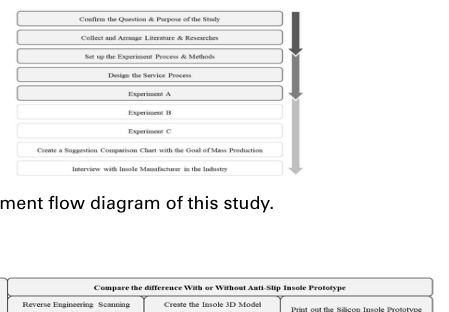
EXPERIMENTAL SETUP Figures 4 and 5 is shown the study’s experiment procedure. Figure 4 lists the main steps, and Figure 5 illustrates the study’s three experiments with diffe- rent purposes, experimental steps, and data-collecting methods. The study is still in progress and is currently on Experiment B, oulined in a light gray color in Figures 4 and 5.
Experiment A Experiment A, a pretest for the entire service design process, was conducted to gain a better understanding of the feasibility of the 3D-printed silicon insole and whether the insole makes high-heeled shoes more comfortable. The sub- jects selected for this experiment were two 22-year-old women. Both had one year of experience wearing high-heeled shoes. At the time of the experiment, one of them wore high-heeled shoes several times a week, and the other did it on a monthly basis.
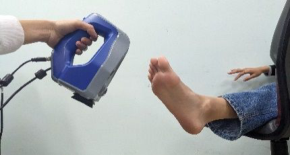
The experiment was conducted using the Artec Space Spider 3D scanner, a high-precision 3D optical scanner that can perfectly capture the fine details of small objects. Its ability to recognize complex geometric patterns, sharp edges, and precise threads is especially practical for reverse workflows that require extreme accuracy. In this case, it captured human body parts with high precision in 3D. After scanning the objects, the finished 3D model can be modified and exported to various CAD files for further 3D printing.
Figure 4: Experiment flow diagram of this study.
Figure available in the original PDF paper.
Figure 5: Details of this study’s experiments.
The Development of Process-Based Customized Service on Insole Design 435
For the anti-slip design prototyping, we used the San Draw S200 A61 Silicon 3D Printer, which adopts fluid additive manufacturing (FAM) tech- nology. With both reconcile-solidified and self-solidified silicon materials, several types of formulas differ in color, stiffness, tensile resistance, tear resi- stance, and elongation for different usage purposes. For this study, SIL 18 and SIL 28 were used. The two are both self-solidified silicon, which saves time for printing and post-processing. Moreover, the stiffness and density are closer to the expected levels.
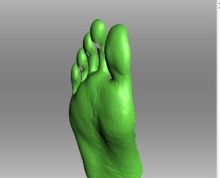
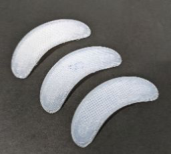
Regarding the experimental process, the first stage of the experiment star- ted by scanning the sole of the subject’s foot (see Figure 6). Then, a 3D model was built following the collected data (see Figure 7). Subsequently, a pair of the prototype of the shoe insole was printed out with silicon rubber mate- rial (see Figure 8). The second stage of the experiment focused on testing the wearing experience—with and without the silicon shoe insole—on the same pair of high-heeled shoes. To fully experience the difference, the subjects were asked to perform the following actions: walking for 10 minutes, standing up and sitting down, and walking upstairs and downstairs. This set of actions was performed twice: first without the insole and then with the insole. A 20-minute break was taken between the two experiments to ensure that the subjects were fully rested.
To collect the test subjects’ feedback, we conducted a semi-structured in- depth interview. With systematic questions, the subjects were asked about their feelings about wearing high-heeled shoes and the effectiveness of the sili- con insole, both physically and emotionally. The subjects answered the same questions twice, with and without the shoe insole, for a clear comparison between the two.
Figure 6: Scanning the subject’s foot with the artec space spider 3D scanner.Figure 7: Scanned CAD on the artec studio 12 professional.Figure 8: The prototype in different parament settings.
RESULTS AND DISCUSSION
According to the result from Experiment A, both subjects indicated that the difference was significant between using and not using the 3D-printed anti- slip silicone insoles. In the interview with the subject, one subject mentioned that the insole stopped her feet from sliding toward the toe, entailing that her feet had a good grip on the high-heeled shoes. Because of the physical obstruction, the stress on the toe was relieved; therefore, the wearers—when using the anti-slip insoles—were much more at ease in the high-heeled shoes, not worrying about the high-heeled shoes sliding off their feet.
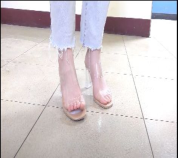
In addition, when using the 3D-printed silicone insoles, the subjects found that the pressure on the front of their feet was reduced and that they had a bet- ter sense of balance when walking and standing (see Figure 9). The subjects estimated a substantial improvement in overall comfort.
In conclusion, the designed anti-slip insole confirmed the requirements, based on the result from scanning the subject’s ball of the foot. The difference between wearing high-heeled shoes with or without the anti-slip insole was significant. This result indicates that the design of the service process is on the right track, and the study will continue, moving on to the Experiment B.
Figure 9: Subject experimenting with walking on high-heeled shoes with silicon insoles.
CONCLUSION AND FURTHER RESEARCH Multiple studies showed that wearing high-heeled shoes increases the risks of physical injuries due to abnormal foot posture. But psychologically, high- heeled shoes bring confidence and strength to their wearers through fashion and its appearance. Rather than choosing a side from being stylish painfully or staying healthy without taking pride, there should be a balance between the two. To achieve this goal, this study created a solution and hoped to benefit people who wear high-heeled shoes.
The Development of Process-Based Customized Service on Insole Design 437
From the perspective of commercial interests, customization is in line with the market trend. There are two types of customizations: one is making perso- nalized designs, patterns, and unique features; the other involves measuring body parts via an ergonomic scanning system to provide a customized fit. This study utilized reverse engineering optical scanning technology to obtain measurements of the soles of the subjects’ feet. Based on above mentioned commercial interests, we aim to generate a solution according to scanning statistical data so that mass-produced products are more compatible with users’ needs.
This study is verified through a series of customized design processes; the subjects directly reflected on their comfort levels while wearing high-heel shoes, and they proved the advantages of customized design. A size com- parison chart will be made in the later steps of the study. To reduce the shortcomings of customization, the time and effort needed from scanning every individual’s body part regarding the customized product.
Based on the positive results of Experiment A, follow-up experiments will concentrate on the parameters of the insole prototype—including the size, thickness, stiffness, and density structure of the insole—find the optimal com- position, and then make this into a reference table for various weights and foot sizes of consumers. Such a table would allow for both mass production and customization, thus achieving the goal of balancing cost and customized service.
REFERENCES
Barkema, D. D., Derrick, T. R., and Martin, P. E. (2012). Heel Height Affects Lower Extremity Frontal Plane Joint Moments During Walking. Gait & Posture, Vol. 35, No. 3, pp. 483–488. Butdee, S., and Tangchaidee, K. (2008). Formulation of 3D Shoe Sizes Using Scan-
ning Camera and CAD Modelling. Journal of Achievements in Materials and Manufacturing Engineering, Vol. 31, No. 2, pp. 449–455. Chen, Kuo-Min, and Liou, Ren-Jie (2004). Interface Strategy of Modular Product Innovation. Journal of Management and Business Research, Vol. 21, pp. 499–514. D’Août, K., Meert, L., Van Gheluwe, B., De Clercq, D., and Aerts, P. (2010).
Experimentally Generated Footprints in Sand: Analysis and Consequences for the Interpretation of Fossil and Forensic footprints. American Journal of Physical Anthropology: The Official Publication of the American Association of Physical Anthropologists, Vol. 141, No. 4, pp. 515–525. Du, Yu-Jie, Cheng, Ming-Yen, and Lin, Miao-Zi (2017). Research on 3D Printing Assisting - Design for Shoe Wearing Requirements of Elderly. Journal of the Hwa Gang Textile, Vol. 24, No. 4. Hsu, Tai-Yen, and Ke, Bo-Ren (2010). Discussion on Foot Lesions from the Structure
of Shoes and Plantar Pressure. Monograph of Department of Physical Education, Taichung University of Education, pp. 1–6. Huang, C.-N., Lee, M.-Y., and Chang, C.-C. (2011). Computer-aided Design and Manufacturing of Customized Insoles. IEEE Computer Graphics and Applicati- ons, Vol. 31, No. 2, pp. 74–79. Huang, Wei-Ge. (2017). Research and Demonstration of the Correlation between
Customization and Modularization on the Characteristics of Visual Modeling Elements.
Kim, N., Wei, J. L. J., Ying, J., Zhang, H., Moon, S. K., and Choi, J. (2020). A customized smart medical mask for healthcare personnel. Paper presented at the 2020 IEEE International Conference on Industrial Engineering and Engineering Management (IEEM). Krueger, M. B., Hsu, S., and Chen, F. (2019). Vogue Fashion Encyclopaedia: The
History of High-Heeled Shoes. Vogue Fashion Magazine. Retrieved from https: //www.vogue.com.tw/fashion/content-46562. Li, Yung-Hsuan. (2015). Knowing of the Skeletal Muscles and Ligaments of the Foot.
Pixnet Blog. Retrieved from https://katelee0508.pixnet.net/blog/post/376894537. Liao, Ben-Yi, Hong, Cheng-You, Yeh, Sheng-Wen, Tsai, Cheng-Hung, and Chen, Ting-Yu (2020). Pressure Analysis and 3D Shoe Insole Design of Arch Pads for Flat Feet. Lin, Ciou-Huei. (1999). Discussion on the Types of Team Utilization in the Advanta-
geous Product Development Process - An Empirical Study of Taiwan Machinery Enterprises. Lin, Wei-Hsiu, Cheng, Hsiu-Chin, and Peng, Cing-Yi (2003). Reliability Analysis of Balance Stability Instrument: KAT2000 & Kistler Force Plate. Journal of College Physical Education, Vol. 5, No. 1, pp. 149–159. Linder, M., and Saltzman, C. L. (1998). A History of Medical Scientists on High
Heels. International Journal of Health Services, Vol. 28, No. 2, pp. 201–225. Liou, Ang-Li (2019). Monitor Movements of Fitness Training by Flexiforce Sensors Application. Shih, Yu-Chuan, Chi, Chia-Fen, Lin, Ruei-Fong, and Lin, Rong-Tai (2018). The
Review and Development of Taiwan Human Factors Engineering and Design. Journal of Management, 321, 365. Sijbrandij, E. S., van Gils, A. P., van Hellemondt, F. J., Louwerens, J. W. K., and de Lange, E. E. (2001). Assessing the Subtalar Joint: The Broden View Revisited. Foot & Ankle International, Vol. 22, No. 4, pp. 329–334. Thomassey, S., and Bruniaux, P. (2013). A Template of Ease Allowance for Gar-
ments Based on a 3D Reverse Methodology. International Journal of Industrial Ergonomics, Vol. 43, No. 5, pp. 406–416. Zhan, Yi-Kun, Li, Shu-Zhen, Yang, Shih-Wei, Chao, Ling-Yi, Lin, Jia-Zhen, and Zhang, Hui-Fang (1997). Analysis of Plantar Pressure in Normal Young Peo- ple. Journal of the Physical Therapy Association of the R. O. C, Vol. 22, No. 2, pp. 81–90.
LISTED IN THE AHFE DIGITAL BOOKSTORE CATALOGUE
Explore the complete digital volume
Ergonomics In Design
Read this individual research paper free through the original publisher, or explore the full digital proceedings book.
ISBN 978-1-958651-53-7
Explore this ISBN in the AHFE Bookstore ↗Listed in the July 2026 bookstore catalogue; search by ISBN to confirm current availability · Digital book purchase optional