Nermin Hasanspahić, Vlado Frančić, Marko Strabić, Ivan Krivokapić (2024). Analysis of human factors in container ships' marine accidents. In: Human Factors in Design, Engineering, and Computing. AHFE Open Access, vol. 159, pp. 2247–2256. https://doi.org/10.54941/ahfe1005793
Around 80% of the world’s trade is transported by sea, and more than half of it is transported by containers. Container ships are getting bigger and bigger, and their average size has doubled in the last 20 years. Their size has increased from 1st-generation ships that could carry about 1000 Twenty-foot Equivalent Units (TEU) to ships carrying 24000 TEU. However, accidents involving giant container ships can cause catastrophic consequences for world trade and the global economy; such was the case with the grounding of the container ship Ever Given in the Suez Canal in 2021. Therefore, it is imperative to reduce the probability that such accidents will occur by improving the safety of container ships. In addition, according to literature, about 85% of marine accidents are caused by human factors, so to understand accidents’ origin and causes, there is a need to meticulously examine accidents, namely safety accident investigation reports, to classify human and other factors of accidents, such as organizational ones. This process leads to determining the most common factors, enabling suggestions for corrective measures, and implementing proactive ones. The investigation and analysis of marine accidents is a corrective approach where the immediate and root causes of accidents are discovered. Based on the analysis of accident investigation reports, suggestions for the reduction of such unwanted events can be brought to light.In this paper, the marine accident reports involving container ships are analyzed using the Human Factor Analysis and Classification System for Marine Accidents (HFACS-MA) method, aiming to determine the most frequent marine accident causes connected to human factors. Based on the results of the analysis, associated corrective safety measures are proposed.
As more than 80% of the volume of all goods in international trade are transported by sea (UNCTAD, 2020), making the marine industry as safe as possible is imperative. One of the fastest-growing segments of the maritime industry is container shipping. When the container ship “Emma Maersk” was delivered in 2006, she was the largest container ship in the world (400 meters in length, 56 meters in width, and a capacity of 14,770 TEU when delivered). The largest ship before her had a capacity of 9,500 TEU, and she was delivered just two months earlier. For comparison, the largest
container ships nowadays have a capacity of about 24,000 TEU (Safety4sea, 2024). Container ships fleet is rapidly expanding. In 2024, 478 container ships with a capacity of 3.1 million TEU are scheduled for delivery (41% more than in 2023). The result is the expected growth of the container fleet capacity by 10%. The most prevalent deliveries are ships larger than 15,000 TEU. According to the Baltic and International Maritime Council (BIMCO), this segment of container ships grew by 28% during 2023, and 83 ships are expected to be delivered in 2024 (gCaptain, 2024). Globally, seaborne containerized cargo amounted to around 2.2 billion tons loaded in 2023 (Statista, 2024). According to the World Shipping Council (WSC) report, around 250 million containers are shipped annually, and on average, “only” 1566 containers are lost at sea (annually). However, according to the WSC report 2023, 661 containers were lost at sea, meaning there is a decrease in lost containers by more than half (WSC, 2023).
A maritime venture (voyage) starts with cargo loading in the load port and ends with cargo discharging in the destination port. The voyage phases can be divided into port, pilotage, and open sea voyage. Neither of the phases is safer than the others, and accidents can happen during any voyage phase. Modern navigation or propulsion systems technologies are introduced on ships aiming to improve safety at sea and protect human lives and the environment.
In addition, various inspections are carried out (for example, Port Stat Control – PSC, Flag state, vetting, and others) at frequent intervals to detect substandard ships and reduce the risk of accidents. However, marine accidents still happen despite all measures implemented so far, and they can have tremendous consequences, such as fatalities and significant environmental pollution.
For example, in 2020, the container ship “X-Press Pearl”, which was carrying hazardous chemicals, caught fire and sank off the coast of Sri Lanka, causing an ecological disaster (Mongabay, 2023). In 2021, the Ultra Large Container Ship “Ever Given” ran aground in the Suez Canal, consequently blocking canal transit for six days. The blockage has disrupted global supply chains and caused costs of almost 10 billion US dollars worth of trade (Insurance Business, 2023). It has to be mentioned that the human factor was involved in both of these accidents.
As it is of great interest to all marine industry stakeholders to improve maritime safety, various international organizations like the International Maritime Organization (IMO), International Association of Classification Societies (IACS), European Maritime Safety Agency (EMSA), International Labour Organization (ILO), International Chamber of Shipping (ICS), International Association of Marine Aids to Navigation and Lighthouse Authorities (IALA) and others work tirelessly to improve maritime safety through various rules and regulations. However, for the rules and regulations to be effective and prevent accidents, they must be adequately applied and implemented. That is the mission of shipping companies and other organizations (stakeholders) directly involved in transporting goods by sea.
There are two main approaches to preventing marine accidents: corrective and proactive approaches. A corrective approach is used when reported
Analysis of Human Factor in Container Ships’ Marine Accidents 2249
marine accidents are investigated and analyzed to find immediate and root causes. Based on the accident analysis results, corrective measures are proposed and implemented. The second approach (proactive) involves reporting, investigation, and analysis of near-misses (or close calls, near hits), i.e., events where the chain of events was broken before harm was done (Hasanspahi´c et al., 2020). Since no harm was done and there was no actual damage, a proactive approach can be regarded as a “cheap “and efficient method for safety improvements in the marine industry (Hasanspahi´c et al., 2020). However, although near-miss reporting is mandatory as per Section 9 of the International Safety Management (ISM) Code (IMO, 2010), near-misses frequently go unreported due to various reporting barriers (Hasanspahi´c et al., 2020), and possible insight into their causation and valuable knowledge that could be used for accident prevention is lost. Therefore, there is a need to apply a corrective approach and analyze accident reports to find accident causes and propose measures for safety improvements.
Because container ships are drivers of containerization and, in return, globalization, their safety is of the utmost importance for the global economy. In addition, container ship accidents can significantly negatively affect the marine environment and the safety and security of major shipping routes’ chokepoints. Therefore, this paper’s objective is to analyze human factors affecting container ship accidents and, based on the findings, propose mitigation measures to improve the safety and resilience of container shipping.
METHODOLOGY
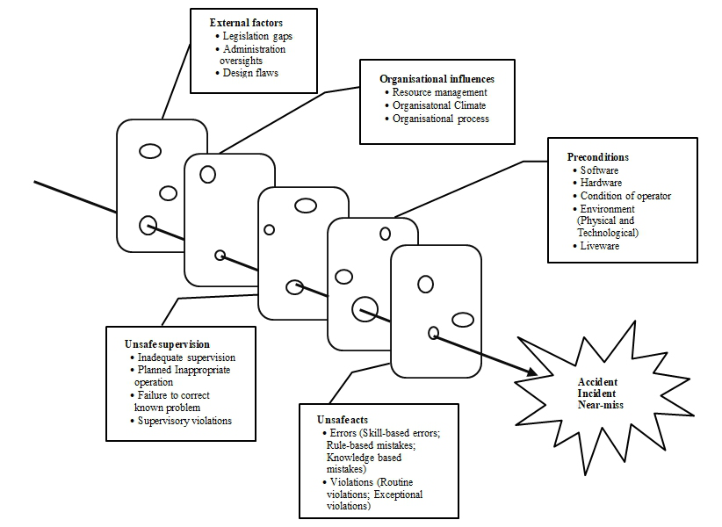
In this paper, the authors employed the Human Factor Analysis and Classification System for Maritime Accidents (HFACS-MA) methodology to analyze container ship accidents. The original HFACS methodology was designed by Shappell and Wiegmann (2000), and it enabled a framework for understanding human error within a specific system. It is an instrument for classifying human factors within accident investigations (Schröder-Hinrichs et al., 2011). HFACS was originally designed to analyze aviation accidents, and consequently, several studies have adapted it for use in different industry sectors. One of the adaptations was made by Chen et al. (2013), who applied the method to analyze maritime accidents and developed the HFACS-MA methodology. Their framework complies with the IMO guidelines for investigating human factors in marine accidents (IMO Resolution A.884(21) from 1999). It is in line with the Swiss Cheese Model developed by Reason (1997), which is why it was used in this study (see Figure 1).
The HFACS-MA methodology consists of five levels that include 21 causal factor categories (see Table 1 for the description of categories). The first four levels include latent failures, while the fifth includes active failures.
Causal Factor Category Description Level I. External factors Legislation gaps Drawbacks of existing regulations. Administration oversights Relevant authorities’ omissions in the implementation and/or enforcement of existing regulations. Design flaws Poor shipboard systems design (for example, not user-friendly systems or systems and equipment requiring complex maintenance procedures). Level II. Organizational influences Resource management Poor or inadequate management of resources (human or equipment) for safe performance of shipboard tasks. Organizational climate Poor or inadequate working atmosphere (for example, poor leadership, non-compliance with prescribed work procedures, and not using necessary systems or equipment for safe task performance). Organizational process Non-compliance with the company’s formal policies (for example, prescribed shipboard operations and procedures). Level III. Unsafe supervision Inadequate supervision Supervision failure during the performance of a specific task (for example, inadequate supervision during enclosed entry procedure) causing unsafe conditions and the possibility of an accident. Planned inappropriate operation
The supervisor’s (usually senior officer onboard a ship) or company’s failure while planning specific shipboard operation (for example, inadequate passage planning procedure). Failure to connect known problem
The supervisor is not reacting to the known deficiencies and allows the unsafe condition to develop without rectifying it. Supervisory violations The supervisor deliberately disregards company procedures and permits rules to be broken (for example, the master tolerates only the officer of the watch on the navigating bridge during night watch).
(continued)
Analysis of Human Factor in Container Ships’ Marine Accidents 2251
Table 1. Continued Causal Factor Category Description
Table available in the original PDF paper.
Level IV. Preconditions Software Non-existing or poor instructions (for example, checklists, written procedures, instruction manuals, navigating charts, loadicator programs, and booklets). Hardware Physical attributes of the workplace (for example, equipment, displays, arrangement, humidity, and temperature). Condition of operator Factors reducing human performances (for example, alcohol consumption, illness, fatigue, stress, and technology complacency). Physical environment Influence of force of nature (for example, gale, tides, and fog). Technological environment Influence of offshore structures (for example, canals, bridges, or locks). Liveware Poor or inadequate internal (for example, within the bridge team) or external (for example, bridge team and pilot or Vessel Traffic Service – VTS) communication. Level V. Unsafe acts Skill-based errors Unintended actions or failures, including slips and lapses. Rule-based mistakes Wrongly perceiving the situation and thus applying the wrong rules to resolve it. Knowledge-based mistakes Lack of operator’s knowledge about the task or system working on or inadequately applying acquired knowledge. Routine violations Habitually taking shortcuts to complete the task as soon as possible (usually due to poor instructions or design). Exceptional violations Intentional ignorance of instructions to complete the task (not usual behavior).
The authors searched the Marine Accident Investigation Board (MAIB) database to find all container ship accident reports because they include human causation factors based on a model designed by Reason (Batalden & Sydnes, 2014). The following available filters were used for searching relevant accident reports: for ship type “Merchant vessels 100 gross tons or over” and for report type “Investigation report.” In addition, the term “container” was used for search. The search resulted in 70 accident reports, but after carefully reading all reports and checking the types of ships involved, only 51 reports involved container ships. Therefore, 51 accident reports were considered and analyzed in this research. It has to be mentioned that the intention was not to re-investigate reported accidents but to analyze reports and classify human factors involved. HFACS-MA framework was utilized to classify causes of container ship accidents by sensibly screening all MAIB accident reports sections (especially conclusions sections where contributing factors revealed during investigations were listed).
RESULTS AND DISCUSSION
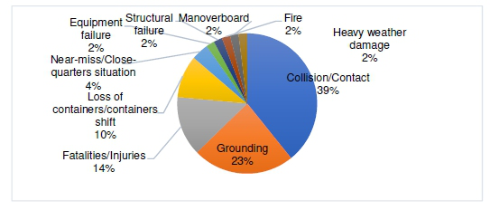
Types of accidents were analyzed to discover the most frequent ones connected with container ships. According to the data obtained from the MAIB reports, the most frequent types of container ship accidents are collision/contact (39%), grounding (23%), and fatalities/injuries (14%) (Figure 2).
2252 Hasanspahi´c et al.
Figure 2: Types of marine accidents analyzed in reviewed accident reports.
These three types of marine accidents comprise 76% of all marine accidents investigated and analyzed in the MAIB database related to container ships.
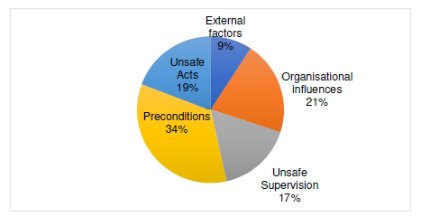
Classification of accident causal factors using the HFACS-MA framework revealed 499 causal factors from 51 analyzed accident reports (one accident can have multiple causal factors). According to the analysis, the most represented groups of causal factors are those related to levels IV, V, and II, namely, Preconditions (34% of total causal factors), Organizational Influences (21%), and Unsafe Acts (19%) (Figure 3).
Figure 3: Groups of causal factors categories of container ship accidents.
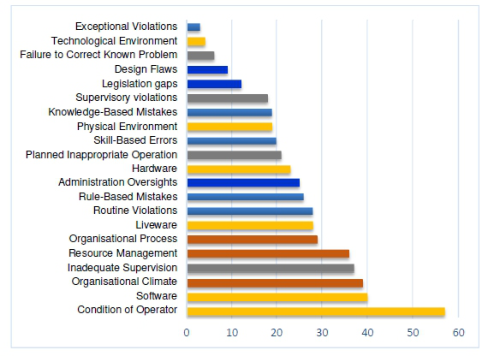
As presented in Figure 3, Preconditions are the most represented level of causal factor categories, while the Condition of Operator (11.4%) and Software (8.1%) are the most frequent causal factors from that level and in total (Figure 4). Some examples of the Condition of Operator causal factor from the analyzed MAIB reports include complacency and losing sight of responsibilities as an OOW, loss of situational awareness, unfamiliarity with bridge equipment, irregular sleep periods causing fatigue, falling asleep during bridge watch and over-confidence in the accuracy of Automated Radar Plotting Aid (ARPA), among others. According to Bieli´c et al. (2017), poor knowledge of ship systems and complacency are factors causing human error in shipping. Inadequate knowledge and over-reliance on ship equipment and systems, especially in combination with complacency, can affect seafarers and cause unsafe situations, leading to accidents. Fatigue contributed to ten accidents analyzed in this study. According to Smith et al. (2007) and Jepsen et al. (2015), seafarer fatigue can be triggered by various factors
Analysis of Human Factor in Container Ships’ Marine Accidents 2253
such as prolonged hours of work, working in shifts, inadequate periods of rest between work, the ship’s engine vibrations, shipboard noise, stress and ship motion (especially during adverse weather conditions). Following the Maritime Labour Convention (MLC) 2006 (Regulation 2.3), all seafarers’ minimum hours of rest are 10 hours in any 24 hours and 77 hours in any seven days (ILO 2006). However, numerous cases exist where rest periods are not complied with, and records are fake.
Some examples of the Software as a causal factor include no explicit instruction to save Voyage Data Recorder (VDR) information following an accident and not being included in the company Safety Management System (SMS), the International Safety Management (ISM) manual not being ship- specific, lack of guidance on watchkeeping arrangements or rest periods, or instructions on the use and testing of the bridge watch alarm, no work procedure for inspecting the lift, inadequate risk assessment for the rigging and un-rigging of the accommodation ladders, and others. The company should provide seafarers with written procedures (including checklists) for safe task performance and environmental and property protection, as the ISM Code Section 7 (Development of plans for shipboard operations) prescribes. Sometimes, prescribed shipboard procedures or checklists are not applicable or practical because they are generic or, for example, written for some other ship. In that case, seafarers tend not to follow them and try to complete given tasks relying on their knowledge and experience, and other causal factors emerge, such as Routine violations or Exceptional violations. In that case, the situation might become unsafe, leading to an accident. Therefore, it is imperative to have adequate and ship-specific written procedures and checklists onboard ships to improve safety and avoid human error. In addition, as shipboard equipment is being replaced with the new one, the instruction manual should also be replaced, and all places where old equipment manuals are kept should be updated with the newly installed equipment manual. In that way, human error could be avoided, and any related task performance could be facilitated.
Figure 4: HFACS-MA causal factor categories identified in the analyzed container ship accident reports ( Level V, Level IV, Level III, Level II, Level I).
2254 Hasanspahi´c et al.
Organisational Climate was the third most frequent causal factor category (7.8%). In simplest terms, it is how things are done onboard a ship. It is affected by various factors, such as leadership and seafarers’ national culture. Some examples of this factor include the absence of a lookout on navigating bridge during the hours of darkness, poor navigational practices, poor bridge team management, giving no support to the master, not keeping an appropriate radar lookout, and others. The leadership style influences the shipboard safety culture and safety behavior of seafarers. Therefore, it is the masters’ (and senior officers’) task to create a safe working environment where seafarers perform their jobs in teams, complying with company rules and procedures (Oltedal and Engen, 2009). The company should provide training and support to senior officers to equip them with the knowledge needed to instill a safety culture onboard their ships. In that way, investing in resources could significantly improve safety and minimize the number of accidents at sea while enabling adequate shipboard management to the satisfaction of the crewmembers.
CONCLUSIONS
The paper focused on the effect of the human factor on maritime accidents, aiming to identify the most common human casual factor categories related to the accidents. The authors analyzed reported accidents involving container ships from the MAIB database and classified causal factors using the HFACS- MA method. The most frequent causal factor categories were Condition of Operator, Software, Organisational Climate, Inadequate Supervision, and Resource Management, making 41.9% of the total causal factors (the first three causal factors make 27.3% of the total). Therefore, acting on these factors and preventing their appearance would be the most beneficial to improving container ships’ safety. Because inadequate and poor knowledge of their ship systems and equipment was recognized as a factor, there is a need to focus on the familiarization and training of seafarers. Training should focus on working knowledge of the functions of the systems in routine everyday situations and emergencies. Additional shore management efforts in developing guidelines for masters and their crews to create an adequate working atmosphere and develop teamwork could improve the Organizational climate onboard ships.
Furthermore, it is a prerequisite to instill and develop a just culture onboard ships to enable the reporting of near-misses and accidents. Hence, senior officers should be trained and guided to succeed in executing that task. Shore management and seafarers must act together to reduce the occurrence of Software causal factors. Inadequate and inapplicable, or even obsolete procedures and checklists should be non-existent, and seafarers should react to such documents and inform shore management. In return, shore managers with extensive maritime backgrounds should design such documentation, while seafarers onboard ships should evaluate their adequacy and applicability. In addition, systems and equipment standardization would reduce the hazard of poor design and the length of the seafarers’ familiarization training between different ships. It must be emphasized that
Analysis of Human Factor in Container Ships’ Marine Accidents 2255
effective teamwork onboard ships is decisive for optimizing safety at sea. Adequate and effective internal and external communication onboard ships can inhibit unsafe acts and unsafe conditions and, hence, accidents induced by design flaws, poor familiarity with equipment, overreliance on modern equipment, and complacency.
REFERENCES
Batalden, B.-M. & Sydnes, A. K. (2014) Maritime safety and the ISM code: a study of investigated casualties and incidents. WMU Journal of Maritime Affairs, 13, pp. 3–25, https://doi.org/10.1007/s13437-013-0051-8 Bieli´c, T., Hasanspahi´c, N. & ˇCulin, J. (2017) Preventing marine accidents caused
by technology-induced human error. Pomorstvo, 31 (1), pp. 33–37. https://doi.or g/10.31217/p.31.1.6 Chen, S.-T., Wall, A., Davies, P., Yang, Z., Wang, J. & Chou, Y.-H. (2013) A Human and Organisational Factors (HOFs) analysis method for marine casualties using HFACS-Maritime Accidents (HFACS-MA). Safety Science, 60, pp. 105–114, https://doi.org/10.1016/j.ssci.2013.06.009 gCaptain. (2024) Record Wave of New Containerships Expected to Push Global Fleet
Above 30 Million TEU. At gCaptain online: https://gcaptain.com/record-wave-o f-new-containerships-in-2024/ GOV. UK. Marine Accident Investigation Branch reports. At MAIB online: https: //www.gov.uk/maib-reports Hasanspahi´c, N., Franˇci´c, V., Vujiˇci´c, S. & Magli´c, L. (2020) Reporting as a Key
Element of an Effective Near-Miss Management System in Shipping. Safety, 6(4): 53. https://doi.org/10.3390/safety6040053 Insurancebussines. (2023) Final report into Ever Given tanker’s Suez Canal blockage. “Indications” that crew received the wrong order. At Insurancebusiness online: https://www.insurancebusinessmag.com/asia/news/marine/final-report-i nto-ever-given-tankers-suez-canal-blockage-452207.aspx International Labour Organization (ILO). (2006) Maritime Labour Convention, 2006, as amended (MLC, 2006). At ILO online: https://normlex.ilo.org/dyn/normlex/en/f?p=NORMLEXPUB:91:0:::: P91_SECTION: MLCA_AMEND_A2 International Maritime Organization (1999) Resolution A.884(21). Amendments to the code for the investigation of marine casualties and incidents. International Maritime Organization (IMO). (2010) ISM Code, International Safety
Management Code and guidelines on implementation of the ISM Code, London, UK Jepsen, J. R., Zhao, Z. & van Leeuwen, W. M. A. (2015) Seafarer fatigue: a review of risk factors, consequences for seafarers’ health and safety and options for mitigation. International Maritime Health, 66, 2, pp. 106–117, DOI: 10.5603/IMH.2015.0024 Mongabay. (2023) X-Press Pearl salvage continues as study shows toxic effects of
disaster. At Mongabay online: https://news.mongabay.com/2023/02/x-press-pear l-salvage-continues-as-study-shows-toxic-effects-of-disaster/ Oltedal, H. A. & Engen, O. A. (2009) Local management and its impact on safety culture and safety within Norwegian shipping. In Safety, Reliability and Risk Analysis: Theory, Methods and Applications; Martorell, S., Guedes Soares, C., Barnett, J., Eds.; Taylor and Francis Group: London, UK, pp. 1423–1430.
2256 Hasanspahi´c et al.
Reason, J. (1997) Managing the Risks of Organizational Accidents (1st Ed.).
Routledge. https://doi.org/10.4324/9781315543543 Safety4Sea. (2024) BIMCO: Ships above 12, 000 TEU drive 100% increase in average ship size. At Safety4Sea online: https://safety4sea.com/bimco-ships-abo ve-12000-teu-drive-100-increase-in-average-ship-size/ Schröder-Hinrichs, J. U., Baldauf, M. & Ghirxi, K. T. (2011) Accident investigation
reporting deficiencies related to organisational factors in machinery space fires and explosions. Accident Analysis & Prevention, 43 (3), pp. 1187–1196, https: //doi.org/10.1016/j.aap.2010.12.033 Shappell, S. A. & Wiegmann, D. A. (2000). The human factors analysis and classification system-HFACS. Federal Aviation Administration, Washington, DC 20591 Smith, A. P., Allen, P. H. & Wadsworth, E. M. (2007) A Comparative Approach
to Seafarers’ Fatigue 2007. In Proceedings of the International Symposium on Maritime Safety, Science and Environmental Protection, Athens, Greece, 10–11 May. United Nations Conference on Trade and Development (UNCTAD). (2020) Review of maritime transport 2020. eISBN 978-92-1-005271-9 World Shipping Council (WSC). (2023) World Shipping Council Releases Containers Lost at Sea Report – 2023 Update. At World Shipping Council online: https://www.worldshipping.org/news/world-shipping-council-releases-c ontainers-lost-at-sea-report-2023-update
LISTED IN THE AHFE DIGITAL BOOKSTORE CATALOGUE
Explore the complete digital volume
Human Factors in Design, Engineering, and Computing
Read this individual research paper free through the original publisher, or explore the full digital proceedings book.
ISBN 978-1-964867-35-9
Explore this ISBN in the AHFE Bookstore ↗Listed in the July 2026 bookstore catalogue; search by ISBN to confirm current availability · Digital book purchase optional