Hongtae Kim, Hyunsoo Choi (2026). An Ontology-Based Human Digital Twin Framework for Proactive Shipboard Safety Intelligence. In: Advances in Human Factors of Transportation. AHFE Open Access, vol. 224, pp. 636–645. https://doi.org/10.54941/ahfe1007892
Maritime operations entail complex interactions between human operators, vessel systems, and dynamic environmental conditions, rendering shipboard safety management a formidable and persistent challenge. Despite advances in automation and monitoring technologies, severe onboard accidents—particularly those related to confined space entry, work at height, hazardous environments, and human error—continue to occur, while existing safety systems remain largely reactive. This paper presents an ongoing study on an ontology-based collaborative shipboard safety analysis framework that integrates artificial intelligence, Human Digital Twin (HDT) modelling, and digital twin–based visualization to support proactive and explainable safety intelligence. The framework is designed to acquire high-density onboard data through multi-source wearable, environmental, spatial, and operational sensors, and to formalize maritime safety regulations and human–environment interaction knowledge into an ontology-driven knowledge base for context-aware risk inference.A multi-layered system architecture encompassing data acquisition, edge-based processing, HDT modelling, AI-driven risk analysis, digital twin simulation, and feedback-driven learning is introduced. This study establishes a foundational architectural and methodological framework for next-generation shipboard safety intelligence and provides a basis for future experimental validation and real-world deployment.
Maritime operations remain one of the most safety-critical industrial domains due to the coexistence of harsh environmental conditions, complex ship systems, and continuous human involvement. Crew members are frequently exposed to high-risk tasks such as confined space entry, working at height, cargo handling, and maintenance under time pressure. According to maritime accident investigations, a significant proportion of severe incidents are attributed not to single-point failures but to a combination of human factors, environmental stressors, and insufficient situational awareness.
Conventional shipboard safety management systems primarily focus on equipment monitoring, compliance verifying, or post-incident investigation.
An Ontology-Based Human Digital Twin Framework 637 While effective in detecting overt violations, these approaches lack the predictive capacity to foresee accidents by identifying early warning signs and cumulative contextual risks. Recent advances in artificial intelligence (AI) have enabled data-driven anomaly detection; however, purely data-driven models often suffer from high false-alarm rates, and poor generalization under unseen conditions.
To address these limitations, this study proposes a Human Digital Twin– integrated, ontology-based shipboard safety intelligence framework. By explicitly modelling human physiological and behavioural states, embedding maritime safety knowledge into an ontology, and leveraging digital twin– based visualization, the proposed approach aims to shift maritime safety management from reactive response to proactive prevention. This paper focuses on the system design and methodological formulation of the proposed framework, while large-scale experimental validation is reserved for future work.
RELATED WORKS This section reviews prior studies related to shipboard safety monitoring, AI-based risk detection in maritime environments, Human Digital Twin modelling, and ontology-based safety reasoning. The objective is to clarify the research gap addressed by the proposed framework.
Shipboard Safety Monitoring and Accident Prevention Systems Conventional shipboard safety systems primarily focus on equipment-level monitoring and rule-based alarm generation. Conventional methodologies rely on fixed thresholds for environmental parameters such as gas concentration, temperature, or oxygen levels, as well as compliance verifications based on standard operating procedures. While these systems are effective in detecting explicit hazardous conditions, they are inherently reactive and provide limited insight into accident precursors involving human behaviour or contextual interactions.
Several studies have emphasized that a large proportion of maritime accidents are caused by complex combinations of human error, environmental stressors, and organizational factors rather than single-point failures (Durlik et al., 2025) (Han et al., 2024). However, existing shipboard safety management systems rarely integrate human physiological or cognitive states into risk assessment, resulting in delayed or excessive alarms and reduced operator trust.
AI-Based Risk Detection in Maritime and Industrial Domains Recent advances in artificial intelligence have enabled data-driven approaches for anomaly detection and risk prediction in maritime and industrial environments. Machine learning and deep learning models, including LSTM and CNN architectures, have been applied to ship navigation safety, collision avoidance, and equipment fault diagnosis (Durlik et al., 2025) (Wang et al.,
638 Kim and Choi 2024). These approaches demonstrate improved detection performance compared to rule-based systems, particularly under complex operational conditions.
Nevertheless, purely data-driven AI models often suffer from poor generalization when deployed in unseen environments. In safety-critical maritime operations, ‘black-box’ predictions devoid of interpretable rationale are inadequate for decision support and may lead to resistance from operators and safety managers (Wang et al., 2024). Furthermore, most AI-based maritime safety studies focus on vessel-level navigation rather than human-centered onboard safety.
Physics-Informed and Hybrid AI Approaches To improve robustness and generalization, physics-informed AI (PIAI) approaches have been introduced by embedding physical laws and system constraints into learning processes. Physics-Informed Neural Networks (PINNs) have demonstrated effectiveness in fluid dynamics, structural monitoring, and autonomous systems (Gao et al., 2022) (Liu et al., 2024). In maritime contexts, physics-informed methods have been applied to ship motion prediction and environmental modelling.
However, existing physics-informed approaches primarily focus on physical systems and rarely incorporate human behavioural constraints. As a result, they remain insufficient for modelling accident mechanisms in which human fatigue, reaction time, and cognitive limitations play a dominant role.
Human Digital Twin Modelling Human Digital Twins (HDTs) aim to represent human physiological, behavioural, and cognitive states in a digital environment. HDT concepts have been explored in healthcare, manufacturing, and ergonomics to support personalized monitoring, fatigue management, and human–machine interaction analysis (Menges et al., 2024) (Zhang et al., 2024) (Mauro and Kana, 2023).
In maritime and offshore domains, human modelling has typically been limited to ergonomic assessment or post-incident analysis. Real- time integration of HDTs with onboard safety systems remains limited, particularly in terms of continuous physiological sensing and dynamic state evolution. This gap restricts the ability of existing systems to proactively predict human-centered accidents.
Ontology-Based Safety Knowledge and Reasoning Ontology-based approaches have been widely used to formalize safety knowledge, regulations, and accident causation models. In industrial safety and construction domains, ontologies enable structured representation of hazards, contextual relationships, and rule-based reasoning for explainable risk assessment (Gao et al., 2022) (Chen and Bria, 2023) (Wu et al., 2025).
An Ontology-Based Human Digital Twin Framework 639 In maritime applications, ontologies have been used to model regulations such as COLREGs and to support navigational decision-making. However, the integration of ontology-based reasoning with real-time sensor data and Human Digital Twin models for onboard safety management remains largely unexplored.
SYSTEM ARCHITECTURE AND DESIGN PRINCIPLES Prior studies have made significant progress in maritime safety monitoring, AI-based risk detection, and digital twin technologies. However, existing approaches exhibit the following limitations:
1. Limited integration of human physiological and behavioural states into safety intelligence 2. Lack of explainable, context-aware reasoning aligned with maritime safety regulations 3. Insufficient coupling between real-time sensing, human modelling, and predictive simulation The proposed framework addresses these gaps by integrating Human Digital Twin modelling, ontology-based reasoning, physics-informed AI, and digital twin visualization into a unified shipboard safety intelligence architecture.
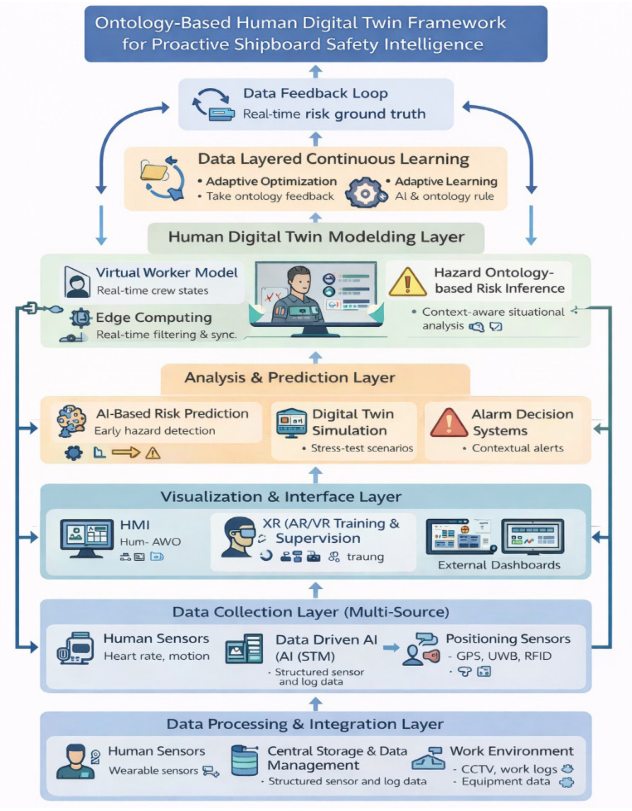
System Architecture As shown in Figure 1, the system follows a layered architecture comprising:
Collection Layer
Data Processing and Integration Layer
Human Digital Twin Modeling Layer
Analysis and Prediction Layer
Visualization and Interface Layer
Feedback and Continuous Learning Layer (1) Data Collection and Processing High-density real-world data are collected from operational vessels using:
Human Sensors: heart rate, body temperature, respiration, motion
Environmental Sensors: temperature, humidity, gas concentration, vibration
Spatial and Positioning Systems: GPS, UWB, RFID
Operational Data: CCTV, work logs, equipment status This multi-modal sensing strategy enables continuous observation of both human and environmental risk factors. To ensure real-time performance, edge computing modules perform preprocessing, noise filtering, feature extraction, and data synchronization. This approach reduces communication overhead and ensures timely risk inference.
Figure 1: System architecture of ontology-based human digital twin framework. (2) Human Digital Twin and Ontology-Based Modeling Each worker is modeled as a Human Digital Twin, defined by their physiological state, fatigue level, motion patterns, and operational context. The HDT evolves dynamically based on real-time sensor inputs and operational conditions.
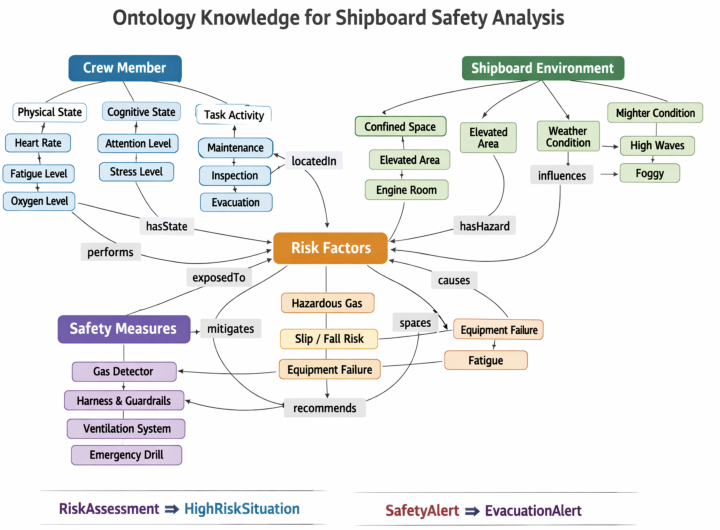
Maritime safety regulations, standard operating procedures, and historical accident cases are formalized into an ontology. Safety knowledge is encoded as structured relationships among workers, spaces, conditions, and hazards, enabling contextual reasoning beyond numerical thresholds.
Figure 2 illustrates an example of the ontology-based knowledge structure designed for shipboard safety analysis. The ontology formalizes the relationships among human operators, shipboard environments, risk factors, and safety measures, enabling context-aware and explainable safety reasoning.
Figure 2: Example of an ontology-based knowledge representation for shipboard safety.
(3) Risk Analysis, Prediction, and Digital Twin Simulation Machine learning and deep learning models analyze temporal patterns in sensor data to predict accident risk. Ontology-based reasoning complements data-driven inference by ensuring rule consistency and explainability.
A digital twin simulation environment enables virtual testing of hazardous scenarios such as confined space accidents and falls from height. The simulation supports proactive risk assessment and post-incident forensic analysis.
(4) Visualization and Collaborative Safety Management Dashboards and HMIs provide intuitive visualization of safety status, worker conditions, and environmental risks. Information is presented using color- coded indicators to reduce cognitive load during emergencies.
XR-based interfaces support immersive training and scenario rehearsal. Remote supervisors and external responders can access synchronized digital twin views, enabling collaborative decision-making without verbal explanation.
(5) Feedback Loop and Continuous Learning A feedback-driven learning loop compares predicted risks with actual outcomes. Discrepancies are used to refine AI models and ontology rules, enabling adaptive optimization over time.
EXPERIMENTAL DESIGN AND EVALUATION FRAMEWORK This section presents the experimental design and evaluation framework for the proposed ontology-based Human Digital Twin (HDT) system. The objective of this section is to define the evaluation methodology, experimental scenarios, baseline methods, and quantitative performance metrics that will be used in future validation studies. Rather than reporting empirical results, this section establishes a structured and reproducible foundation for systematic assessment of the proposed framework in subsequent simulation- based and real-world deployments.
Experimental Design To evaluate the effectiveness of the proposed ontology-based Human Digital Twin (HDT) framework, a set of representative shipboard accident scenarios was designed based on maritime accident investigation reports, safety guidelines, and operational practices. The experimental scenarios aim to capture typical high-risk situations involving complex interactions among human operators, environmental conditions, and shipboard spaces, rather than isolated sensor threshold violations.
The scenarios were implemented using a hybrid approach combining real-world sensor data collected from operational vessels and synthetically generated hazard progressions within the digital twin simulation environment. This design enables controlled evaluation of early risk detection and prediction performance while preserving realism. Table 1 summarizes the representative experimental scenarios designed to evaluate the proposed framework under realistic shipboard safety conditions.
Table 1: Summary of planned experimental scenarios.
Table available in the original PDF paper.
Scenario ID
Scenario Type
Operational Context
Key Risk Factors
Human Factors Considered
Evaluation Focus
S1 Confined Space Asphyxiation
Maintenance or inspection in enclosed shipboard spaces (e.g., engine room, ballast tank)
Early detection of latent risk before threshold violation
Oxygen depletion, hazardous gas accumulation, poor ventilation
S2 Fall from Height
Fatigue-aware prediction of fall risk
Fatigue accumulation, postural instability
Prolonged maintenance or inspection tasks on elevated platforms or ladders
Height exposure, proximity to edges, unstable footing
S3 Fatigue- Induced Human Error
Reaction time degradation, vigilance loss
Effectiveness of dynamic HDT modeling
Extended working hours during night shifts or emergency operations
Cognitive overload, reduced attention
S4 Compound Hazard Scenario
Maintenance tasks under semi- confined and adverse conditions
Combined environmental and spatial hazards
Concurrent physiological and behavioral degradation
Ontology- based reasoning for multi-factor risk inference
An Ontology-Based Human Digital Twin Framework 643 Quantitative Performance Metrics
To quantitatively assess the effectiveness of the proposed ontology-based Human Digital Twin (HDT) framework, a set of performance metrics was defined to evaluate early hazard detection capability, prediction accuracy, operational reliability, and explainability. These metrics were selected to reflect practical requirements in shipboard safety management, where timely intervention and operator trust are critical. Table 2 summarizes the quantitative performance metrics defined for the planned evaluation of the proposed framework.
Table 2: Quantitative performance metrics for planned evaluation.
Table available in the original PDF paper.
Metric Category Metric Name Definition Evaluation Purpose Early Detection Hazard Detection Lead Time (HDLT) Time difference between risk alert generation and onset of a critical hazardous state Assess early intervention capability
Reliability False Alarm Rate (FAR)
Ratio of false alerts to total system alerts
Evaluate operational reliability and alarm fatigue risk
Prediction Accuracy
Measure correctness of risk inference
Precision Proportion of correctly predicted hazardous states among all predicted hazards Prediction Accuracy
Measure sensitivity to true hazards
Recall Proportion of correctly predicted hazardous states among all actual hazards Prediction Accuracy F1-score Harmonic mean of precision and recall Balance between precision and recall
Human-Aware Sensitivity
Fatigue- Aware Risk Sensitivity
Rate of change of predicted risk probability with respect to operator fatigue level
Evaluate effectiveness of Human Digital Twin modeling
Explainability Explainability Score
Expert-rated interpretability of system outputs on a Likert scale
Assess transparency and usability of risk reasoning
Computational Performance
Inference Latency
Verify real-time operational feasibility
Average processing time per evaluation cycle on onboard hardware
CONCLUSION AND FUTURE WORKS This paper introduced an ontology-based Human Digital Twin framework for proactive and explainable shipboard safety intelligence. The proposed approach addresses fundamental limitations of conventional shipboard safety systems by shifting the focus from reactive alarm generation to context-aware, human-centered risk reasoning. Through the integration of multi-source sensing, ontology-driven knowledge representation, AI-based risk analysis, and digital twin visualization, the framework establishes a unified architecture for next-generation maritime safety management.
644 Kim and Choi The primary contribution of this work is the conceptual and architectural integration of Human Digital Twin modelling with ontology-based safety reasoning and digital twin–enabled situational awareness. By explicitly representing human physiological states, task context, and environmental interactions, the proposed framework provides a more realistic foundation for understanding and preventing shipboard accidents. Furthermore, the explain ability afforded by ontology-based inference supports transparency, accountability, and regulatory alignment—key requirements in maritime safety applications.
Future work will focus on progressive experimental validation of the proposed framework through real-world and simulated studies. Planned evaluation activities include:
Pilot-scale onboard deployments to collect high-density physiological, environmental, and spatial data from operational vessels
Scenario-based experiments targeting confined space entry, work at height, fatigue-induced human error, and compound hazard situations
Quantitative performance evaluation using metrics such as hazard detection lead time, false alarm rate, and prediction accuracy
Long-term validation of system robustness, sensor reliability, and operational feasibility under diverse maritime conditions Additionally, future research will explore adaptive learning mechanisms for continuously refining ontology rules and Human Digital Twin models based on accumulated operational feedback. Extension of the framework to offshore platforms and other safety-critical maritime domains is also envisioned.
In conclusion, while empirical validation is reserved for future studies, this paper provides a foundational architecture and methodological framework for proactive, explainable, and human-centered shipboard safety intelligence. The proposed approach lays the groundwork for systematic experimentation and real-world deployment aimed at reducing severe maritime accidents and improving emergency response effectiveness.
ACKNOWLEDGMENT
This work is a result of the principal R&D program [PES5961] which is supported by KRISO. The support is gratefully acknowledged.
REFERENCES
Chen, W.T. and Bria, T.A. (2023) A review of ontology-based safety management in construction. Sustainability, Volume 15, No. 1. Durlik, I. Miller, T. Kostecka, E. and Tuński, T. (2024) Artificial intelligence in
maritime transportation: A comprehensive review of safety. Applied Sciences, Volume 14, No. 18. Durlik, I. Miller, T. Kostecka, E. Kozlovska, P. and Ślączka, W. (2025) Enhancing safety in autonomous maritime transportation systems with real-time AI agents. Applied Sciences, Volume 15, No. 9.
An Ontology-Based Human Digital Twin Framework 645 Gao, S. Ren, G. and Li, H. (2022) Knowledge management in construction health
and safety based on ontology modelling. Applied Sciences, Volume 12, No. 17. Han, S. Li, F. Lee, C.H. Wang, T. and Diaconeasa, M.A. (2024) Mirror the mind of crew: Maritime risk analysis with explicit cognitive processes in a human digital twin. Advanced Engineering Informatics, Volume 62. Liu, P. Jin, X. and Shang, Y. (2024) Ontology-based automated knowledge
identification of safety risks in metro shield construction. Journal of Asian Architecture and Building Engineering, pp. 1–30. Mauro, F. and Kana, A.A. (2023) Digital twin for ship life-cycle: A critical systematic review. Ocean Engineering, Volume 269. Menges, D. Brandis, A.V. and Rasheed, A. (2024) Digital twin of autonomous surface
vessels for safe maritime navigation enabled through predictive modeling and reinforcement learning. arXiv preprint arXiv:2401.04032. Wang, K. Xu, H. Wang, H. Qiu, R. Hu, Q. and Liu, X. (2024) Digital twin-driven safety management and decision support approach for port operations and logistics. Frontiers in Marine Science, Volume 11. Wu, Z. Liu, M. and Ma, G. (2025) A semi-automatic ontology development
framework for knowledge transformation of safety requirements. Buildings, Volume 15, No. 4. Zhang, H. Mao, R. Major, P. Li, G. and Hildre, H.P. (2024) Digital twins in the maritime industry. in: Digital Twins and Industry 4.0. pp. 13–27, Springer.
LISTED IN THE AHFE DIGITAL BOOKSTORE CATALOGUE
Explore the complete digital volume
Advances in Human Factors of Transportation
Read this individual research paper free through the original publisher, or explore the full digital proceedings book.
ISBN 979-8-950676-00-0
Explore this ISBN in the AHFE Bookstore ↗Listed in the July 2026 bookstore catalogue; search by ISBN to confirm current availability · Digital book purchase optional