Nicole Costa, Staffan Bram, Victor Fabricius, Ted Sjöblom, Erik Nilsson (2026). Emergency Response for Uncrewed MASS Passenger Ferries: Coordination Between ROC, Rescue Services, and Passengers in Multi-Hazard Scenarios. In: Advances in Human Factors of Transportation. AHFE Open Access, vol. 224, pp. 609–619. https://doi.org/10.54941/ahfe1007889
The rise of Maritime Autonomous Surface Ships (MASS) introduces critical challenges for emergency preparedness and response. This study examines a multiple-emergency sequence involving man-overboard, onboard fire, passenger evacuation, and loss of ship-shore connectivity on an uncrewed autonomous passenger river ferry. A simulated Remote Operations Center (ROC) operator, simulated passengers, and professional rescue services participated in the scenarios. Field observations and interviews revealed challenges related to coordination, communication, situational awareness, and physical access. The findings highlight the need for clearly defined operational roles and ROC-responder collaboration; improved decision-support tools; robust fallback systems with standardized onboard emergency controls and equipment; and effective bidirectional passenger communication. Overall, these insights inform future regulatory, technical, and procedural developments for emergency-management frameworks in urban autonomous ferry operations.
Maritime Autonomous Surface Ships (MASS), as defined by the International Maritime Organization (IMO), are commercial vessels operating with varying degrees of automation and reduced human intervention. The IMO and several classification societies have established taxonomies for these automation levels, categorizing vessels based on their increasing independence from onboard crew (BV, 2019; DNV, 2018; IMO, 2021; Rødseth and Nordahl, 2017). As automation progresses from decision-support to highly automated operations, Remote Operations Centers (ROC) become critical in monitoring/controlling vessels from shore (Burmeister et al., 2014; IMO, 2021). This requires a reassessment of traditional shipping practices, work routines, communication protocols, Received February 20, 2026; Revised April 5, 2026; Accepted April 19, 2026; Available online July 20, 2026
and role distributions, including during emergencies (IMO, 2017; Johnsen et al., 2022; Porathe, 2021). Building on prior research on man-overboard (MOB) scenarios (Bram et al., 2025), this paper presents a case study of preparedness and response to a series of emergency scenarios – MOB, passenger evacuation, onboard fire, and loss of ship-shore connectivity – on the small automated river ferry MF Estelle, operated by Torghatten, with Zeabuz automation. The study examines existing procedures, role distribution, and communication among involved stakeholders, and assesses how these may need to be adapted for vessels operating with higher autonomy and, in this case, without crew onboard.
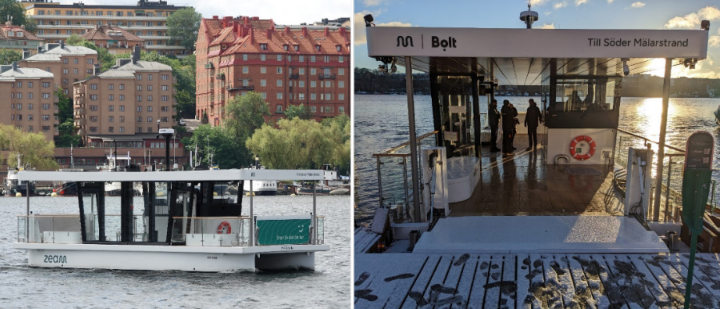
Vessel Description: MF Estelle (Figure 1) operates along a 700m inner-city canal in Stockholm, shared with other commercial and private vessels. The ferry carries up to 24 passengers and is typically manned by a single onboard operator (though this study examines a simulated fully uncrewed ferry supported by an ROC). The ferry has an open, roofed deck with railings, passenger ramps at both ends, and a bridge cabin on one side, adjacent to an emergency station. Navigation is automated via a control system that coordinates the four 10 kW, 180°-rotating corner-mounted thruster pods, enabling precise maneuvers such as position holding, automatic docking, and speed control via Dynamic Positioning (DP)-like functionality. The bridge has windows in all directions, LIDAR and RADAR overlays on a chart display, and video feeds from four vessel-mounted cameras. In normal operation, the onboard operator initiates transit, after which the ferry raises its ramp, crosses, and docks automatically, with manual control available if needed. Safety equipment includes two floatation devices with lights, a rescue sling, life vests, and a life raft.
Search & Rescue (SAR) Services: When a maritime emergency is reported via 112, the Joint Rescue Coordination Centre (JRCC) of the Swedish Maritime Administration assesses the situation and determines which resources to deploy. Under Act SFS 2003:778 on Protection Against Accidents, municipal
Emergency Response for Uncrewed MASS Passenger Ferries 611 rescue services handle emergency response within their geographical areas, including canals, ports, lakes, and coastal shorelines. They operate high- speed rescue boats and can deploy divers for SAR operations. Depending on the incident’s severity and location, they may be assisted by the voluntary Swedish Sea Rescue Society (SSRS) or the Swedish Coast Guard, responsible for environmental response at sea. For MF Estelle’s inner-city Stockholm route, the primary responder is the Stockholm Fire Department.
METHODS
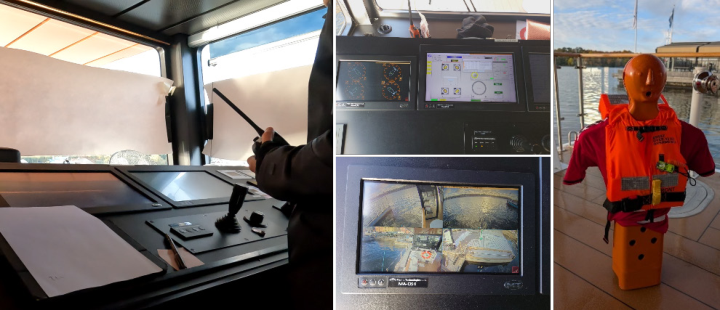
Experimental Setup: The study involved an autonomous, uncrewed passenger ferry (MF Estelle), monitored and controlled from a makeshift ROC by a single operator acting as the ferry’s remote crew, including communication with third parties. Since no dedicated ROC currently exists for this ferry, a simulated ROC was created on the ferry’s bridge by covering the windows and relying exclusively on available digital interfaces: video feeds from vessel-mounted cameras providing a partial view of the ferry’s emergency station, LIDAR data overlaid on a marine chart, and thruster controls (Figure 2).
Figure 2: Left: ROC setup. Middle: Thruster control panel (top), video feed panel (bottom). Right: MOB dummy.
Participants included an ROC operator acting as the ferry’s Master, responsible for navigation, machinery monitoring, and safety; three members of the Stockholm Fire Department representing local rescue services; and three researchers acting as passengers. JRCC remained on standby, and Zeabuz staff observed remotely and compiled footage from the ferry’s onboard cameras. Prior to the experiment, all participants received a structured briefing on the scenarios and their roles. The experiment simulated a sequence of emergency scenarios under controlled conditions on a warm autumn day with light winds, good visibility, and minimal traffic. A test dummy wearing a life vest was used to simulate the MOB (Figure 2). The scenario sequence was performed as described in Table 1.
Table 1: Scenario sequence.
Table available in the original PDF paper.
Scenario Description
1. MOB Event - Three passengers at departure; one (dummy) falls overboard mid-transit, leaving two passengers onboard. - MOB alarm triggered by ROC via simulated emergency
channels (112, VHF 74). - Passenger deploys lifebuoy; position marked, and visual contact maintained. - ROC initiates MOB response and holds ferry position near
casualty while awaiting rescue. - JRCC tasks Stockholm Fire Brigade as SAR responder. - Divers deployed to recover the dummy. - MF Estelle maintains ~50m distance from the rescue area. - Fire Brigade recovers the dummy. - Dummy transferred onboard rescue boat for care.
- Simulated battery-space fire caused by overheating. - Fire suppression activated; simulated smoke released onto
- After fire suppression, ROC loses control of MF Estelle. - Ferry drifts toward nearby object, creating collision risk. - ROC anchors the ferry remotely. - Emergency towing performed by Fire Brigade. - Fire Brigade attempts maneuvering MF Estelle to dock.
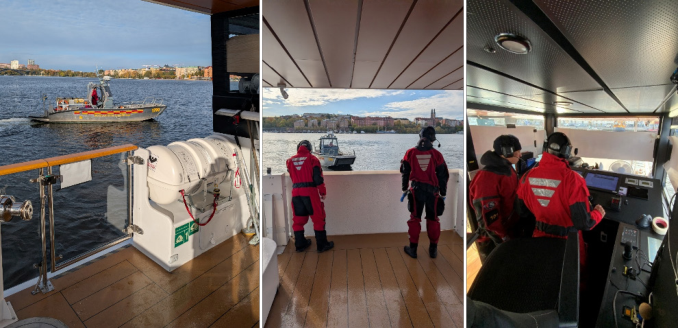
Figure 3: Left: Responders approaching MF Estelle. Middle: Responders on deck. Right: Responders on emergency bridge.
Data Collection & Analysis: All participants consented to data collection. Data included direct observations, video and audio recordings, field notes, and separate semi-structured debriefing interviews with the fire department and the ROC operator. These data provided qualitative insights into human factors, coordination, communication, and system performance under emergency conditions. Analysis followed thematic qualitative principles such
Emergency Response for Uncrewed MASS Passenger Ferries 613 as axial grouping and theme refinement (Flick, 2014) to identify patterns related to operational and procedural gaps, communication and information needs, user experience, and stakeholder roles.
RESULTS
Six themes emerged from the data analysis, describing operational gaps and design implications for safe and effective response.
Emergency Response Speed: Fire Department participants estimated that a rescue boat could reach this ferry within about 15 minutes, or up to 45 minutes if units are busy. SSRS requires around 15 minutes to mobilize, followed by a 6–7 km transit. Given these timelines, responders stressed that in an MOB situation the vessel must conduct immediate life-saving attempts to uphold the status quo until responders arrive. The narrow survival window makes early mitigation essential: maintaining visual contact with MOB, keeping station, and deploying lifebuoys with floating lines as early as possible.
A typical rescue team consists of three people, expanding to as many as eight when divers are required. On an uncrewed vessel, rescue personnel may also need to assume duties normally fulfilled by the crew, potentially increasing overall personnel demands.
Rescue Service Information Needs: Rescue personnel noted the importance of early information on vessel type, weight, position, passenger count, and maneuverability. Confirming the number of passengers can be challenging if passenger manifests are unavailable or if passengers are suspected missing, and uncertainty complicates accountability and diver tasking. In MOB cases, having somebody onboard continuously pointing towards the MOB is valuable for the arriving team, and keeping the vessel close also reduces search and response time.
Emergency call centers increasingly gather on-scene information through connecting to the caller’s phone cameras or using the vessel’s video recordings. For major incidents, post-hoc registration (e.g., video or other automated counts) may be needed to support search and dive planning. However, the rescue personnel also stated that, during the call-out phase, they often juggle multiple parallel communications – coordinating with external actors, discussing response tactics internally, and communicating with the vessel in distress. In this situation, their ability to receive and process detailed information may be limited.
ROC Resource Needs: The ROC operator described working in the simulated ROC as significantly calmer than acting as captain during routine onboard safety drills, noting that the relative psychological detachment from the emergency afforded in the ROC could support clearer thinking and decision-making. At the same time, the ROC’s psychological distance can reduce response urgency if cues are weak (the “videogame” risk). Interfaces must therefore provide strong, salient cues.
The monitoring and information displays made available to the ROC operator in this experiment were deemed adequate but improvable. The operator suggested one main display and side screens for video feeds from the ferry, and separate displays for the autonomous systems status (e.g.,
power, steering) and safety systems (e.g. fire systems). The operator felt that a top “bird’s-eye” view of the ferry and its surroundings, with automatic detection and tracking of people and objects in the water, would improve distance judgment, MOB handling, and interaction with rescue boats.
That said, during the exercise, the ROC operator simultaneously monitored the ferry and VHF channel, communications with rescue organizations, and passenger communication channels, which the operator noted as “too many external links” to manage effectively in peak workload moments. Short pre-recorded “first messages” and checklists for passengers could help reduce cognitive load during the initial response phase.
ROC & Responders Communication: Communication between the ROC and rescue services was generally perceived to function well, especially during the initial response phase, though the participants see room for improvement. They suggested clearer communication of the status of vessel controls, power, and movement to the rescue services, to reinforce operational safety. The rescue personnel noted, however, that more complex interactions during rescue operations may become challenging. Complex interactions are where they typically need directions and guidance from the crew, as crew is expected to know everything about the vessel. Maintaining these functions in the transition to uncrewed vessels could, in the responders’ view, be one of the greatest challenges: “We are not mariners to a 100 percent. So having people who know the ship is always a support. […] Maybe not everybody would feel comfortable going in and fidgeting with a computer screen, even with instructions” (Figure 3).
Responders also pointed out how shared references are created in communication. The ferry involved in this exercise had a relatively symmetrical design, with openings at both fore and aft. Although lights should indicate which end should be considered bow and stern – and subsequently port and starboard sides – it was suggested that additional standardized markings such as text or symbols/icons may support clearer communication between responders, ROC, and passengers.
Manual Vessel Handling & Safety Equipment: At present, the ferry’s firefighting system below deck cannot be activated remotely, and for this functionality to be possible, connectivity would have to be highly dependable, or else a simple local activation option could be in place. On land, it is common for public and commercial spaces to form agreements with the rescue services and have their fire alarms connected directly to the rescue service alarm central. Firefighters can then gain access to materials such as instructions, fire plans, and fire safety system controls on the premises with an electronic key. Similarly, they suggested that standardized, minimal emergency interfaces could be conceived to support responders across autonomous vessels (e.g., a simple multibutton panel for critical actions). Other systems mentioned that may require local, manual activation include lifeboats and emergency anchoring, though designs must avoid accidental activation, e.g., by passengers.
The ROC operator highlighted MOB retrieval as an area needing further development. According to company procedure, an MOB should be rescued
Emergency Response for Uncrewed MASS Passenger Ferries 615 using the life-saving sling and boom available on the ferry for this purpose. However, the operator believed that a more realistic method would be to retrieve an MOB using a ladder that can quickly be mounted on the side of the ferry, and suggested exploring more extendable ladders that could also be deployed automatically. He viewed deploying a lifeboat as a last resort that adds limited safety value under most emergency circumstances, at least for the operational context of an inner-city ferry: “In inner-city traffic – even when they’ve had fires – […] you still disembark the passengers on shore because it’s always closer, it’s always faster, it’s always safer”. In his view, with two ferries of MF Estelle’s type working in tandem, one could readily serve as a rescue boat for the other. However, it would be difficult and unlikely to employ such a solution and meet regulatory requirements as a safety case for rule exemption, due to operational dependencies and that it would require that both ferries are always operational, which may not be compatible with the business case for the ferry company.
Regarding the physical design of the vessel, some features requested by the rescue services were full-perimeter rubber fenders all around the vessel, exterior handles or grab rails, and multiple points of access onto the deck, to facilitate boarding.
Passenger Information & Instructions: Providing correct, timely, and reassuring feedback to passengers was viewed as one of the major challenges in emergency management on an uncrewed vessel. Participants agreed that passengers are likely to expect direct contact with the ROC should an accident occur. It was felt that voice communication alone would go a long way towards reassuring the passengers, but that a video feed of the ROC operator could be even more effective. It was suggested by the ROC operator that passengers should first be notified that the emergency situation has been acknowledged and that a response is underway, because this may be less obvious on a ferry without crew onboard. This sort of generic message could, in the opinion of the participants, be pre-recorded.
Participants also discussed ways in which passengers could assist in an emergency, e.g., head counts, throwing lifebuoys, and keeping visual contact with an MOB. These more complex interactions between operators and passengers may, in turn, place higher demands both on communication technologies and on the operators themselves. To reduce this burden, the ROC operator proposed directing passenger questions and requests of a more general nature to an envisioned centralized “safety center” that could service a large number of uncrewed ferries, allowing ROC operators to focus on communicating more detailed information and instructions. Ultimately, however, participants also agreed that passenger reactions in emergencies can be unpredictable, making it difficult to determine in advance what information or support they will need.
DISCUSSION
Results Discussion: The findings highlight opportunities and practical challenges for emergency management on uncrewed ferries, and the importance of aligning technological and procedural adaptations with the operational needs and constraints of rescue services, ROC operators,
and passengers. Operating without crew onboard led to a significant loss of onboard expertise (Burmeister et al., 2014), requiring more complex communication and responders to board the ferry and assume crew tasks, creating staffing tradeoffs and increased workload and operational risks.
Early information requirements were straightforward but critical under time pressure: vessel position, type, weight, passenger count, and a concise event description. The absence of a passenger list was flagged as a significant complication for accountability and dive operations, prompting suggestions for automated headcounts or post-hoc registration using video.
Communication loads were consistently high across channels (112/VHF/ phone/ passengers), demanding strict prioritization. Responders and ROC operator agreed on the value of two-way communication with passengers and, when possible, a visual presence (e.g., a screen) to foster trust and clarity. Multilingual pre-recorded announcements and checklists were suggested for the management of initial uncertainty and for cognitive load reduction.
Operating from the ROC provided a calmer decision environment, which the ROC operator associated with more rational judgments and improved communication control. However, he cautioned about the potential for detachment (“a little like a video game”) if cues are weak. This tension points to HMI requirements that amplify urgency when warranted (salient alerts, integrated overviews and “bird’s-eye” overlays, and automatic detection and tracking of objects/persons) to sustain situational awareness without overloading operators.
Command, role clarity, and legal boundaries require explicit policy. In this experiment, it was considered that the ROC holds the captain’s role even when the rescue service boards, who then execute instructions without assuming vessel responsibility. Responsibility for passengers is transferred to the responders as passengers board the rescue craft, with structured handover on shore. Jurisdictional lines between rescue vs. salvage actions were recognized as unresolved and context-dependent. Codifying these boundaries and handovers (including when and how command authority shifts, and what responders may operate onboard) is essential for dependable practice across agencies.
Participants strongly advocated for physical, clearly marked manual overrides to address connectivity loss and time-critical actions, e.g., automated or remote life raft release, emergency anchoring via physical pin/lever and ready heat-resistant tow lines, hull-integrated ladders/handles for overboard recovery, and two access paths with exterior handles and fendering to facilitate safe approach (as responders were required to jump onto the ledge of the ferry to open the emergency gate and board). These findings generalize into a principle of physically operable, standardized, and tamperresistant emergency controls for critical functions.
For battery fires, responders emphasized the importance of minimizing toxic smoke risks and the difficulty of extinguishment. Strategies included remote activation of suppression and ventilation control – with local manual means when remote activation is unavailable – and submersion where feasible. Ventilation shutdown and emissions control must also be locally operable if connectivity fails.
Emergency Response for Uncrewed MASS Passenger Ferries 617 Response times framed the survival window: ~15 minutes in best urban conditions versus ~45 minutes if handling other alarms, making simple immediate shipside measures – such as fast deployment of lifebuoys with lines, maintaining visual contact with MOB, visual pointing, and keeping vessel position – pivotal in the first minutes to bridge the window until responders arrive.
The initial response phase is very data-saturated on the responding boat; hence such inputs must be triaged by JRCC/command vehicles. The ROC operator argued that automatic detection and tracking are a “must-have”, while cameras are “nice-to-have” if an integrated “bird’s eye” overlay on charts already localizes the hazard. Interface ergonomics (screen layout, separation of automation and video feeds) were recurring concerns. Consistent with responder practice, secondary media streams (e.g., bystander phone video) should be routed to JRCC/command vehicles first – not to the boat crew during drive-out – then filtered into concise updates for the onscene units.
Finally, standardization emerged as a key systemic enabler, including emergency interfaces (e.g., “three buttons”) across autonomous ferries to support responders, smart-key access tied to formal agreements, practical orientation cues on double-ended ferries, and exploration of joint rescue resources or contractual arrangements where relevant. Such standardization should reduce training burden, support mutual aid across jurisdictions, and mitigate integration risks as fleets diversify.
Overall, successful unmanned-ferry response hinges on simple, physically robust controls and interfaces; lean, prioritized communication; detection- driven decision support and situational awareness; and clear role distribution and operational/legal frameworks.
Methods Discussion: This study had to rely on several idealized assumptions and conditions to enable the experiment, yet it is not guaranteed that they fully reflect future autonomous ferry or ROC operations in all cases:
The onboard fire was extinguished by remote activation of the ferry’s firesuppression system before responders arrived on scene.
Although uncrewed, the ferry retained a complete navigation bridge to allow manual takeover by responders if remote operation is not an option.
The ROC operator was assumed to be fully trained on MF Estelle and equipped with a replica of the vessel’s bridge systems, enabling accurate guidance and instructions to responders when they board the vessel to perform manual navigation or docking.
The ROC operator was assumed to be able to remotely trigger fire- suppression, anchoring, and docking.
The ROC operator was assumed to have accurate passenger counts and be able to detect and track MOB from the ROC.
Additional limitations include the single-vessel, single-city context, the simulated nature of the exercise, and the specific agencies and technologies involved, which may limit generalizability. Future work should test and
evaluate these design and governance proposals (e.g., pre-recorded messages, ROC video presence) across multiple controlled settings.
Furthermore, it can be argued that being physically onboard provides superior situational awareness. The ability to sense vessel motion and perceive direction provided the ROC operator with insights that would likely be more difficult to obtain remotely. Designers should therefore treat embodied sensory cues (motion, vibration, auditory context) as targets for interface augmentation, noting that ROC advantages (calmer judgment and coordination) must be balanced against risks (detachment) through salient, situational-awareness-enhancing guiderails.
CONCLUSION
This study examined preparedness and response to a multipleemergency sequence – man overboard, onboard fire, passenger evacuation, and loss of connectivity – on an autonomous and uncrewed passenger river ferry. Based on field observations and interviews with first responders and ROC operator, the results reveal interconnected humanfactor challenges requiring clear role definitions and command transfer between the ROC and rescue services; procedural and organizational alignment, including shared training to strengthen multiagency coordination; improved information systems and remote situational awareness tools such as detection systems and overlays; updated vessel and equipment design that supports responders’ rapid boarding and response, standardized onboard emergency controls, and fallback systems for manual activation and overrides; and enhanced twoway passenger communication.
The findings suggest that rescue services need rapid, reliable information, predictable vessel behavior, and rapid vessel access; ROC operators need integrated interfaces, workload support, and communication structures aligned with multitasking demands; and passengers need reassurance and clear instructions that compensate for the absence of onboard crew.
Overall, emergencies on autonomous uncrewed ferries reshape rather than remove the human element by distributing responsibilities across remote operators, responders, passengers, and automation, therefore requiring ecosystem-level coordination among them. These findings contribute to ongoing discussions on regulatory frameworks, operational procedures, and design directions for urban autonomous ferries aimed at strengthening safety and resilience during emergency events and enabling scalable autonomous passenger transport.
ACKNOWLEDGMENT
This paper draws on research from the “EMERGE – Emergency Preparedness on Autonomous Passenger Ferries and Remote Operation Centers” project, funded by the Swedish Transport Administration (TRV 2024/30563). The authors thank vessel operator Torghatten and the Stockholm Fire Brigade for their invaluable contributions, and Zeabuz staff and JRCC operators for their support.
REFERENCES
Bram, S., Costa, N., Fabricius, V., Sjöblom, T., and Nilsson, E. (2025) “Reframing procedures and teamwork for man overboard (MOB) scenarios on small mass passenger ferries”, proceedings of the AHFE 2025 Conference, Orlando, FL. Burmeister, H.-C., Bruhn, W., Rødseth, Ø. J., and Porathe, T. (2014) “Can unmanned
ships improve navigational safety?”, proceedings of the Transport Research Arena 2014, Paris, FR. BV (2019). Guidelines for autonomous shipping. Retrieved from https://marineoffshore.bureauveritas.com/bv-rules DNV. (2018). Autonomous and remotely-operated ships: AROS class notations.
Retrieved from https://www.dnv.com/maritime/autonomous-remotely-operated- ships/aros-class-notation/ Flick, U. (2014). The SAGE handbook of qualitative data analysis. UK: SAGE Publications Ltd. IMO (2017). Revised guidelines on the preparation of passenger ships for emergencies
(MSC.1/Circ.1532). Retrieved from https://www.imo.org/en/OurWork/Safety/ Pages/PassengerShips.aspx IMO (2021). Autonomous shipping. Retrieved from https://www.imo.org/en/ MediaCentre/HotTopics/Pages/Autonomous-shipping.aspx Johnsen, S., Thieme, C., Myklebust, T., Holte, E., Fjørtoft, K., and Rødseth, Ø. J.
(2022) “Hazards and risks of automated passenger ferry operations in Norway”, proceedings of the AHFE 2022 Conference, New York, USA. Porathe, T. (2021) “Autonomous ships: a research strategy for human factors research in autonomous shipping”, proceedings of the AHFE 2021 Conference, New York, USA. Rødseth, Ø. J., and Nordahl, H. (2017). Definition of autonomy levels for merchant
ships. Retrieved from https://nfas.autonomous-ship.org/resources_page/ documents/ SFS 2003:778, Act on Protection Against Accidents.
LISTED IN THE AHFE DIGITAL BOOKSTORE CATALOGUE
Explore the complete digital volume
Advances in Human Factors of Transportation
Read this individual research paper free through the original publisher, or explore the full digital proceedings book.
ISBN 979-8-950676-00-0
Explore this ISBN in the AHFE Bookstore ↗Listed in the July 2026 bookstore catalogue; search by ISBN to confirm current availability · Digital book purchase optional