Staffan Bram, Nicole Costa, Victor Fabricius, Ted Sjöblom, Erik Nilsson (2025). Reframing Procedures and Teamwork for Man Overboard (MOB) Scenarios on Small MASS Passenger Ferries. In: Advances in Human Factors of Transportation. AHFE Open Access, vol. 186, pp. 535–545. https://doi.org/10.54941/ahfe1006543
The rise of Maritime Autonomous Surface Ships (MASS) requires reevaluating emergency procedures and teamwork dynamics. This study examines man overboard (MOB) emergencies on small passenger ferries, comparing a single onboard operator setup (baseline) to one including a Remote Operations Center (ROC) operator. Data from document reviews, observations, questionnaires, and interviews with three mariners revealed gaps between written procedures and actual practices due to contextual constraints and technological limitations. The ROC setup showed potential for task relief for the onboard operator but highlighted the need for enhanced technology and improved remote situational awareness. This study explores the impact of increasing automation, ROC integration, and reduced onboard manning on MOB procedures, teamwork, communication, and passengers, and discusses further work needed to maintain safety on small MASS ferries.
Maritime Autonomous Surface Ships (MASS), as coined by the International Maritime Organization (IMO), are commercial vessels that operate with varying levels of automation and autonomy from human intervention (IMO, 2021). The IMO and various classification societies have developed taxonomies for these automation levels, under which vessels can be categorized based on their increasing independence and decreasing onboard manning. The concept of a Remote Operations Centre (ROC) becomes relevant as vessel automation progresses from decision-support to more automated navigation, involving human operators monitoring or controlling vessels from land (IMO, 2021).
With rising automation, MASS is transforming traditional shipping, requiring a reassessment of work practices and teamwork, especially during emergencies (Johnsen et al., 2022; Porathe, 2021). This paper examines man overboard (MOB) emergencies using a small, automated river passenger ferry as a case study, Torghatten’s MF Estelle, exploring current procedures and
how these may need to be revised for vessels with increased automation and limited onboard manning.
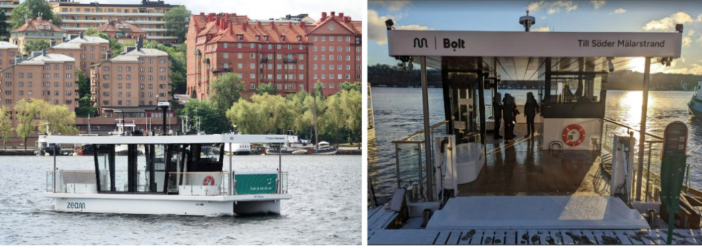
Figure 1: MF Estelle underway, on the left. Front view of MF Estelle at quay, on the right.
Vessel Characteristics and Operational Context: MF Estelle (Figure 1) operates along a 700-meter inner-city canal in Stockholm shared with other commercial and private crafts. The vessel is manned by a single operator and can carry up to 24 passengers. It features an open, roofed deck with railings, and passenger embarkation ramps at both ends. A bridge cabin is placed on one side, with an emergency station by the bridge. The ferry has automated navigation through a control system that steers the vessel’s thrusters, enabling precise maneuvers like maintaining position, automatic docking, and speed adjustment using Dynamic Positioning (DP). The bridge has windows in all directions, LIDAR and RADAR data overlaid on a chart display, and video feeds from four vessel-mounted cameras. The onboard operator initiates transit, after which the vessel lifts the ramp, crosses, and docks. The operator monitors and can manually control the vessel if needed. Propulsion is provided by four 10 kW thruster pods with 180-degree movement located in each corner of the catamaran hull. The vessel is equipped with two floatation devices with lights, a rescue sling, life vests, and a life raft. For MOB scenarios, the sling is used to retrieve individuals from the water.
Man Overboard (MOB) Protocol and Life-Saving Equipment: MOB protocols are outlined in company documents based on guidelines from maritime authorities (e.g., International Chamber of Shipping (2022)). The current MOB protocol documentation for MF Estelle, summarized in Table 1, contains a checklist of steps and guidelines specific to the vessel, considering the onboard life-saving equipment and protocols. These documents were the basis for drills conducted with both the baseline and experimental ROC setups onboard.
Reframing Procedures and Teamwork for MOB Scenarios on Small MASS 537
Table 1: Current MOB procedure divided into overarching tasks and their required capacities.
Table available in the original PDF paper.
Task Required Capacities Comment Locate Identify MOB There is currently no dedicated object detection system in place to identify and track an MOB. Track MOB
Inform Call rescue services The company has a land-based safety Inform passengers and the company’s land-based safety officer officer on call for emergencies, similar to the Designated Person (DP) in larger ferry operations. This person supports the vessel with safety regulations and liaises with external parties.
Approach Maneuver to MOB The thrusters on the MOB side should be Deactivate thrusters Provide lifebuoy shut off using emergency stop buttons and the other two thrusters set to neutral.
Retrieve Assemble sling This process entails loosening mounting Deploy sling Open/close evacuation
door Start medical care if needed
straps, assembling a forked rescue pole, mounting a rescue boom, preparing a line, attaching a rescue sling to the line, and securing the sling to the pole with clips. The pole with the sling is placed in the water and slid over the MOB feet first until the sling sits across the chest, under the arms. Pushing the pole down and simultaneously pulling the line loosens the sling from the pole and tightens it around the MOB.
Go to
Maneuver to shore The vessel berths at a suitable location shore along the quay. Update rescue services Berth External reporting
METHODS
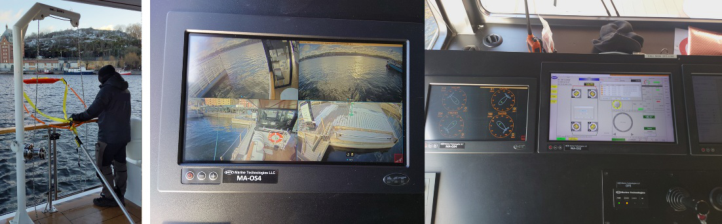
Field Study: Two operational setups were tested for the MOB scenario. The Baseline setup used current roles and procedures, with one onboard operator manning the vessel, supported by the company’s land-based safety officer via telephone. This setup aimed to identify gaps between written procedure and actual practices and was repeated in two drills with two participants (Figure 2).
The ROC setup was intended to simulate ROC involvement. One participant remained onboard as a deckhand, while another remotely controlled the vessel as ROC operator, maneuvering to the MOB location. Communication was kept via telephone throughout the MOB procedure (the land-based safety officer was not included in this setup due to unavailability of an additional participant). Since no actual ROC currently exists for this vessel, an ROC environment was simulated on the vessel’s bridge by blocking the outside view and using the available screens for navigation
and maneuvering: video feeds from the vessel-mounted cameras (Figure 2) providing the ROC with a partial view of the sling station, LIDAR data overlaid on a marine chart, and thruster controls (Figure 2). This setup aimed to investigate task distribution and communication between the roles, and was performed in one drill.
Figure 2: Rescue sling, on the left. Video feed panel, in the middle. Thruster control panel, on the right.
A life vest was used to simulate the MOB in all drills. These drills excluded berthing and reporting to other stakeholders (e.g., rescue services), as their involvement was deemed unrequired in this scenario.
Data Collection and Analysis: Three mariners participated and provided written informed consent prior to data collection. Data collection included observations and recordings of the MOB drills, participant ratings of perceived task difficulty on a 7-point scale, and semi-structured debriefing interviews with the participants.
Simple one-item ratings, validated as practical substitutes for more elaborate surveys such as NASA-TLX (Sauro and Dumas, 2009; von Janczewski et al., 2022), were employed to evaluate user tasks and workload. Ratings were plotted along a user journey based on task descriptions (Table 1). For the baseline setup, combined (mean) scores from the two participants were used, while separate scores were recorded for the onboard and ROC operators in the ROC setup.
A thematic breakdown (Flick, 2014) of the observed tasks and gaps was performed. Additionally, an Interdependence Analysis (Johnson et al., 2014) was conducted to highlight dependencies and critical interactions between tasks and roles during the joint activity.
RESULTS
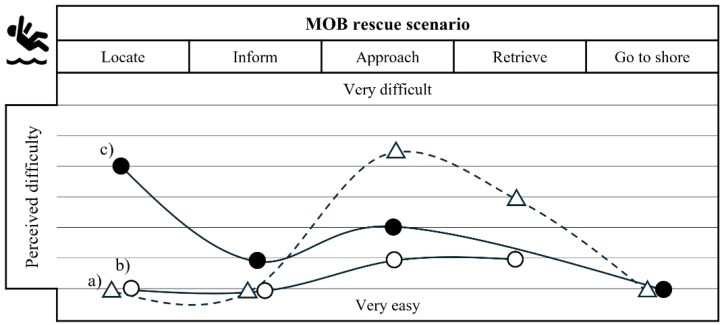
Figure 3 shows the perceived task difficulty scores along the user journey, from identifying and tracking the MOB to maneuvering to shore.
Locate: The process of locating the MOB varied between the baseline and ROC setups, impacting the time required for the activity.
In the baseline setup, a participant acting as a passenger was asked to track the MOB and point towards it while the onboard operator maneuvered the vessel closer. In the ROC setup, where the ROC operator steered the
Reframing Procedures and Teamwork for MOB Scenarios on Small MASS 539
vessel, the task of monitoring the MOB’s position was instead assumed by the onboard operator. However, the onboard operator was simultaneously occupied with preparing the life-saving equipment, leading to occasional loss of sight of the MOB and subsequent delays.
Figure 3: Perceived task difficulty scored by a) onboard operators (baseline drill, triangles), b) onboard operator (ROC drill, white dots), and c) ROC operator (ROC drill, black dots).
The ROC operator struggled to identify the MOB using the existing camera feeds, as reflected in the difficulty rating for “Locate” in Figure 3. The life vest used as a simulated MOB drifted rapidly in the current, exacerbating the difficulty of spotting it. The participants believed that a real person would be more visible. Although the vessel’s LIDAR system can detect small objects in the water (e.g., birds and canoeists, as reported by the participants), it did not detect the life vest.
Inform: After locating the MOB, the onboard operator contacted the land- based safety officer in the baseline setup, and the ROC operator in the ROC setup. In both setups, the onboard operator put the phone on speaker and placed it in a chest pocket, allowing hands-free communication while performing manual tasks. During one of the drills, the mobile phone fell from the participant’s pocket into the water while on the call.
As the onboard operators prepared for rescue, they spontaneously reported their actions to the contact on land. Although this practice was not part of the procedure, the participants stated that vocalizing the tasks helped reinforce correct procedures and allowed the person on land to intervene if steps were missed. Difficulty ratings for this activity were low for both onboard and ROC operators (Figure 3).
Approach: The next step was to maneuver into a position where the MOB could be retrieved through the vessel’s rescue gate. This activity displayed the greatest differences between the baseline and ROC setups.
In the baseline setup, the onboard operator had to go into the vessel’s bridge to maneuver it into position, then go out on deck to prepare the equipment, and finally make a rescue attempt using the pole and sling.
However, the time taken to walk out on deck was sufficient for the MOB to drift away. This prompted a series of attempts with the onboard operator moving back and forth between the two stations before the MOB could be reached and retrieved. Consequently, the approach activity received the highest ratings of perceived difficulty (Figure 3).
In the ROC setup, the onboard operator could remain stationary at the vessel’s rescue gate, simultaneously monitoring the MOB’s location and preparing the rescue equipment. Due to the ROC operator’s limited view through the existing cameras, a spontaneous practice emerged where the onboard operator continuously reported the bearing and distance of the MOB (e.g., “starboard side 120 degrees, distance 15 meters”), indicating the effectiveness of maneuvering. Despite maintaining close communication, the constant drift of the MOB led to several failed attempts before it could be retrieved. The ROC operator’s difficulty rating for this activity was slightly higher than that of the onboard operator (Figure 3). It was suggested by the participants that better video coverage would have enabled the ROC operator to act more autonomously during this process.
One challenge in both setups was the influence of the thrusters on the MOB’s position. Disengaging two of the thrusters was intended to avoid pushing the MOB away and to protect them from the propellers. On the other hand, the participants noted that turning the thrusters off decreased the vessel’s maneuverability.
In the baseline setup, the onboard operator used the vessel’s Dynamic Positioning (DP) functionality to maintain its position when sufficiently close to the MOB. However, when attempting to retrieve the MOB, the DP automation system suddenly re-engaged the thrusters, pushing the MOB away from the vessel. This occurred due to the onboard operator not remembering to cut power (i.e., push the emergency stop button) in the process of moving between the bridge and the rescue gate. During the debriefing, the participants expressed a preference for manual maneuvering in the case of an incident.
In one drill, the wrong pair of thrusters was disengaged from the bridge, which was attributed to the design of the thruster controls. One participant stated afterwards that “It was difficult to tell which pods should be disengaged”.
Retrieve: In the baseline setup, emergency equipment preparation began once the ship was close to the MOB. In the ROC setup, preparations started immediately after contact had been established with the ROC operator. Preparing and handling the rescue equipment (the pole, boom, rope, and sling) presented several challenges. Previous experience had shown that getting the sling to disengage from the pole required significant force and had proven nearly impossible if the sling was properly attached to the clips. In addition, pushing down on the pole would temporarily submerge the MOB. As one participant expressed, “It works, but barely”. Instead, a workaround was employed where the sling was loosely attached to only a few of the clips.
Using a life vest as a simulated MOB added to the difficulty of the activity, as reflected in the participant ratings (Figure 3). The vest’s low mass made it unworkable to use the prescribed procedure of pushing against it to engage
Reframing Procedures and Teamwork for MOB Scenarios on Small MASS 541
the sling. The participants discussed the possibility of mounting a ladder on the side of the vessel to facilitate climbing aboard, in addition to the existing rescue gate in the railing.
Go to Shore: The final task consisted of maneuvering to shore (either manually or automatically), updating the rescue services, and quickly berthing the vessel at a suitable location. Although the drills concluded before this point, it was not perceived as challenging.
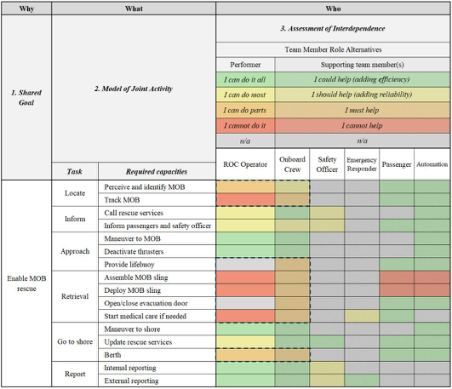
Future Roles and Teamwork: Focusing on the investigated ROC setup, Figure 4 presents an Interdependence Analysis (Johnson et al., 2014) based on the identified roles (human and non-human) and required tasks and capacities. Here, expected role capacities are highlighted with color codes, where certain combinations (e.g., red-orange) between a main performer and supporting team member indicate “hard” dependencies (i.e., absolutely necessary for carrying out the joint activity), while others (e.g., green-yellow) are “softer” (i.e., representing opportunities for improving joint activity). This study shows that having the ROC operator as main performer of the current MOB procedure will still demand close collaboration with at least one onboard operator. However, this setup will also present new opportunities for optimizing and offloading work between actors.
Figure 4: Team roles and capacities based on the interdependence analysis framework (Johnson et al., 2014). Dashed lines indicate hard dependencies between the ROC and onboard operator during the ROC drill.
DISCUSSION
Small, automated passenger ferries are increasingly being discussed in the context of urban mobility, with potential benefits such as increased transport accessibility and reduced operational costs (Braathen et al., 2024). Still, a significant obstacle to the broad introduction and adoption of these services is ensuring that their safety performance is maintained or improved compared to traditional and well-established means of transport (Jalonen et al., 2017).
This study investigated operational performance for an MOB scenario across different levels of automation and manning schemes, examining both current operations and a setup where certain tasks were allocated to an ROC. Key observations were made in connection with the following activities and aspects.
Locating a Person in Distress: The conditions for this study were largely ideal, with full daylight, relatively benign weather (aside from low temperatures), and limited traffic. Even so, locating the simulated MOB proved difficult at times. Factors such as darkness, waves, rain, fog, or ice could have easily aggravated the situation. The workaround of utilizing a passenger as a lookout to offload the onboard operator in the baseline setup was effective in this instance – and passenger involvement is mentioned in the literature (Johnsen et al., 2022) – but it is difficult to conceive of as a steady practice. In the ROC setup, the ROC operator could offer substantial support, allowing the onboard operator to maintain better visual contact with the MOB. Further ROC support including monitoring the MOB’s position could be envisioned, freeing up even more time for the preparation of life-saving equipment. The LIDAR system installed on this vessel could potentially contribute to this end, but its practical use needs to be investigated further. Other alternatives for MOB localization have been investigated in previous research, such as autonomous flying drones (Angelis et al., 2024) and sea- going drones (Cristea et al., 2023). However, the time for activation of such measures would need to match the response time of current onboard operators.
Communication and Teamwork: According to the participants, maintaining contact with the land-based safety officer provided confirmation and reassurance during the baseline rescue process. On the other hand, since the safety officer’s role encompasses multiple responsibilities, they might not always be in an optimal position to assist when the call is made. This function could potentially be fulfilled more effectively by the ROC, who could monitor onboard activities and possibly assist with other tasks, such as passenger communication. As noted in the literature, however, the total sum of communication tasks may place excessive pressure on a single ROC operator (van den Broek et al., 2020).
In the observed drill, only a single mobile phone was available for communication. In a real-life emergency, this phone may be needed for other purposes, obstructing communication with land-based resources. In addition, the incident where the onboard operator lost their mobile phone in the water demonstrated the need for robust and redundant communication technologies.
Ship Maneuvering: The combination of maneuvering, lookout duties, and life-saving equipment preparations revealed a peak in perceived difficulty for the baseline case. In addition, approaching the MOB produced delays in both drill setups, which would realistically affect the chances of survival. Offloading ship maneuvering to the ROC operator provided apparent benefits, but for this to be fully effective, ship controls and monitoring technologies need improvement.
Reframing Procedures and Teamwork for MOB Scenarios on Small MASS 543
In this study, the maneuvering-to-MOB task in the ROC setup relied on camera feeds, thruster information, and marine charts. Previous studies have suggested the use of more cameras and a range of other views and visualizations (Porathe, 2021). The interaction with DP automation and thruster controls resulted in a mishap, highlighting the need for more detailed design studies for both bridge and ROC configurations.
Another important aspect of the maneuvering was that the ROC was mimicked on the actual vessel’s bridge. This allowed the ROC operator to inadvertently sense indicators such as the vessel movements, position relative to the MOB, and thrust vibrations, which would not be available on land. Therefore, further studies into MOB emergencies with the ROC in place are necessary.
MOB Retrieval: Several steps in the practical usage of MOB retrieval equipment required workarounds from the onboard operator. There were also uncertainties around the practical usability of this equipment, such as with an MOB who is in a panic state or unable to physically cooperate. Additionally, it was unclear how pushing the MOB down to engage the sling would affect their behavior, or if the equipment would be effective for a lightweight individual. There seems to be considerable room for improvement with regards to both the equipment and practices for this activity, either by augmenting the crew’s ability to efficiently retrieve an MOB or by offloading this task entirely to an external agent.
When comparing the written MOB procedure to actual drill performance, it became apparent that onboard operators had to make substantial adaptations, involving a combination of professional decision-making, manual task proficiency, and seamanship, that were essential to complete the objective. This type of gap between formalized work descriptions and real-world performance requirements is often conceptualized as work-as- imagined versus work-as-done (Hollnagel and Clay-Williams, 2022). Such gaps should be acknowledged when evaluating new operational setups, and the ability to adapt to situational circumstances should be preserved when proposing new roles and task distributions.
Limitations and Future Work: While this study investigated a modified role for the onboard operator, completely uncrewed operations would require larger adjustments to the MOB procedure and life-saving equipment. Concepts such as automatically launchable life buoys or automated rescue rafts may be viable technical solutions to make up for the absence of crew onboard, and their effectiveness in this context should be investigated.
Additionally, it is important to address interaction with passengers to ensure that both their actual and perceived safety (Burgén and Bram, 2024; Goerlandt and Pulsifer, 2022) match the safety contribution from onboard crew on traditional passenger ferries.
CONCLUSION
This study examined MOB emergencies on a small MASS passenger ferry, focusing on the impact of increased automation on safety procedures and
teamwork. Two operational setups were analyzed: a baseline setup with a single onboard operator, and a setup with an added ROC operator.
Findings indicate that written procedures need practical adaptations due to real-world conditions, including environmental factors, passenger behavior, and technological limitations. For instance, a single onboard operator faces challenges in locating the MOB, maneuvering the vessel, and assembling and deploying life-saving equipment simultaneously. In such scenarios, passengers (if available) may be required to assist in tracking the MOB while the onboard operator handles other tasks. The ROC setup reduced perceived task difficulty by relieving the onboard operator, particularly in maneuvering to the MOB location, allowing a focus on the life-saving equipment. However, this also underscored the need for enhanced technology and remote situational awareness to effectively monitor the MOB’s position relative to the vessel and the onboard operator’s ongoing activities.
Future research should continue to explore the evolving roles and responsibilities of mariners, ROC integration, and emergency management as a joint effort between human and non-human actors. Additionally, investigating alternative life-saving equipment that can further reduce the onboard operator’s workload or be used in the absence of onboard crew is recommended.
ACKNOWLEDGMENT
This paper is based on research from the “EMERGE – Emergency Preparedness on Autonomous Passenger Ferries and Remote Operation Centers” project, funded by the Swedish Transport Administration (TRV 2024/30563). The authors extend their gratitude to the mariners at Torghatten for their invaluable contributions.
REFERENCES
Angelis, D., Andersen, R. E., Feraru, V. A. and Boukas, E. (2024) “UAV Design for Fully Autonomous Man Overboard Detection”, 2024 IEEE International Conference on Imaging Systems and Techniques (IST). Braathen, C., Goez, J. C. and Guajardo, M. (2024) Autonomous ferries in light
of labor regulations—A passenger perspective, Maritime Transport Research Volume 7. Burgén, J. and Bram, S. (2024) Safety on automated passenger ships: Exploration of evacuation scenarios for coastal vessels, Maritime Transport Research Volume 6. Cristea, O., Onea, ¸S.-V. and Popa, S.-N. (2023) Search and Rescue Autonomous
Vessel, Journal of Marine Technology and Environment Volume 2, No. 2, pp. 20–25. Flick, U. (2014) The SAGE Handbook of Qualitative Data Analysis, SAGE Publications Ltd. Goerlandt, F. and Pulsifer, K. (2022) An exploratory investigation of public
perceptions towards autonomous urban ferries, Safety Science Volume 145. Hollnagel, E. and Clay-Williams, R. (2022) “Work-as-imagined and work-as-done.
In Implementation science: The key concepts” in: Routledge, Taylor and Francis Group. pp. 175–177.
Reframing Procedures and Teamwork for MOB Scenarios on Small MASS 545
IMO. (2021) Outcome of the regulatory scoping exercise for the use of maritime autonomous surface ships (MASS). International Chamber of Shipping. (2022) “C3 Emergencies Checklists”, in: Bridge
Procedures Guide, Sixth Edition (Ed.). pp. 177–189. Jalonen, R., Tuominen, R. and Wahlström, T. (2017) Safety of unmanned ships-Safe shipping with autonomous and remote controlled ships. A. University. Johnsen, S., Thieme, C., Myklebust, T., Holte, E., Fjørtoft, K. and Rødseth, Ø. J. (2022) “Hazards and Risks of Automated Passenger Ferry Operations in Norway”, proceedings of the 13th International Conference on Applied Human Factors and Ergonomics (AHFE 2022), New York, USA. Johnson, M., Bradshaw, J. M., Feltovich, P. J., Jonker, C. M., Van Riemsdijk, M. B.
and Sierhuis, M. (2014) Coactive Design: Designing Support for Interdependence in Joint Activity, Journal of Human-Robot Interaction Volume 3, No. 1, pp. 43–69. Porathe, T. (2021) Autonomous Ships: A Research Strategy for Human Factors Research in Autonomous Shipping. Sauro, J. and Dumas, J. S. (2009) Comparison of three one-question, post-task
usability questionnaires. van den Broek, H., Griffioen, J. and van der Drift, M. (2020) “Meaningful Human Control in Autonomous Shipping: An Overview”, proceedings of the IOP Conf. Ser.: Mater. Sci. Eng. 929 012008. von Janczewski, N., Kraus, J., Engeln, A. and Baumann, M. (2022) A subjective one-
item measure based on NASA-TLX to assess cognitive workload in driver-vehicle interaction, Transportation Research Part F: Traffic Psychology and Behaviour Volume 86, pp. 210–225. Wahlström, M., Hakulinen, J., Karvonen, H. and Lindborg, I. (2015) Human Factors Challenges in Unmanned Ship Operations–Insights from Other Domains.
LISTED IN THE AHFE DIGITAL BOOKSTORE CATALOGUE
Explore the complete digital volume
Advances in Human Factors of Transportation
Read this individual research paper free through the original publisher, or explore the full digital proceedings book.
ISBN 978-1-964867-62-5
Explore this ISBN in the AHFE Bookstore ↗Listed in the July 2026 bookstore catalogue; search by ISBN to confirm current availability · Digital book purchase optional